This comprehensive analysis compares BLUM and RUNE as investment opportunities in 2024, examining two distinct cryptocurrency models. BLUM, launched in 2025, operates as a hybrid exchange on Telegram offering gamified trading across 30+ chains through Gate integration. RUNE, established since 2019, functions as THORChain's native token for multi-chain liquidity provision. The article evaluates historical price performance, current market status showing BLUM at $0.01384 and RUNE at $0.467, supply mechanisms, institutional adoption, and technical ecosystems. Key considerations include BLUM's extreme volatility and emerging market focus versus RUNE's established liquidity infrastructure and higher trading volume. Investment recommendations differentiate between conservative investors favoring RUNE's 70-80% allocation and experienced investors considering BLUM's higher-risk exposure. Price projections through 2031 and comprehensive risk analysis guide strategic allocation decisions across market cycles.
Introduction: Investment Comparison Between BLUM and RUNE
In the cryptocurrency market, the comparison between BLUM vs RUNE has always been a topic that investors cannot avoid. The two not only have significant differences in market cap ranking, application scenarios and price performance, but also represent different crypto asset positioning.
BLUM (BLUM): Launched in 2025, it has gained market recognition with its positioning as a hybrid exchange offering universal token access through gamification within a Telegram mini-app, supporting CEX and DEX integration across 30+ chains.
RUNE (RUNE): Since its launch in 2019, it has been known as a multi-chain liquidity protocol, serving as the native token of the THORChain ecosystem and used for transaction fees, liquidity provision, and block rewards.
This article will comprehensively analyze the investment value comparison of BLUM vs RUNE around historical price trends, supply mechanisms, institutional adoption, technical ecosystems and future predictions, and attempt to answer the question that investors care about most:
"Which is the better buy right now?"
I. Historical Price Comparison and Current Market Status
BLUM (Coin A) and RUNE (Coin B) Historical Price Trends
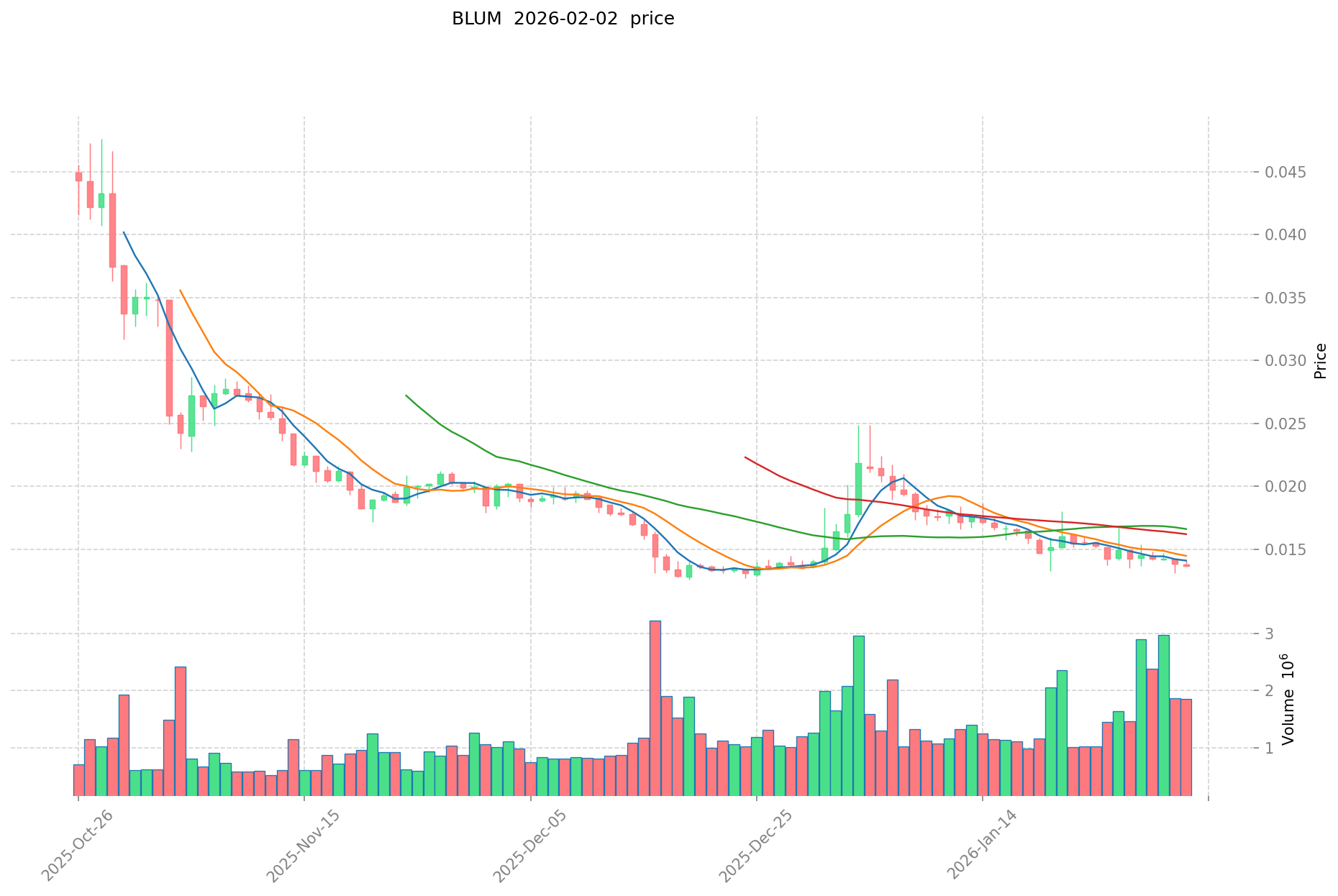
- 2025: BLUM launched on June 27, 2025, reaching an all-time high of $0.2256 on the same day, followed by significant volatility.
- 2019-2021: RUNE experienced substantial growth during the 2021 bull market, reaching an all-time high of $20.87 on May 19, 2021, before entering a prolonged downtrend.
- Comparative Analysis: During the recent market cycle, BLUM declined from its all-time high of $0.2256 to a low of $0.00133 on April 4, 2025, while RUNE has declined from its peak of $20.87 to its current level, representing a significant correction over multiple years.
Current Market Status (February 2, 2026)
- BLUM current price: $0.01384
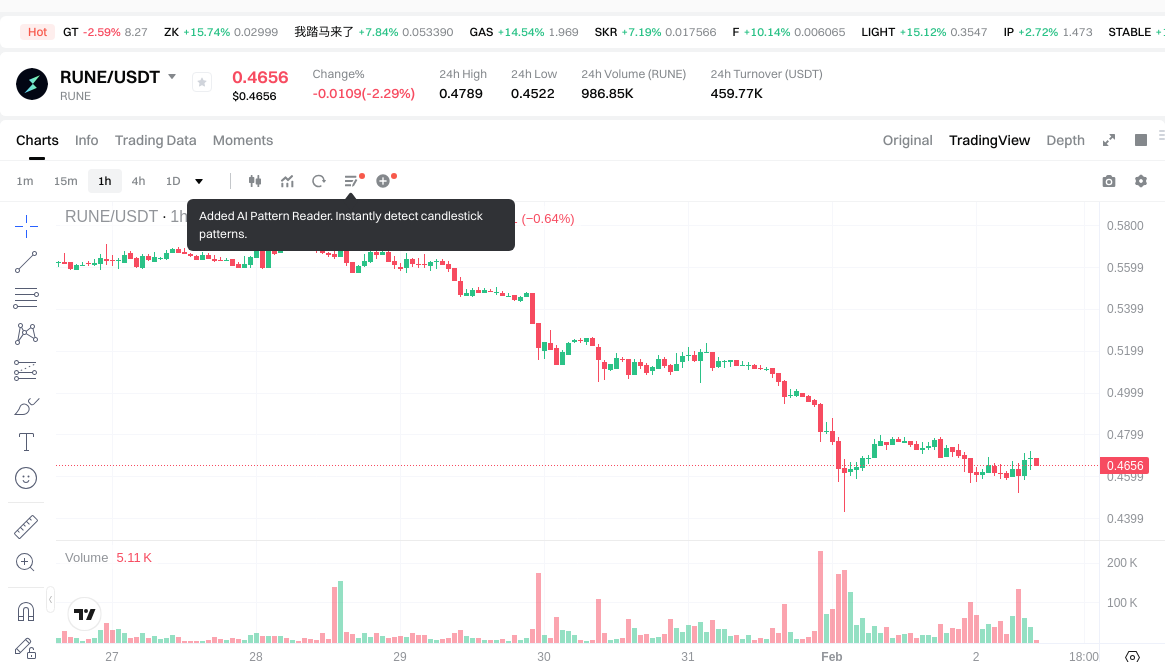
- RUNE current price: $0.467
- 24-hour trading volume: BLUM $25,593.35 vs RUNE $459,622.09
- Market Sentiment Index (Fear & Greed Index): 14 (Extreme Fear)
Click to view real-time prices:
II. Core Factors Influencing BLUM vs RUNE Investment Value
Supply Mechanism Comparison (Tokenomics)
- BLUM: The reference materials do not provide specific information regarding BLUM's supply mechanism or tokenomics structure.
- RUNE: The reference materials do not provide specific information regarding RUNE's supply mechanism or tokenomics structure.
- 📌 Historical patterns: Supply mechanisms can influence price cycles through scarcity dynamics and programmed issuance schedules, though specific data for these assets is not available in the provided materials.
Institutional Adoption and Market Applications
- Institutional Holdings: The reference materials do not contain comparative data on institutional preference between BLUM and RUNE.
- Enterprise Adoption: BLUM is described as a hybrid platform combining centralized exchange (CEX) and decentralized exchange (DEX) functionalities, operating as a Telegram Mini App targeting seamless trading experiences. The platform focuses on emerging markets in Southeast Asia and Africa, attracting Generation Z users and meme coin investors. RUNE's enterprise applications are not detailed in the provided materials.
- National Policies: The reference materials do not provide information on regulatory attitudes toward either BLUM or RUNE across different jurisdictions.
Technology Development and Ecosystem Building
- BLUM Technology: The platform integrates CEX and DEX technological advantages through its Telegram-based infrastructure, enabling unified trading interfaces. The system targets accessibility and user experience improvements for mobile-first demographics.
- RUNE Technology: The reference materials mention Rune Christensen's association with MakerDAO but do not provide specific technical development information about RUNE's protocol upgrades or technological roadmap.
- Ecosystem Comparison: BLUM's ecosystem emphasizes social trading and accessibility through messaging platforms. Specific comparative data on DeFi integration, NFT functionality, payment applications, or smart contract implementations for either platform is not available in the reference materials.
Macroeconomic Factors and Market Cycles
- Performance During Inflationary Environments: The reference materials do not provide data comparing the inflation-hedging characteristics of BLUM versus RUNE.
- Macroeconomic Monetary Policy: The materials mention market observations regarding Bitcoin's sensitivity to interest rates and dollar index movements, with research suggesting retail and institutional capital flows may focus on fixed dollar amounts rather than price levels. However, specific correlations for BLUM or RUNE are not documented.
- Geopolitical Factors: BLUM's strategy targets emerging markets, potentially positioning it within cross-border transaction demand in regions with developing financial infrastructure. Specific geopolitical impact analysis for either asset is not provided in the reference materials.
III. 2026-2031 Price Prediction: BLUM vs RUNE
Short-term Forecast (2026)
- BLUM: Conservative $0.0073-$0.0138 | Optimistic $0.0138-$0.0191
- RUNE: Conservative $0.318-$0.467 | Optimistic $0.467-$0.486
Mid-term Forecast (2028-2029)
- BLUM may enter a gradual growth phase, with projected price range of $0.011-$0.026
- RUNE may enter a moderate expansion phase, with projected price range of $0.379-$0.677
- Key drivers: institutional capital inflows, ETF developments, ecosystem expansion
Long-term Forecast (2030-2031)
- BLUM: Baseline scenario $0.019-$0.024 | Optimistic scenario $0.024-$0.033
- RUNE: Baseline scenario $0.514-$0.591 | Optimistic scenario $0.685-$0.823
View detailed price predictions for BLUM and RUNE
Disclaimer
BLUM:
| Year |
Predicted High Price |
Predicted Average Price |
Predicted Low Price |
Price Change |
| 2026 |
0.0190992 |
0.01384 |
0.0073352 |
0 |
| 2027 |
0.018775344 |
0.0164696 |
0.008893584 |
19 |
| 2028 |
0.02590503384 |
0.017622472 |
0.01127838208 |
27 |
| 2029 |
0.0263341410332 |
0.02176375292 |
0.019587377628 |
57 |
| 2030 |
0.02645384167426 |
0.0240489469766 |
0.018758178641748 |
73 |
| 2031 |
0.032574298679804 |
0.02525139432543 |
0.020706143346852 |
82 |
RUNE:
| Year |
Predicted High Price |
Predicted Average Price |
Predicted Low Price |
Price Change |
| 2026 |
0.48568 |
0.467 |
0.31756 |
0 |
| 2027 |
0.5096838 |
0.47634 |
0.3524916 |
2 |
| 2028 |
0.517662495 |
0.4930119 |
0.448640829 |
5 |
| 2029 |
0.67715184465 |
0.5053371975 |
0.379002898125 |
8 |
| 2030 |
0.780442767819 |
0.591244521075 |
0.54985740459975 |
26 |
| 2031 |
0.8230123733364 |
0.685843644447 |
0.51438273333525 |
46 |
IV. Investment Strategy Comparison: BLUM vs RUNE
Long-term vs Short-term Investment Strategies
- BLUM: May suit investors focused on emerging market penetration, social trading innovation, and mobile-first platform adoption, particularly those interested in Telegram-based crypto applications and Generation Z user demographics
- RUNE: May suit investors seeking exposure to multi-chain liquidity protocols and decentralized exchange infrastructure with established operational history since 2019
Risk Management and Asset Allocation
- Conservative Investors: BLUM 20-30% vs RUNE 70-80%
- Aggressive Investors: BLUM 50-60% vs RUNE 40-50%
- Hedging Tools: Stablecoin allocation for volatility management, options strategies for downside protection, cross-asset diversification across multiple crypto segments
V. Potential Risk Comparison
Market Risks
- BLUM: High volatility given recent launch in 2025, with historical decline from $0.2256 to $0.00133 representing substantial drawdown risk; relatively low 24-hour trading volume of $25,593.35 may indicate liquidity constraints
- RUNE: Multi-year downtrend from 2021 peak of $20.87 to current levels reflects prolonged market weakness; susceptibility to broader DeFi sector sentiment shifts and liquidity protocol competition
Technical Risks
- BLUM: Platform dependency on Telegram infrastructure; scalability challenges associated with hybrid CEX-DEX model integration; limited operational track record for assessing system stability under stress conditions
- RUNE: Network security considerations related to cross-chain bridge operations; potential vulnerabilities in multi-chain liquidity provision mechanisms; technical complexity of maintaining interoperability across 30+ chains
Regulatory Risks
- Global regulatory developments may affect both assets differently: BLUM's hybrid exchange model combining centralized and decentralized elements may face regulatory scrutiny regarding compliance frameworks; RUNE's cross-chain liquidity protocol may encounter varying jurisdictional interpretations of DeFi regulation; emerging market focus of BLUM introduces additional regulatory uncertainty in target regions
VI. Conclusion: Which Is the Better Buy?
📌 Investment Value Summary:
- BLUM Advantages: Innovative Telegram-based social trading approach; strategic positioning in emerging Southeast Asian and African markets; hybrid CEX-DEX model addressing accessibility challenges; early-stage growth potential with Generation Z demographic appeal
- RUNE Advantages: Established operational history since 2019; proven multi-chain liquidity protocol infrastructure; broader market recognition and higher trading volume ($459,622.09 vs $25,593.35); more mature ecosystem positioning
✅ Investment Recommendations:
- Beginner Investors: Consider RUNE for its longer operational track record and relatively higher liquidity; maintain smaller position sizes given current extreme fear sentiment (Fear & Greed Index: 14); prioritize risk management through diversification
- Experienced Investors: May evaluate BLUM for higher-risk, higher-potential-reward exposure to social trading innovation; consider RUNE for core DeFi infrastructure allocation; implement staged entry strategies given current market conditions
- Institutional Investors: Assess RUNE for established liquidity protocol exposure with documented multi-year performance data; evaluate BLUM's emerging market penetration potential within speculative allocation parameters; conduct thorough due diligence on regulatory compliance frameworks for both assets
⚠️ Risk Warning: The cryptocurrency market exhibits extreme volatility. This content does not constitute investment advice. Investors should conduct independent research and consult qualified financial advisors before making investment decisions.
VII. FAQ
Q1: What is the fundamental difference between BLUM and RUNE's business models?
BLUM is a hybrid exchange platform combining CEX and DEX functionalities through a Telegram Mini App, focusing on social trading and accessibility for Generation Z users in emerging markets. In contrast, RUNE serves as the native token of THORChain, a multi-chain liquidity protocol that facilitates cross-chain swaps and liquidity provision across 30+ blockchains. While BLUM prioritizes user experience and mobile-first accessibility, RUNE emphasizes decentralized infrastructure for cross-chain liquidity operations.
Q2: Which asset has demonstrated greater price stability historically?
RUNE has exhibited more established price behavior with a longer operational history since 2019, though it experienced significant decline from its May 2021 all-time high of $20.87 to current levels around $0.467. BLUM, launched in June 2025, has shown extreme volatility with a decline from $0.2256 to $0.00133 within its first year. RUNE's longer track record provides more historical data for analysis, though both assets have experienced substantial corrections during their respective market cycles.
Q3: How do the trading volumes compare between BLUM and RUNE?
As of February 2, 2026, RUNE demonstrates significantly higher liquidity with 24-hour trading volume of $459,622.09 compared to BLUM's $25,593.35. This represents approximately 18 times higher trading activity for RUNE, indicating better market liquidity, easier entry and exit positions, and potentially tighter bid-ask spreads. The substantial volume difference suggests RUNE has achieved broader market adoption and deeper liquidity pools.
Q4: What are the primary target markets for each project?
BLUM strategically targets emerging markets in Southeast Asia and Africa, positioning itself to capture Generation Z users and meme coin investors through its accessible Telegram-based interface. The platform emphasizes mobile-first adoption in regions with developing financial infrastructure. RUNE, as part of the THORChain ecosystem, addresses a global DeFi audience requiring cross-chain liquidity solutions, focusing on users and protocols needing decentralized asset swaps without relying on centralized intermediaries.
Q5: How should risk-averse investors approach allocation between these assets?
Conservative investors are recommended to allocate 70-80% to RUNE and 20-30% to BLUM, based on RUNE's longer operational history and higher liquidity. This allocation reflects RUNE's more established market position and lower relative volatility. Risk management should include stablecoin reserves for market downturns, diversification across multiple crypto segments, and recognition of current extreme fear sentiment (Fear & Greed Index: 14). Position sizing should account for the substantial historical drawdowns both assets have experienced.
Q6: What technological risks differentiate BLUM from RUNE?
BLUM faces platform dependency risks related to Telegram infrastructure, scalability challenges in integrating hybrid CEX-DEX functionalities, and limited operational track record for stress-testing system stability. RUNE encounters different technical challenges including cross-chain bridge security vulnerabilities, complexity in maintaining interoperability across 30+ chains, and potential risks in multi-chain liquidity provision mechanisms. Both face distinct technical risk profiles based on their architectural differences.
Q7: Which asset offers better long-term growth potential according to 2031 projections?
Based on baseline projections, RUNE shows stronger absolute price growth potential with predicted average price of $0.686 by 2031 (47% increase from current $0.467), while BLUM projects average price of $0.025 by 2031 (82% increase from current $0.014). However, BLUM demonstrates higher percentage growth potential from its lower base, while RUNE offers more modest percentage gains from a higher current valuation. Optimistic scenarios suggest RUNE could reach $0.823 and BLUM $0.033 by 2031, though these projections carry substantial uncertainty.
Q8: How do regulatory considerations differ between BLUM and RUNE?
BLUM's hybrid exchange model combining centralized and decentralized elements may face complex regulatory scrutiny regarding compliance frameworks, particularly in its target emerging markets where regulatory environments remain developing. RUNE's decentralized cross-chain liquidity protocol encounters varying jurisdictional interpretations of DeFi regulation, with potential concerns around cross-chain operations. BLUM's centralized components may require more traditional licensing, while RUNE's fully decentralized approach faces evolving DeFi regulatory standards globally.
* The information is not intended to be and does not constitute financial advice or any other recommendation of any sort offered or endorsed by Gate.