BSV vs DYDX: A Comprehensive Comparison of Two Distinct Blockchain Assets and Their Market Performance
Introduction: BSV vs DYDX Investment Comparison
In the cryptocurrency market, comparisons between Bitcoin SV and dYdX remain a topic that investors cannot overlook. The two assets exhibit significant differences in market capitalization ranking, use cases, and price performance, while also representing distinct positioning within the crypto ecosystem. Bitcoin SV (BSV): Since its emergence in 2018 following a hard fork of Bitcoin Cash, it has sought recognition by aiming to realize the original vision of the Bitcoin protocol as described in Satoshi Nakamoto's white paper, offering scalability and stability as a peer-to-peer electronic cash system while supporting enterprise-level advanced blockchain applications. dYdX (DYDX): Since its launch in 2021, it has established itself as a decentralized derivatives trading protocol, operating as a decentralized perpetual contracts exchange on L2 blockchain systems while providing spot, margin, and lending services on L1, with DYDX serving as a governance token for protocol management and fee discounts. This article will comprehensively analyze the investment value comparison between BSV and DYDX across historical price trends, supply mechanisms, market positioning, and ecosystem development, while attempting to address the question investors care most about:
"Which is the better buy right now?"
Comparative Analysis Report: Bitcoin SV (BSV) and dYdX (DYDX)
I. Historical Price Comparison and Current Market Status
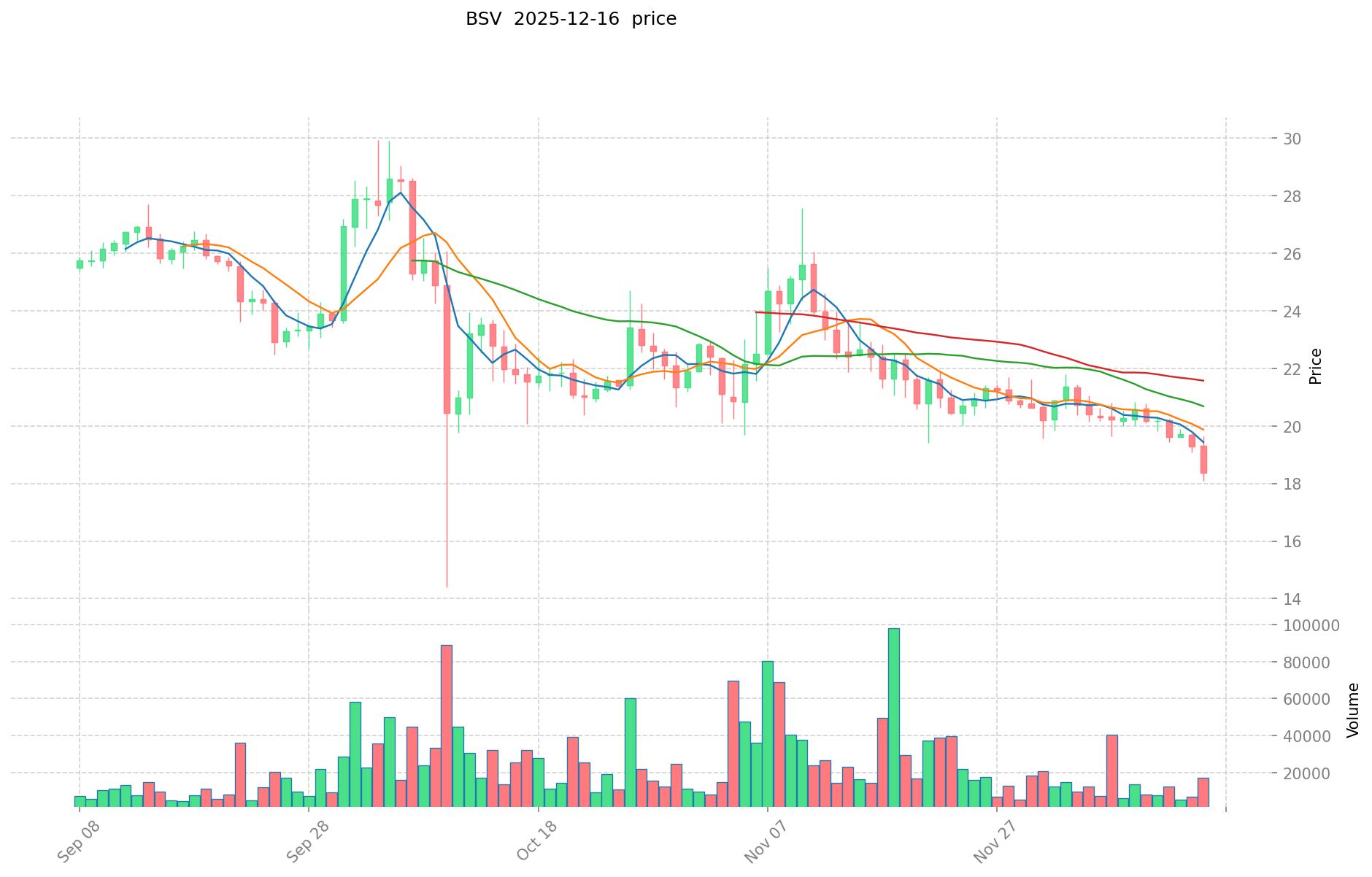
Bitcoin SV (BSV) and dYdX (DYDX) Historical Price Trends
Bitcoin SV (BSV):
- All-Time High (ATH): $489.75 on April 17, 2021
- All-Time Low (ATL): $18.05 on December 16, 2025
- Cumulative decline from ATH to ATL: approximately 96.31%
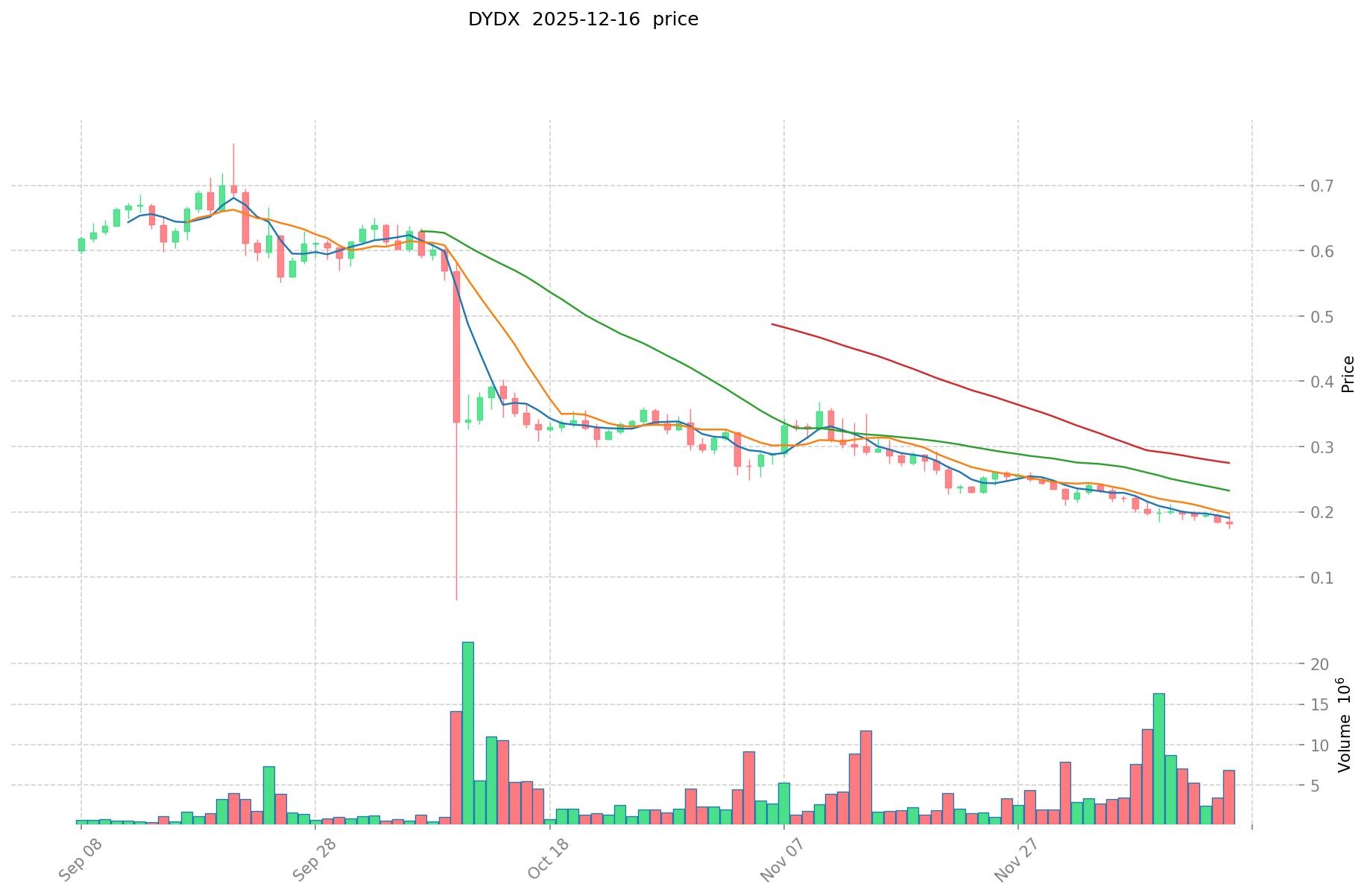
dYdX (DYDX):
- All-Time High (ATH): $4.52 on March 8, 2024
- All-Time Low (ATL): $0.126201 on October 11, 2025
- Cumulative decline from ATH to ATL: approximately 97.21%
Comparative Analysis: Both assets have experienced significant downward pressure over their respective market cycles. BSV declined from its peak of $489.75 to near its all-time low, representing a severe contraction. Similarly, DYDX has collapsed from $4.52 to current levels around $0.18, demonstrating similar volatility patterns typical of alternative cryptocurrencies during bear market conditions.
Current Market Status (December 16, 2025)
Price Data:
- Bitcoin SV (BSV) current price: $18.15
- dYdX (DYDX) current price: $0.1783
- Market capitalization (BSV): $362,300,771.25
- Market capitalization (DYDX): $170,872,512.50
24-Hour Trading Performance:
- BSV 24-hour volume: $343,019.40
- BSV 24-hour price change: -6.35%
- DYDX 24-hour volume: $1,225,454.71
- DYDX 24-hour price change: -8.32%
Market Sentiment Indicator:
- Crypto Fear & Greed Index: 11 (Extreme Fear)
Current market sentiment reflects heightened anxiety across cryptocurrency markets, with both assets trading in a bearish environment.
Market Positioning:
- BSV Market Rank: #159
- DYDX Market Rank: #273
- BSV Market Dominance: 0.011%
- DYDX Market Dominance: 0.0054%
II. Project Overview and Technical Architecture
Bitcoin SV (BSV)
Project Genesis and Objectives: Bitcoin SV emerged from a hard fork of Bitcoin Cash (BCH) in 2018. The project aims to fulfill the original vision of the Bitcoin protocol as described in Satoshi Nakamoto's white paper. BSV positions itself as a peer-to-peer electronic cash system with enterprise-grade scalability.
Key Characteristics:
- Circulating Supply: 19,961,475 BSV
- Maximum Supply: 21,000,000 BSV
- Circulating Supply Ratio: 95.05%
- Total Holders: 10,811,392
- Listed on 17 exchanges
Market Metrics:
- Historical high price: $489.75
- Historical low price: $18.05
- Publishing price: $88.30
- Fully diluted valuation: $362,300,771.25
dYdX (DYDX)
Protocol Framework: dYdX operates as a decentralized derivatives trading protocol, functioning as a decentralized perpetual contracts exchange. The platform operates on Layer 2 blockchain infrastructure while offering Layer 1 spot, margin, and lending services.
Technical Infrastructure: dYdX employs a hybrid infrastructure model featuring:
- Non-custodial architecture
- On-chain settlement mechanisms
- Off-chain low-latency order matching engine with order book functionality
Governance Token Properties: DYDX serves as the governance token, enabling community members to:
- Participate in protocol governance
- Access trading fee discounts
- Direct protocol development decisions
Supply Metrics:
- Circulating Supply: 813,317,306.90 DYDX
- Total Supply: 958,342,751 DYDX
- Maximum Supply: 1,000,000,000 DYDX
- Circulating Supply Ratio: 81.33%
- Total Holders: 45,361
- Listed on 20 exchanges
Funding History: dYdX has completed at least four rounds of institutional financing, indicating sustained venture capital support throughout its development cycle.
III. Performance Metrics and Market Indicators
Price Performance Analysis
Short-Term Price Movements (as of December 16, 2025):
| Time Period | BSV Change | DYDX Change |
|---|---|---|
| 1 Hour | +0.11% | -0.38% |
| 24 Hours | -6.35% | -8.32% |
| 7 Days | -9.98% | -5.16% |
| 30 Days | -20.16% | -41.41% |
| 1 Year | -73.08% | -91.85% |
Interpretation:
- Both assets demonstrate significant year-over-year declines, with DYDX experiencing more severe depreciation
- Recent 30-day performance shows DYDX underperforming BSV by approximately 21 percentage points
- Both tokens are trading near historical low levels, suggesting potential support zones
Market Liquidity and Trading Activity
24-Hour Trading Volume:
- BSV: $343,019.40 USD (relatively thin liquidity)
- DYDX: $1,225,454.71 USD (approximately 3.57x higher volume)
Trading Range (24-Hour):
- BSV: $18.09 (low) to $19.42 (high)
- DYDX: $0.1749 (low) to $0.1964 (high)
Valuation Metrics
Market Capitalization Positioning:
- BSV fully diluted market cap: $362,300,771.25
- DYDX fully diluted market cap: $170,872,512.50
- BSV carries approximately 2.12x larger market capitalization
Market Cap to FDV Ratio:
- BSV: 95.05% (indicating minimal inflation from token releases)
- DYDX: 81.33% (indicating greater future dilution potential)
IV. Risk Assessment and Market Considerations
Downside Risk Exposure
BSV Risk Profile:
- Trading distance from ATL: minimal buffer (~0.55% above all-time low)
- Year-over-year decline: -73.08%
- Extended bear market exposure with limited recovery catalysts identified in available data
DYDX Risk Profile:
- Trading distance from ATL: approximately 41.36% above all-time low
- Year-over-year decline: -91.85% (more severe than BSV)
- Protocol dependency on derivatives market adoption and regulatory acceptance
Market Structure Observations
Holder Distribution:
- BSV: 10,811,392 holders (distributed base)
- DYDX: 45,361 holders (more concentrated distribution)
The significant disparity in holder numbers suggests BSV has broader retail participation, while DYDX exhibits more concentrated ownership patterns, potentially indicating higher volatility risk.
Sentiment and Technical Context
Current Market Environment: The Crypto Fear & Greed Index at 11 (Extreme Fear) indicates:
- Maximum risk aversion across cryptocurrency markets
- Potential capitulation in speculative positions
- Historically associated with volatility extremes and potential support testing
V. Network and Exchange Access
Blockchain Infrastructure
Bitcoin SV:
- Explorer: WhatsOnChain (https://whatsonchain.com/)
- Repository: GitHub (https://github.com/bitcoin-sv/bitcoin-sv)
- Official Website: https://bitcoinsv.com/
dYdX:
- Official Exchange: https://dydx.exchange/
- Block Explorer: Mintscan (https://www.mintscan.io/)
- Community: Twitter (@dYdX), Reddit (/r/dydxprotocol)
- Development: GitHub (https://github.com/dydxprotocol)
- Blog/Forum: https://dydx.exchange/blog
Exchange Availability
- BSV: Available on 17 cryptocurrency exchanges
- DYDX: Available on 20 cryptocurrency exchanges
Conclusion
Both Bitcoin SV and dYdX are trading at significant discounts from their historical peaks within an environment of extreme market fear. BSV maintains larger absolute market capitalization despite greater holder concentration, while DYDX commands higher 24-hour trading volume relative to its market size. The extended bear market conditions and proximity to historical low levels suggest both assets require significant positive catalysts for recovery. The current market sentiment of extreme fear may represent either a capitulation bottom or ongoing downside pressure, requiring careful risk management for market participants.
Comparative Investment Analysis: BSV vs DYDX
I. Executive Summary
Bitcoin SV (BSV) and dYdX (DYDX) represent two distinct segments within the cryptocurrency ecosystem. BSV functions as a blockchain platform emphasizing transaction throughput and block capacity, while DYDX operates as a decentralized derivatives and trading protocol. This report analyzes the core investment value drivers for both assets based on available market data.
II. Core Factors Influencing Investment Value of BSV vs DYDX
Supply Mechanism and Tokenomics
DYDX:
- Operates as a governance and utility token for the dYdX protocol
- Token unlock events occur periodically (e.g., scheduled unlocks in June with significant token releases)
- Supply dynamics influenced by governance participation and protocol fee distribution mechanisms
BSV:
- Functions as the native cryptocurrency of the Bitcoin SV network
- Used for transaction facilitation, transaction fee payments, and miner rewards for block validation and blockchain security
- Inherits supply characteristics from its blockchain protocol design
Institutional Adoption and Market Application
dYdX Platform Positioning:
- Provides competitive leverage ratios and low fee structures for derivatives trading
- Combines trading, lending, and borrowing functionalities on a unified platform
- Aggregates spot pricing from multiple users and cross-exchange lending liquidity
- Operates as a Cosmos-based application chain with optimized throughput
- Supported by top-tier venture capital including a16z and Polychain Capital
BSV Network Application:
- Block capacity and transaction speed attract investor interest
- Serves as the underlying asset for the Bitcoin SV network operations
Market Competitive Dynamics:
- On-chain derivatives segment experiences significant competition; platforms like Hyperliquid (with 100,000+ TPS on self-built L1) and dYdX (Cosmos application chain) compete with centralized exchanges
- dYdX demonstrates order book mechanism with low slippage and high capital efficiency, approaching CEX user experience
Technical Development and Ecosystem Construction
dYdX Technical Architecture:
- Built on Cosmos application chain framework requiring high throughput blockchain infrastructure
- Offers on-chain order book matching mechanism with direct counterparty matching
- Faces competitive pressures in the broader on-chain derivatives landscape
BSV Technical Characteristics:
- Emphasizes block capacity and transaction speed as core technical features
- Supports network transactions and miner-based consensus security
Ecosystem Differentiation:
- dYdX operates within the DeFi derivatives and trading segment
- BSV functions as blockchain infrastructure with focus on transaction throughput
Future Potential Determinants
Market Acceptance Drivers:
- dYdX future potential depends on DeFi market adoption rates and protocol technological advancement
- BSV future potential contingent on market acceptance of its block capacity and transaction speed advantages
- Both assets face ongoing competition from alternative platforms and protocols
III. Key Observations
Market demand and technological innovation remain fundamental determinants of investment value for both BSV and DYDX. DYDX presents competitive leverage opportunities and fee structures within the DeFi derivatives segment, while BSV offers block capacity and transaction speed advantages at the blockchain infrastructure layer. Long-term value realization depends on sustained market adoption and continued technological development.
Report Generated: December 16, 2025
Data Sources: Referenced cryptocurrency market analysis and ecosystem reports
Disclaimer: This report presents factual analysis of available information without providing investment recommendations or subjective assessments.
III. 2025-2030 Price Predictions: BSV vs DYDX
Short-term Predictions (2025)
- BSV: Conservative $10.73-$18.18 | Optimistic $18.18-$22.54
- DYDX: Conservative $0.0964-$0.1786 | Optimistic $0.1786-$0.2197
Medium-term Predictions (2026-2028)
- BSV may enter a consolidation phase with fluctuations, estimated price range $11.20-$37.63
- DYDX may enter a gradual growth phase, estimated price range $0.1175-$0.2398
- Key drivers: Institutional capital inflows, regulatory clarity, ecosystem development
Long-term Predictions (2029-2030)
- BSV: Base scenario $18.54-$31.97 | Optimistic scenario $33.57-$42.93
- DYDX: Base scenario $0.2234-$0.2728 | Optimistic scenario $0.3104-$0.3273
Disclaimer: This analysis is based on historical data and statistical models. Cryptocurrency markets are highly volatile and unpredictable. Price predictions should not be considered investment advice. Past performance does not guarantee future results. Investors should conduct their own research and assess their risk tolerance before making investment decisions.
BSV:
| 年份 | 预测最高价 | 预测平均价格 | 预测最低价 | 涨跌幅 |
|---|---|---|---|---|
| 2025 | 22.5432 | 18.18 | 10.7262 | 0 |
| 2026 | 22.601376 | 20.3616 | 11.19888 | 12 |
| 2027 | 31.1481576 | 21.481488 | 13.9629672 | 18 |
| 2028 | 37.630196604 | 26.3148228 | 22.36759938 | 45 |
| 2029 | 33.5711351871 | 31.972509702 | 18.54405562716 | 76 |
| 2030 | 42.9310874023605 | 32.77182244455 | 23.595712160076 | 80 |
DYDX:
| 年份 | 预测最高价 | 预测平均价格 | 预测最低价 | 涨跌幅 |
|---|---|---|---|---|
| 2025 | 0.219678 | 0.1786 | 0.096444 | 0 |
| 2026 | 0.25290653 | 0.199139 | 0.11749201 | 11 |
| 2027 | 0.2350636756 | 0.226022765 | 0.11527161015 | 26 |
| 2028 | 0.239764949112 | 0.2305432203 | 0.140631364383 | 29 |
| 2029 | 0.31040339181192 | 0.235154084706 | 0.2233963804707 | 31 |
| 2030 | 0.327334485910752 | 0.27277873825896 | 0.264595376111191 | 52 |
Comparative Investment Analysis: Bitcoin SV (BSV) vs dYdX (DYDX)
IV. Investment Strategy Comparison: BSV vs DYDX
Long-term vs Short-term Investment Strategy
Bitcoin SV (BSV):
- Suited for investors focusing on blockchain infrastructure scalability and transaction throughput advantages
- Long-term positioning emphasizes network adoption as a peer-to-peer electronic cash system
- Short-term strategy should account for extreme market sentiment and proximity to historical lows
dYdX (DYDX):
- Suited for investors seeking exposure to decentralized derivatives market growth and DeFi protocol governance participation
- Long-term positioning depends on DeFi market maturation and protocol feature development
- Short-term strategy should consider higher trading volume relative to market capitalization, indicating liquidity advantages
Risk Management and Asset Allocation
Conservative Investor Profile:
- BSV: 30% | DYDX: 20% | Stablecoins and low-volatility assets: 50%
- Rationale: Limited exposure to both assets given extreme market conditions, with emphasis on capital preservation
Aggressive Investor Profile:
- BSV: 40% | DYDX: 45% | Alternative positions: 15%
- Rationale: Higher allocation reflects potential recovery from historical lows and long-term ecosystem development
Hedging Instruments:
- Stablecoin allocation for market volatility management
- Cross-asset diversification across infrastructure layer (BSV) and application layer (DYDX) protocols
- Position sizing relative to individual risk tolerance given year-over-year depreciation exceeding 70% for both assets
V. Potential Risk Comparison
Market Risk
Bitcoin SV (BSV):
- Trading within 0.55% of all-time low price levels, indicating minimal downside buffer
- Year-over-year decline of -73.08% reflects extended bear market exposure
- Limited market capitalization dominance (0.011%) suggests vulnerability to sentiment shifts
dYdX (DYDX):
- Year-over-year decline of -91.85% exceeds BSV depreciation, indicating more severe downside pressure
- Concentrated holder distribution (45,361 total holders vs 10,811,392 for BSV) increases volatility risk
- Dependency on DeFi derivatives market adoption introduces segment-specific risk exposure
Technical Risk
Bitcoin SV (BSV):
- Network security dependent on miner participation and hash rate distribution
- Block capacity expansion strategy requires continued miner support and consensus maintenance
- Limited ecosystem adoption relative to competing blockchain platforms
dYdX (DYDX):
- Smart contract vulnerabilities and on-chain settlement mechanism dependencies
- Cosmos-based application chain architecture introduces layer-specific technical dependencies
- Order book matching engine performance under high-volume stress conditions
- Protocol upgrade coordination complexity across governance stakeholders
Regulatory Risk
Global Regulatory Environment:
- Cryptocurrency derivatives platforms face intensified regulatory scrutiny across jurisdictions
- dYdX potential exposure through decentralized derivatives trading protocol classification
- BSV regulatory considerations related to blockchain scalability and transaction processing capabilities
- Both assets subject to evolving digital asset regulatory frameworks without predictable outcomes
- Stablecoin regulation and exchange listing requirements impact both tokens' market accessibility
VI. Conclusion: Which Is the Better Buy?
📌 Investment Value Summary
Bitcoin SV (BSV) Advantages:
- Larger absolute market capitalization ($362.3M) providing greater market depth
- Broader holder distribution (10.8M holders) suggesting retail participation and network resilience
- Blockchain infrastructure positioning offers infrastructure-layer diversification
- Minimal token dilution remaining (95.05% circulating supply ratio)
- Technical specifications emphasize transaction throughput and scalability as differentiation factors
dYdX (DYDX) Advantages:
- Higher 24-hour trading volume ($1.23M vs $343K for BSV) indicating superior liquidity relative to market size
- Exposure to high-growth DeFi derivatives market segment
- Venture capital backing from tier-one institutional investors (a16z, Polychain Capital)
- Governance token utility provides protocol participation and fee discount mechanisms
- Greater distance from all-time low (41.36% buffer) compared to BSV (0.55% buffer)
✅ Investment Recommendations
Beginner Investors:
- Consider minimal allocation (2-5% of portfolio) to either asset given extreme market volatility and proximity to historical lows
- Prioritize stablecoin positioning during Extreme Fear market conditions (index at 11)
- Focus on understanding project fundamentals before capital deployment rather than timing entry during market extremes
Experienced Investors:
- BSV allocation suitable for investors with thesis on blockchain transaction throughput and infrastructure layer adoption
- DYDX allocation appropriate for investors with DeFi derivatives market conviction and protocol governance interest
- Implement dollar-cost averaging strategy to mitigate timing risk during extreme volatility
- Utilize price prediction ranges (2025-2030) as guidance reference only, not as deterministic forecasts
- Monitor regulatory developments affecting derivatives platforms and blockchain infrastructure projects
Institutional Investors:
- Evaluate both assets within broader cryptocurrency market allocation framework
- BSV consideration for infrastructure-diversified portfolios; DYDX for DeFi segment exposure
- Conduct independent due diligence on tokenomics, governance structures, and competitive positioning
- Consider entry strategies aligned with institution-specific risk management frameworks
- Monitor venture capital funding patterns and enterprise adoption metrics for competitive differentiation assessment
⚠️ Risk Disclaimer: Cryptocurrency markets exhibit extreme volatility with both assets experiencing year-over-year declines exceeding 70%. This analysis presents factual market data and observed patterns without providing investment advice. Price prediction models are based on historical data and statistical analysis; actual outcomes may differ substantially from projections. Past performance does not guarantee future results. Investors must conduct independent research, assess personal risk tolerance, and consult financial advisors before capital deployment. Trading near historical low levels carries elevated risk exposure requiring careful position sizing and risk management discipline.
Report Generated: December 16, 2025
Data Currency: Market data as of December 16, 2025
Methodology: Comparative analysis based on quantitative market metrics and available ecosystem information
None
FAQ: Bitcoin SV (BSV) vs dYdX (DYDX) Investment Comparison
I. Market Performance and Price Dynamics
Q1: Why have both BSV and DYDX experienced such severe price declines?
A: Both assets have suffered significant depreciation due to extended bear market conditions in the cryptocurrency sector. BSV declined 96.31% from its all-time high of $489.75 (April 2021) to current levels near $18.15, while DYDX fell 97.21% from $4.52 (March 2024) to approximately $0.1783. These declines reflect reduced institutional investor participation, regulatory uncertainty affecting derivatives platforms, and broader cryptocurrency market sentiment shifts captured by the Crypto Fear & Greed Index at extreme fear levels (11/100).
Q2: What distinguishes the current trading environments of BSV versus DYDX?
A: DYDX demonstrates superior 24-hour trading volume ($1.23 million) relative to market capitalization compared to BSV ($343,019), indicating better liquidity conditions. However, BSV maintains a larger absolute market capitalization ($362.3 million vs $170.9 million) with broader holder distribution (10.8 million holders vs 45,361 for DYDX). BSV trades within 0.55% of its all-time low, while DYDX maintains 41.36% buffer above its historical minimum, suggesting different risk-reward profiles for market participants.
Q3: What do price predictions for 2025-2030 indicate about recovery potential?
A: Conservative 2025 projections suggest BSV trading range of $10.73-$18.18 and DYDX range of $0.0964-$0.1786, indicating further downside risk under adverse scenarios. Medium-term (2026-2028) predictions model consolidation phases with BSV range of $11.20-$37.63 and DYDX range of $0.1175-$0.2398. Long-term optimistic scenarios (2029-2030) project BSV recovery to $33.57-$42.93 and DYDX to $0.3104-$0.3273, contingent upon institutional capital inflows, regulatory clarity, and ecosystem development. These projections should not be considered investment advice and represent statistical models subject to significant deviation.
II. Project Fundamentals and Use Cases
Q4: What are the fundamental differences in project positioning between BSV and DYDX?
A: Bitcoin SV functions as blockchain infrastructure emphasizing transaction throughput and scalability, operating as a peer-to-peer electronic cash system compatible with Satoshi Nakamoto's original protocol vision. dYdX operates as a decentralized derivatives and trading protocol on Layer 2 blockchain systems, providing spot, margin, lending, and perpetual futures services. BSV's value derives from network adoption for transaction processing, while DYDX's value depends on DeFi derivatives market adoption and protocol governance participation. These represent distinct ecosystem layers: BSV at infrastructure level versus DYDX at application level.
Q5: How do tokenomics and supply mechanisms differ between these assets?
A: BSV maintains 19.96 million circulating supply (95.05% of 21 million maximum), with supply mechanics tied directly to blockchain mining rewards and transaction facilitation. DYDX has 813.3 million circulating supply (81.33% of 1 billion maximum), with ongoing token unlock events (June unlocks demonstrated significant releases) affecting supply dynamics. BSV's minimal inflation (4.95% remaining) suggests limited future dilution, while DYDX's larger remaining supply (18.67%) creates greater inflation potential. DYDX governance token utility includes protocol participation and trading fee discounts, whereas BSV functions primarily as network currency for transaction fees and miner compensation.
III. Risk Assessment and Market Considerations
Q6: Which asset presents greater downside risk in current market conditions?
A: DYDX demonstrates higher downside risk exposure through year-over-year decline of -91.85% (versus BSV's -73.08%) and concentrated holder distribution (45,361 holders indicating higher volatility potential). However, DYDX maintains 41.36% buffer above all-time low versus BSV's minimal 0.55% cushion, suggesting BSV closer to potential capitulation extremes. DYDX faces segment-specific derivatives market risks including regulatory scrutiny affecting on-chain trading platforms, while BSV confronts broader blockchain infrastructure competition. Both assets trade during Extreme Fear market conditions (index at 11), historically associated with volatility extremes and potential support testing but also capitulation bottom scenarios requiring careful risk management.
Q7: What regulatory risks should investors consider for each asset?
A: dYdX faces intensified regulatory scrutiny as a decentralized derivatives platform, with potential jurisdictional restrictions on derivatives trading affecting protocol adoption and token utility. Global regulatory frameworks for cryptocurrency derivatives remain uncertain, creating compliance risks for platform operations and exchange listings. Bitcoin SV encounters regulatory considerations related to blockchain scalability positioning and transaction processing capabilities, though faces lower regulatory risk than derivatives protocols. Both assets depend on stablecoin regulation outcomes and exchange listing requirements for market accessibility. Regulatory clarity remains fundamental for long-term value realization for both projects, with adverse regulatory outcomes potentially suppressing price recovery prospects across both assets.
IV. Investment Suitability and Strategy
Q8: Which asset represents better investment value for different investor profiles?
A: Beginner investors should maintain minimal allocations (2-5% of portfolio) to either asset given extreme market volatility, prioritizing stablecoin positioning and fundamental research during Extreme Fear conditions. Experienced investors with blockchain infrastructure conviction may consider BSV allocation; those with DeFi derivatives conviction may allocate to DYDX, with dollar-cost averaging strategies recommended to mitigate timing risk. Conservative portfolios should emphasize: BSV 30% | DYDX 20% | Stablecoins 50%, while aggressive portfolios might allocate: BSV 40% | DYDX 45% | Alternatives 15%. Institutional investors should evaluate both assets within broader cryptocurrency allocation frameworks, conducting independent due diligence on tokenomics, governance structures, competitive positioning, and monitoring venture capital patterns (DYDX demonstrates institutional backing from a16z and Polychain Capital). All investor profiles should recognize that cryptocurrency markets exhibit extreme volatility with assets trading near historical lows, requiring careful position sizing and independent risk assessment before capital deployment.
⚠️ Disclaimer: This FAQ presents factual analysis of available market data without providing investment advice. Cryptocurrency investments carry substantial risk including potential total capital loss. Past performance does not guarantee future results. Investors must conduct independent research and consult financial advisors before making investment decisions.
Report Generated: December 16, 2025
Share
Content
Introduction: BSV vs DYDX Investment Comparison
I. Historical Price Comparison and Current Market Status
II. Project Overview and Technical Architecture
III. Performance Metrics and Market Indicators
IV. Risk Assessment and Market Considerations
V. Network and Exchange Access
Conclusion
I. Executive Summary
II. Core Factors Influencing Investment Value of BSV vs DYDX
III. Key Observations
III. 2025-2030 Price Predictions: BSV vs DYDX
IV. Investment Strategy Comparison: BSV vs DYDX
V. Potential Risk Comparison
VI. Conclusion: Which Is the Better Buy?
I. Market Performance and Price Dynamics
II. Project Fundamentals and Use Cases
III. Risk Assessment and Market Considerations
IV. Investment Suitability and Strategy
How to Buy Cryptocurrency


Trending Cryptocurrencies



XZXX: A Comprehensive Guide to the BRC-20 Meme Token in 2025

Bitcoin Fear and Greed Index: Market Sentiment Analysis for 2025

Top Crypto ETFs to Watch in 2025: Navigating the Digital Asset Boom

5 ways to get Bitcoin for free in 2025: Newbie Guide

Bitcoin Market Cap in 2025: Analysis and Trends for Investors

2025 Bitcoin Price Prediction: Trump's Tariffs' Impact on BTC

Is Lombard (BARD) a good investment?: A Comprehensive Analysis of Tokenomics, Market Position, and Future Potential

Is 0G (0G) a good investment?: A Comprehensive Analysis of Risk, Potential Returns, and Market Outlook for 2024

Is WEMIX (WEMIX) a good investment?: A Comprehensive Analysis of Price Performance, Market Potential, and Risk Factors for 2024

Is FTX Token (FTT) a good investment?: Analyzing the Risks, Recovery Prospects, and Future Viability of FTT After the Exchange Collapse
EGLD vs NEAR: A Comprehensive Comparison of Two Leading Layer-1 Blockchain Platforms