BUCK vs ADA: A Comprehensive Comparison of Two Leading Blockchain Assets in the Crypto Market


Introduction: BUCK vs ADA Investment Comparison
In the cryptocurrency market, the comparison between BUCK and ADA has become a topic of interest for investors. The two differ significantly in market cap ranking, use cases, and price performance, representing distinct crypto asset positioning. BUCK: Launched in November 2024 as the official mascot of GameStop, positioned as a meme token. ADA (Cardano): Since its launch in October 2017, it has been recognized for its layered blockchain architecture and smart contract capabilities, becoming one of the widely-adopted cryptocurrencies. This article will comprehensively analyze the investment value comparison between BUCK and ADA, covering historical price trends, supply mechanisms, adoption scenarios, technical ecosystems, and future outlook, attempting to answer investors' most concerned question:
"Which is the better buy right now?"
I. Historical Price Comparison and Current Market Status
BUCK (GME Mascot) and ADA (Cardano) Historical Price Trends
- 2024: BUCK reached its historical high of $0.05859 on November 21, 2024, shortly after its launch in November 2024.
- 2021: ADA experienced notable price movements, with its historical high of $3.09 recorded on September 2, 2021, driven by network upgrades including the Alonzo upgrade that enhanced smart contract functionality.
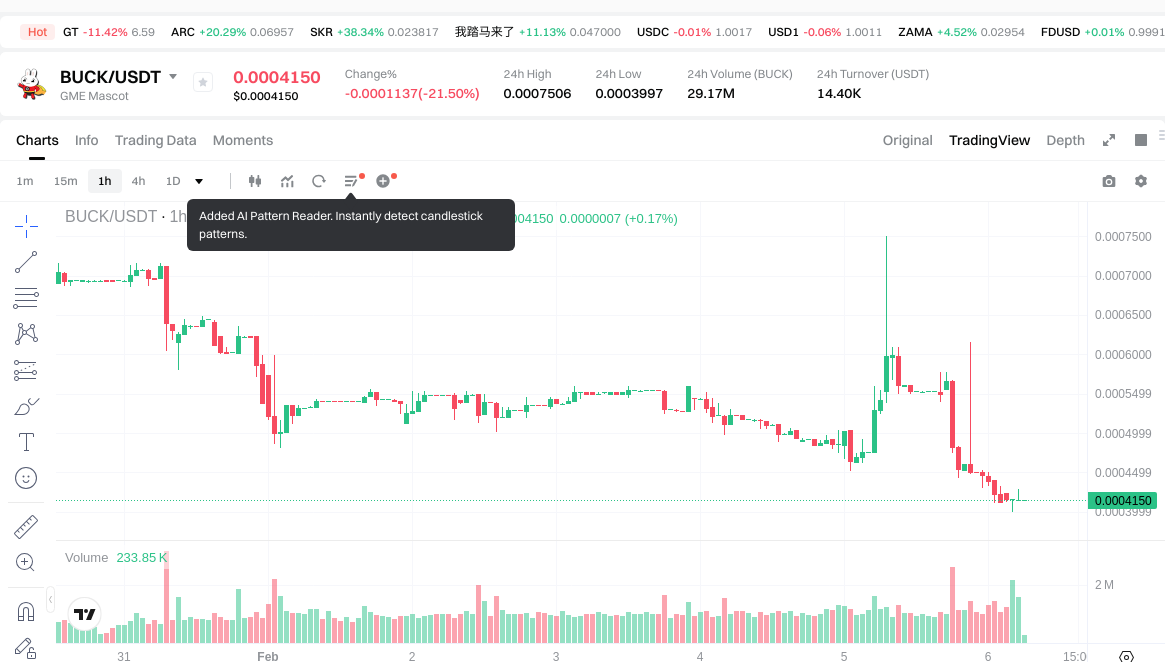
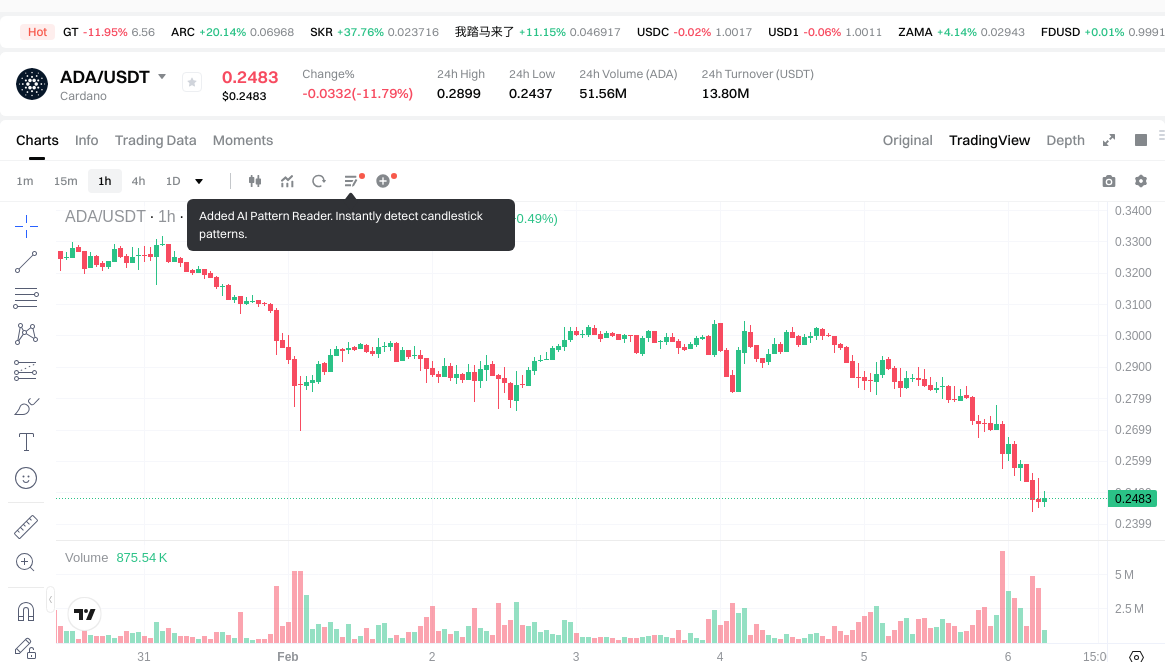
- Comparative Analysis: During recent market cycles, BUCK declined from its peak of $0.05859 to a low of $0.0003997 recorded on February 5, 2026, representing significant volatility. Meanwhile, ADA decreased from $3.09 to its historical low of $0.01925275 recorded on March 13, 2020, demonstrating different market behavior patterns.
Current Market Status (February 6, 2026)
- BUCK Current Price: $0.0004143
- ADA Current Price: $0.2473
- 24-Hour Trading Volume: BUCK $14,454.07 vs ADA $13,731,923.66
- Market Sentiment Index (Fear & Greed Index): 12 (Extreme Fear)
View real-time prices:
- Check BUCK current price Market Price
- Check ADA current price Market Price
II. Core Factors Influencing BUCK vs ADA Investment Value
Supply Mechanism Comparison (Tokenomics)
- BUCK: As a stablecoin within the Bucket Protocol ecosystem, BUCK maintains value stability through algorithmic mechanisms and collateral backing, distinguishing it from traditional supply models.
- ADA: Features a maximum supply of 45 billion tokens with approximately 35 billion currently in circulation (78% circulation rate), following a predetermined distribution schedule without mining-based inflation.
- 📌 Historical Pattern: ADA's fixed supply model has contributed to price appreciation during market cycles, while BUCK's stability mechanism targets value preservation rather than speculative growth.
Institutional Adoption and Market Application
- Institutional Holdings: ADA has demonstrated stronger appeal to institutional investors, maintaining consistent presence in top 10 cryptocurrencies by market capitalization at approximately $10 billion.
- Enterprise Adoption: Cardano/ADA emphasizes scalability and governance functionality for financial applications, while BUCK serves primarily within its blockchain ecosystem for transaction settlement.
- National Policies: Both assets remain subject to evolving cryptocurrency regulations across jurisdictions, with regulatory frameworks and technological innovation among key factors affecting their trajectories.
Technology Development and Ecosystem Building
- ADA Technical Upgrades: Cardano employs the Ouroboros Proof-of-Stake (PoS) consensus mechanism, achieving 250 transactions per second through dual-layer architecture, with ongoing development across five phases (Byron, Shelley, Goguen, Basho, Voltaire).
- BUCK Technical Development: Value influenced by broader blockchain ecosystem dynamics and market volatility, with specific technical implementations not extensively detailed in available materials.
- Ecosystem Comparison: Cardano's DeFi total value locked (TVL) stood at $320 million as of March 27, ranking 19th among public chains. The ecosystem includes smart contract capabilities and governance features, though development pace has faced challenges compared to competitors like Ethereum.
Macroeconomic Environment and Market Cycles
- Performance Under Inflation: Material does not provide sufficient data for definitive comparison of inflation-hedging properties between BUCK and ADA.
- Macroeconomic Monetary Policy: Interest rate movements and US dollar strength typically affect risk assets including cryptocurrencies, with accommodative monetary policies generally more favorable for assets like ADA.
- Geopolitical Factors: Market sentiment, overall economic trends, policy regulations, and technological innovation constitute key factors affecting price volatility for both assets, with investor confidence particularly influencing market direction.
III. 2026-2031 Price Forecast: BUCK vs ADA
Short-term Forecast (2026)
- BUCK: Conservative $0.0002158 - $0.000415 | Optimistic $0.000415 - $0.0004814
- ADA: Conservative $0.132076 - $0.2492 | Optimistic $0.2492 - $0.358848
Mid-term Forecast (2028-2029)
- BUCK may enter a gradual growth phase, with estimated price range of $0.00026248833 - $0.0007611666309
- ADA may enter a consolidation and expansion phase, with estimated price range of $0.329257992 - $0.429179127888
- Key drivers: institutional capital flows, ETF developments, ecosystem expansion
Long-term Forecast (2030-2031)
- BUCK: Baseline scenario $0.000557966855726 - $0.000878175756607 | Optimistic scenario $0.000764338158528 - $0.00108536018511
- ADA: Baseline scenario $0.251295108856621 - $0.43343574054984 | Optimistic scenario $0.390482649144 - $0.584982056682626
Disclaimer
BUCK:
| Year | Predicted High Price | Predicted Average Price | Predicted Low Price | Price Change |
|---|---|---|---|---|
| 2026 | 0.0004814 | 0.000415 | 0.0002158 | 0 |
| 2027 | 0.000542322 | 0.0004482 | 0.000286848 | 8 |
| 2028 | 0.00058440798 | 0.000495261 | 0.00026248833 | 19 |
| 2029 | 0.0007611666309 | 0.00053983449 | 0.0004804526961 | 30 |
| 2030 | 0.000878175756607 | 0.00065050056045 | 0.000591955510009 | 57 |
| 2031 | 0.00108536018511 | 0.000764338158528 | 0.000557966855726 | 84 |
ADA:
| Year | Predicted High Price | Predicted Average Price | Predicted Low Price | Price Change |
|---|---|---|---|---|
| 2026 | 0.358848 | 0.2492 | 0.132076 | 0 |
| 2027 | 0.38915072 | 0.304024 | 0.16113272 | 22 |
| 2028 | 0.3569849808 | 0.34658736 | 0.329257992 | 40 |
| 2029 | 0.429179127888 | 0.3517861704 | 0.337714723584 | 42 |
| 2030 | 0.43343574054984 | 0.390482649144 | 0.27724268089224 | 57 |
| 2031 | 0.584982056682626 | 0.41195919484692 | 0.251295108856621 | 66 |
IV. Investment Strategy Comparison: BUCK vs ADA
Long-term vs Short-term Investment Strategies
- BUCK: May appeal to speculative traders focused on short-term volatility opportunities within niche blockchain ecosystems, though limited adoption and liquidity present significant challenges for sustained positioning.
- ADA: May suit investors seeking exposure to established blockchain infrastructure with multi-year development roadmaps, particularly those interested in proof-of-stake mechanisms and smart contract platform evolution.
Risk Management and Asset Allocation
- Conservative Investors: BUCK 5-10% vs ADA 15-25% (within overall cryptocurrency allocation)
- Aggressive Investors: BUCK 10-20% vs ADA 25-40% (within overall cryptocurrency allocation)
- Hedging Tools: Stablecoin reserves for liquidity management, derivative instruments where available, diversified exposure across multiple blockchain protocols
V. Potential Risk Comparison
Market Risk
- BUCK: Exhibits pronounced volatility patterns with limited trading volume ($14,454.07 on February 6, 2026), potentially resulting in significant price fluctuations and liquidity constraints during market stress periods.
- ADA: Subject to broader cryptocurrency market cycles with trading volume of $13,731,923.66, experiencing correlation with major digital assets while maintaining relatively deeper liquidity infrastructure.
Technical Risk
- BUCK: Technical development details remain limited in available materials, with ecosystem maturity and network stability requiring further assessment.
- ADA: Faces ongoing scalability considerations despite achieving 250 transactions per second, with ecosystem development pace and smart contract adoption presenting implementation challenges compared to competing platforms.
Regulatory Risk
- Both assets remain subject to evolving regulatory frameworks across jurisdictions, with potential classification differences affecting compliance requirements. ADA's larger market capitalization and institutional presence may attract greater regulatory scrutiny, while BUCK's positioning within specific ecosystem contexts presents distinct compliance considerations.
VI. Conclusion: Which Is the Better Buy?
📌 Investment Value Summary:
- BUCK Characteristics: Represents niche positioning within specific blockchain ecosystem, with price movements primarily driven by ecosystem dynamics and market sentiment, offering speculative opportunities accompanied by elevated volatility and liquidity considerations.
- ADA Characteristics: Demonstrates established market presence with defined technical roadmap across five development phases, proof-of-stake consensus mechanism, and governance capabilities, though facing competitive pressures within smart contract platform landscape.
✅ Investment Considerations:
- Beginning Investors: May consider starting with more established assets like ADA while developing understanding of cryptocurrency market dynamics, maintaining conservative position sizing relative to overall portfolio.
- Experienced Investors: Could evaluate diversified exposure based on risk tolerance and market outlook, potentially incorporating both assets within broader cryptocurrency allocation strategy while maintaining disciplined risk management protocols.
- Institutional Investors: May focus on assets demonstrating deeper liquidity, regulatory clarity, and established infrastructure, with ADA potentially offering more suitable characteristics for institutional requirements compared to BUCK's current market positioning.
⚠️ Risk Disclosure: Cryptocurrency markets exhibit extreme volatility. This content does not constitute investment advice. Market conditions, regulatory developments, and technological factors may significantly impact asset values. Investors should conduct independent research and consider professional guidance appropriate to their circumstances.
VII. FAQ
Q1: What is the fundamental difference between BUCK and ADA as investment assets?
BUCK is a meme token launched in November 2024 as GameStop's official mascot, operating within a niche blockchain ecosystem with limited adoption and high speculative characteristics. ADA (Cardano), launched in October 2017, is an established smart contract platform featuring layered blockchain architecture, Ouroboros Proof-of-Stake consensus mechanism achieving 250 transactions per second, and institutional-grade infrastructure. The key distinction lies in market positioning: BUCK represents speculative meme token exposure with trading volume of $14,454.07 (February 6, 2026), while ADA offers exposure to a mature blockchain platform with $13.7 million daily trading volume and approximately $10 billion market capitalization.
Q2: How do the supply mechanisms of BUCK and ADA impact their investment potential?
BUCK operates as a stablecoin within the Bucket Protocol ecosystem, maintaining value stability through algorithmic mechanisms and collateral backing rather than pursuing speculative appreciation. ADA features a fixed maximum supply of 45 billion tokens with approximately 35 billion currently circulating (78% circulation rate), following a predetermined distribution schedule without mining-based inflation. This fundamental difference means BUCK targets value preservation within its ecosystem, while ADA's fixed supply model has historically contributed to price appreciation during market cycles. ADA's supply scarcity mechanism may offer stronger long-term value proposition for investors seeking capital appreciation.
Q3: Which asset demonstrates better liquidity and institutional adoption?
ADA significantly outperforms BUCK in both liquidity and institutional adoption metrics. As of February 6, 2026, ADA's 24-hour trading volume reached $13,731,923.66 compared to BUCK's $14,454.07—representing approximately 950x greater liquidity. ADA maintains consistent presence among top 10 cryptocurrencies by market capitalization and demonstrates stronger appeal to institutional investors. Cardano's DeFi total value locked stood at $320 million as of March 27, ranking 19th among public chains. This substantial liquidity differential means ADA offers significantly reduced slippage risk and easier position management for investors across all portfolio sizes.
Q4: What are the price forecasts for BUCK and ADA through 2031?
Short-term forecasts for 2026 project BUCK ranging from $0.0002158 to $0.0004814, while ADA ranges from $0.132076 to $0.358848. Long-term projections for 2031 estimate BUCK between $0.000557966855726 and $0.00108536018511 (baseline to optimistic scenarios), representing potential 84% growth from 2026 baseline. ADA's 2031 forecasts range from $0.251295108856621 to $0.584982056682626, representing potential 66% growth from 2026 baseline. However, these projections remain highly speculative and depend on numerous factors including institutional capital flows, ETF developments, ecosystem expansion, regulatory frameworks, and broader macroeconomic conditions. Investors should view these forecasts as scenario analyses rather than guaranteed outcomes.
Q5: What portfolio allocation strategy should different investor types consider for BUCK versus ADA?
Conservative investors might consider allocating 5-10% to BUCK versus 15-25% to ADA within their overall cryptocurrency portfolio, prioritizing established infrastructure and liquidity. Aggressive investors could increase allocations to 10-20% for BUCK and 25-40% for ADA, accepting higher volatility for potential return enhancement. Beginning investors should prioritize more established assets like ADA while developing market understanding, maintaining conservative position sizing relative to overall portfolio. Institutional investors typically require deeper liquidity, regulatory clarity, and established infrastructure—characteristics where ADA demonstrates significant advantages over BUCK's current market positioning. All allocation strategies should incorporate stablecoin reserves for liquidity management and maintain disciplined risk management protocols.
Q6: What are the primary technical and regulatory risks distinguishing BUCK from ADA?
Technical risk profiles differ substantially between the two assets. BUCK's technical development details remain limited in available materials, with ecosystem maturity and network stability requiring further assessment before confident evaluation. ADA faces ongoing scalability considerations despite achieving 250 transactions per second, with ecosystem development pace presenting implementation challenges compared to competing platforms like Ethereum. Regulatory risks affect both assets but with different implications: ADA's larger market capitalization ($10 billion) and institutional presence may attract greater regulatory scrutiny, while BUCK's niche positioning within specific ecosystem contexts presents distinct compliance considerations. Both remain subject to evolving regulatory frameworks across jurisdictions, with potential classification differences affecting compliance requirements and market access.
Q7: How do macroeconomic conditions and market cycles affect BUCK versus ADA differently?
Both assets demonstrate sensitivity to broader cryptocurrency market cycles, though with different magnitude and characteristics. ADA, with its established market presence and institutional participation, exhibits correlation with major digital assets while maintaining relatively deeper liquidity infrastructure during market stress periods. BUCK's limited trading volume and niche positioning result in pronounced volatility patterns with potentially amplified reactions to market sentiment shifts. The current market sentiment index of 12 (Extreme Fear as of February 6, 2026) affects both assets negatively, though BUCK's speculative nature may experience more severe impact. Accommodative monetary policies generally favor risk assets like ADA more predictably, while BUCK's price movements remain primarily driven by ecosystem-specific dynamics and sentiment rather than systematic macroeconomic factors.
Q8: What timeline considerations should investors evaluate when choosing between BUCK and ADA?
Investment timeline significantly influences the comparative attractiveness of BUCK versus ADA. For short-term traders (weeks to months), BUCK may offer speculative opportunities within niche blockchain ecosystems, though accompanied by elevated volatility and liquidity constraints requiring sophisticated risk management. ADA may appeal to short-term traders during technical breakout scenarios, benefiting from deeper liquidity for position management. For medium-term investors (1-3 years), ADA's defined technical roadmap across five development phases provides clearer milestone evaluation framework compared to BUCK's limited visibility. Long-term investors (3+ years) should consider ADA's multi-year development roadmap, proof-of-stake mechanisms, and smart contract platform evolution as potentially offering more predictable value drivers than BUCK's speculative positioning. Both assets require continuous monitoring of ecosystem developments, competitive dynamics, and regulatory evolution regardless of intended holding period.
Share
Content
Introduction: BUCK vs ADA Investment Comparison
I. Historical Price Comparison and Current Market Status
II. Core Factors Influencing BUCK vs ADA Investment Value
III. 2026-2031 Price Forecast: BUCK vs ADA
IV. Investment Strategy Comparison: BUCK vs ADA
V. Potential Risk Comparison
VI. Conclusion: Which Is the Better Buy?
VII. FAQ
How to Buy Cryptocurrency


Trending Cryptocurrencies



Cardano (ADA) Price Prediction 2025 & 2030 – Is ADA Set to Soar?

Cardano (ADA): A History, Tech Overview, and Price Outlook
How Does Cardano's Proof of Stake (PoS) Mechanism Work?

What is Cardano?
Cardano (ADA) Price Analysis and Outlook for 2025
Factors Affecting Cardano's Price

What is a Private Key? How Does It Differ from a Public Key and What Can You Do with It?

Using and Calculating RSI in Cryptocurrency Trading

What Are RWAs (Real World Assets): A Complete Guide to Tokenizing Real-World Assets

How to Begin Trading NFTs

Smooth Love Potion (SLP) Price Prediction: Short-term and Long-term Analysis