CLORE vs GRT: A Comprehensive Comparison of Two Leading Blockchain Utility Tokens

Introduction: Investment Comparison Between CLORE and GRT
In the cryptocurrency market, the comparison between CLORE vs GRT has consistently been a topic investors cannot overlook. The two not only differ significantly in market cap ranking, application scenarios, and price performance, but also represent distinct crypto asset positioning.
CLORE.ai (CLORE): Launched in December 2022, it has gained market recognition through its innovative GPU computing power sharing and leasing marketplace, enabling accessible and affordable access to advanced computational resources.
The Graph (GRT): Since its launch in December 2020, it has been recognized as a decentralized protocol for indexing and querying blockchain data, serving as critical infrastructure for the Ethereum ecosystem and beyond.
This article will comprehensively analyze the investment value comparison of CLORE vs GRT around historical price trends, supply mechanisms, institutional adoption, technical ecosystem, and future predictions, attempting to answer the question investors care about most:
"Which is the better buy right now?"
I. Historical Price Comparison and Current Market Status
CLORE and GRT Historical Price Trends
- 2024: CLORE experienced notable volatility, reaching an all-time high of $0.45 on March 17, 2024, before entering a prolonged correction phase.
- 2021: GRT achieved its all-time high of $2.84 on February 12, 2021, driven by strong adoption in the decentralized indexing sector during the DeFi boom.
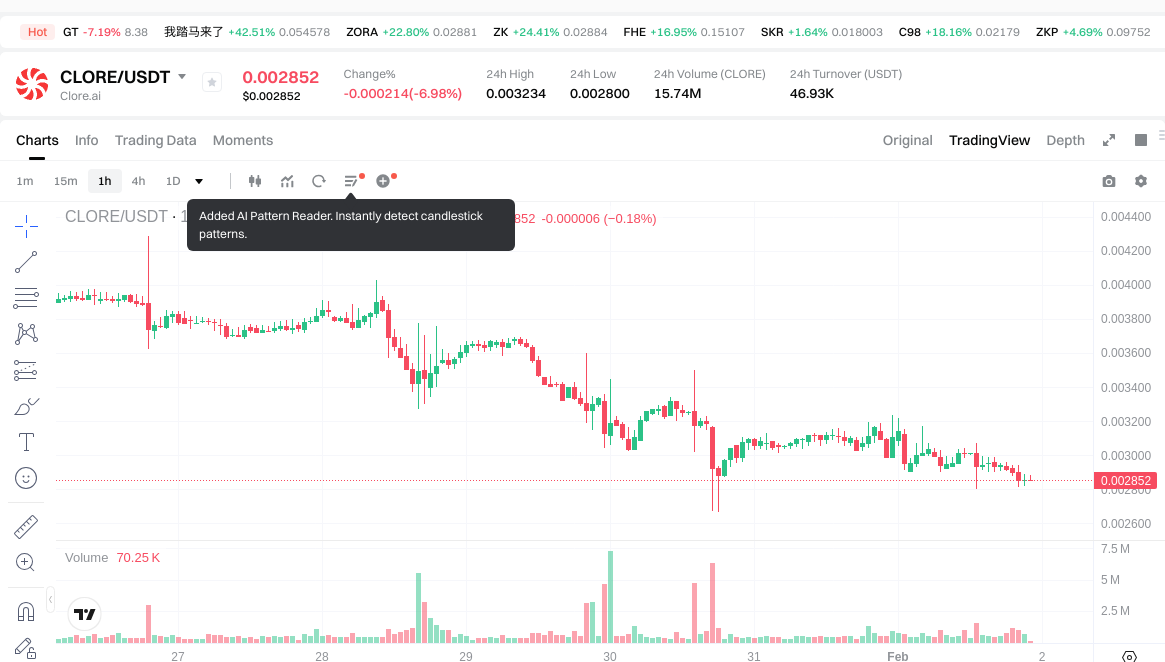
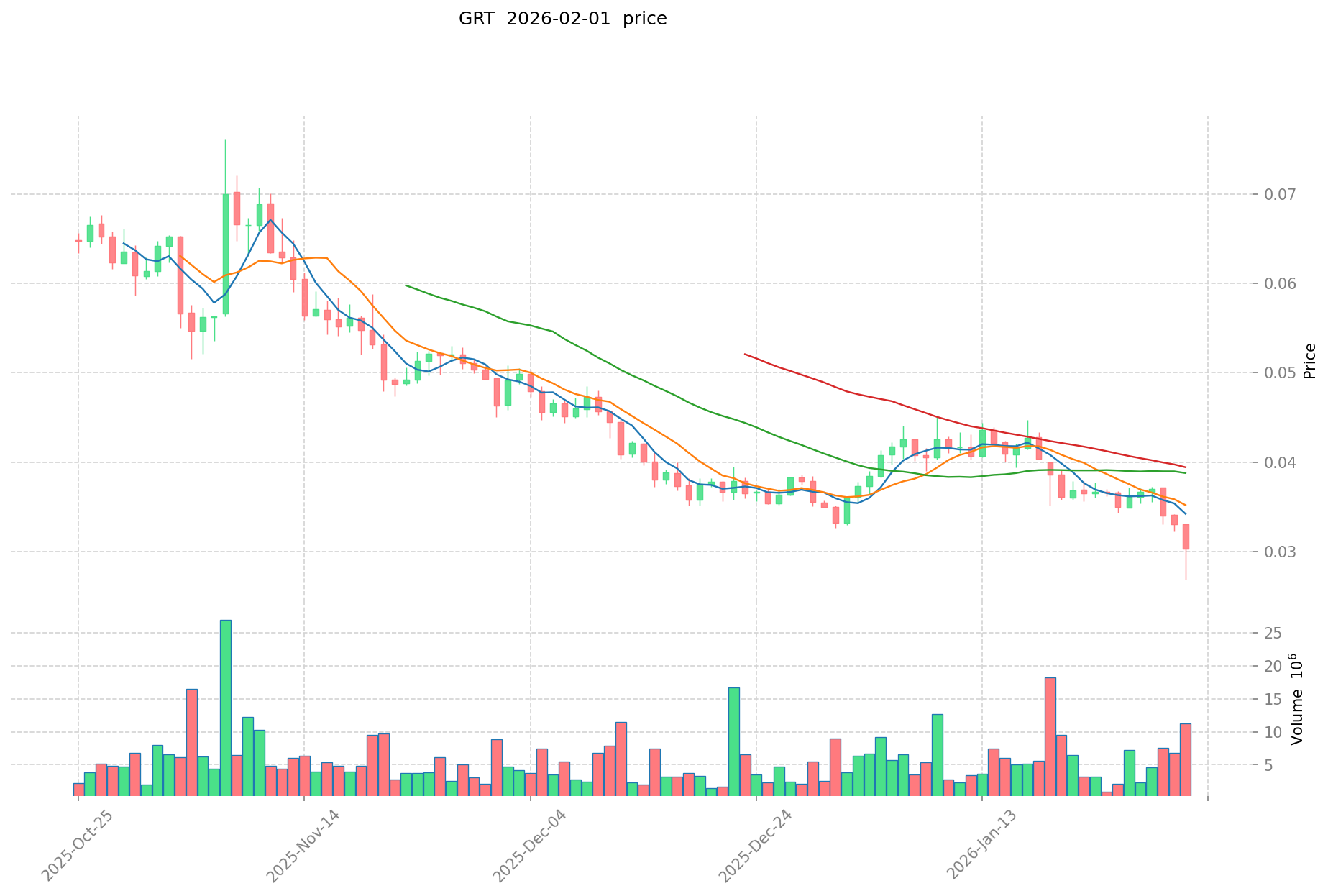
- Comparative Analysis: During the 2024-2026 market cycle, CLORE declined from its peak of $0.45 to a low of $0.002667 on January 30, 2026, representing a significant drawdown. In contrast, GRT fell from its 2021 high of $2.84 to $0.02834245 on February 1, 2026, reflecting substantial downward pressure over a longer timeframe.
Current Market Status (February 1, 2026)
- CLORE Current Price: $0.002852
- GRT Current Price: $0.03076
- 24-hour Trading Volume: CLORE $46,902.95 vs GRT $360,449.23
- Market Sentiment Index (Fear & Greed Index): 14 (Extreme Fear)
View Real-time Prices:
- Check CLORE Current Price Market Price
- Check GRT Current Price Market Price
II. Core Factors Influencing CLORE vs GRT Investment Value
Tokenomics Comparison
- CLORE: Operates within a decentralized GPU computing network model, where token supply mechanisms support rental transactions and network participant rewards.
- GRT: Functions based on blockchain indexing protocols, with tokenomics designed to incentivize data querying and network maintenance activities.
- 📌 Historical Pattern: Supply mechanisms in blockchain networks tend to influence price cycles through incentive structures and participant behavior patterns.
Institutional Adoption and Market Application
- Institutional Holdings: Market data suggests varying levels of institutional interest in decentralized computing versus blockchain indexing solutions.
- Enterprise Adoption: CLORE focuses on distributed GPU computing services, while GRT targets blockchain data accessibility infrastructure. Each serves distinct enterprise use cases in their respective domains.
- National Policies: Regulatory approaches toward decentralized computing networks and blockchain data protocols differ across jurisdictions, affecting deployment strategies.
Technology Development and Ecosystem Building
- CLORE Technology Upgrades: The platform continues to develop its API infrastructure and distributed computing capabilities to enhance GPU rental efficiency and network performance.
- GRT Technology Development: Ongoing improvements to blockchain data indexing protocols aim to expand query capabilities and network scalability.
- Ecosystem Comparison: CLORE primarily serves computing-intensive applications, while GRT supports DeFi and blockchain data accessibility use cases. Each maintains distinct ecosystem positioning within their technology domains.
Macroeconomic Conditions and Market Cycles
- Performance in Inflationary Environments: Digital assets with utility-driven value propositions may respond differently to macroeconomic pressures compared to speculative assets.
- Macroeconomic Monetary Policy: Interest rate movements and dollar index fluctuations can affect risk appetite for technology-focused digital assets across market segments.
- Geopolitical Factors: Demand for decentralized infrastructure and data accessibility solutions may be influenced by regulatory developments and cross-border technology adoption trends.
III. 2026-2031 Price Forecast: CLORE vs GRT
Short-term Forecast (2026)
- CLORE: Conservative $0.00232308 - $0.002868 | Optimistic $0.002868 - $0.00321216
- GRT: Conservative $0.0295776 - $0.03081 | Optimistic $0.03081 - $0.0351234
Mid-term Forecast (2028-2029)
- CLORE may enter a gradual growth phase, with estimated price range of $0.002114071632 - $0.0053129046096
- GRT may enter an expansion phase, with estimated price range of $0.0201426537 - $0.0666334478745
- Key drivers: institutional capital inflows, ETF developments, ecosystem expansion
Long-term Forecast (2030-2031)
- CLORE: Base scenario $0.003177917531208 - $0.0044759401848 | Optimistic scenario $0.00492353420328 - $0.005592687260907
- GRT: Base scenario $0.044787719246609 - $0.068904183456322 | Optimistic scenario $0.080862760750395 - $0.095776815004288
Disclaimer
This forecast is for informational purposes only and does not constitute investment advice. Cryptocurrency markets are highly volatile and subject to various risk factors. Past performance does not guarantee future results. Please conduct your own research and consult with financial professionals before making investment decisions.
CLORE:
| Year | Predicted High Price | Predicted Average Price | Predicted Low Price | Price Change |
|---|---|---|---|---|
| 2026 | 0.00321216 | 0.002868 | 0.00232308 | 0 |
| 2027 | 0.0038913024 | 0.00304008 | 0.0015808416 | 6 |
| 2028 | 0.00381226032 | 0.0034656912 | 0.002114071632 | 21 |
| 2029 | 0.0053129046096 | 0.00363897576 | 0.002365334244 | 27 |
| 2030 | 0.00492353420328 | 0.0044759401848 | 0.003177917531208 | 56 |
| 2031 | 0.005592687260907 | 0.00469973719404 | 0.00357180026747 | 64 |
GRT:
| Year | Predicted High Price | Predicted Average Price | Predicted Low Price | Price Change |
|---|---|---|---|---|
| 2026 | 0.0351234 | 0.03081 | 0.0295776 | 0 |
| 2027 | 0.044505045 | 0.0329667 | 0.022747023 | 7 |
| 2028 | 0.0557796564 | 0.0387358725 | 0.0201426537 | 26 |
| 2029 | 0.0666334478745 | 0.04725776445 | 0.0430045656495 | 53 |
| 2030 | 0.080862760750395 | 0.05694560616225 | 0.048973221299535 | 85 |
| 2031 | 0.095776815004288 | 0.068904183456322 | 0.044787719246609 | 124 |
IV. Investment Strategy Comparison: CLORE vs GRT
Long-term vs Short-term Investment Strategies
- CLORE: May appeal to investors interested in emerging distributed computing infrastructure with higher risk tolerance for volatility cycles
- GRT: May suit investors seeking exposure to established blockchain data infrastructure with focus on DeFi ecosystem integration
Risk Management and Asset Allocation
- Conservative Investors: CLORE 20-30% vs GRT 70-80%
- Aggressive Investors: CLORE 40-50% vs GRT 50-60%
- Hedging Tools: Stablecoin allocation, options strategies, cross-asset portfolio diversification
V. Potential Risk Comparison
Market Risks
- CLORE: Subject to volatility patterns associated with early-stage computing infrastructure adoption, with historical price drawdowns from $0.45 to $0.002667 between March 2024 and January 2026
- GRT: Exposed to market cycles affecting blockchain indexing demand, with extended correction from $2.84 peak in February 2021 to $0.02834245 in February 2026
Technical Risks
- CLORE: Network scalability considerations and platform stability factors during expansion phases
- GRT: Query infrastructure performance and protocol upgrade implementation considerations
Regulatory Risks
- Global regulatory approaches toward decentralized computing networks and blockchain data protocols vary across jurisdictions, potentially affecting deployment strategies and market accessibility for both assets
VI. Conclusion: Which Is the Better Buy?
📌 Investment Value Summary:
- CLORE Characteristics: Focuses on distributed GPU computing marketplace with relatively earlier development stage positioning
- GRT Characteristics: Established blockchain data indexing infrastructure with integration across DeFi ecosystems
✅ Investment Considerations:
- New Investors: Consider starting with established infrastructure assets while conducting thorough research on emerging technologies
- Experienced Investors: Evaluate allocation strategies based on risk appetite and portfolio diversification objectives across computing and data infrastructure segments
- Institutional Investors: Assess technology adoption trends, ecosystem development metrics, and regulatory landscape factors when considering exposure to decentralized infrastructure assets
⚠️ Risk Disclaimer: Cryptocurrency markets exhibit high volatility. This content does not constitute investment advice. Conduct independent research and consult financial professionals before making investment decisions.
VII. FAQ
Q1: What are the main differences between CLORE and GRT in terms of use cases?
CLORE focuses on decentralized GPU computing power sharing and leasing, while GRT specializes in blockchain data indexing and querying infrastructure. CLORE serves users requiring computational resources for AI training, rendering, and other GPU-intensive applications through its distributed marketplace. In contrast, GRT provides critical data accessibility infrastructure for DeFi protocols and blockchain applications by enabling efficient indexing and querying of on-chain data across multiple blockchain networks.
Q2: How do the historical price performances of CLORE and GRT compare?
CLORE reached its all-time high of $0.45 in March 2024 before declining to $0.002667 by January 2026, representing a significant drawdown. GRT achieved its peak of $2.84 in February 2021 during the DeFi boom and corrected to $0.02834245 by February 2026. Both assets have experienced substantial corrections from their respective peaks, though GRT's correction occurred over a longer timeframe following the 2021 bull market, while CLORE's volatility pattern reflects its more recent market entry in late 2022.
Q3: What is the current market sentiment for CLORE and GRT investments?
As of February 1, 2026, the broader cryptocurrency market reflects extreme fear with a Fear & Greed Index reading of 14. CLORE trades at $0.002852 with 24-hour volume of $46,902.95, while GRT trades at $0.03076 with significantly higher volume of $360,449.23. The market sentiment suggests cautious positioning among investors, with GRT showing relatively stronger trading activity compared to CLORE's lower liquidity levels.
Q4: Which asset offers better risk-adjusted returns for different investor profiles?
Conservative investors may consider allocating 20-30% to CLORE and 70-80% to GRT, favoring the more established blockchain indexing infrastructure. Aggressive investors might pursue a more balanced 40-50% CLORE and 50-60% GRT allocation to capture potential upside in emerging computing infrastructure. GRT's longer operational history and established ecosystem integration may provide relatively lower volatility, while CLORE's early-stage positioning carries higher risk alongside potential growth opportunities in the distributed computing sector.
Q5: What are the long-term price forecasts for CLORE vs GRT through 2031?
Based on conservative scenarios, CLORE may reach $0.003177917531208 - $0.0044759401848 by 2030-2031, while GRT could achieve $0.044787719246609 - $0.068904183456322 over the same period. Optimistic projections suggest CLORE may reach $0.005592687260907 and GRT could reach $0.095776815004288 by 2031. These forecasts assume continued ecosystem development, institutional adoption trends, and favorable macroeconomic conditions, though cryptocurrency markets remain highly volatile and subject to various risk factors.
Q6: How do regulatory considerations differ between CLORE and GRT?
Regulatory approaches vary across jurisdictions for decentralized computing networks versus blockchain data protocols. CLORE's distributed GPU marketplace faces considerations related to cloud computing regulations and data processing frameworks. GRT's blockchain indexing infrastructure encounters regulatory perspectives on data accessibility and DeFi infrastructure support. Both assets operate in evolving regulatory environments where classification, compliance requirements, and cross-border deployment strategies differ significantly based on regional policy frameworks and technology adoption patterns.
Q7: What factors should investors monitor when comparing CLORE and GRT?
Key monitoring factors include ecosystem development metrics, institutional adoption trends, technology upgrade implementations, and trading volume patterns. For CLORE, track GPU rental marketplace growth, API infrastructure improvements, and computing demand indicators. For GRT, monitor blockchain indexing query volumes, DeFi protocol integrations, and network scalability upgrades. Additionally, observe macroeconomic conditions, regulatory developments, market sentiment shifts, and competitive positioning within respective technology sectors to inform allocation decisions between these distinct infrastructure assets.
Share
Content
Introduction: Investment Comparison Between CLORE and GRT
I. Historical Price Comparison and Current Market Status
II. Core Factors Influencing CLORE vs GRT Investment Value
III. 2026-2031 Price Forecast: CLORE vs GRT
IV. Investment Strategy Comparison: CLORE vs GRT
V. Potential Risk Comparison
VI. Conclusion: Which Is the Better Buy?
VII. FAQ
How to Buy Cryptocurrency


Trending Cryptocurrencies



What will be the market capitalization of USDC in 2025? Analysis of the stablecoin market landscape.

How is DeFi different from Bitcoin?

What is DeFi: Understanding Decentralized Finance in 2025

USDC stablecoin 2025 Latest Analysis: Principles, Advantages, and Web3 Eco-Applications

Development of Decentralized Finance Ecosystem in 2025: Integration of Decentralized Finance Applications with Web3
2025 USDT USD Complete Guide: A Must-Read for Newbie Investors

What is GMRT: Understanding the Giant Metrewave Radio Telescope and Its Role in Modern Astronomy

What is DEAI: Decentralized Ethical AI and Its Impact on the Future of Technology

What is LOULOU: A Comprehensive Guide to the Emerging Fashion and Lifestyle Brand

What is RFD: A Comprehensive Guide to Request for Discussion in Software Development
What is AIR: A Comprehensive Guide to Understanding Artificial Intelligence and Robotics