CREDI vs BCH: A Comprehensive Comparison of Two Emerging Cryptocurrency Projects


Introduction: CREDI vs BCH Investment Comparison
In the cryptocurrency market, the comparison between CREDI and BCH has been a topic that investors cannot avoid. The two differ significantly in market cap ranking, application scenarios, and price performance, representing different crypto asset positioning.
CREDI (CREDI): Launched in 2021, it has gained market recognition with its positioning as an alternative lending FinTech solution connecting crypto lenders and SME borrowers from the real economy, offering stable returns backed by real-world assets.
BCH (BCH): Since its launch in 2017, it has been regarded as a scalable peer-to-peer electronic cash system, ranking among the top cryptocurrencies globally in terms of trading volume and market capitalization.
This article will comprehensively analyze the investment value comparison between CREDI and BCH around historical price trends, supply mechanisms, institutional adoption, technical ecosystems, and future predictions, attempting to answer investors' most concerned question:
"Which is the better buy right now?"
I. Historical Price Comparison and Current Market Status
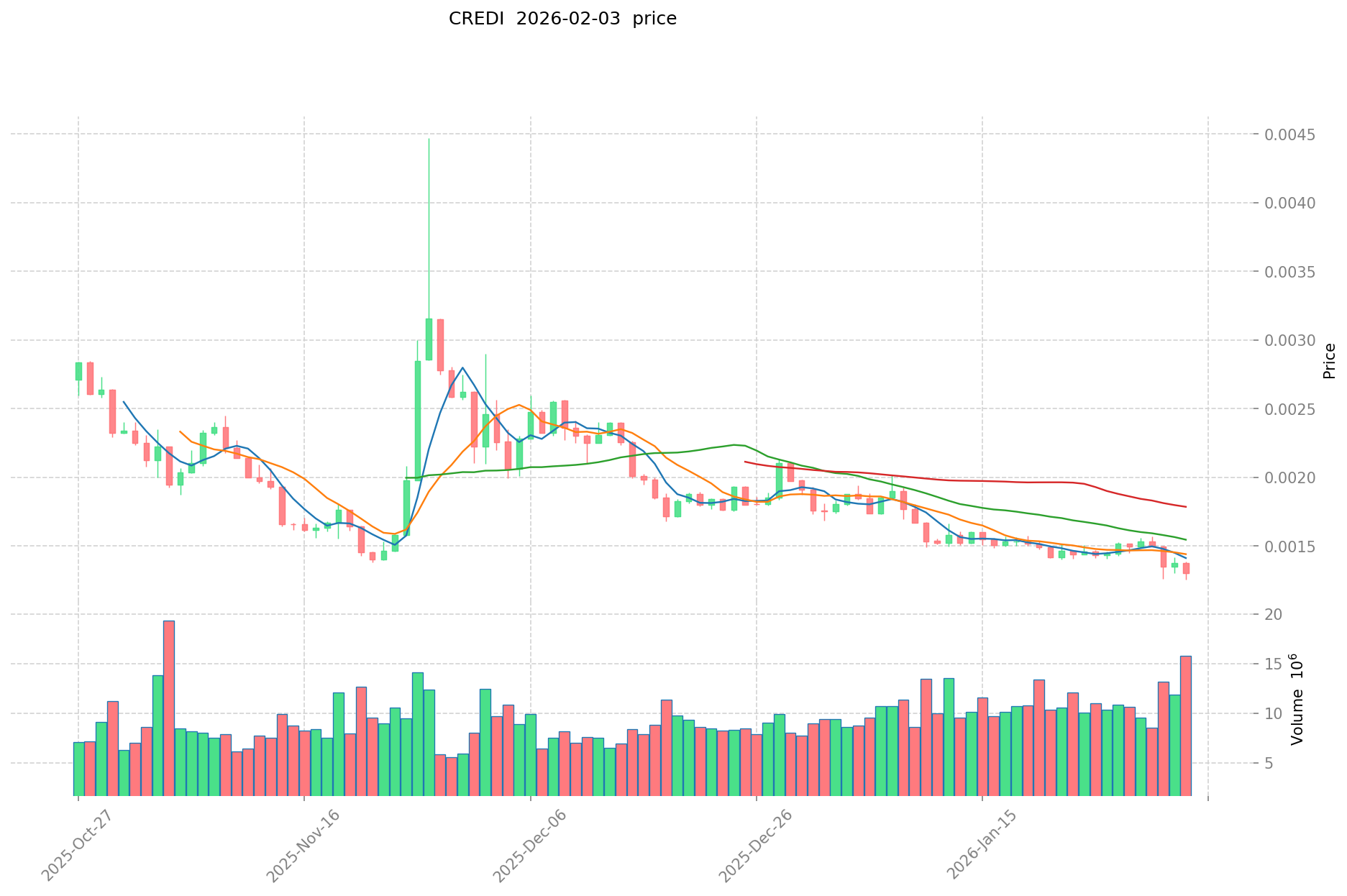
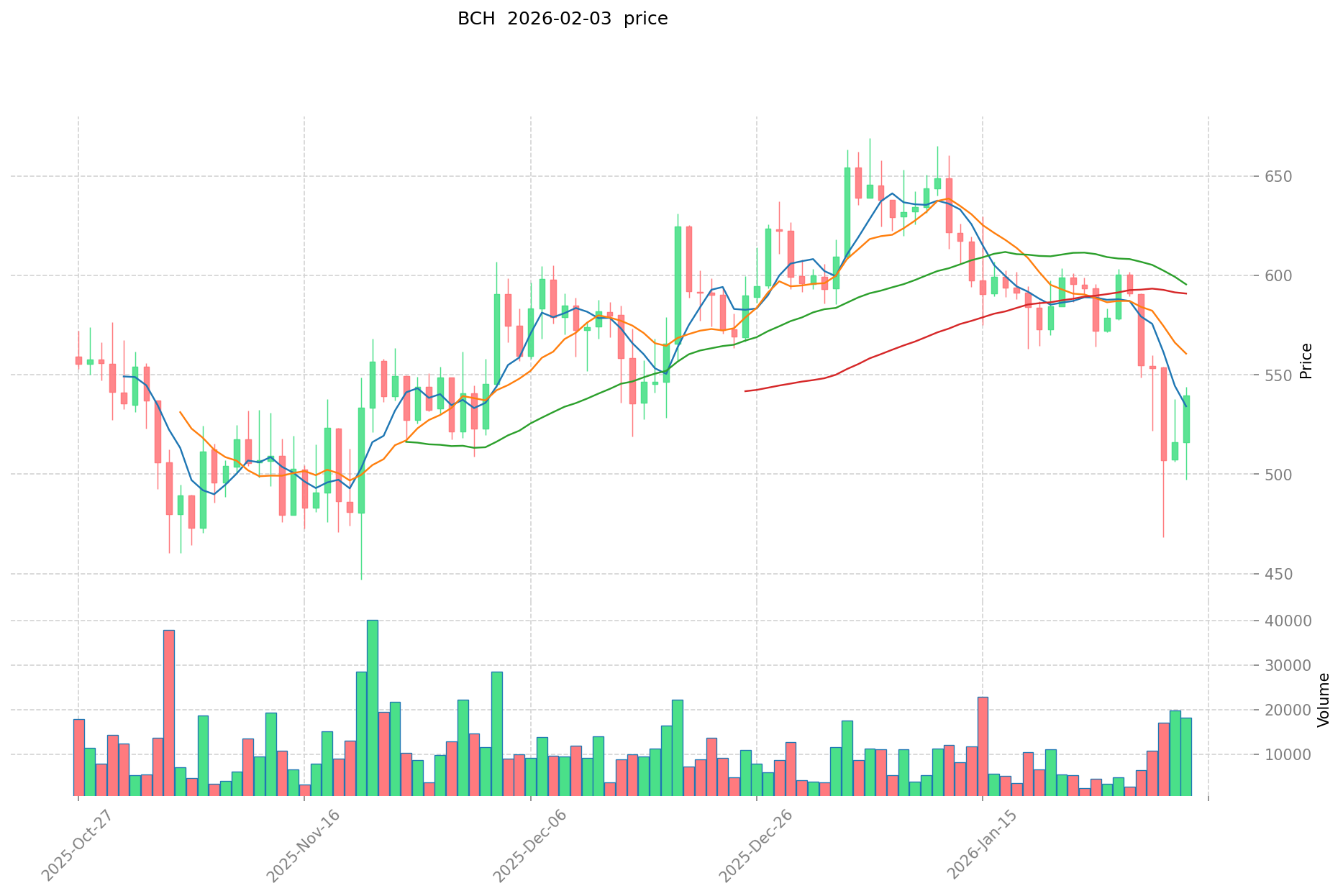
CREDI (Coin A) and BCH (Coin B) Historical Price Trends
- 2017: BCH emerged from a Bitcoin hard fork, launching at approximately $555.89 and experiencing significant volatility in its early months.
- 2017: BCH reached its all-time high of $3,785.82 on December 20, 2017, during the broader cryptocurrency market rally.
- 2018: BCH declined substantially, recording its all-time low of $76.93 on December 16, 2018, amid a prolonged market downturn.
- 2024: CREDI recorded its all-time high of $0.03456 on May 22, 2024.
- 2026: CREDI reached its all-time low of $0.001255 on February 2, 2026.
- Comparative analysis: During recent market cycles, CREDI has experienced considerable price compression from its peak of $0.03456 to current levels around $0.00131, representing a decline of approximately 96.2%. Meanwhile, BCH has demonstrated relative stability from its 2017 peak, currently trading at $528.59, though this still represents an approximate 86% decline from its historical high.
Current Market Status (February 3, 2026)
- CREDI current price: $0.00131
- BCH current price: $528.59
- 24-hour trading volume: CREDI recorded $20,896.87 compared to BCH's $5,677,421.05
- Market sentiment index (Fear & Greed Index): 17 (Extreme Fear)
- CREDI 24-hour price change: -1.27%
- BCH 24-hour price change: +1.87%
- CREDI market capitalization: $980,631.78
- BCH market capitalization: $10,566,211,757.96
- CREDI circulating supply: 748,573,880 tokens (74.86% of max supply)
- BCH circulating supply: 19,989,428.02 coins (95.19% of max supply)
View real-time prices:
- View CREDI current price Market Price
- View BCH current price Market Price
II. Core Factors Influencing CREDI vs BCH Investment Value
Tokenomics Comparison
- BCH: Bitcoin Cash emerged from Bitcoin's hard fork in August 2017, expanding block size from 1MB to 8MB to enhance scalability and reduce transaction fees. The project maintains Bitcoin's decentralization principles while focusing on payment efficiency.
- 📌 Historical Pattern: BCH's tokenomics centers on improved transaction throughput, though actual average block sizes have rarely exceeded 1MB since 2017, suggesting supply mechanisms alone may not fully drive adoption cycles.
Institutional Adoption and Market Applications
- Market Application: BCH positions itself for instant payment scenarios through larger block capacity, aiming to resolve transaction congestion issues that affect Bitcoin.
- Enterprise Use Cases: BCH finds application in cross-border payment and settlement systems, though widespread enterprise adoption remains limited compared to Bitcoin.
- Regulatory Environment: Different jurisdictions maintain varying regulatory stances toward Bitcoin Cash, with some regions treating it similarly to Bitcoin while others apply distinct compliance requirements.
Technology Development and Ecosystem Building
- BCH Technical Upgrades: Current development work focuses on enhancing scalability, privacy features, and smart contract functionality while preserving Bitcoin's core principles of decentralization and security.
- BCH Technical Evolution: The network experienced a significant hard fork in November 2018, splitting into Bitcoin SV and Bitcoin ABC, with Bitcoin ABC (retaining the BCH ticker) becoming the dominant chain due to greater node count and hash power.
- Ecosystem Comparison: BCH's ecosystem primarily emphasizes payment infrastructure, with relatively limited presence in DeFi, NFT, and advanced smart contract applications compared to more programmable blockchain platforms.
Macroeconomic Factors and Market Cycles
- Performance Context: BCH price movements exhibit narrow-range oscillations with Bollinger Bands compression, suggesting cautious positioning from both bulls and bears awaiting clearer directional signals.
- Market Sentiment Indicators: Technical analysis shows RSI maintaining consolidation trends along ascending trendlines, with recent bounces from lower bounds suggesting potential continuation of similar patterns.
- Influencing Variables: BCH's future price trajectory may be shaped by broader cryptocurrency market trends, technological advancement progress, regulatory developments, and overall investor sentiment toward alternative payment-focused digital assets.
III. 2026-2031 Price Prediction: CREDI vs BCH
Short-term Prediction (2026)
- CREDI: Conservative $0.00080337 - $0.001317 | Optimistic $0.001317 - $0.00177795
- BCH: Conservative $486.83 - $529.16 | Optimistic $529.16 - $645.58
Mid-term Prediction (2028-2029)
- CREDI may enter a gradual accumulation phase, with projected price range of $0.0016946 - $0.002866
- BCH may enter an expansion phase, with projected price range of $663.75 - $1107.44
- Key drivers: institutional capital inflows, ETF developments, ecosystem expansion
Long-term Prediction (2031)
- CREDI: Base scenario $0.001715 - $0.002560 | Optimistic scenario $0.002560 - $0.003456
- BCH: Base scenario $752.60 - $1157.85 | Optimistic scenario $1157.85 - $1215.74
Disclaimer
CREDI:
| Year | Predicted High Price | Predicted Average Price | Predicted Low Price | Price Change |
|---|---|---|---|---|
| 2026 | 0.00177795 | 0.001317 | 0.00080337 | 0 |
| 2027 | 0.00205814175 | 0.001547475 | 0.00088206075 | 18 |
| 2028 | 0.00250590364125 | 0.001802808375 | 0.0016946398725 | 37 |
| 2029 | 0.002865293490806 | 0.002154356008125 | 0.001314157164956 | 64 |
| 2030 | 0.002610217739444 | 0.002509824749465 | 0.00145569835469 | 91 |
| 2031 | 0.003456028680014 | 0.002560021244454 | 0.001715214233784 | 95 |
BCH:
| Year | Predicted High Price | Predicted Average Price | Predicted Low Price | Price Change |
|---|---|---|---|---|
| 2026 | 645.5752 | 529.16 | 486.8272 | 0 |
| 2027 | 781.198908 | 587.3676 | 387.662616 | 11 |
| 2028 | 944.31089052 | 684.283254 | 663.75475638 | 29 |
| 2029 | 1107.4440182736 | 814.29707226 | 480.4352726334 | 54 |
| 2030 | 1354.827468826188 | 960.8705452668 | 739.870319855436 | 81 |
| 2031 | 1215.7414573988187 | 1157.849007046494 | 752.6018545802211 | 119 |
IV. Investment Strategy Comparison: CREDI vs BCH
Long-term vs Short-term Investment Strategies
-
CREDI: May suit investors interested in alternative lending models and real-world asset backing, though the asset has experienced significant price compression from its 2024 peak. The current market positioning suggests a focus on niche FinTech applications connecting crypto lenders with SME borrowers.
-
BCH: May appeal to investors focusing on payment infrastructure and seeking exposure to established cryptocurrency networks with extensive trading history. The asset maintains positioning as a peer-to-peer electronic cash system with emphasis on transaction scalability.
Risk Management and Asset Allocation
-
Conservative investors: Consider diversified exposure across multiple asset classes with limited allocation to speculative positions. CREDI represents a smaller market capitalization asset ($980,631.78) while BCH maintains substantially larger market presence ($10.57 billion).
-
Aggressive investors: Higher-risk portfolios may incorporate assets with greater volatility characteristics, though allocation decisions should reflect individual risk tolerance and investment horizons.
-
Hedging instruments: Portfolio protection strategies may include stablecoin positioning, derivatives exposure, and cross-asset diversification to manage downside risk during market uncertainty.
V. Potential Risk Comparison
Market Risk
-
CREDI: Trading volume of $20,896.87 (24-hour) indicates limited liquidity compared to larger market cap assets. Price volatility remains elevated with 96.2% decline from all-time high, suggesting sensitivity to market sentiment shifts.
-
BCH: Despite larger trading volume ($5,677,421.05 in 24 hours), the asset has experienced approximate 86% decline from 2017 peak levels. Current market sentiment index at 17 (Extreme Fear) may influence short-term price movements.
Technical Risk
-
CREDI: Limited information available regarding network infrastructure and technical development roadmap. Circulating supply represents 74.86% of maximum supply.
-
BCH: The network experienced a significant hard fork in November 2018, resulting in chain split. Average block sizes have rarely exceeded 1MB since 2017 despite 8MB capacity, suggesting actual usage patterns differ from technical capabilities.
Regulatory Risk
- Different jurisdictions maintain varying regulatory frameworks for cryptocurrency assets. BCH treatment varies across regions, with some applying similar compliance requirements as Bitcoin while others impose distinct regulations. Evolving regulatory landscapes may impact both assets differently based on their specific use cases and operational characteristics.
VI. Conclusion: Which Is the Better Buy?
📌 Investment Value Summary:
-
CREDI characteristics: Positioned in alternative lending segment with real-world asset backing focus. Market capitalization of $980,631.78 with circulating supply of 748,573,880 tokens. Price projections for 2031 range from $0.001715 to $0.003456 under base and optimistic scenarios.
-
BCH characteristics: Established payment-focused cryptocurrency with market capitalization of $10.57 billion. Circulating supply represents 95.19% of maximum supply. Price projections for 2031 range from $752.60 to $1,215.74 under base and optimistic scenarios.
✅ Investment Considerations:
-
Newer market participants: May benefit from understanding fundamental differences between smaller market cap assets and established cryptocurrencies. Liquidity considerations and volatility characteristics should inform position sizing decisions.
-
Experienced market participants: Portfolio construction may incorporate both established networks and emerging protocols based on individual investment thesis and risk parameters. Technical analysis and on-chain metrics can provide additional decision-making inputs.
-
Institutional participants: Due diligence frameworks should evaluate regulatory compliance, custody solutions, liquidity depth, and operational infrastructure when considering exposure to either asset class.
⚠️ Risk Disclosure: Cryptocurrency markets exhibit extreme volatility characteristics. This content does not constitute investment advice. Market participants should conduct independent research and consult qualified financial advisors before making investment decisions.
VII. FAQ
Q1: What are the primary differences in market positioning between CREDI and BCH?
CREDI positions itself as an alternative lending FinTech solution connecting crypto lenders with SME borrowers backed by real-world assets, while BCH functions as a scalable peer-to-peer electronic cash system focused on payment infrastructure. CREDI operates in a niche market segment with significantly smaller market capitalization ($980,631.78) compared to BCH's established presence ($10.57 billion). The fundamental distinction lies in their core applications: CREDI targets the intersection of cryptocurrency lending and traditional business finance, whereas BCH emphasizes transaction throughput and payment efficiency as a Bitcoin fork with expanded block capacity from 1MB to 8MB.
Q2: How do the liquidity profiles of CREDI and BCH compare for trading purposes?
BCH demonstrates substantially higher liquidity with 24-hour trading volume of $5,677,421.05 compared to CREDI's $20,896.87. This significant disparity reflects BCH's broader market acceptance and longer operational history since 2017, versus CREDI's launch in 2021. The liquidity difference directly impacts execution capabilities: BCH offers tighter bid-ask spreads and deeper order books, facilitating larger position entries and exits with minimal price impact. CREDI's limited trading volume suggests potential slippage concerns for larger transactions and may require careful order execution strategies to avoid adverse price movements.
Q3: What technical developments distinguish these assets' blockchain infrastructure?
BCH emerged from Bitcoin's August 2017 hard fork, implementing 8MB block sizes to enhance scalability, though actual average block utilization has rarely exceeded 1MB since inception. The network experienced a significant split in November 2018, dividing into Bitcoin SV and Bitcoin ABC (retaining BCH ticker) based on node count and hash power distribution. Current BCH development emphasizes privacy features and smart contract functionality while maintaining decentralization principles. CREDI's technical infrastructure details remain limited in available documentation, with circulating supply representing 74.86% of maximum token allocation. The fundamental architectural difference reflects BCH's focus on payment layer optimization versus CREDI's emphasis on lending protocol mechanics.
Q4: How have price volatility patterns differed between CREDI and BCH historically?
CREDI experienced extreme price compression of approximately 96.2% from its May 2024 all-time high of $0.03456 to its February 2026 low of $0.001255, demonstrating significant volatility characteristics typical of smaller market cap assets. BCH shows comparatively moderate decline of approximately 86% from its December 2017 peak of $3,785.82 to current levels around $528.59, reflecting more established market behavior despite substantial correction. The volatility differential indicates CREDI's greater sensitivity to market sentiment shifts and liquidity constraints, while BCH exhibits relative stability associated with larger trading volumes and broader holder distribution across multiple exchanges and custody solutions.
Q5: What are the projected price trajectories for both assets through 2031?
CREDI price projections for 2031 range from $0.001715 (base scenario low) to $0.003456 (optimistic scenario high), representing potential upside of 164% to 564% from current levels of $0.00131. BCH forecasts indicate range from $752.60 (base scenario low) to $1,215.74 (optimistic scenario high), suggesting potential appreciation of 42% to 130% from current price of $528.59. These projections incorporate assumptions about institutional capital flows, ecosystem expansion, and broader cryptocurrency market cycles. The percentage upside differential reflects CREDI's smaller market capitalization and higher theoretical growth potential versus BCH's established market position with more constrained percentage appreciation expectations.
Q6: What regulatory considerations affect CREDI and BCH differently?
BCH faces varying regulatory treatment across jurisdictions, with some regions applying similar compliance frameworks as Bitcoin while others impose distinct requirements based on its classification as a payment-focused cryptocurrency. The asset's longer operational history provides greater regulatory clarity in established markets. CREDI's positioning in alternative lending connecting cryptocurrency and traditional SME financing may trigger additional regulatory scrutiny related to securities laws, lending regulations, and cross-border financial service compliance depending on operational jurisdictions. The regulatory risk profiles differ fundamentally: BCH primarily navigates cryptocurrency payment regulations, while CREDI must address both digital asset frameworks and traditional financial service requirements applicable to lending activities.
Q7: How do circulating supply dynamics differ between these assets?
CREDI maintains circulating supply of 748,573,880 tokens representing 74.86% of maximum allocation, indicating approximately 25% of total supply remains unissued or held in reserve. BCH circulating supply stands at 19,989,428.02 coins representing 95.19% of maximum supply, demonstrating near-complete token distribution with minimal inflation pressure from new issuance. The supply structure difference impacts dilution considerations: CREDI faces potential downward price pressure if remaining tokens enter circulation without corresponding demand growth, while BCH's mature distribution profile suggests stabilized supply economics. These dynamics influence long-term value accrual mechanics and should inform allocation decisions based on individual sensitivity to future dilution risks.
Q8: What market sentiment indicators currently influence both assets?
The Fear & Greed Index registers 17 (Extreme Fear) as of February 3, 2026, indicating broad cryptocurrency market pessimism affecting both assets. CREDI demonstrated 24-hour price decline of -1.27% while BCH showed positive movement of +1.87%, suggesting divergent short-term sentiment despite overall market caution. Technical indicators for BCH show Bollinger Bands compression and RSI consolidation patterns, suggesting market participants await clearer directional signals before establishing significant positions. The extreme fear reading historically correlates with potential accumulation opportunities, though timing recovery phases requires careful analysis of catalyst developments, institutional positioning changes, and broader macroeconomic conditions affecting risk asset appetite across global markets.
Share
Content
Introduction: CREDI vs BCH Investment Comparison
I. Historical Price Comparison and Current Market Status
II. Core Factors Influencing CREDI vs BCH Investment Value
III. 2026-2031 Price Prediction: CREDI vs BCH
IV. Investment Strategy Comparison: CREDI vs BCH
V. Potential Risk Comparison
VI. Conclusion: Which Is the Better Buy?
VII. FAQ
How to Buy Cryptocurrency


Trending Cryptocurrencies



Bitcoin Fear and Greed Index: Market Sentiment Analysis for 2025

Newbie Must Read: How to Formulate Investment Strategies When Nasdaq Turns Positive in 2025
Bitcoin Market Cap in 2025: Analysis and Trends for Investors

How to Mine Ethereum in 2025: A Complete Guide for Beginners

Best Crypto Wallets 2025: How to Choose and Secure Your Digital Assets

TapSwap Listing Date: What Investors Need to Know in 2025

Comprehensive Guide to Cryptocurrency Mining Profitability

Identifying and Assessing Risks in DeFi Lending Protocols

The most affordable cryptocurrencies for investment

How to Participate in Cryptocurrency Airdrops and Security Measures

What is mobile mining, and can you actually make money from it