This comprehensive analysis compares CREDI, an alternative lending FinTech platform connecting crypto lenders with SME borrowers through real-world asset backing, against SOL, a high-performance blockchain infrastructure launched by former Qualcomm and Intel engineers. The article examines critical investment factors including historical price trends, where CREDI declined 96.4% from its peak while SOL maintains higher stability with $58.77 billion market cap versus CREDI's $1.01 million. Key differences emerge in tokenomics, institutional adoption, and ecosystem development, with SOL demonstrating extensive DeFi, gaming, and consumer application integration across a mature ecosystem. The comparison addresses liquidity disparities, technical architecture advantages, regulatory considerations, and macroeconomic influences affecting both assets. Investment recommendations stratify by experience level, providing allocation guidance for conservative and aggressive investors, while forecasting trajectories through
Introduction: Investment Comparison Between CREDI and SOL
In the cryptocurrency market, the comparison between CREDI vs SOL has become an important consideration for investors. The two assets differ significantly in market cap ranking, application scenarios, and price performance, representing distinct positioning within the crypto asset landscape.
Credefi (CREDI): Launched in December 2021, this alternative lending FinTech solution aims to bridge crypto lenders and SME borrowers from the real economy, backed by real-world assets including real estate and future receivables.
Solana (SOL): Established in March 2020 by former engineers from Qualcomm, Intel and Dropbox, it has positioned itself as a high-performance blockchain protocol focused on providing scalability without compromising decentralization or security.
This article will comprehensively analyze the CREDI vs SOL investment value comparison through historical price trends, supply mechanisms, institutional adoption, technical ecosystem and future outlook, attempting to address investors' most pressing question:
"Which is the better buy right now?"
I. Historical Price Comparison and Current Market Status
CREDI (Coin A) and SOL (Coin B) Historical Price Trends
- 2020: CREDI launched through a public auction at $0.014 in December 2021, experiencing initial market establishment phase.
- 2020: SOL launched through a public auction at $0.22 in March 2020, with price fluctuating between $0.50 and $1.5 during the first three months, reaching a peak of $4.735 in August 2020.
- 2021: SOL experienced significant growth with over 2,500% increase in the first quarter, reaching a peak of $253 in November 2021 during the broader crypto market bull run.
- 2024-2025: CREDI reached its all-time high of $0.03456 on May 22, 2024, while SOL achieved its historical peak of $293.31 on January 19, 2025.
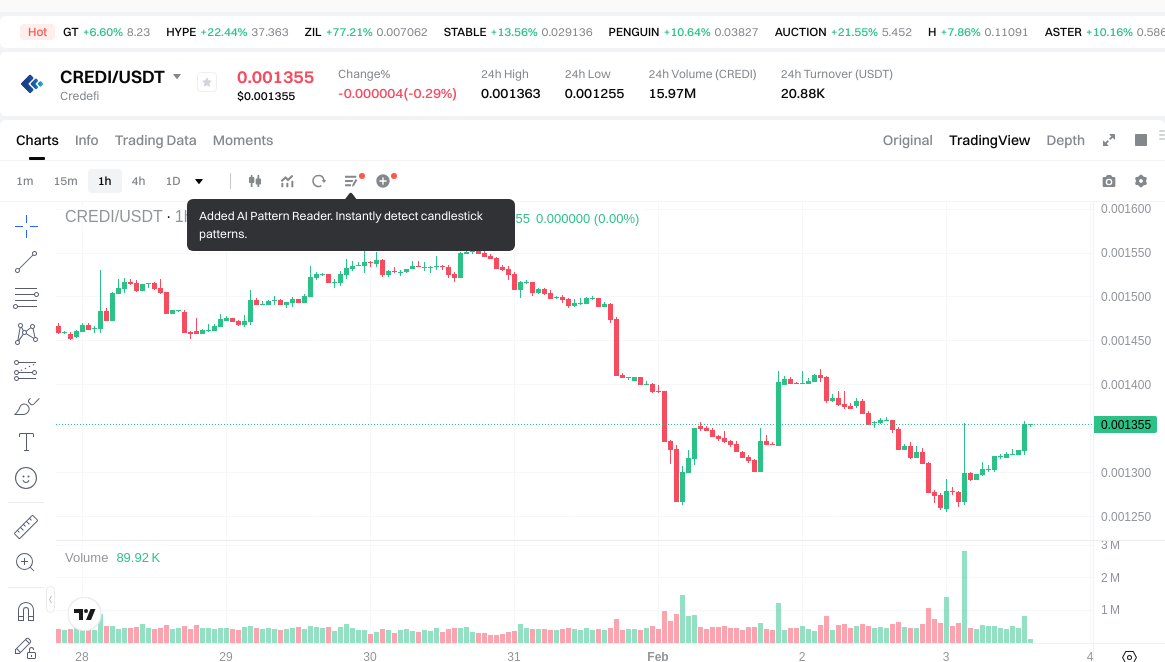
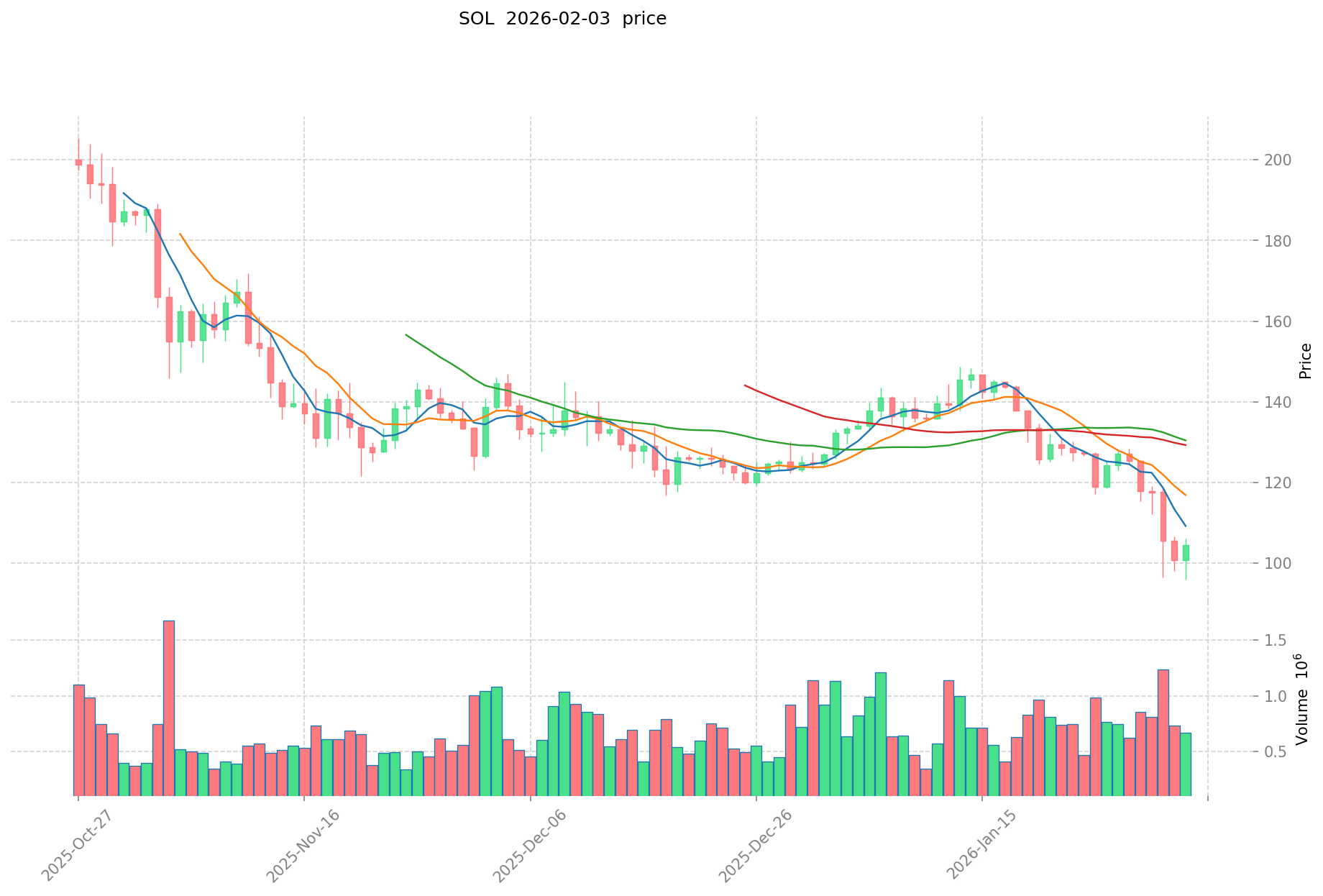
- Comparative Analysis: During recent market cycles, CREDI declined from its all-time high of $0.03456 to its all-time low of $0.001255 (recorded on February 2, 2026), representing a decline of approximately 96.4%. In contrast, SOL decreased from its peak of $293.31 to current levels, showing relatively different volatility patterns.
Current Market Status (February 3, 2026)
- CREDI current price: $0.001355
- SOL current price: $103.75
- 24-hour trading volume: CREDI $20,884.59 vs SOL $55,932,375.97
- Market capitalization: CREDI $1.01 million vs SOL $58.77 billion
- Market sentiment index (Fear & Greed Index): 17 (Extreme Fear)
View real-time prices:
II. Core Factors Influencing CREDI vs SOL Investment Value
Supply Mechanism Comparison (Tokenomics)
- SOL: Solana employs an inflationary supply model with staking rewards distributed to validators and delegators. The network initially had an inflation rate that decreases over time according to a predetermined schedule, designed to incentivize network security while gradually reducing new token issuance.
- CREDI: Information regarding CREDI's specific supply mechanism was not available in the provided materials.
- 📌 Historical Pattern: Supply mechanisms play a role in shaping price cycle dynamics, with deflationary or fixed-supply models potentially creating scarcity-driven value appreciation, while inflationary models may distribute rewards to network participants but require sustained demand to maintain price stability.
Institutional Adoption and Market Application
- Institutional Holdings: SOL has attracted attention from investment funds and venture capital firms focused on blockchain infrastructure, with Gate Ventures and similar entities supporting Solana ecosystem development.
- Enterprise Adoption: SOL has been integrated into various applications spanning DeFi protocols, consumer applications, gaming platforms, and decentralized physical infrastructure networks (DePin). The blockchain's high throughput capacity positions it for consumer-facing applications and payment use cases. Information on CREDI's enterprise adoption was not available in the reference materials.
- National Policy: Regulatory approaches toward blockchain platforms vary across jurisdictions, with some regions embracing innovation while others maintain cautious oversight. The materials did not provide specific comparative policy information for CREDI versus SOL.
Technology Development and Ecosystem Building
- SOL Technology Upgrades: Solana's technical architecture incorporates Proof of History (POH) for transaction ordering, Tower BFT consensus mechanism, Turbine data propagation protocol, and Solana Virtual Machine (SVM) with parallel execution capabilities. These components aim to achieve high transaction throughput and low latency. The ecosystem has shown growth across DeFi, infrastructure, GameFi/NFT, DePin/AI, and consumer application sectors. Development continues in areas such as network stability optimization, transaction success rate improvement, and state growth management.
- CREDI Technology Development: The reference materials did not contain information regarding CREDI's technical architecture or development roadmap.
- Ecosystem Comparison: Solana's ecosystem demonstrates activity in DeFi protocols with notable total value locked metrics, infrastructure projects including MEV solutions (such as Jito Labs), mobile integration efforts, and consumer-oriented applications. The platform provides SDK support for developers building decentralized applications. CREDI's ecosystem positioning was not detailed in the available materials.
Macroeconomic Environment and Market Cycles
- Performance in Inflationary Environments: Digital assets with established market presence and utility-driven demand may demonstrate resilience during periods of monetary expansion. The materials noted that alternative assets, including certain cryptocurrencies, have been considered by some market participants as portfolio diversification components during periods of macroeconomic uncertainty.
- Macroeconomic Monetary Policy: Interest rate adjustments, central bank policy shifts, and currency strength fluctuations influence capital flows across asset classes. The materials referenced a global trend of monetary policy easing in 2024, which contributed to financial market momentum. Changes in policy direction may affect risk asset valuations, including blockchain platform tokens.
- Geopolitical Factors: Cross-border transaction requirements, international regulatory coordination, and regional policy frameworks shape the operational environment for blockchain networks. The materials highlighted that geopolitical dynamics and policy uncertainty characterized the outlook for 2025, potentially impacting market volatility and asset allocation strategies.
III. 2026-2031 Price Forecast: CREDI vs SOL
Short-term Forecast (2026)
- CREDI: Conservative $0.00104335 - $0.001355 | Optimistic $0.001355 - $0.00201895
- SOL: Conservative $94.852 - $103.1 | Optimistic $103.1 - $115.472
Mid-term Forecast (2028-2029)
- CREDI may enter a consolidation phase, with projected price range of $0.00107898921 - $0.0030477295224
- SOL may enter a growth phase, with projected price range of $60.5280511 - $147.711285458
- Key drivers: institutional capital inflows, ETF developments, ecosystem expansion
Long-term Forecast (2031)
- CREDI: Baseline scenario $0.002080659547196 - $0.003059793451759 | Optimistic scenario $0.003059793451759 - $0.00342696866597
- SOL: Baseline scenario $162.3886937399232 - $169.15488931242 | Optimistic scenario $169.15488931242 - $211.443611640525
View detailed price predictions for CREDI and SOL
Disclaimer
CREDI:
| Year |
Predicted High Price |
Predicted Average Price |
Predicted Low Price |
Price Change |
| 2026 |
0.00201895 |
0.001355 |
0.00104335 |
0 |
| 2027 |
0.0024629835 |
0.001686975 |
0.00123149175 |
24 |
| 2028 |
0.00215797842 |
0.00207497925 |
0.00107898921 |
53 |
| 2029 |
0.0030477295224 |
0.002116478835 |
0.00192599573985 |
56 |
| 2030 |
0.003537482724819 |
0.0025821041787 |
0.001316873131137 |
90 |
| 2031 |
0.00342696866597 |
0.003059793451759 |
0.002080659547196 |
125 |
SOL:
| Year |
Predicted High Price |
Predicted Average Price |
Predicted Low Price |
Price Change |
| 2026 |
115.472 |
103.1 |
94.852 |
0 |
| 2027 |
119.12174 |
109.286 |
60.1073 |
5 |
| 2028 |
140.4707601 |
114.20387 |
60.5280511 |
10 |
| 2029 |
147.711285458 |
127.33731505 |
119.697076147 |
22 |
| 2030 |
200.78547837084 |
137.524300254 |
104.51846819304 |
32 |
| 2031 |
211.443611640525 |
169.15488931242 |
162.3886937399232 |
63 |
IV. Investment Strategy Comparison: CREDI vs SOL
Long-term vs Short-term Investment Strategies
- CREDI: May appeal to investors with higher risk tolerance seeking exposure to alternative lending solutions bridging cryptocurrency and real economy sectors, though limited ecosystem information and lower liquidity present considerations for portfolio allocation.
- SOL: May suit investors interested in established blockchain infrastructure with demonstrated ecosystem activity across DeFi, consumer applications, and developer tooling, seeking exposure to platforms with higher transaction throughput capabilities.
Risk Management and Asset Allocation
- Conservative Investors: CREDI 5-10% vs SOL 15-25% allocation within cryptocurrency portfolio segments, with remainder in diversified digital assets and stable value instruments.
- Aggressive Investors: CREDI 15-25% vs SOL 30-40% allocation within cryptocurrency portfolio segments, reflecting higher conviction in growth potential with corresponding volatility acceptance.
- Hedging Tools: Stablecoin reserves for market downturn protection, options contracts for directional exposure management, cross-asset correlation analysis for portfolio diversification.
V. Potential Risk Comparison
Market Risk
- CREDI: Lower market capitalization ($1.01 million) and trading volume ($20,884.59 daily) present liquidity constraints, wider bid-ask spreads, and potential price impact from modest transaction sizes. Historical volatility patterns show significant drawdowns from peak valuations.
- SOL: Market capitalization of $58.77 billion with daily trading volume of $55,932,375.97 indicates higher liquidity, though price movements remain subject to broader cryptocurrency market cycles, ecosystem development progress, and competitive positioning among Layer 1 platforms.
Technical Risk
- CREDI: Limited information regarding technical architecture, development roadmap, and network security measures requires additional due diligence before investment consideration.
- SOL: Network stability considerations include historical outage incidents requiring protocol upgrades, transaction success rate optimization efforts, and state growth management as ecosystem usage scales. Validator decentralization metrics and consensus mechanism resilience represent ongoing development focuses.
Regulatory Risk
- Jurisdictional frameworks for digital assets continue evolving, with varying approaches to token classification, trading platform oversight, and cross-border transaction monitoring. Both assets face exposure to policy shifts affecting market access, institutional participation parameters, and compliance requirements. Real-world asset integration features in CREDI's model may encounter additional regulatory considerations in lending and securities frameworks.
VI. Conclusion: Which Is the Better Buy?
📌 Investment Value Summary:
- CREDI Advantages: Positions within the alternative lending sector connecting cryptocurrency liquidity with real economy borrowing needs, backed by tangible asset collateral models. Early-stage project characteristics may present asymmetric return profiles for risk-tolerant investors.
- SOL Advantages: Established blockchain infrastructure with demonstrated ecosystem activity across multiple verticals, technical architecture emphasizing high throughput and low latency, institutional attention from venture capital and development funds, SDK availability for application builders, and diversified use case adoption spanning financial services, consumer applications, and infrastructure solutions.
✅ Investment Recommendations:
- New Investors: Consider beginning cryptocurrency exposure with more established assets demonstrating liquidity depth, ecosystem maturity, and information availability. SOL may align with this profile compared to CREDI, though all digital asset investments require thorough research and risk assessment appropriate to individual circumstances.
- Experienced Investors: Portfolio construction may incorporate both established infrastructure platforms and emerging sector-specific solutions based on conviction levels, risk tolerance, and diversification objectives. Position sizing should reflect liquidity profiles and volatility characteristics of each asset.
- Institutional Investors: Due diligence frameworks encompassing custody solutions, regulatory compliance requirements, counterparty risk assessment, and portfolio mandate alignment remain essential. SOL's market depth and ecosystem development may facilitate institutional allocation parameters, while CREDI's early-stage positioning requires enhanced risk evaluation protocols.
⚠️ Risk Disclosure: Cryptocurrency markets exhibit extreme volatility with potential for significant capital loss. This content does not constitute investment advice, financial guidance, or trading recommendations. Investors should conduct independent research, consult qualified advisors, and assess suitability based on individual financial circumstances and risk tolerance before making investment decisions.
VII. FAQ
Q1: What are the main differences between CREDI and SOL in terms of use cases?
CREDI focuses on alternative lending solutions bridging crypto lenders with SME borrowers backed by real-world assets, while SOL operates as a high-performance blockchain infrastructure supporting diverse applications including DeFi, consumer apps, gaming, and decentralized physical infrastructure networks. CREDI represents a specialized financial service sector targeting real economy integration through asset-backed lending, whereas SOL provides foundational blockchain technology designed for scalability and high throughput across multiple industry verticals. This fundamental difference positions CREDI as a niche financial product and SOL as a platform infrastructure with broader ecosystem applicability.
Q2: How does the liquidity profile differ between CREDI and SOL?
SOL demonstrates significantly higher liquidity with $55.93 million in daily trading volume and $58.77 billion market capitalization compared to CREDI's $20,884.59 daily volume and $1.01 million market cap. This substantial disparity means SOL investors can execute larger transactions with minimal price impact and tighter bid-ask spreads, while CREDI's limited liquidity presents challenges including wider spreads, potential slippage on modest trade sizes, and difficulty exiting positions during market stress. The liquidity differential reflects SOL's established market presence versus CREDI's early-stage positioning.
Q3: Which asset experienced greater price volatility from its all-time high?
CREDI exhibited more extreme volatility with a 96.4% decline from its all-time high of $0.03456 (May 22, 2024) to its all-time low of $0.001255 (February 2, 2026). While both assets experienced significant drawdowns during market corrections, CREDI's smaller market capitalization and lower liquidity amplified price swings, creating more pronounced volatility patterns. SOL's larger ecosystem and higher trading volumes provided relative stability compared to CREDI's price movements, though both remain subject to cryptocurrency market cyclicality and sentiment shifts.
Q4: What technical advantages does SOL offer over other blockchain platforms?
SOL implements Proof of History (POH) for efficient transaction ordering, Tower BFT consensus mechanism, Turbine data propagation protocol, and Solana Virtual Machine (SVM) with parallel execution capabilities designed to achieve high transaction throughput and low latency. These technical components aim to address scalability limitations facing earlier blockchain architectures without compromising decentralization. The platform's SDK availability and infrastructure focus have attracted developer activity across DeFi protocols, consumer applications, and infrastructure solutions, establishing an ecosystem with demonstrated real-world adoption metrics.
Q5: What are the primary risk considerations for investing in CREDI?
CREDI presents multiple risk factors including extremely low liquidity ($1.01 million market cap) limiting position exit flexibility, limited publicly available information regarding technical architecture and development roadmap, severe historical price volatility (96.4% decline from peak), minimal ecosystem visibility compared to established platforms, and early-stage project risks associated with operational execution and market adoption. Additionally, CREDI's focus on real-world asset integration may encounter regulatory considerations in lending and securities frameworks across different jurisdictions. These factors require enhanced due diligence and appropriate risk tolerance assessment.
Q6: How might macroeconomic conditions affect CREDI versus SOL differently?
SOL's established market presence and utility-driven demand across multiple ecosystem verticals may provide relative resilience during macroeconomic shifts, benefiting from diversified use cases and institutional attention. CREDI's concentrated focus on alternative lending connecting crypto and real economy sectors creates exposure to credit market conditions, real estate valuations, and SME borrowing demand patterns. During monetary policy tightening, CREDI's lending-focused model may face headwinds from reduced borrowing activity, while SOL's infrastructure positioning could benefit from enterprise blockchain adoption trends seeking operational efficiency solutions regardless of credit cycles.
Q7: What allocation strategy is appropriate for conservative versus aggressive investors?
Conservative investors might consider 5-10% CREDI allocation versus 15-25% SOL allocation within cryptocurrency portfolio segments, with remainder in diversified digital assets and stable value instruments, recognizing CREDI's higher risk profile requires limited position sizing. Aggressive investors with higher risk tolerance and longer time horizons might allocate 15-25% CREDI versus 30-40% SOL within crypto portfolios, reflecting conviction in asymmetric return potential while accepting corresponding volatility. All allocations should incorporate hedging tools including stablecoin reserves, options contracts for directional exposure management, and cross-asset correlation analysis for portfolio diversification.
Q8: What are the projected price trajectories for CREDI and SOL through 2031?
CREDI shows conservative 2026 projections of $0.00104335-$0.001355 expanding to long-term 2031 baseline scenario of $0.002080659547196-$0.003059793451759, representing potential growth from current distressed levels but requiring ecosystem development and market adoption. SOL demonstrates conservative 2026 projections of $94.852-$103.1 expanding to long-term 2031 baseline scenario of $162.3886937399232-$169.15488931242, reflecting established infrastructure positioning with ecosystem expansion potential. These projections incorporate assumptions regarding institutional capital inflows, regulatory frameworks, technical development progress, and broader cryptocurrency market cycles, with actual outcomes subject to significant uncertainty and volatility.
* The information is not intended to be and does not constitute financial advice or any other recommendation of any sort offered or endorsed by Gate.