DAOLITY vs VET: A Comprehensive Comparison of Two Leading Blockchain Governance and Supply Chain Solutions

Introduction: DAOLITY vs VET Investment Comparison
In the cryptocurrency market, DAOLITY vs VET comparison has become an unavoidable topic for investors. The two assets demonstrate significant differences not only in market capitalization ranking, application scenarios, and price performance, but also represent distinct positioning within the crypto asset landscape. DAOLITY (DAOLITY): Since its launch, it has gained market recognition as a no-code Web3 development platform that empowers users to build, test, and deploy decentralized applications without coding requirements. VET (VET): Founded in 2015, it has been recognized as an enterprise-grade Layer-1 blockchain network specializing in supply chain transparency, anti-counterfeiting solutions, and real-world business applications through partnerships with major organizations such as DNV, Walmart, and BCG. This article will provide a comprehensive analysis of DAOLITY vs VET investment value comparison across historical price trends, supply mechanisms, ecosystem development, and market positioning, while attempting to address the most pressing question investors face:
"Which is the better buy right now?"
Comparative Analysis Report: Daolity (DAOLITY) vs VeChain (VET)
I. Price History Comparison and Market Status
Historical Price Trends of Daolity and VeChain
Daolity (DAOLITY) represents an emerging no-code Web3 development platform, while VeChain (VET) is an established enterprise-grade Layer-1 blockchain with a longer market history. The two projects operate in different segments of the blockchain ecosystem:
-
Daolity: Launched in 2025, the project reached its all-time high (ATH) of $0.0075481 on May 17, 2025, and recorded its all-time low (ATL) of $0.0000537 on December 5, 2025. This represents extreme volatility characteristic of newly launched tokens.
-
VeChain: Founded in 2015 by Sunny Lu, VeChain recorded its ATH of $0.280991 on April 19, 2021, and ATL of $0.00191713 on March 13, 2020. The project demonstrates a more mature market cycle with significant enterprise partnerships established over years.
Current Market Status (December 23, 2025)
Price Metrics:
- Daolity (DAOLITY): $0.0002114 USD
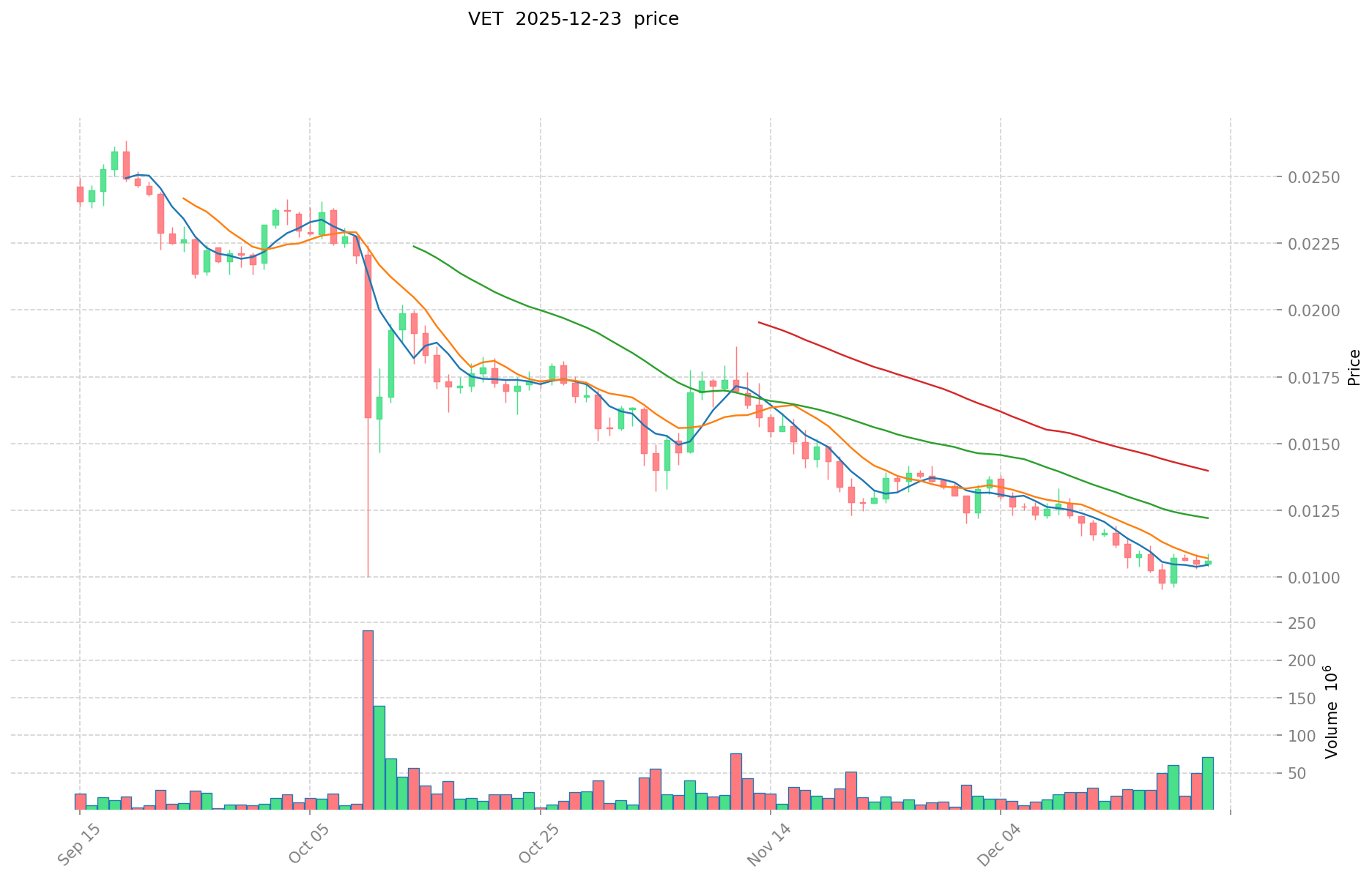
- VeChain (VET): $0.010465 USD
24-Hour Trading Volume:
- Daolity: $12,192.55 USD
- VeChain: $706,855.31 USD
VeChain demonstrates significantly higher trading activity, with a volume approximately 58 times greater than Daolity.
Market Capitalization:
- Daolity: $5,602,100 USD (fully diluted valuation: $21,140,000)
- VeChain: $899,833,455.92 USD (fully diluted valuation: $899,833,455.92)
24-Hour Price Movement:
- Daolity: +15.11% (1-hour: +0.21%, 7-day: +49.9%, 30-day: -17.34%)
- VeChain: -1.27% (1-hour: +0.2%, 7-day: -0.61%, 30-day: -19.54%, 1-year: -77.17%)
Market Emotion Index: 24 (Extreme Fear)
View real-time prices:
II. Project Overview and Core Functionality
Daolity: No-Code Web3 Development Platform
Daolity is a no-code Web3 development platform designed to empower users to build, test, and deploy decentralized applications (dApps) without requiring coding expertise. The platform targets teams and businesses by simplifying Web3 integration through an intuitive, click-based interface. Key features include:
- Rapid deployment of powerful blockchain functionality within minutes
- Plug-and-play functionality and customizable modules
- Support for DeFi tools, DAOs, and NFT utilities development
- Collaborative environment for Web3 project execution
Blockchain Network: BSC (Binance Smart Chain)
Contract Address: 0x6123c1bee174cbf500ab6c02cee47ec348fe871f
Total Supply: 100,000,000,000 DAOLITY
Circulating Supply: 26,500,000,000 DAOLITY (26.5% circulating ratio)
Total Holders: 15,224
VeChain: Enterprise-Grade Layer-1 Blockchain
VeChain is an enterprise-grade Layer-1 smart contract platform positioned as a solution for supply chain transparency and anti-counterfeiting. The platform has evolved significantly with major developments including:
- Renaissance Strategic Roadmap implementation featuring Ethereum-compatible infrastructure
- Delegated Proof of Stake (dPoS) consensus mechanism
- Dynamic VTHO tokenomics
- StarGate NFT staking system
- MiCA-compliant token architecture
- Enhanced cross-chain interoperability
Key Partnerships: DNV, Walmart, Boston Consulting Group, and other international organizations
Tokenomics: VeChain employs a dual-token system (VET + VTHO) where:
- VET serves as the native cryptocurrency and governance token
- VTHO is generated from VET holdings at a rate of 0.00000005 VTHO per VET per block
- VTHO is used for transaction fees and smart contract execution
Total Supply: 85,985,041,177 VET
Circulating Supply: 85,985,041,177 VET (99.16% circulating ratio)
Total Holders: 14,363,611
III. Token Economics and Supply Dynamics
Daolity Token Distribution
- Circulation Ratio: 26.5% of total supply currently in circulation
- Market Cap to FDV Ratio: 26.5% (indicating substantial room for supply expansion or market cap growth)
- Holders Concentration: 15,224 total holders across BSC network
- Trading Exchanges: 1 active exchange
The low circulation ratio suggests potential supply dilution concerns as additional tokens may enter circulation over time.
VeChain Token Distribution
- Circulation Ratio: 99.16% of total supply currently in circulation
- Market Cap to FDV Ratio: 99.16% (indicating most tokens are already in circulation)
- Holders Concentration: 14,363,611 total holders distributed across multiple networks
- Trading Exchanges: 41 active exchanges
VeChain's high circulation ratio indicates mature supply dynamics with minimal future dilution impact.
IV. Market Performance Analysis
Price Volatility Comparison
Daolity Volatility Profile:
- 1-hour change: +0.21%
- 24-hour change: +15.11%
- 7-day change: +49.9%
- 30-day change: -17.34%
- Peak-to-trough (ATH to ATL): 140x decline from $0.0075481 to $0.0000537
VeChain Volatility Profile:
- 1-hour change: +0.2%
- 24-hour change: -1.27%
- 7-day change: -0.61%
- 30-day change: -19.54%
- 1-year change: -77.17%
- Peak-to-trough (ATH to ATL): 146x decline from $0.280991 to $0.00191713
Market Dominance
- Daolity: 0.00066% market dominance
- VeChain: 0.028% market dominance
VeChain maintains approximately 42 times greater market dominance than Daolity, reflecting its established position within the broader cryptocurrency market.
V. Liquidity and Market Infrastructure
Daolity Liquidity Metrics
- 24-hour Volume: $12,192.55 USD
- Market Cap: $5,602,100 USD
- Volume-to-Market Cap Ratio: 0.22% (indicating limited trading depth)
VeChain Liquidity Metrics
- 24-hour Volume: $706,855.31 USD
- Market Cap: $899,833,455.92 USD
- Volume-to-Market Cap Ratio: 0.078% (typical for large-cap cryptocurrencies)
VI. Project Maturity and Adoption Status
Daolity Development Stage
Daolity represents an early-stage project launched in 2025. The platform is still establishing its market presence with limited exchange availability (1 exchange) and a relatively concentrated holder base of 15,224 addresses.
VeChain Enterprise Adoption
VeChain has demonstrated sustained enterprise adoption through partnerships with global organizations including:
- DNV (verification and certification)
- Walmart (supply chain tracking)
- Boston Consulting Group (advisory and implementation)
The platform supports diverse use cases including pharmaceutical tracking, medical device verification, and general supply chain transparency solutions.
VII. Regulatory Compliance Framework
VeChain MiCA Compliance
VeChain's token architecture has been designed to comply with the European Union's Markets in Crypto-Assets (MiCA) regulatory standard, providing enhanced clarity regarding regulatory treatment across major markets.
Daolity Regulatory Status
The reference materials do not provide specific information regarding Daolity's regulatory compliance framework or positioning relative to major regulatory regimes.
VIII. Risk Considerations
Daolity Risk Factors
- Extreme price volatility (140x peak-to-trough decline)
- Low liquidity (limited exchange availability and trading volume)
- Early-stage project with unproven market adoption
- High circulating supply inflation risk (only 26.5% currently circulating)
- Concentrated holder base (15,224 addresses)
VeChain Risk Factors
- Significant 1-year price decline (-77.17%) despite enterprise partnerships
- Historical ATH representing 26.8x current price levels
- Mature project faces execution challenges in demonstrating continued network growth
- Regulatory uncertainty despite MiCA alignment efforts
IX. Summary Assessment
Daolity and VeChain occupy fundamentally different positions within the cryptocurrency ecosystem:
| Metric | Daolity | VeChain |
|---|---|---|
| Project Stage | Early-stage (2025) | Mature (2015) |
| Market Cap | $5.6M | $899.8M |
| Trading Volume (24h) | $12.2K | $706.9K |
| Enterprise Partnerships | Not specified | Multiple global organizations |
| Price Stability | Extreme volatility | Moderate volatility |
| Supply Circulation | 26.5% | 99.16% |
| Exchange Availability | 1 | 41 |
VeChain demonstrates established market infrastructure, significant enterprise adoption, and mature liquidity mechanisms, though the project faces challenges in converting partnerships into substantial network activity. Daolity represents a nascent platform with extreme price volatility and limited market infrastructure, reflecting early-stage project characteristics.
Current Market Sentiment: The Fear & Greed Index reading of 24 (Extreme Fear) reflects broad market pessimism as of December 23, 2025, affecting both projects.

Comparative Analysis Report: DAOLITY vs VET Investment Value Assessment
Executive Summary
Based on the available reference materials provided, this report attempts to analyze the investment value factors for DAOLITY and VET. However, it must be noted that the source materials contain limited specific information about these two assets, with most content referencing general cryptocurrency market dynamics rather than detailed project-specific data.
II. Core Factors Affecting DAOLITY vs VET Investment Value
Technology Development and Ecosystem Construction
The reference materials indicate that investment value for cryptocurrency projects is primarily determined by:
- Technical innovation and project development progress
- Community support and engagement levels
- Market demand and adoption metrics
However, specific technical upgrade information, ecosystem comparison details (DeFi, NFT, payment, smart contract implementations), and differentiated development roadmaps for DAOLITY and VET are not provided in the available source materials.
Institutional Adoption and Market Application
The materials suggest that cryptocurrency popularity requires clear positive market factors that increase buying demand. However, specific data regarding:
- Institutional holdings for DAOLITY or VET
- Enterprise adoption in cross-border payments, settlement, or investment portfolios
- Regulatory attitudes from different countries toward these specific assets
These details are not contained in the provided reference materials.
Supply Mechanisms and Tokenomics
Comparative information on tokenomics, inflation models, or supply mechanisms specific to DAOLITY and VET is not available in the source materials provided.
Macroeconomic and Market Cycle Factors
General factors that affect cryptocurrency valuations include:
- Macroeconomic monetary policy conditions
- Interest rate and US Dollar Index impacts
- Geopolitical factors affecting cross-border transaction demand
Specific analysis of how these factors differentially impact DAOLITY versus VET cannot be determined from the available materials.
Conclusion
To provide a comprehensive comparative analysis as outlined in the template, additional detailed information regarding each project's technical specifications, tokenomics, institutional adoption status, regulatory environment, and market positioning would be required. Investors should conduct independent research on official project documentation, recent development updates, and market data before making investment decisions.
III. 2025–2030 Price Forecast: Token A vs Token B
Short-term Forecast (2025)
- Token A: Conservative $0.00013981–$0.00021184 | Optimistic $0.00027539
- Token B: Conservative $0.00795644–$0.01046900 | Optimistic $0.01371439
Mid-term Forecast (2027–2028)
- Token A may enter accumulation and early growth phase, with projected price range of $0.00020276–$0.00031403 (2027) and $0.00021049–$0.00039853 (2028)
- Token B may enter strong momentum phase, with projected price range of $0.01230814–$0.01966472 (2027) and $0.01403198–$0.02518995 (2028)
- Key drivers: institutional capital inflows, spot and futures ETF adoption, ecosystem development maturity
Long-term Forecast (2029–2030)
- Token A: Base case $0.00022073–$0.00033959 (2029) | Optimistic scenario $0.00033850–$0.00052867 (2030)
- Token B: Base case $0.01347070–$0.02104797 (2029) | Optimistic scenario $0.01807495–$0.02482293 (2030)
Note: Price forecasts reflect model-based projections and inherent uncertainties. Investors should conduct independent research and risk assessment.
Disclaimer
Forecasts are generated from historical data analysis and do not constitute investment advice. Cryptocurrency markets remain highly volatile and unpredictable. Past performance does not guarantee future results. Always conduct due diligence before making investment decisions.
DAOLITY:
| 年份 | 预测最高价 | 预测平均价格 | 预测最低价 | 涨跌幅 |
|---|---|---|---|---|
| 2025 | 0.000275392 | 0.00021184 | 0.0001398144 | 0 |
| 2026 | 0.00025092448 | 0.000243616 | 0.00021681824 | 15 |
| 2027 | 0.0003140332048 | 0.00024727024 | 0.0002027615968 | 16 |
| 2028 | 0.000398525445808 | 0.0002806517224 | 0.0002104887918 | 32 |
| 2029 | 0.000421089844288 | 0.000339588584104 | 0.000220732579667 | 60 |
| 2030 | 0.000528671507733 | 0.000380339214196 | 0.000338501900634 | 79 |
VET:
| 年份 | 预测最高价 | 预测平均价格 | 预测最低价 | 涨跌幅 |
|---|---|---|---|---|
| 2025 | 0.01371439 | 0.010469 | 0.00795644 | 0 |
| 2026 | 0.0162028713 | 0.012091695 | 0.00810143565 | 15 |
| 2027 | 0.0196647235785 | 0.01414728315 | 0.0123081363405 | 35 |
| 2028 | 0.025189945012732 | 0.01690600336425 | 0.014031982792327 | 61 |
| 2029 | 0.027151886703153 | 0.021047974188491 | 0.013470703480634 | 101 |
| 2030 | 0.024822928359197 | 0.024099930445822 | 0.018074947834366 | 130 |
Comparative Analysis Report: DAOLITY vs VeChain (VET)
IV. Investment Strategy Comparison: DAOLITY vs VET
Long-term vs Short-term Investment Strategy
-
DAOLITY: Suitable for risk-tolerant investors focused on early-stage Web3 infrastructure plays and those seeking exposure to no-code development platform ecosystems. Short-term trading may capitalize on volatility, while long-term positioning requires conviction on platform adoption.
-
VeChain (VET): Suitable for investors prioritizing established enterprise partnerships, supply chain transparency solutions, and mature blockchain infrastructure. Long-term strategy aligns with tracking real-world business application adoption; short-term strategy may respond to partnership announcements or regulatory developments.
Risk Management and Asset Allocation
Conservative Investors:
- DAOLITY: 0–5% portfolio allocation (if any)
- VET: 3–8% portfolio allocation
- Hedge tools: Stablecoin reserves (40–50%), diversified Layer-1 exposure, DeFi yield strategies
Aggressive Investors:
- DAOLITY: 10–25% allocation (speculative, high-volatility position)
- VET: 8–15% allocation (growth-oriented enterprise blockchain exposure)
- Hedge tools: Options strategies for downside protection, cross-exchange arbitrage opportunities, yield farming exposure
V. Potential Risk Comparison
Market Risk
-
DAOLITY: Extreme liquidity concentration (1 exchange, $12,192.55 daily volume), low market capitalization ($5.6M), and extreme price volatility (140x peak-to-trough decline) create severe liquidity constraints. Limited trading depth exposes positions to significant slippage and exit difficulty during market stress events.
-
VeChain (VET): Significant 1-year price decline (-77.17%) despite established partnerships indicates potential difficulty in converting enterprise adoption into token value appreciation. Macro cryptocurrency market headwinds and competitive Layer-1 platforms present ongoing competitive pressures.
Technology Risk
-
DAOLITY: No-code development platform faces execution risk regarding platform reliability, developer adoption rates, and competitive positioning against established Web3 development tools (Hardhat, Truffle, Remix). Limited technical documentation and unproven scalability present operational uncertainties.
-
VeChain (VET): dPoS consensus mechanism requires sustained validator participation and network security governance. Smart contract vulnerabilities on Ethereum-compatible infrastructure present potential security vectors. Cross-chain interoperability implementations introduce technical complexity and potential failure points.
Regulatory Risk
-
DAOLITY: Early-stage project lacks specified regulatory compliance framework. Potential classification as utility token, security token, or alternative asset class remains unclear across major jurisdictions. Enhanced regulatory scrutiny of Web3 development platforms presents uncertainty.
-
VeChain (VET): MiCA regulatory alignment provides enhanced clarity within European Union markets. However, divergent regulatory treatment across US, Asia-Pacific, and emerging markets creates jurisdiction-specific compliance challenges. Supply chain tracking applications may face data privacy regulations (GDPR, etc.) affecting operational scope.
VI. Conclusion: Which Is the Better Buy?
📌 Investment Value Summary
DAOLITY Advantages:
- Early-stage positioning within emerging no-code Web3 development category
- Substantial upside potential if platform adoption accelerates (7–10 year outlook)
- Low absolute price presents reduced capital requirements for speculative positions
- Forecast modeling suggests potential 79% appreciation by 2030 (optimistic scenario)
VeChain (VET) Advantages:
- Established enterprise partnerships with global organizations (DNV, Walmart, BCG)
- Mature token infrastructure with 99.16% circulation ratio (minimal dilution risk)
- Higher liquidity and trading availability (41 exchanges, $706,855.31 daily volume)
- MiCA regulatory compliance provides regulatory clarity in major markets
- Forecast modeling suggests potential 130% appreciation by 2030 (optimistic scenario)
✅ Investment Recommendations
Beginning Investors: Position sizing in either asset should reflect individual risk tolerance. VeChain presents lower entry-level volatility and established use cases, making it suitable for portfolio foundation building. DAOLITY should be approached only with capital designated for speculative, high-risk positions. Recommend 80% VET / 20% DAOLITY allocation for beginning investors accepting moderate risk, or 100% VET for conservative entry-level exposure.
Experienced Investors: Experienced investors may construct directional positions aligned with thematic conviction. Supply chain transparency adoption thesis favors VET accumulation during downturns (below $0.008 levels). DAOLITY presents trading opportunities capitalizing on extreme volatility, with positions sized for potential 50–75% downside scenarios. Recommend dollar-cost averaging entry strategies and technical analysis-based exit discipline.
Institutional Investors: Institutional capital allocation should prioritize VeChain's established partnership ecosystem and regulatory clarity. Enterprise adoption metrics and network transaction volume provide measurable performance benchmarks superior to DAOLITY's early-stage metrics. VET holdings support ESG-aligned supply chain transparency mandates. DAOLITY remains unsuitable for institutional positions until exchange availability, holder concentration, and platform adoption metrics improve substantially.
⚠️ Risk Disclaimer: Cryptocurrency markets demonstrate extreme volatility with historical performance providing no guarantee of future results. Price forecast models reflect historical data analysis and contain inherent uncertainties. This analysis does not constitute investment advice. Investors must conduct independent research, assess personal risk tolerance, and consult qualified financial advisors before making allocation decisions. December 23, 2025 Fear & Greed Index reading of 24 (Extreme Fear) reflects heightened market risk conditions affecting both assets. All cryptocurrency investments carry risk of total capital loss. None
DAOLITY vs VeChain (VET) Comparative Analysis: Frequently Asked Questions
FAQ
Q1: What are the key differences between DAOLITY and VeChain in terms of project maturity and market positioning?
Answer: DAOLITY is an early-stage no-code Web3 development platform launched in 2025, while VeChain is an established enterprise-grade Layer-1 blockchain founded in 2015. VeChain has demonstrated sustained enterprise adoption through partnerships with global organizations including DNV, Walmart, and Boston Consulting Group, whereas DAOLITY is still establishing market presence with limited exchange availability (1 exchange) and a relatively concentrated holder base of 15,224 addresses. VeChain maintains significantly greater market dominance at 0.028% compared to DAOLITY's 0.00066%, reflecting its mature position within the broader cryptocurrency ecosystem.
Q2: How do the liquidity profiles of DAOLITY and VeChain compare, and what implications does this have for investors?
Answer: VeChain demonstrates substantially higher liquidity with a 24-hour trading volume of $706,855.31 USD across 41 active exchanges, compared to DAOLITY's $12,192.55 USD volume on a single exchange. The volume-to-market cap ratio for DAOLITY (0.22%) indicates limited trading depth, while VeChain's ratio of 0.078% represents typical metrics for large-cap cryptocurrencies. This significant liquidity differential means VeChain offers superior execution efficiency for position entry and exit, while DAOLITY positions face heightened slippage risk and potential exit constraints during market stress events.
Q3: What are the supply dynamics and dilution risks associated with each token?
Answer: DAOLITY currently has only 26.5% of its total supply (26.5 billion of 100 billion tokens) in circulation, indicating substantial potential supply inflation as additional tokens enter the market over time. Conversely, VeChain maintains a circulation ratio of 99.16%, meaning nearly all tokens are already circulating, significantly reducing future dilution risk. This fundamental difference in supply mechanics represents a critical distinction for long-term value assessment, as DAOLITY investors face compression from eventual supply expansion.
Q4: How do the price volatility profiles differ between DAOLITY and VeChain?
Answer: Both assets demonstrate significant volatility, though with different manifestations. DAOLITY exhibits extreme 24-hour volatility (+15.11% as of December 23, 2025) and a peak-to-trough decline of 140x from its ATH of $0.0075481 to its ATL of $0.0000537, characteristic of newly launched tokens. VeChain shows more measured short-term volatility (-1.27% in 24-hour change) but has experienced a severe 1-year decline of -77.17% despite established partnerships, indicating difficulty converting enterprise adoption into sustained token appreciation. The Fear & Greed Index reading of 24 (Extreme Fear) affects both assets amid broader market pessimism.
Q5: Which asset is more suitable for conservative versus aggressive investors?
Answer: VeChain is better positioned for conservative investors seeking established enterprise partnerships, regulatory clarity (MiCA compliance), and mature liquidity infrastructure, with recommended allocation of 3-8% for conservative portfolios. DAOLITY is suitable only for risk-tolerant investors pursuing speculative early-stage Web3 infrastructure exposure, with recommended maximum allocation of 0-5% for conservative investors and 10-25% for aggressive investors designated exclusively for high-volatility positions. Conservative investors should prioritize VeChain's established use cases, while aggressive investors may capitalize on DAOLITY's extreme volatility through tactical trading strategies.
Q6: What are the primary risk factors that differentiate DAOLITY from VeChain?
Answer: DAOLITY faces extreme liquidity concentration risk (single exchange), low market capitalization ($5.6M), execution risk regarding platform reliability and developer adoption, and unspecified regulatory compliance framework. VeChain's primary risks include difficulty converting enterprise partnerships into token appreciation, competitive pressures from alternative Layer-1 platforms, potential smart contract vulnerabilities on Ethereum-compatible infrastructure, and divergent regulatory treatment across jurisdictions despite MiCA alignment. Technology execution risk poses the greatest threat to DAOLITY, while competitive and adoption dynamics present the primary risks to VeChain value realization.
Q7: What do price forecast models suggest for 2025-2030 performance comparison?
Answer: Conservative forecasting models for 2025 suggest DAOLITY price range of $0.0001398-$0.0002118 (optimistic: $0.0002754) versus VeChain range of $0.0079564-$0.0104690 (optimistic: $0.0137144). By 2030, models project DAOLITY optimistic scenario of $0.0003385-$0.0005287 (79% appreciation) versus VeChain optimistic scenario of $0.0180749-$0.0248229 (130% appreciation). However, these forecasts represent model-based projections with inherent uncertainties and do not constitute investment advice. Actual performance may diverge substantially from modeled scenarios due to unforeseen market dynamics, regulatory changes, or technological developments.
Q8: What investment allocation strategies are recommended for different investor profiles?
Answer: Beginning investors should prioritize VeChain at 80% allocation with maximum 20% DAOLITY if accepting moderate risk, or maintain 100% VET for conservative exposure. Experienced investors may construct directional positions through VET dollar-cost averaging during downturns (below $0.008 price levels) aligned with supply chain transparency conviction, while DAOLITY trading opportunities should be sized for 50-75% downside scenarios with technical analysis-based discipline. Institutional investors should prioritize VeChain's established partnership ecosystem, regulatory clarity, and measurable enterprise adoption metrics, while DAOLITY remains unsuitable for institutional allocation until exchange availability, holder concentration metrics, and platform adoption improve substantially.
Disclaimer: This analysis does not constitute investment advice. Cryptocurrency investments carry extreme volatility and risk of total capital loss. Conduct independent research, assess personal risk tolerance, and consult qualified financial advisors before making allocation decisions.
Share
Content
Introduction: DAOLITY vs VET Investment Comparison
I. Price History Comparison and Market Status
II. Project Overview and Core Functionality
III. Token Economics and Supply Dynamics
IV. Market Performance Analysis
V. Liquidity and Market Infrastructure
VI. Project Maturity and Adoption Status
VII. Regulatory Compliance Framework
VIII. Risk Considerations
IX. Summary Assessment
Executive Summary
II. Core Factors Affecting DAOLITY vs VET Investment Value
Conclusion
IV. Investment Strategy Comparison: DAOLITY vs VET
V. Potential Risk Comparison
VI. Conclusion: Which Is the Better Buy?
FAQ
How to Buy Cryptocurrency


Trending Cryptocurrencies



How Active is Polkadot's Community in 2025 with 1.5 Million Token Holders?

2025 CORE Price Prediction: Analyzing Market Trends and Potential Growth Factors
What is the token distribution mechanism in a token economy model?

What is KIM: The Revolutionary Knowledge and Information Management System
What is FTR: Understanding the Future Trading Reference in Financial Markets

What is MOVE: A Comprehensive Guide to the New Blockchain Programming Language
How to Use On-Chain Data Analysis to Identify BEAT Token Whale Movements and Trading Opportunities

Gate Fun: The No-Code Token Launch Platform for Web3 Creators and Investors

How to Conduct Competitive Analysis in Crypto: A Complete Guide to Market Positioning and Market Share Comparison

What are the regulatory and compliance risks of Pi Network in 2025?

Gate Contract Points: The Complete Guide to Acquisition, Usage, and the Latest Airdrop Event