DEFI vs SNX: Which Decentralized Finance Protocol Offers Better Yield Farming Opportunities in 2024?

Introduction: Investment Comparison Between DEFI and SNX
In the cryptocurrency market, the comparison between De.Fi vs Synthetix has consistently been a topic of interest for investors. These two projects differ significantly in market capitalization ranking, application scenarios, and price performance, representing distinct positioning within the crypto asset landscape.
De.Fi (DEFI): Launched in 2024, this project positions itself as a Web3 SocialFi and antivirus solution, combining accessibility and gamification with risk mitigation technology to onboard investors into decentralized finance opportunities.
Synthetix (SNX): Established in 2018, this protocol has been recognized as a synthetic asset platform, enabling the creation and trading of derivatives representing various assets including fiat currencies, precious metals, indices, and other cryptocurrencies.
This article will provide a comprehensive analysis of the DEFI vs SNX investment value comparison, covering historical price trends, supply mechanisms, technical ecosystems, and future outlook, while addressing investors' most pressing question:
"Which is the better buy right now?"
I. Historical Price Comparison and Market Status
Historical Price Trends of DEFI (Coin A) and SNX (Coin B)
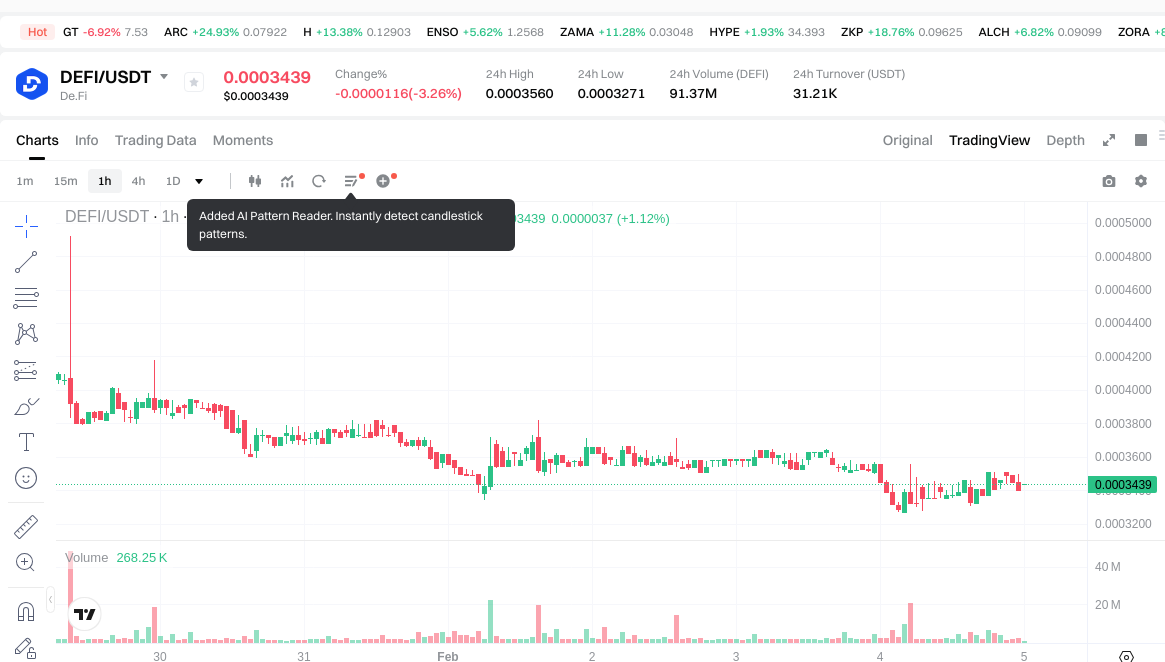
- 2024: DEFI reached its all-time high of $1.09 on January 31, 2024, following its initial listing at $0.2 in January 2024.
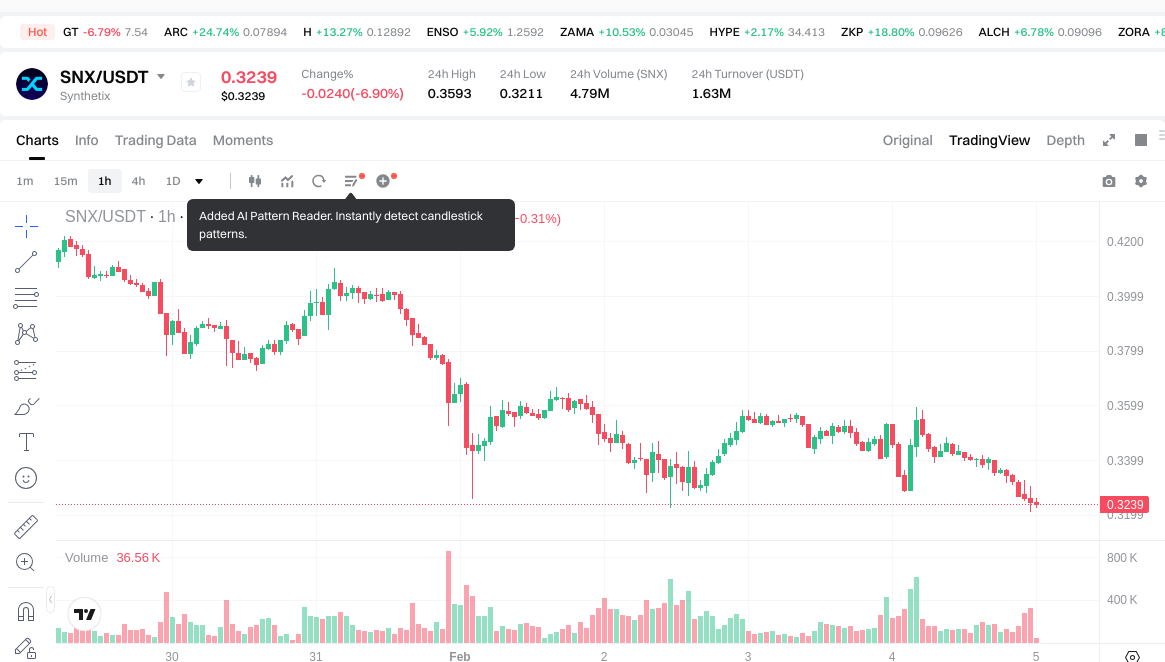
- 2021: SNX experienced significant price movements, reaching its historical peak of $28.53 on February 14, 2021, driven by growing DeFi adoption.
- 2026: DEFI recorded its all-time low of $0.0003271 on February 3, 2026, while SNX continued to trade substantially below its peak.
- Comparative Analysis: During the recent market downturn, DEFI declined from its high of $1.09 to approximately $0.0003401, representing a substantial correction, while SNX dropped from $28.53 to around $0.3237, maintaining relatively higher price levels despite similar downward pressure.
Current Market Situation (February 5, 2026)
- DEFI current price: $0.0003401
- SNX current price: $0.3237
- 24-hour trading volume: DEFI $31,225.79 vs SNX $1,640,117.31
- Market Sentiment Index (Fear & Greed Index): 14 (Extreme Fear)
- Recent performance: DEFI declined 4.33% over 24 hours, while SNX decreased 7.96% in the same period.
- Weekly performance: DEFI down 14.89%, SNX down 20.71%
- Annual performance: DEFI down 98.95%, SNX down 74.24%
View real-time prices:
- Check DEFI current price Market Price
- Check SNX current price Market Price
II. Core Factors Influencing DEFI vs SNX Investment Value
Supply Mechanism Comparison (Tokenomics)
-
SNX: The token operates within a collateralization model where users lock SNX tokens in a debt pool to mint synthetic assets. The collateralization ratio directly affects the relationship between locked SNX quantity and the value of synthetic assets that can be obtained. Maintaining an appropriate collateralization ratio is essential for the protocol's stability.
-
📌 Historical Pattern: Supply mechanisms and collateralization dynamics influence price cycles through liquidity requirements and debt pool participation rates.
Institutional Adoption and Market Application
-
DeFi Market Application: DeFi protocols enable users to provide capital in exchange for value streams, either through protocol-native rewards such as governance tokens from liquidity mining, or external rewards paid in stablecoins and other crypto assets (ETH, BTC, etc.).
-
Competitive Landscape: The DeFi derivatives sector shows intense competition. Synthetix faces competition from established protocols like dYdX and emerging platforms such as AEVO and Hyperliquid, which have gained considerable trading volume and exposure. Jupiter Perp on Solana has achieved comparable TVL and exceeded trading volumes using similar mechanisms. Common trading mining incentives reduce user switching costs, resulting in generally low user loyalty.
Technology Development and Ecosystem Construction
-
Synthetix Technology: The core business logic of the "dynamic debt pool" has been validated over more than two years. Under the dynamic debt pool mechanism, Synthetix has the potential to achieve "unlimited liquidity for unlimited trading pairs," demonstrating stronger network effects.
-
DeFi Ecosystem Development: The DeFi sector encompasses a six-layer stack including atomic value units, transaction layers, price oracles, underlying DeFi products, protocol aggregators, and wallets/frontends. Smart contracts define the trading rules and user experience of financial products, with the entire lifecycle (including ownership, custody, maintenance, execution, and settlement) managed on-chain.
-
Synthetic Assets: In decentralized finance, synthetic assets operate through blockchain and distributed ledger technology. As crypto-native financial derivatives, synthetic assets can accurately track real-world asset market prices through smart contracts.
Macroeconomic and Market Cycles
-
Market Cycle Drivers: The current upward momentum can be attributed to a transmission path where the market entering a bull cycle drives increased liquidity demand, which in turn pushes up base lending rate levels. This mechanism directly impacts DeFi protocol valuations and sector rotation patterns.
-
Liquidity Environment: Market liquidity needs during bull cycles create favorable conditions for DeFi protocols, particularly affecting borrowing rates and collateral requirements that influence protocol participation and token value.
III. 2026-2031 Price Prediction: DEFI vs SNX
Short-term Forecast (2026)
- DEFI: Conservative $0.000202901 - $0.0003439 | Optimistic $0.0003439 - $0.000495216
- SNX: Conservative $0.29097 - $0.3233 | Optimistic $0.3233 - $0.38796
Mid-term Forecast (2028-2029)
- DEFI may enter a consolidation phase with projected price range of $0.000407528 - $0.0006269665 by 2029, showing gradual growth momentum
- SNX may experience moderate expansion with estimated range of $0.27859236 - $0.532603046 by 2029, reflecting broader market dynamics
- Key drivers: institutional capital flows, ETF developments, ecosystem expansion
Long-term Forecast (2030-2031)
- DEFI: Baseline scenario $0.000458855 - $0.000665008 | Optimistic scenario $0.000665008 - $0.000738159
- SNX: Baseline scenario $0.367354757 - $0.532398199 | Optimistic scenario $0.532398199 - $0.559018109
Disclaimer
DEFI:
| Year | Predicted High Price | Predicted Average Price | Predicted Low Price | Price Change |
|---|---|---|---|---|
| 2026 | 0.000495216 | 0.0003439 | 0.000202901 | 1 |
| 2027 | 0.00061675026 | 0.000419558 | 0.00031886408 | 23 |
| 2028 | 0.0007357788646 | 0.00051815413 | 0.0004559756344 | 52 |
| 2029 | 0.000645775492219 | 0.0006269664973 | 0.000407528223245 | 84 |
| 2030 | 0.000693644384287 | 0.000636370994759 | 0.000591825025126 | 87 |
| 2031 | 0.000738158535371 | 0.000665007689523 | 0.000458855305771 | 95 |
SNX:
| Year | Predicted High Price | Predicted Average Price | Predicted Low Price | Price Change |
|---|---|---|---|---|
| 2026 | 0.38796 | 0.3233 | 0.29097 | 0 |
| 2027 | 0.3662989 | 0.35563 | 0.2027091 | 9 |
| 2028 | 0.4584248515 | 0.36096445 | 0.339306583 | 11 |
| 2029 | 0.532603045975 | 0.40969465075 | 0.27859236251 | 26 |
| 2030 | 0.59364754893675 | 0.4711488483625 | 0.34865014778825 | 45 |
| 2031 | 0.559018108582106 | 0.532398198649625 | 0.367354757068241 | 64 |
IV. Investment Strategy Comparison: DEFI vs SNX
Long-term vs Short-term Investment Strategies
- DEFI: Suitable for risk-tolerant investors focused on emerging SocialFi concepts and early-stage project exposure, primarily oriented toward short-term speculative positioning given the substantial price volatility and limited market maturity
- SNX: Suitable for investors seeking exposure to established DeFi infrastructure with proven protocol mechanics, more aligned with medium-to-long-term positioning given the mature synthetic asset framework and multi-year operational track record
Risk Management and Asset Allocation
- Conservative investors: DEFI 5-10% vs SNX 15-25%
- Aggressive investors: DEFI 15-25% vs SNX 30-40%
- Hedging instruments: stablecoin allocation (20-30% portfolio weight), options strategies for downside protection, cross-asset diversification across DeFi protocols
V. Potential Risk Comparison
Market Risk
- DEFI: Exposure to extreme volatility evidenced by the 98.95% annual decline, limited liquidity with 24-hour trading volume of $31,225.79, susceptibility to rapid devaluation during adverse market conditions
- SNX: Subject to DeFi sector rotation dynamics, competitive pressure from protocols including dYdX, AEVO, Hyperliquid, and Jupiter Perp, correlation with broader crypto market cycles affecting synthetic asset demand
Technical Risk
- DEFI: Scalability challenges for Web3 SocialFi infrastructure, network stability concerns for newer protocol architecture, limited operational history for stress-testing during extreme market conditions
- SNX: Collateralization ratio management complexity, debt pool mechanism vulnerabilities during liquidity crises, smart contract risks inherent in synthetic asset minting and settlement processes
Regulatory Risk
- Global regulatory frameworks may impact both projects differently: DEFI faces uncertainty regarding SocialFi classification and consumer protection requirements, while SNX encounters scrutiny related to synthetic derivatives offering and securities law applicability across jurisdictions
VI. Conclusion: Which Is the Better Buy?
📌 Investment Value Summary:
- DEFI advantages: Early positioning in emerging SocialFi narrative, potential for asymmetric returns if adoption materializes, low absolute price point enabling larger position sizing
- SNX advantages: Established protocol with validated business logic spanning multiple market cycles, proven synthetic asset infrastructure with "unlimited liquidity for unlimited trading pairs" potential, stronger network effects from mature ecosystem
✅ Investment Recommendations:
- Novice investors: Consider SNX for initial DeFi exposure given operational track record and established infrastructure, limit allocation to 5-10% of portfolio with emphasis on risk education
- Experienced investors: Evaluate tactical allocation to DEFI (5-15%) for high-risk/high-reward exposure while maintaining core SNX position (15-25%) for DeFi infrastructure exposure, implement systematic rebalancing protocols
- Institutional investors: Prioritize SNX (20-30% of crypto allocation) for established DeFi derivatives exposure, conduct thorough due diligence on DEFI protocol economics before considering minor tactical positions
⚠️ Risk Disclosure: Cryptocurrency markets exhibit extreme volatility. This content does not constitute investment advice.
VII. FAQ
Q1: Which cryptocurrency has better long-term investment potential - DEFI or SNX?
SNX demonstrates stronger long-term investment potential due to its established protocol infrastructure and proven track record. SNX has operated successfully since 2018 with validated "dynamic debt pool" mechanics that enable unlimited liquidity for unlimited trading pairs, showcasing robust network effects. The protocol has weathered multiple market cycles, maintaining functionality during both bull and bear markets. In contrast, DEFI launched only in 2024 and has experienced a 98.95% annual decline with limited operational history. For long-term investors prioritizing protocol maturity and proven business logic, SNX offers more sustainable value proposition despite both assets facing current market headwinds.
Q2: What are the primary risks associated with investing in DEFI compared to SNX?
DEFI carries significantly higher risk across multiple dimensions. The primary concerns include extreme volatility (evidenced by the drop from $1.09 to $0.0003401), severely limited liquidity with only $31,225.79 in 24-hour trading volume, and lack of operational track record for stress-testing during adverse conditions. SNX, while also subject to market risks, benefits from established infrastructure and $1,640,117.31 in daily trading volume. However, SNX faces specific technical risks including collateralization ratio management complexity and debt pool vulnerabilities during liquidity crises. Both projects face regulatory uncertainty, but DEFI's SocialFi classification adds additional compliance ambiguity compared to SNX's more defined DeFi derivatives positioning.
Q3: How do the tokenomics and supply mechanisms differ between DEFI and SNX?
SNX operates a sophisticated collateralization model where users lock SNX tokens in a debt pool to mint synthetic assets, creating direct utility and value capture mechanisms. The collateralization ratio requirements directly influence protocol stability and token demand, establishing clear economic incentives for participation. This mechanism has been validated over multiple years and creates sustainable token value through protocol usage. DEFI's tokenomics information is less transparent in available materials, focusing primarily on its SocialFi and gamification positioning without detailed supply dynamics. The fundamental difference lies in SNX's proven utility-driven model versus DEFI's emerging narrative-driven approach, significantly impacting long-term sustainability and value accrual mechanisms.
Q4: What is the recommended portfolio allocation strategy for DEFI vs SNX?
Portfolio allocation should align with individual risk tolerance and investment experience. Conservative investors should consider 5-10% allocation to DEFI and 15-25% to SNX, focusing primarily on the more established protocol. Aggressive investors may allocate 15-25% to DEFI and 30-40% to SNX, accepting higher volatility for potential asymmetric returns. Institutional investors should prioritize SNX (20-30% of crypto allocation) for established DeFi derivatives exposure while conducting thorough due diligence before considering minor tactical DEFI positions. All allocations should incorporate hedging instruments including stablecoin reserves (20-30% portfolio weight), options strategies for downside protection, and cross-asset diversification across multiple DeFi protocols to mitigate concentration risk.
Q5: How does current market sentiment affect the short-term outlook for DEFI and SNX?
Current market sentiment registers at 14 on the Fear & Greed Index, indicating "Extreme Fear" conditions that typically precede either capitulation bottoms or extended downtrends. Both assets have experienced significant recent declines - DEFI down 14.89% weekly and SNX down 20.71% weekly. This sentiment environment suggests limited near-term upside catalysts and potential for further downside pressure. However, extreme fear conditions can present strategic entry opportunities for long-term investors with appropriate risk management. The 2026 conservative forecasts reflect this challenging environment: DEFI $0.000202901-$0.0003439 and SNX $0.29097-$0.3233. Investors should monitor sentiment indicators, market liquidity conditions, and macro catalysts before deploying significant capital in the current environment.
Q6: What competitive advantages does SNX have over newer DeFi derivatives protocols?
SNX's primary competitive advantage lies in its proven "dynamic debt pool" mechanism validated over multiple years, enabling unlimited liquidity for unlimited trading pairs with strong network effects. However, SNX faces intense competition from established protocols like dYdX and emerging platforms including AEVO, Hyperliquid, and Jupiter Perp on Solana, which have achieved comparable TVL and exceeded trading volumes. The key differentiator remains SNX's mature infrastructure and first-mover advantage in synthetic assets, though trading mining incentives across protocols reduce user switching costs and loyalty. SNX's sustainability depends on maintaining protocol innovation, competitive fee structures, and ecosystem development to counter the commoditization of DeFi derivatives trading. Investors should evaluate whether SNX's established position justifies valuation premiums relative to faster-growing competitors.
Q7: What factors should investors monitor to assess the future performance of DEFI and SNX?
Critical monitoring factors include: (1) Protocol-specific metrics - for SNX, track collateralization ratios, debt pool composition, synthetic asset trading volumes, and staking participation rates; for DEFI, monitor user growth, engagement metrics, and ecosystem development milestones. (2) Market conditions - liquidity environment indicators, base lending rate levels, institutional capital flows, and sector rotation patterns that drive DeFi valuations. (3) Competitive dynamics - market share changes, new protocol launches, technological innovations, and user migration patterns across DeFi derivatives platforms. (4) Regulatory developments - jurisdictional policy changes affecting synthetic derivatives and SocialFi classifications. (5) Technical developments - protocol upgrades, security audits, ecosystem partnerships, and integration with broader DeFi infrastructure. Systematic monitoring of these factors enables informed portfolio management decisions.
Q8: Is now an appropriate time to invest in DEFI or SNX given current market conditions?
Current market conditions present a complex investment environment. The Extreme Fear sentiment (14) and substantial year-to-date declines (DEFI -98.95%, SNX -74.24%) suggest significant risk but potentially attractive entry points for long-term investors with high risk tolerance. For SNX, the established protocol infrastructure and proven mechanics may offer relative value at current prices ($0.3237) compared to the historical high ($28.53), though recovery timing remains uncertain. For DEFI, the extreme volatility and limited track record make current prices ($0.0003401) highly speculative despite the low absolute cost. Appropriate timing depends on individual circumstances: investors with existing positions may consider dollar-cost averaging strategies, while new investors should prioritize capital preservation and wait for clearer bullish catalysts or further capitulation signals. Risk management through position sizing and portfolio hedging remains essential regardless of entry timing.
Share
Content
Introduction: Investment Comparison Between DEFI and SNX
I. Historical Price Comparison and Market Status
II. Core Factors Influencing DEFI vs SNX Investment Value
III. 2026-2031 Price Prediction: DEFI vs SNX
IV. Investment Strategy Comparison: DEFI vs SNX
V. Potential Risk Comparison
VI. Conclusion: Which Is the Better Buy?
VII. FAQ
How to Buy Cryptocurrency


Trending Cryptocurrencies



2025 SUI coin: price, buying guide, and Staking rewards
How to Buy Crypto: A Step-by-Step Guide with Gate.com

HNT Price in 2025: Helium Network Token Value and Market Analysis

What is SwissCheese (SWCH) and How Does It Democratize Investment?

Cardano (ADA) Price Analysis and Outlook for 2025

How to Invest in Metaverse Crypto
How to Buy Bitcoin in Russia with Rubles Without Paying Fees: Essential Strategies

Seven Leading NFT Artists to Watch
Top 15 Altcoins for Investment in 2025
Bitcoin Dominance and Market Analysis: A Comprehensive Guide

What is a cryptocurrency airdrop: where to find them and how to earn