This comprehensive analysis compares FLT and BTC as long-term investment assets through 2031, examining their distinct market positions and value propositions. FLT, a 2024-launched decentralized computing platform with 1 billion fixed supply, exhibits significant volatility (97.43% decline from highs) yet targets emerging Web3 infrastructure adoption. Bitcoin, established since 2008 with 21 million maximum coins and deflationary halving mechanisms, maintains broader institutional acceptance and moderate drawdown (37.75%). The article evaluates tokenomics, institutional adoption patterns, technical ecosystems, macroeconomic sensitivities, and risk profiles to guide investment decisions. Conservative investors may prioritize BTC's stability and liquidity, while aggressive investors might diversify into FLT's growth potential, with all market participants advised to conduct independent research given substantial cryptocurrency market volatility and regulatory uncertainties.
Introduction: Investment Comparison Between FLT and BTC
In the cryptocurrency market, the comparison between FLT and BTC has consistently been a topic of significant interest among investors. These two assets differ markedly in market capitalization ranking, application scenarios, and price performance, representing distinct positions within the crypto asset landscape.
Fluence (FLT): Launched in 2024, it has positioned itself as a decentralized cloudless computing platform, offering an open alternative to centralized cloud monopolies with cost advantages and verifiable infrastructure.
Bitcoin (BTC): Since its inception in 2008, it has been regarded as digital gold and remains one of the cryptocurrencies with the highest trading volume and market capitalization globally.
This article will comprehensively analyze the investment value comparison between FLT and BTC across historical price trends, supply mechanisms, institutional adoption, technological ecosystems, and future forecasts, attempting to address the question that investors care about most:
"Which is the better buy right now?"
I. Price History Comparison and Current Market Status
FLT and BTC Historical Price Trends
-
2024: FLT experienced significant volatility following its mainnet launch in March 2024, with the price reaching $1.55 during the initial trading period. BTC during the same timeframe benefited from institutional adoption momentum, achieving new cycle highs near $126,080 in October 2025.
-
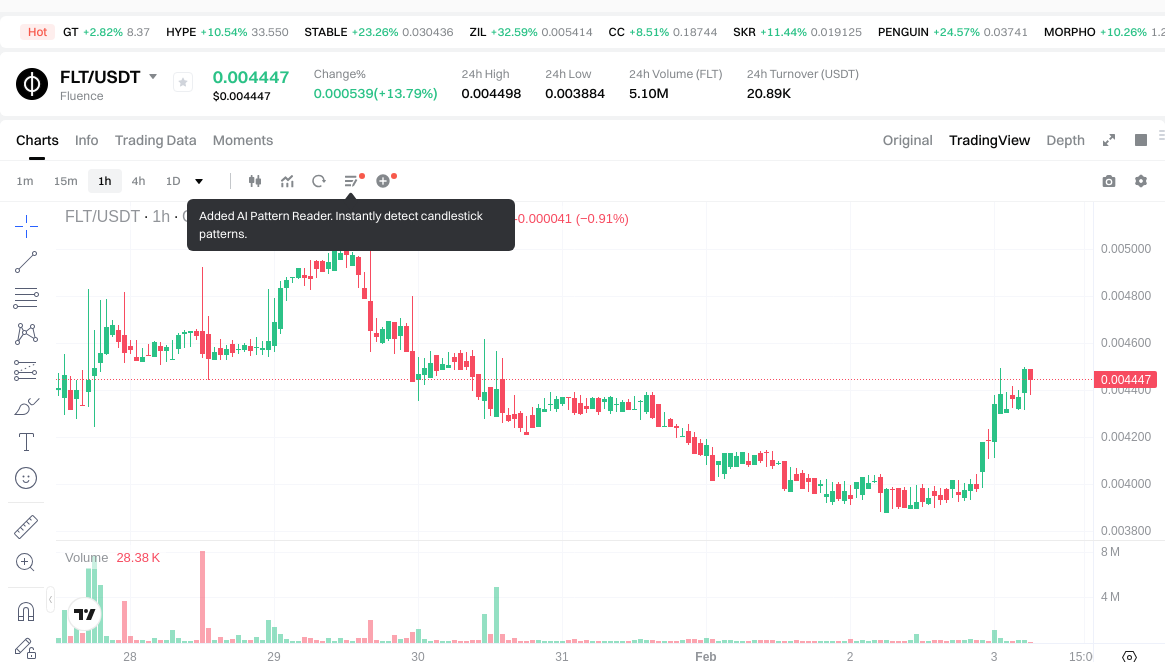
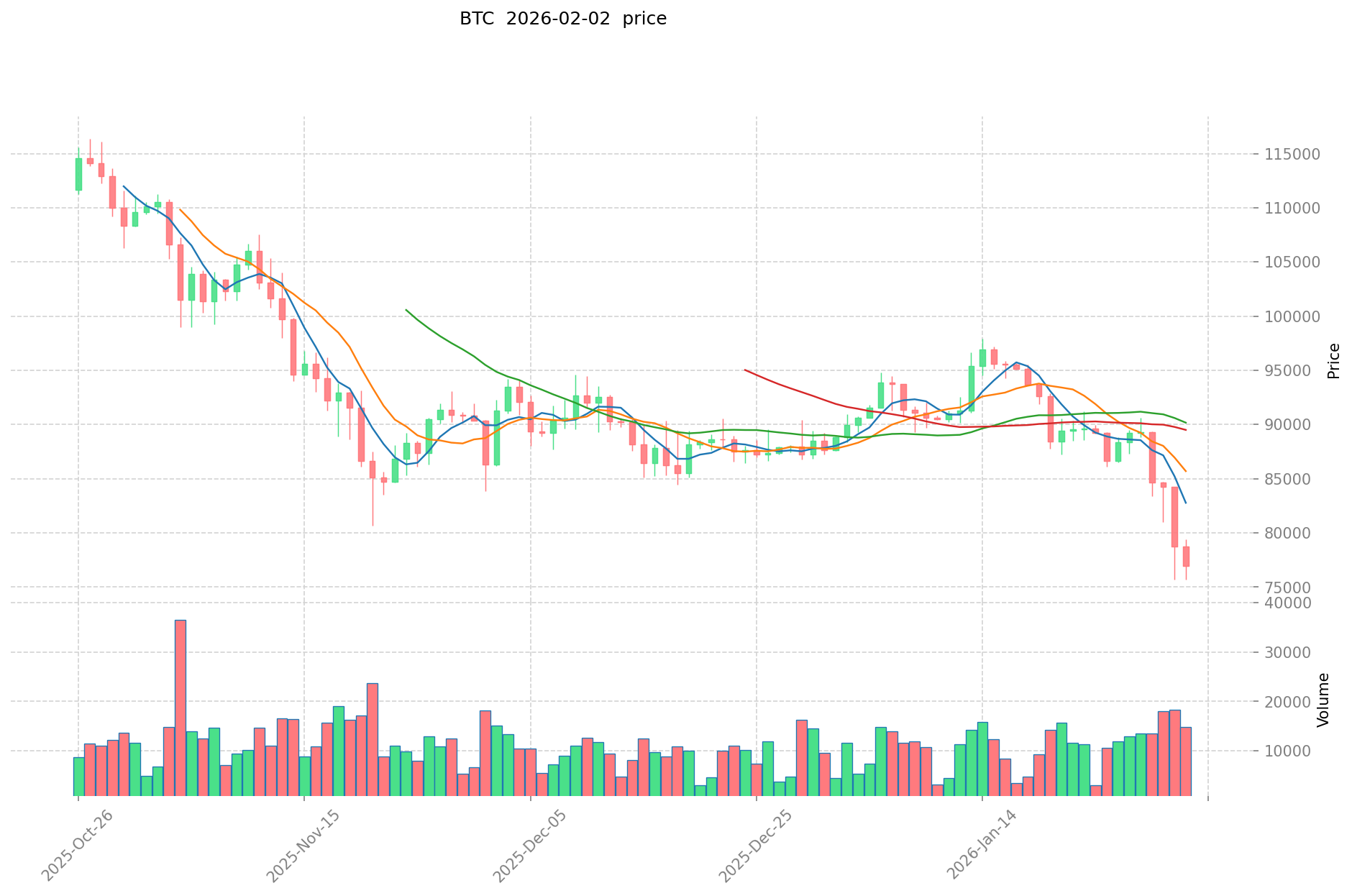
2025-2026: FLT saw substantial price decline throughout 2025 and into early 2026, dropping from its all-time high to $0.003821 by January 2026. BTC also entered a correction phase, declining from its peak to approximately $78,477.9 as of February 2026.
-
Comparative Analysis: During the recent market cycle, FLT declined approximately 97.43% from its historical high of $1.55 to its current levels, while BTC experienced a more moderate drawdown of around 37.75% from its peak of $126,080 to current trading ranges.
Current Market Status (2026-02-03)
- FLT Current Price: $0.004491
- BTC Current Price: $78,477.9
- 24-Hour Trading Volume: FLT recorded $20,900.87 compared to BTC's $1,659,847,050.31
- Market Sentiment Index (Fear & Greed Index): 14 (Extreme Fear)
Check real-time prices:
II. Core Factors Influencing FLT vs BTC Investment Value
Supply Mechanism Comparison (Tokenomics)
-
FLT: The total supply of Fluence is capped at 1 billion FLT tokens, establishing a fixed supply model. This scarcity mechanism may contribute to value appreciation as market demand increases, though the impact depends on adoption rates and network utilization.
-
BTC: Bitcoin operates under a deflationary supply model with a maximum cap of 21 million coins. The halving mechanism, which reduces block rewards approximately every four years, has historically influenced price cycles by constraining new supply while demand evolves.
-
📌 Historical Pattern: Supply mechanisms have demonstrated correlation with price cycles. Bitcoin's halving events have historically preceded significant price movements, typically exhibiting parabolic trends in the periods following supply reductions. For FLT, the fixed supply framework creates a different dynamic where value accrual may depend more directly on platform adoption and computational market demand.
Institutional Adoption and Market Application
-
Institutional Holdings: Bitcoin has shown broader institutional acceptance, with various financial institutions incorporating BTC into portfolios and treasury strategies. FLT's institutional adoption remains in earlier stages, tied primarily to decentralized computing infrastructure development.
-
Enterprise Adoption: Bitcoin has established use cases in cross-border payments, settlement systems, and corporate treasury management. Fluence focuses on enabling serverless, decentralized computing applications, targeting developers and organizations seeking censorship-resistant computational infrastructure without reliance on centralized cloud providers.
-
National Policies: Regulatory approaches vary significantly across jurisdictions. Bitcoin faces diverse regulatory frameworks ranging from acceptance as legal tender in some nations to restrictions in others. FLT operates within the broader regulatory environment for utility tokens and decentralized infrastructure services.
Technical Development and Ecosystem Building
-
FLT Technical Framework: Fluence's core innovation centers on its decentralized serverless architecture, functioning as a blockchain-economic-driven computing marketplace. The platform enables developers to build and deploy applications across a network of diverse computational providers, facilitating peer-to-peer computing without centralized intermediaries or vendor lock-in.
-
BTC Technical Evolution: Bitcoin's development focuses on network security, transaction efficiency improvements, and layer-two scaling solutions. The fundamental protocol emphasizes stability and security over rapid feature expansion.
-
Ecosystem Comparison: Bitcoin maintains established presence in payment systems and store-of-value applications. Fluence targets decentralized application infrastructure, positioning within the broader Web3 ecosystem. The ecosystems serve different primary functions—Bitcoin as digital currency and value storage, Fluence as computational infrastructure layer.
Macroeconomic and Market Cycles
-
Performance Under Inflation: Bitcoin has been explored as a potential inflation hedge due to its fixed supply and decentralized nature, though market behavior shows complex relationships with traditional inflation metrics. FLT's value proposition relates more directly to demand for decentralized computing services rather than macroeconomic hedging characteristics.
-
Macro Monetary Policy: Interest rate adjustments and US dollar index movements have demonstrated correlations with cryptocurrency market dynamics. Bitcoin, as the largest cryptocurrency by market capitalization, often reflects broader risk-on/risk-off sentiment in financial markets. FLT may exhibit different sensitivity patterns based on technology sector trends and infrastructure adoption cycles.
-
Geopolitical Factors: Cross-border transaction requirements and international developments can influence demand for decentralized financial and computational infrastructure. Bitcoin has shown relevance in scenarios involving capital controls or currency instability. Fluence's value proposition relates to decentralized computing needs, which may be influenced by concerns regarding data sovereignty and censorship resistance in computational services.
III. 2026-2031 Price Prediction: FLT vs BTC
Short-term Prediction (2026)
- FLT: Conservative $0.00365 - $0.00445 | Optimistic $0.00445 - $0.00591
- BTC: Conservative $60,637 - $78,750 | Optimistic $78,750 - $91,350
Mid-term Prediction (2028-2029)
- FLT may enter a consolidation phase, with projected price range of $0.00317 - $0.00667
- BTC may enter an expansion phase, with projected price range of $60,428 - $180,408
- Key drivers: institutional capital inflows, ETF developments, ecosystem growth
Long-term Prediction (2030-2031)
- FLT: Base scenario $0.00504 - $0.00741 | Optimistic scenario $0.00741 - $0.01090
- BTC: Base scenario $81,623 - $165,513 | Optimistic scenario $165,513 - $220,132
View detailed price predictions for FLT and BTC
Disclaimer
FLT:
| Year |
Predicted High Price |
Predicted Average Price |
Predicted Low Price |
Price Change |
| 2026 |
0.00591451 |
0.004447 |
0.00364654 |
0 |
| 2027 |
0.00575063805 |
0.005180755 |
0.0026939926 |
15 |
| 2028 |
0.0066681497605 |
0.005465696525 |
0.0031701039845 |
21 |
| 2029 |
0.00655227699417 |
0.00606692314275 |
0.003822161579932 |
35 |
| 2030 |
0.008517960092421 |
0.00630960006846 |
0.005931024064352 |
40 |
| 2031 |
0.010898256718247 |
0.00741378008044 |
0.005041370454699 |
65 |
BTC:
| Year |
Predicted High Price |
Predicted Average Price |
Predicted Low Price |
Price Change |
| 2026 |
91349.768 |
78749.8 |
60637.346 |
0 |
| 2027 |
123322.1868 |
85049.784 |
51880.36824 |
8 |
| 2028 |
139609.220436 |
104185.9854 |
60427.871532 |
32 |
| 2029 |
180408.45231864 |
121897.602918 |
76795.48983834 |
55 |
| 2030 |
179872.1028658008 |
151153.02761832 |
81622.6349138928 |
92 |
| 2031 |
220131.711771940332 |
165512.5652420604 |
89376.785230712616 |
110 |
IV. Investment Strategy Comparison: FLT vs BTC
Long-term vs Short-term Investment Strategies
-
FLT: May appeal to investors focused on decentralized computing infrastructure and Web3 ecosystem development. The asset exhibits characteristics associated with early-stage technology platforms, where value accrual relates to adoption of serverless computing services and network utilization growth.
-
BTC: May appeal to investors seeking exposure to established digital assets with broader market recognition. Bitcoin's positioning as a potential store of value and its presence in institutional portfolios represents a different investment profile compared to infrastructure-focused tokens.
Risk Management and Asset Allocation
-
Conservative Investors: A framework emphasizing capital preservation might consider BTC allocation as the primary component with minimal or no FLT exposure, reflecting Bitcoin's established market position and liquidity characteristics.
-
Aggressive Investors: A growth-oriented approach might include diversified exposure across both assets, with allocation decisions reflecting individual risk tolerance and investment objectives. Higher-risk portfolios may incorporate infrastructure tokens like FLT alongside established assets.
-
Hedging Tools: Portfolio risk management strategies may include stablecoin allocations for liquidity management, derivative instruments where available, and diversification across multiple asset categories within the cryptocurrency market.
V. Potential Risk Comparison
Market Risk
-
FLT: Exhibits substantial price volatility, with approximately 97.43% decline from historical highs. Lower trading volumes of $20,900.87 may contribute to wider bid-ask spreads and execution challenges. Market depth considerations remain relevant for position sizing decisions.
-
BTC: Demonstrates significant price fluctuations, with drawdowns of approximately 37.75% from recent peaks. Despite higher liquidity with 24-hour trading volume of $1,659,847,050.31, market sentiment indicators show extreme fear levels (Fear & Greed Index: 14), reflecting broader market uncertainty.
Technical Risk
-
FLT: Technical considerations include network adoption rates, computational marketplace development, and competitive dynamics within decentralized infrastructure sectors. Platform maturity and ecosystem growth trajectories represent relevant factors for long-term value assessment.
-
BTC: Network security considerations include mining distribution patterns and hash rate concentration. Protocol development focuses on stability and security, with scaling solutions introducing additional complexity and implementation timelines.
Regulatory Risk
- Regulatory frameworks for digital assets vary substantially across jurisdictions, with ongoing policy developments affecting market participants differently. Bitcoin faces diverse regulatory approaches ranging from acceptance frameworks to restrictive policies. Utility tokens like FLT operate within evolving regulatory environments for decentralized infrastructure services, where classification and compliance requirements continue to develop across different regulatory regimes.
VI. Conclusion: Which Is the Better Buy?
📌 Investment Value Summary
-
FLT Characteristics: Positioning within decentralized computing infrastructure sector, fixed supply of 1 billion tokens, focus on serverless application development and censorship-resistant computational services. Price performance shows substantial volatility with significant drawdown from historical levels.
-
BTC Characteristics: Established market presence with broader institutional recognition, deflationary supply model with 21 million coin cap, positioning as potential store of value and digital currency. Demonstrates market cycles influenced by halving events and macroeconomic factors.
✅ Investment Considerations
-
New Investors: Beginning market participants may benefit from understanding fundamental differences between infrastructure tokens and established digital currencies. Education regarding market volatility, custody practices, and risk management remains essential before capital allocation decisions.
-
Experienced Investors: Participants with existing market knowledge may evaluate allocation strategies based on individual risk profiles, investment timeframes, and portfolio diversification objectives. Technical analysis, on-chain metrics, and ecosystem development monitoring can inform position management approaches.
-
Institutional Investors: Organizations considering digital asset exposure may assess liquidity profiles, regulatory compliance frameworks, custody solutions, and risk management infrastructure. Due diligence processes typically encompass technical architecture review, market structure analysis, and regulatory landscape evaluation.
⚠️ Risk Disclosure: Cryptocurrency markets exhibit substantial volatility and uncertainty. This analysis does not constitute investment advice, financial guidance, or recommendations for specific trading actions. Market participants should conduct independent research, assess individual risk tolerance, and consult qualified financial professionals before making investment decisions.
VII. FAQ
Q1: What are the fundamental differences between FLT and BTC as investment assets?
FLT and BTC represent fundamentally different value propositions within the cryptocurrency ecosystem. FLT operates as a utility token powering a decentralized serverless computing platform, launched in 2024 with a fixed supply of 1 billion tokens. Its value accrual depends primarily on adoption rates of its computational marketplace and Web3 infrastructure services. BTC, established in 2008, functions as a digital currency and potential store of value with a maximum supply of 21 million coins and a deflationary halving mechanism. While BTC has achieved broader institutional acceptance and positioning as "digital gold," FLT focuses on enabling censorship-resistant computational infrastructure without centralized intermediaries.
Q2: How do the current market conditions affect FLT and BTC differently?
Current market conditions show divergent impacts on these assets. As of February 2026, FLT has experienced approximately 97.43% decline from its all-time high of $1.55 to $0.004491, with 24-hour trading volume of $20,900.87, indicating lower liquidity and higher volatility characteristics. BTC demonstrates a more moderate drawdown of around 37.75% from its peak of $126,080 to $78,477.9, maintaining substantially higher liquidity with $1,659,847,050.31 in daily trading volume. The extreme fear market sentiment (Fear & Greed Index: 14) affects both assets, though BTC's established market position provides relatively greater price stability and execution efficiency compared to FLT's early-stage market characteristics.
Q3: What supply mechanisms influence the long-term value potential of FLT versus BTC?
Both assets employ fixed supply models but with different mechanisms and market implications. BTC operates under a deflationary supply model with a 21 million coin cap, utilizing halving events approximately every four years to reduce block rewards, historically correlating with subsequent price cycles and parabolic trends. This scarcity mechanism has demonstrated influence on market dynamics over Bitcoin's 15+ year history. FLT implements a fixed supply cap of 1 billion tokens without halving mechanisms, where value appreciation depends more directly on platform adoption and computational market demand rather than programmatic supply reductions. The different supply frameworks create distinct dynamics—BTC's predictable supply constraints versus FLT's adoption-driven value proposition.
Q4: What are the projected price ranges for FLT and BTC through 2031?
Price projections indicate different trajectories for these assets. For 2026, FLT shows conservative estimates of $0.00365-$0.00445 and optimistic scenarios of $0.00445-$0.00591, while BTC conservative projections range $60,637-$78,750 with optimistic scenarios at $78,750-$91,350. Mid-term predictions for 2028-2029 suggest FLT consolidation between $0.00317-$0.00667, while BTC may experience expansion within $60,428-$180,408. Long-term 2030-2031 forecasts project FLT base scenarios at $0.00504-$0.00741 (optimistic $0.00741-$0.01090) and BTC base scenarios at $81,623-$165,513 (optimistic $165,513-$220,132). These projections reflect different growth assumptions based on institutional adoption patterns, ecosystem development, and market maturity factors.
Q5: How should different investor profiles approach FLT versus BTC allocation?
Investment approaches vary substantially based on risk tolerance and objectives. Conservative investors focused on capital preservation might emphasize BTC allocation as the primary component given its established market position, higher liquidity ($1.66 billion daily volume versus $20,900 for FLT), and broader institutional recognition, with minimal or no FLT exposure. Aggressive investors with higher risk tolerance and growth-oriented objectives might incorporate diversified exposure across both assets, with FLT positioning offering potential upside tied to decentralized computing infrastructure adoption, while accepting significantly higher volatility and liquidity constraints. Institutional investors typically conduct comprehensive due diligence encompassing technical architecture review, regulatory compliance frameworks, custody solutions, and risk management infrastructure before considering either asset class.
Q6: What are the primary risks distinguishing FLT from BTC investments?
Risk profiles differ significantly between these assets. FLT exhibits substantial market risk with approximately 97.43% decline from historical highs, lower trading volumes of $20,900.87 contributing to wider bid-ask spreads, and technical risks related to network adoption rates and competitive dynamics within decentralized infrastructure sectors. Platform maturity and ecosystem growth trajectories represent critical factors for long-term value assessment. BTC demonstrates significant but relatively lower volatility with approximately 37.75% drawdown from peaks, higher liquidity mitigating execution risks, though still subject to extreme market sentiment (Fear & Greed Index: 14). Technical considerations include mining distribution patterns and hash rate concentration. Both face evolving regulatory environments, with Bitcoin encountering diverse frameworks from acceptance to restrictions, while FLT operates within developing regulatory approaches for utility tokens and decentralized infrastructure services.
Q7: How do macroeconomic factors influence FLT and BTC differently?
Macroeconomic impacts manifest through distinct channels for these assets. BTC has been explored as a potential inflation hedge due to its fixed supply and decentralized nature, though market behavior shows complex relationships with traditional inflation metrics. As the largest cryptocurrency by market capitalization, Bitcoin often reflects broader risk-on/risk-off sentiment correlating with interest rate adjustments, US dollar movements, and institutional capital flows. Geopolitical factors including capital controls and currency instability have influenced Bitcoin demand in cross-border transaction scenarios. FLT's value proposition relates more directly to demand for decentralized computing services rather than macroeconomic hedging characteristics, with sensitivity patterns potentially tied to technology sector trends, infrastructure adoption cycles, and concerns regarding data sovereignty and censorship resistance in computational services.
Q8: What technical development factors should investors consider when comparing FLT and BTC?
Technical considerations reveal fundamentally different development priorities. FLT's core innovation centers on decentralized serverless architecture functioning as a blockchain-economic-driven computing marketplace, enabling developers to build applications across diverse computational providers without centralized intermediaries or vendor lock-in. Platform success depends on adoption rates among developers seeking censorship-resistant infrastructure and competitive positioning within Web3 ecosystem development. BTC's technical evolution emphasizes network security, transaction efficiency improvements, and layer-two scaling solutions, with protocol development prioritizing stability and security over rapid feature expansion. The ecosystems serve different primary functions—Bitcoin as digital currency and value storage versus Fluence as computational infrastructure layer—requiring distinct evaluation frameworks for technical risk assessment and development trajectory monitoring.
* The information is not intended to be and does not constitute financial advice or any other recommendation of any sort offered or endorsed by Gate.