FRED vs HBAR: A Comprehensive Comparison of Two Emerging Blockchain Tokens and Their Market Potential

Introduction: Investment Comparison Between FRED and HBAR
In the cryptocurrency market, the comparison of FRED vs HBAR has become a topic that investors cannot ignore. The two differ significantly in market cap ranking, application scenarios, and price performance, representing distinct positioning in the crypto asset landscape. FRED (First Convicted Raccon): Launched in 2024 with the positioning of "Justice for Fred," it has gained attention in the meme token sector. HBAR (Hedera): Since its launch in 2020, it has been recognized for its fast transaction speed (>10,000+ TPS), security (aBFT consensus), and fair public ledger network, establishing itself as a notable enterprise-grade distributed ledger technology. This article will provide a comprehensive analysis of FRED vs HBAR investment value comparison around historical price trends, supply mechanisms, institutional adoption, technical ecosystems, and future predictions, attempting to answer the question investors care about most:
"Which is the better buy right now?"
I. Historical Price Comparison and Current Market Conditions
Historical Price Trends of FRED (Coin A) and HBAR (Coin B)
- 2024: FRED reached a notable price level of $0.2388 in November 2024, representing a significant period following its launch at $0.2204.
- 2021: HBAR experienced price movement reaching $0.569229 in September 2021, reflecting market activity during that period.
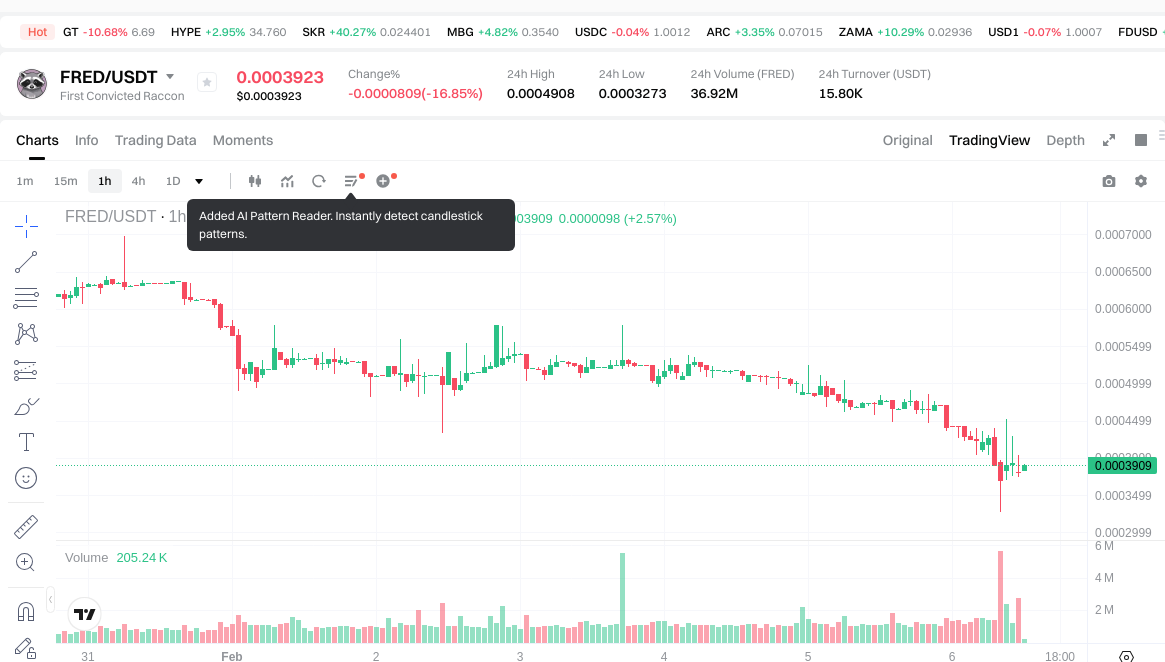
- 2026: FRED recorded a price level of $0.0003273 on February 6, 2026, showing substantial movement from previous levels.
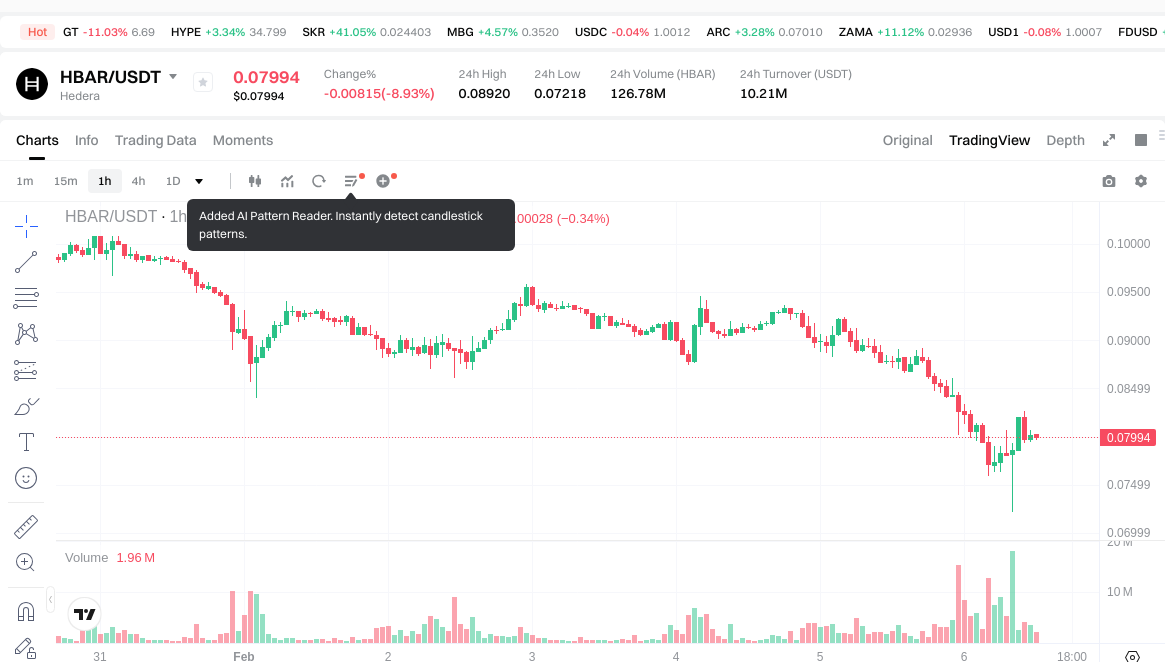
- Comparative Analysis: During the recent market cycle, FRED moved from its price level of $0.2388 to $0.0003883, while HBAR transitioned from $0.569229 to $0.0801 over different timeframes.
Current Market Status (2026-02-06)
- FRED Current Price: $0.0003883
- HBAR Current Price: $0.0801
- 24-Hour Trading Volume: FRED $15,786.04 vs HBAR $10,125,038.07
- Market Sentiment Index (Fear & Greed Index): 9 (Extreme Fear)
View real-time prices:
- View FRED current price Market Price
- View HBAR current price Market Price
II. Core Factors Influencing FRED vs HBAR Investment Value
Supply Mechanism Comparison (Tokenomics)
- FRED: Supply mechanism details are not specified in available materials.
- HBAR: Supply mechanism details are not specified in available materials.
- 📌 Historical Pattern: Supply mechanisms may influence price cycles through scarcity or inflation dynamics, though specific historical data for these assets is not provided.
Institutional Adoption and Market Application
- Institutional Holdings: Available materials do not provide comparative data on institutional preference between FRED and HBAR.
- Enterprise Adoption: References indicate that market demand and ecosystem growth influence both assets' value, though specific applications in cross-border payments, settlements, or investment portfolios are not detailed.
- National Policy: Regulatory developments are noted as influencing factors for both projects, though specific country-level regulatory stances are not documented in the materials.
Technology Development and Ecosystem Building
- FRED Technology: FRED is associated with DeFi and blockchain innovation, though specific technical upgrades are not detailed in the materials.
- HBAR Technology: HBAR is linked to Hedera's scalable network, though particular technological developments are not specified.
- Ecosystem Comparison: Both projects' value is influenced by community support and ecosystem growth, though specific deployment details in DeFi, NFT, payments, or smart contracts are not provided.
Macroeconomic Environment and Market Cycles
- Performance in Inflationary Environment: Materials do not provide comparative analysis of anti-inflation properties for either asset.
- Macroeconomic Monetary Policy: The influence of interest rates, dollar index, or other macroeconomic factors on these specific assets is not addressed in available materials.
- Geopolitical Factors: While cross-border transaction demand and international situations may affect crypto asset value generally, specific impacts on FRED and HBAR are not documented.
III. 2026-2031 Price Forecast: FRED vs HBAR
Short-term Forecast (2026)
- FRED: Conservative $0.000341 - $0.000392 | Optimistic $0.000392 - $0.000404
- HBAR: Conservative $0.053 - $0.080 | Optimistic $0.080 - $0.119
Mid-term Forecast (2028-2029)
- FRED may enter a gradual expansion phase, with estimated price range of $0.000301 - $0.000600
- HBAR may enter a steady growth phase, with estimated price range of $0.090 - $0.159
- Key drivers: institutional capital inflows, ETF developments, ecosystem expansion
Long-term Forecast (2030-2031)
- FRED: Baseline scenario $0.000440 - $0.000611 | Optimistic scenario $0.000575 - $0.000686
- HBAR: Baseline scenario $0.109 - $0.170 | Optimistic scenario $0.144 - $0.198
Disclaimer
FRED:
| Year | Predicted High Price | Predicted Average Price | Predicted Low Price | Price Change |
|---|---|---|---|---|
| 2026 | 0.000404069 | 0.0003923 | 0.000341301 | 1 |
| 2027 | 0.00043800295 | 0.0003981845 | 0.00020705594 | 2 |
| 2028 | 0.0005267980935 | 0.000418093725 | 0.000301027482 | 7 |
| 2029 | 0.000600006304747 | 0.00047244590925 | 0.000401579022862 | 21 |
| 2030 | 0.000686369416958 | 0.000536226106998 | 0.000439705407739 | 38 |
| 2031 | 0.000654088605317 | 0.000611297761978 | 0.000574619896259 | 57 |
HBAR:
| Year | Predicted High Price | Predicted Average Price | Predicted Low Price | Price Change |
|---|---|---|---|---|
| 2026 | 0.1188424 | 0.07976 | 0.0526416 | 0 |
| 2027 | 0.13405662 | 0.0993012 | 0.096322164 | 23 |
| 2028 | 0.1330139574 | 0.11667891 | 0.0898427607 | 45 |
| 2029 | 0.158554970799 | 0.1248464337 | 0.116107183341 | 55 |
| 2030 | 0.1983809831493 | 0.1417007022495 | 0.109109540732115 | 76 |
| 2031 | 0.185344518542346 | 0.1700408426994 | 0.14453471629449 | 112 |
IV. Investment Strategy Comparison: FRED vs HBAR
Long-term vs Short-term Investment Strategies
-
FRED: May appeal to investors exploring emerging meme token opportunities with tolerance for market movement variability. The asset's positioning in the meme token sector suggests consideration for those examining alternative crypto categories.
-
HBAR: May appeal to investors examining enterprise-grade distributed ledger technology applications, particularly those interested in network scalability and consensus mechanisms. The project's association with institutional-oriented infrastructure suggests relevance for technology-focused portfolios.
Risk Management and Asset Allocation
-
Conservative Investors: A potential allocation framework could consider FRED: 10-20% vs HBAR: 80-90%, reflecting different risk profiles, though individual circumstances vary significantly.
-
Aggressive Investors: A potential allocation framework could consider FRED: 30-50% vs HBAR: 50-70%, adjusting for higher risk tolerance, though market conditions require continuous evaluation.
-
Hedging Tools: Portfolio diversification strategies may include stablecoin positions, options strategies where available, and cross-asset combinations to manage exposure.
V. Potential Risk Comparison
Market Risks
-
FRED: The asset exhibits price movement characteristics common to meme tokens, with 24-hour trading volume of $15,786.04 indicating liquidity considerations. Market sentiment indicators show extreme fear levels (Fear & Greed Index: 9), suggesting heightened market uncertainty.
-
HBAR: The asset demonstrates price dynamics influenced by enterprise adoption patterns and network development cycles. 24-hour trading volume of $10,125,038.07 reflects different liquidity characteristics compared to FRED.
Technical Risks
-
FRED: Technical considerations related to network stability and scalability are not detailed in available materials, requiring independent research for comprehensive evaluation.
-
HBAR: While associated with Hedera's network infrastructure, specific technical vulnerabilities or consensus mechanism risks are not elaborated in reference materials.
Regulatory Risks
- Regulatory developments may affect both assets differently based on their respective classifications and use cases. FRED's positioning as a meme token and HBAR's enterprise-focused approach may encounter distinct regulatory considerations across jurisdictions, though specific policy impacts are not documented in available materials.
VI. Conclusion: Which Is the Better Buy?
📌 Investment Value Summary:
-
FRED Characteristics: Represents exposure to the meme token sector with community-driven positioning. Price forecasts suggest conservative range of $0.000341 - $0.000404 for 2026, with long-term baseline scenario of $0.000440 - $0.000611 by 2030-2031.
-
HBAR Characteristics: Represents exposure to enterprise-grade distributed ledger technology with focus on transaction speed and network security. Price forecasts suggest conservative range of $0.053 - $0.119 for 2026, with long-term baseline scenario of $0.109 - $0.170 by 2030-2031.
✅ Investment Considerations:
-
New Investors: May consider starting with smaller position sizes in either asset while developing understanding of crypto market dynamics and conducting thorough due diligence on each project's fundamentals.
-
Experienced Investors: May evaluate both assets within broader portfolio context, considering diversification across different crypto categories and risk profiles based on individual investment objectives.
-
Institutional Investors: May assess each asset's alignment with institutional criteria including liquidity requirements, regulatory compliance considerations, and long-term technology infrastructure development.
⚠️ Risk Disclosure: Cryptocurrency markets involve substantial price movement potential. This analysis does not constitute investment advice. Investors should conduct independent research and consider their individual circumstances before making investment decisions.
VII. FAQ
Q1: What are the main differences between FRED and HBAR in terms of their fundamental positioning?
FRED is a meme token launched in 2024 with community-driven positioning under "Justice for Fred," while HBAR is an enterprise-grade distributed ledger technology operational since 2020 with focus on high-speed transactions (>10,000 TPS) and aBFT consensus mechanism. FRED represents exposure to the alternative meme token sector with emphasis on community engagement, whereas HBAR targets institutional and enterprise applications through its scalable network infrastructure. Their distinct positioning reflects fundamentally different value propositions within the cryptocurrency ecosystem.
Q2: How do the current liquidity profiles of FRED and HBAR compare?
HBAR demonstrates significantly higher liquidity with 24-hour trading volume of $10,125,038.07 compared to FRED's $15,786.04 as of February 6, 2026. This substantial difference in trading volume indicates that HBAR offers greater market depth and potentially lower price impact for larger transactions. The liquidity disparity reflects HBAR's broader market adoption and more established trading infrastructure compared to FRED's emerging market presence in the meme token category.
Q3: What are the price forecast ranges for FRED and HBAR through 2031?
For FRED, conservative 2026 forecasts range from $0.000341 to $0.000392, with long-term baseline scenarios projecting $0.000440 to $0.000611 by 2030-2031. For HBAR, conservative 2026 forecasts range from $0.053 to $0.119, with long-term baseline scenarios projecting $0.109 to $0.170 by 2030-2031. These projections suggest HBAR maintains higher absolute price levels, while both assets show potential for measured growth depending on market conditions, institutional adoption patterns, and ecosystem development trajectories.
Q4: Which asset is more suitable for conservative versus aggressive investment strategies?
Conservative investors may consider a potential allocation favoring HBAR at 80-90% versus FRED at 10-20%, reflecting HBAR's enterprise-grade infrastructure and established market presence. Aggressive investors with higher risk tolerance might consider more balanced allocations of FRED at 30-50% versus HBAR at 50-70%, incorporating greater exposure to meme token sector volatility. These frameworks should be adjusted based on individual circumstances, market conditions, and comprehensive due diligence on each project's fundamentals and risk characteristics.
Q5: What are the primary risk considerations for each asset?
FRED's primary risks include price movement characteristics common to meme tokens, lower liquidity levels ($15,786.04 24-hour volume), and extreme market sentiment conditions (Fear & Greed Index: 9). HBAR's risks center on enterprise adoption cycles, network development dependencies, and potential regulatory considerations affecting institutional-focused blockchain infrastructure. Both assets face broader cryptocurrency market risks including macroeconomic factors, regulatory developments across jurisdictions, and technological uncertainties, though their distinct positioning means these factors may impact them differently.
Q6: How does current market sentiment affect FRED and HBAR investment decisions?
The current Fear & Greed Index of 9 (Extreme Fear) indicates heightened market uncertainty affecting both assets. Under such conditions, FRED's meme token characteristics may amplify sentiment-driven volatility, while HBAR's enterprise-grade positioning may provide relative stability through institutional backing. Extreme fear periods historically present both accumulation opportunities and downside continuation risks. Investors should evaluate whether current market psychology aligns with their risk tolerance and investment timeframes before making allocation decisions.
Q7: What role do institutional adoption patterns play in differentiating FRED and HBAR?
HBAR's enterprise-grade distributed ledger technology positions it for potential institutional adoption through scalable network infrastructure and consensus mechanisms designed for business applications. FRED's community-driven meme token positioning targets different adoption patterns focused on retail engagement and social dynamics. While specific institutional holdings data is not provided in available materials, the fundamental architectural differences suggest distinct pathways for institutional consideration, with HBAR potentially aligning more closely with traditional institutional evaluation criteria around technology infrastructure, regulatory compliance, and enterprise use cases.
Q8: How should new investors approach the FRED vs HBAR decision?
New investors should begin with smaller position sizes in either asset while developing understanding of cryptocurrency market dynamics and conducting thorough independent research on each project's fundamentals, technology, and risk characteristics. Starting with educational resources about meme tokens versus enterprise blockchain infrastructure helps clarify which category aligns with individual investment objectives. Diversification across different crypto categories may reduce concentration risk, though portfolio construction should reflect personal risk tolerance, investment timeframe, and financial circumstances rather than following generalized allocation frameworks without proper due diligence.
Share
Content
Introduction: Investment Comparison Between FRED and HBAR
I. Historical Price Comparison and Current Market Conditions
II. Core Factors Influencing FRED vs HBAR Investment Value
III. 2026-2031 Price Forecast: FRED vs HBAR
IV. Investment Strategy Comparison: FRED vs HBAR
V. Potential Risk Comparison
VI. Conclusion: Which Is the Better Buy?
VII. FAQ
How to Buy Cryptocurrency


Trending Cryptocurrencies



Bitcoin Fear and Greed Index: Market Sentiment Analysis for 2025

Bitcoin Market Cap in 2025: Analysis and Trends for Investors

Newbie Must Read: How to Formulate Investment Strategies When Nasdaq Turns Positive in 2025

How to Mine Ethereum in 2025: A Complete Guide for Beginners
Best Crypto Wallets 2025: How to Choose and Secure Your Digital Assets
TapSwap Listing Date: What Investors Need to Know in 2025

Comprehensive Guide to Trading Indicators

Top 7 Crypto Prop Trading Firms for Funded Trading Accounts

How To Get Free NFT (5 Easy Ways)
What is Bitcoin dominance and why does this metric matter

Comprehensive Guide to OpenSea NFT Trading