GATA vs QNT: A Comprehensive Comparison of Two Leading Blockchain Infrastructure Tokens

Introduction: GATA vs QNT Investment Comparison
In the cryptocurrency market, the comparison between GATA vs QNT has consistently been a topic investors cannot overlook. The two not only show significant differences in market cap ranking, application scenarios, and price performance, but also represent distinct crypto asset positioning. GATA (GATA): Launched in 2025, it has gained market recognition by positioning itself as a provider of advanced decentralized AI inference and training technologies, enabling large-scale AI models to collaborate efficiently across globally distributed GPUs. QNT (QNT): Since its launch in 2018, it has been positioned as a technology provider enabling trusted digital interactions, creating a secure digital future for enterprises, regulators, governments, and individuals through the Overledger operating system that addresses blockchain interoperability. This article will comprehensively analyze the investment value comparison between GATA vs QNT around historical price trends, supply mechanisms, institutional adoption, technical ecosystems, and future predictions, attempting to answer the question investors care about most:
"Which is the better buy right now?"
I. Historical Price Comparison and Current Market Status
GATA and QNT Historical Price Trends
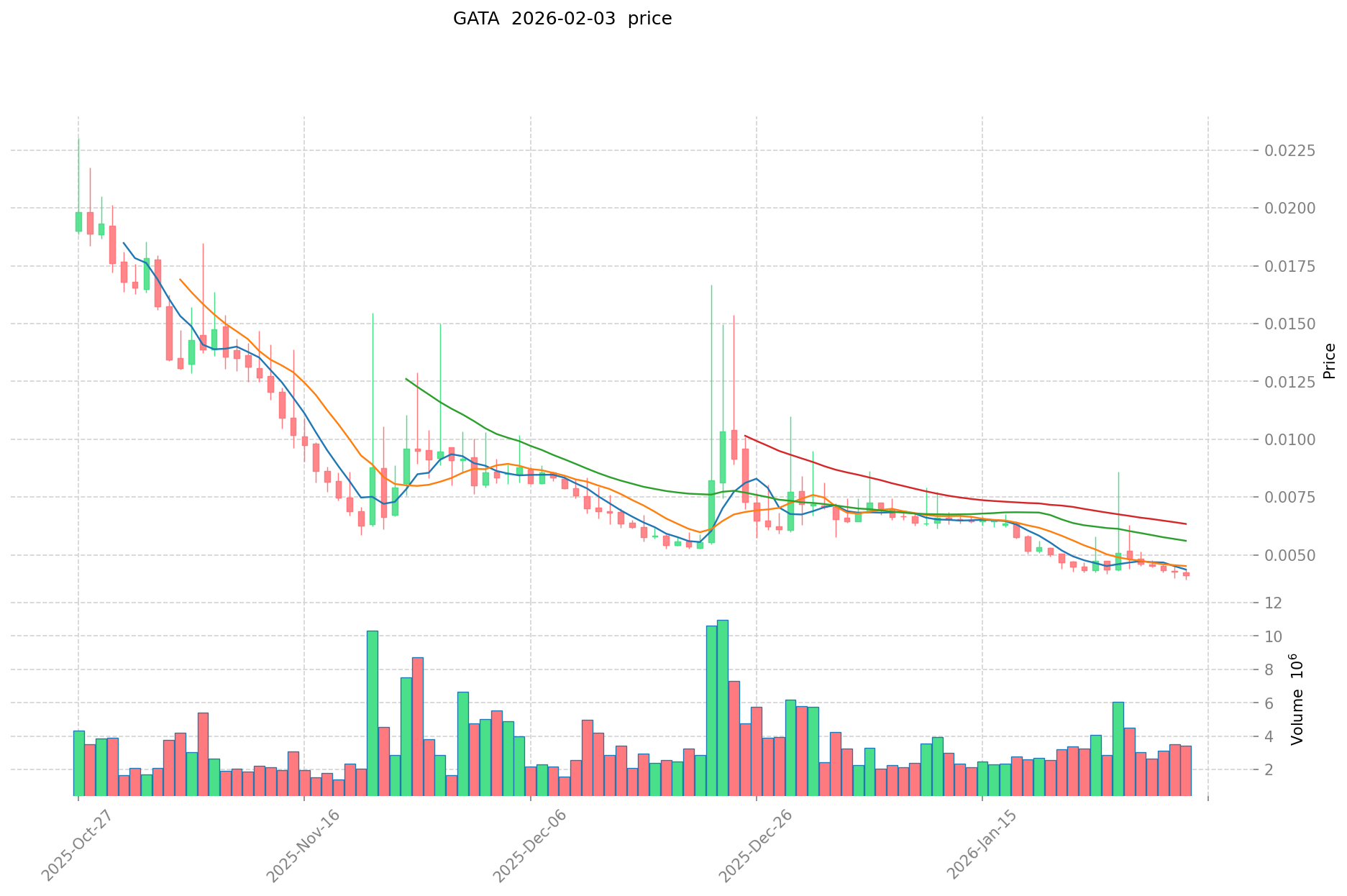
- 2025: GATA reached its all-time high of $0.09911 on September 24, 2025, marking a significant milestone in its early trading history.
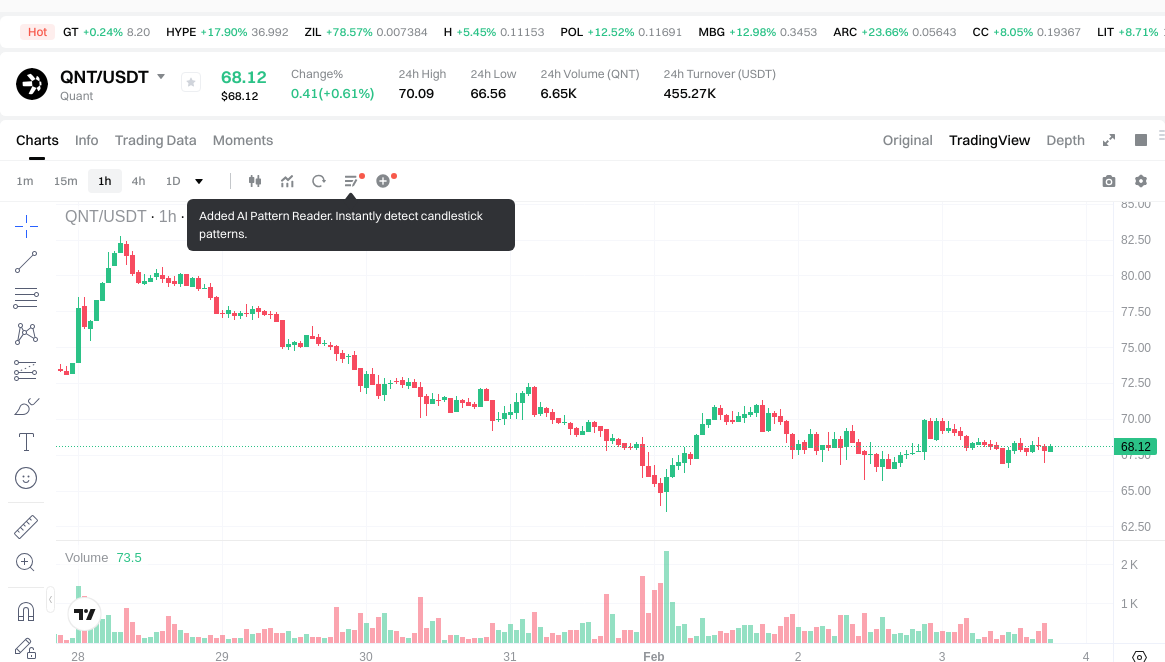
- 2021: QNT achieved its all-time high of $427.42 on September 11, 2021, representing a major peak during the broader crypto market expansion.
- Comparative Analysis: During recent market cycles, GATA has experienced substantial volatility from its peak of $0.09911 to a low of $0.003927 recorded on February 2, 2026, while QNT has declined from its historical high of $427.42 to current levels around $68, reflecting broader market corrections.
Current Market Status (February 3, 2026)
- GATA current price: $0.004003
- QNT current price: $68
- 24-hour trading volume: GATA $12,884.00 vs QNT $453,245.15
- Market Sentiment Index (Fear & Greed Index): 17 (Extreme Fear)
View real-time prices:
- Check GATA current price Market Price
- Check QNT current price Market Price
II. Core Factors Influencing GATA vs QNT Investment Value
Supply Mechanism Comparison (Tokenomics)
The supply mechanisms of GATA and QNT play a role in shaping their potential value dynamics. Supply-related factors such as fixed supply models, deflationary mechanisms, or periodic supply adjustments can influence how these assets respond to market demand shifts. Historical patterns in cryptocurrency markets suggest that supply constraints, when combined with increasing adoption, may contribute to price volatility cycles. However, the actual impact depends on multiple variables including market sentiment, technological developments, and broader economic conditions.
Institutional Adoption and Market Application
- Institutional Holdings: The level of institutional interest in GATA and QNT may vary based on factors such as regulatory clarity, liquidity profiles, and alignment with institutional investment mandates.
- Enterprise Adoption: Both assets may find applications across different use cases. Potential areas include cross-border payment solutions, settlement systems, and portfolio diversification strategies, though actual enterprise integration depends on technological maturity and business case validation.
- National Policies: Regulatory approaches toward GATA and QNT differ across jurisdictions. Policy frameworks regarding digital assets continue to evolve, influencing how these tokens can be held, traded, and utilized in various markets.
Technical Development and Ecosystem Building
- GATA Technical Evolution: Technical developments related to GATA, if any, would influence its utility and adoption potential. The impact of technical upgrades depends on implementation success and market reception.
- QNT Technical Progress: QNT's technical roadmap and ecosystem developments may affect its value proposition. The practical implementation of technological improvements remains subject to development timelines and market validation.
- Ecosystem Comparison: The presence and maturity of DeFi integrations, NFT platforms, payment applications, and smart contract implementations vary between GATA and QNT. Ecosystem depth and developer activity can be indicators of long-term sustainability, though they do not guarantee investment outcomes.
Macroeconomic Context and Market Cycles
- Performance in Inflationary Environments: The behavior of GATA and QNT during periods of inflation depends on multiple factors including investor perception, liquidity flows, and correlation with traditional financial markets. Claims about inflation-hedging properties should be evaluated against historical data and current market conditions.
- Macroeconomic Monetary Policy: Interest rate changes and fluctuations in the US Dollar Index can influence cryptocurrency markets broadly. Both GATA and QNT may respond to these macroeconomic variables, though their sensitivity levels may differ based on market positioning and investor base composition.
- Geopolitical Factors: Cross-border transaction demand and international developments can affect cryptocurrency adoption patterns. Geopolitical uncertainties may influence capital flows into digital assets, though the specific impact on GATA and QNT depends on their respective use cases and market positioning.
III. 2026-2031 Price Prediction: GATA vs QNT
Short-term Forecast (2026)
- GATA: Conservative $0.00306 - $0.00403 | Optimistic $0.00403 - $0.00487
- QNT: Conservative $37.46 - $68.10 | Optimistic $68.10 - $97.38
Mid-term Forecast (2028-2029)
- GATA may enter a gradual growth phase, with projected price range of $0.0025 - $0.0063
- QNT may enter a consolidation and expansion phase, with projected price range of $63.66 - $102.41
- Key drivers: institutional capital inflows, ETF developments, ecosystem expansion
Long-term Forecast (2031)
- GATA: Base scenario $0.0056 - $0.0063 | Optimistic scenario $0.0063 - $0.0070
- QNT: Base scenario $56.99 - $111.74 | Optimistic scenario $111.74 - $166.49
Disclaimer: Price predictions are based on historical data analysis and market modeling. Cryptocurrency markets are highly volatile and subject to various factors including regulatory changes, technological developments, and macroeconomic conditions. These forecasts should not be considered as investment advice, and actual prices may vary significantly from projections.
GATA:
| Year | Predicted High Price | Predicted Average Price | Predicted Low Price | Price Change |
|---|---|---|---|---|
| 2026 | 0.00487267 | 0.004027 | 0.00306052 | 0 |
| 2027 | 0.0049838152 | 0.004449835 | 0.00244740925 | 11 |
| 2028 | 0.005801694873 | 0.0047168251 | 0.002499917303 | 17 |
| 2029 | 0.006258519383935 | 0.0052592599865 | 0.00483851918758 | 31 |
| 2030 | 0.006795489828556 | 0.005758889685217 | 0.003340156017426 | 43 |
| 2031 | 0.006967680630144 | 0.006277189756887 | 0.005649470781198 | 56 |
QNT:
| Year | Predicted High Price | Predicted Average Price | Predicted Low Price | Price Change |
|---|---|---|---|---|
| 2026 | 97.383 | 68.1 | 37.455 | 0 |
| 2027 | 101.772045 | 82.7415 | 53.781975 | 21 |
| 2028 | 102.405017475 | 92.2567725 | 63.657173025 | 35 |
| 2029 | 102.197439736875 | 97.3308949875 | 93.437659188 | 43 |
| 2030 | 123.7075675291125 | 99.7641673621875 | 62.851425438178125 | 46 |
| 2031 | 166.4864424940185 | 111.73586744565 | 56.9852923972815 | 64 |
IV. Investment Strategy Comparison: GATA vs QNT
Long-term vs Short-term Investment Strategies
-
GATA: May be considered by investors interested in emerging AI infrastructure narratives and early-stage technology projects. The asset's early development phase and recent launch in 2025 suggest a different risk-return profile compared to more established assets.
-
QNT: May appeal to investors seeking exposure to enterprise blockchain interoperability solutions. QNT's longer market presence since 2018 and established positioning in the Overledger ecosystem provide a different investment context compared to newer market entrants.
Risk Management and Asset Allocation
-
Conservative Investors: Asset allocation strategies for conservative investors typically prioritize capital preservation and lower volatility exposure. A balanced approach might consider higher allocation toward assets with longer track records and established use cases, though specific percentages should be determined based on individual risk tolerance and investment objectives.
-
Aggressive Investors: Investors with higher risk tolerance may explore different allocation weightings, potentially including exposure to both established and emerging projects. However, concentration risk and portfolio diversification principles should guide allocation decisions.
-
Hedging Tools: Risk management approaches may include stablecoin reserves for liquidity management, options strategies where available for downside protection, and cross-asset diversification to mitigate concentration risk.
V. Potential Risk Comparison
Market Risk
-
GATA: The asset exhibits significant price volatility, having declined from $0.09911 to $0.003927 between September 2025 and February 2026. Limited trading volume of $12,884 on February 3, 2026 may indicate liquidity constraints during market stress periods.
-
QNT: Price movements from the all-time high of $427.42 in September 2021 to current levels around $68 reflect substantial volatility cycles. Trading volume of $453,245 suggests relatively higher liquidity compared to GATA, though market conditions can affect execution capabilities.
Technical Risk
-
GATA: As a project launched in 2025 focusing on decentralized AI infrastructure, technical implementation risks may include scalability challenges in coordinating distributed GPU networks, potential network stability issues during high-demand periods, and the maturity level of the underlying protocol.
-
QNT: Technical considerations include the ongoing development requirements for maintaining blockchain interoperability across multiple networks, potential security vulnerabilities inherent in cross-chain communication protocols, and dependency on the continued evolution of enterprise blockchain adoption.
Regulatory Risk
Global regulatory frameworks for digital assets continue to evolve differently across jurisdictions. GATA and QNT may face varying regulatory considerations based on their respective positioning. AI-focused cryptocurrency projects may encounter scrutiny related to data governance and computational resource regulation, while enterprise blockchain solutions may face frameworks specific to financial infrastructure and cross-border data transfer requirements. Regulatory developments can impact both assets' accessibility, trading conditions, and institutional adoption potential.
VI. Conclusion: Which Is the Better Buy?
📌 Investment Value Summary:
-
GATA Considerations: Represents exposure to the intersection of AI and decentralized infrastructure narratives. The project's early stage and positioning in emerging technology sectors present both opportunity and uncertainty. Limited trading volume and recent price volatility reflect an early-phase market presence.
-
QNT Considerations: Offers exposure to enterprise blockchain interoperability with a longer operational history since 2018. The Overledger ecosystem positioning provides a different value proposition focused on connecting disparate blockchain networks. Higher trading volume relative to GATA may indicate more developed market liquidity.
✅ Investment Considerations:
-
New Investors: Should prioritize understanding cryptocurrency market fundamentals, risk management principles, and the distinct characteristics of each asset before making allocation decisions. Starting with established assets having longer track records may align with learning objectives while managing exposure.
-
Experienced Investors: May evaluate both assets within the context of broader portfolio diversification strategies, considering factors such as correlation with existing holdings, risk-adjusted return potential, and alignment with investment thesis regarding sector development trajectories.
-
Institutional Investors: Should conduct comprehensive due diligence including regulatory compliance assessment, liquidity analysis, custody solutions evaluation, and alignment with institutional investment mandates. Both assets present different considerations regarding enterprise adoption pathways and regulatory positioning.
⚠️ Risk Disclosure: Cryptocurrency markets demonstrate high volatility with potential for substantial value fluctuations. This analysis does not constitute investment advice. Market conditions, technological developments, and regulatory changes can significantly impact asset values. Investors should conduct independent research and consider their financial situation before making investment decisions.
VII. FAQ
Q1: What are the main differences between GATA and QNT in terms of market positioning?
GATA focuses on decentralized AI infrastructure for distributed GPU coordination, while QNT specializes in enterprise blockchain interoperability through its Overledger operating system. GATA, launched in 2025, represents an early-stage project targeting the AI and decentralized computing sector with a current price of $0.004003 and limited trading volume of $12,884. QNT, operational since 2018, has established itself in the enterprise blockchain space with a longer market presence, trading at $68 with significantly higher volume of $453,245. The fundamental distinction lies in their technological focus: GATA addresses computational resource coordination for AI workloads, while QNT provides cross-chain connectivity solutions for enterprise blockchain applications.
Q2: How do the supply mechanisms of GATA and QNT potentially influence their value dynamics?
Both assets employ supply mechanisms that may affect their response to demand fluctuations, though specific tokenomics details vary between the two projects. Supply-related factors such as fixed supply models, distribution schedules, and potential deflationary mechanisms can contribute to price volatility patterns when combined with adoption changes. Historical cryptocurrency market patterns suggest that supply constraints paired with increasing demand may create upward price pressure, while oversupply relative to demand can exert downward pressure. However, actual price impacts depend on multiple interconnected variables including market sentiment cycles, technological milestone achievements, ecosystem growth rates, and broader macroeconomic conditions affecting capital flows into digital assets.
Q3: What are the key risk factors investors should consider when comparing GATA vs QNT?
GATA presents early-stage project risks including extreme price volatility (declining from $0.09911 to $0.003927 within months), limited liquidity constraints evidenced by low trading volume, and technical implementation uncertainties related to coordinating distributed AI infrastructure at scale. QNT faces different considerations including substantial historical volatility (from $427.42 peak to current $68 levels), ongoing technical requirements for maintaining multi-chain interoperability, and dependency on enterprise blockchain adoption rates. Both assets face evolving regulatory frameworks that differ across jurisdictions, with AI-focused projects potentially encountering data governance scrutiny and enterprise blockchain solutions facing financial infrastructure regulations. Market risk remains elevated for both assets given the current Fear & Greed Index at 17 (Extreme Fear).
Q4: How do the price predictions for 2026-2031 compare between GATA and QNT?
GATA's conservative 2026 forecast ranges from $0.00306 to $0.00403, with long-term 2031 projections between $0.0056 and $0.0070 in the base scenario. QNT's conservative 2026 outlook spans $37.46 to $68.10, with 2031 base scenario predictions ranging from $56.99 to $111.74. The percentage change projections show GATA potentially increasing 56% by 2031 from current levels, while QNT shows a potential 64% increase. However, these forecasts demonstrate different absolute price ranges reflecting their distinct market capitalizations and maturity levels. GATA's predictions reflect higher uncertainty typical of early-stage projects, while QNT's forecasts incorporate longer historical data. Both projections assume various adoption scenarios and market conditions that may not materialize as modeled.
Q5: Which asset suits different investor profiles in the GATA vs QNT comparison?
Conservative investors may find QNT's longer operational history since 2018, higher trading volume, and established enterprise positioning more aligned with capital preservation objectives, though significant volatility remains. Aggressive investors with higher risk tolerance might explore GATA's early-stage positioning in the AI infrastructure narrative, accepting substantial volatility and liquidity constraints for potential asymmetric return opportunities. Institutional investors should conduct comprehensive due diligence on both assets, evaluating factors such as regulatory compliance status, custody solution availability, and alignment with institutional mandates—QNT's enterprise focus may present clearer integration pathways, while GATA's emerging technology positioning requires deeper technical assessment. All investor categories should prioritize portfolio diversification principles and avoid concentration risk in either asset.
Q6: How do technical development trajectories differ between GATA and QNT?
GATA's technical development centers on enabling large-scale AI model collaboration across globally distributed GPU networks, requiring advancement in decentralized coordination protocols, computational resource allocation mechanisms, and network stability during high-demand periods. QNT's technical roadmap focuses on maintaining and expanding blockchain interoperability through the Overledger operating system, addressing cross-chain communication protocols, security considerations in multi-network environments, and integration capabilities with emerging blockchain platforms. GATA's ecosystem is in early formation stages following its 2025 launch, while QNT benefits from longer development maturity but faces ongoing requirements to support an expanding universe of blockchain networks. Both technical trajectories face execution risks related to scalability, security, and market validation of their respective technological approaches.
Q7: What macroeconomic factors could differentially impact GATA and QNT valuations?
Macroeconomic monetary policy changes, including interest rate adjustments and US Dollar Index fluctuations, may affect both assets through broader cryptocurrency market liquidity dynamics, though their sensitivity levels could differ based on investor base composition and use case positioning. GATA's alignment with AI infrastructure narratives may correlate with technology sector capital flows and computing resource demand cycles, while QNT's enterprise blockchain focus may respond to institutional adoption patterns influenced by regulatory clarity and cross-border transaction requirements. Inflationary environments' impact depends on investor perception of digital assets as alternative stores of value versus speculative technology investments. Geopolitical factors affecting international data sovereignty, computational resource regulation, and cross-border financial infrastructure development may create differential impacts based on each project's specific positioning and target market exposure.
Q8: What liquidity considerations should investors evaluate when choosing between GATA and QNT?
Liquidity assessment reveals significant differences between the two assets. GATA's 24-hour trading volume of $12,884 on February 3, 2026 indicates limited market depth, potentially resulting in higher slippage during trade execution, difficulty executing large position sizes without material price impact, and reduced ability to exit positions quickly during market stress periods. QNT's substantially higher volume of $453,245 suggests more developed liquidity infrastructure, though this remains modest compared to major cryptocurrency assets. Investors should consider order book depth across multiple exchanges, bid-ask spread patterns during various market conditions, and historical volume trends when planning position sizing. Limited liquidity in GATA may be particularly concerning for investors requiring rapid position adjustments, while QNT's higher relative liquidity still warrants careful execution strategy planning for larger allocations.
Share
Content
Introduction: GATA vs QNT Investment Comparison
I. Historical Price Comparison and Current Market Status
II. Core Factors Influencing GATA vs QNT Investment Value
III. 2026-2031 Price Prediction: GATA vs QNT
IV. Investment Strategy Comparison: GATA vs QNT
V. Potential Risk Comparison
VI. Conclusion: Which Is the Better Buy?
VII. FAQ
How to Buy Cryptocurrency


Trending Cryptocurrencies



2025 SUI coin: price, buying guide, and Staking rewards

How to Buy Crypto: A Step-by-Step Guide with Gate.com

HNT Price in 2025: Helium Network Token Value and Market Analysis

What is SwissCheese (SWCH) and How Does It Democratize Investment?
Cardano (ADA) Price Analysis and Outlook for 2025
How to Invest in Metaverse Crypto

Comprehensive Guide to Web3 Marketing
10 Ways to Get Cryptocurrency for Free in Recent Years (and Avoid Scams)
OpenSea NFT Marketplace: Reviews, Advantages and Disadvantages

Comprehensive Guide to Cryptocurrency Mining Profitability

What is a node in cryptocurrency and how do you set one up in today’s environment