This article provides a comprehensive investment comparison between GST (Green Satoshi Token) and ETC (Ethereum Classic), two distinct cryptocurrency assets serving different market needs. GST operates as an ecosystem-specific move-to-earn utility token within STEPN with unlimited supply and $1.19 million market cap, while ETC functions as an established layer-1 blockchain platform supporting smart contracts with limited supply and $1.52 billion market cap. The analysis examines historical price trends, tokenomics differences, institutional adoption levels, and technical ecosystems to help investors understand which asset aligns with their strategy. ETC demonstrates stronger liquidity ($4.98M daily volume) and institutional recognition, suitable for medium-to-long-term holders seeking blockchain infrastructure exposure. GST presents higher volatility and ecosystem-specific risks, appealing to aggressive investors targeting move-to-earn sector growth. The article includes 2026-2031 price forecasts, risk assess
Introduction: GST vs ETC Investment Comparison
In the cryptocurrency market, the comparison between GST vs ETC has always been a topic that investors cannot avoid. The two not only have significant differences in market cap ranking, application scenarios, and price performance, but also represent different crypto asset positioning.
GST (Green Satoshi Token): Launched in 2018, it has gained market recognition with its positioning as a "move-to-earn game token" within the STEPN ecosystem, enabling users to earn rewards through outdoor activities.
ETC (Ethereum Classic): Since its inception in 2016, it has been regarded as a continuation of the original Ethereum chain, upholding the "code is law" principle and supporting smart contract execution on a decentralized platform.
This article will provide a comprehensive analysis of GST vs ETC investment value comparison around historical price trends, supply mechanisms, institutional adoption, technical ecosystem, and future predictions, attempting to answer the question that investors care about most:
"Which is the better buy right now?"
I. Historical Price Comparison and Current Market Status
GST (Coin A) and ETC (Coin B) Historical Price Trends
- 2022: GST experienced significant volatility following its launch within the STEPN ecosystem, reaching an all-time high of $8.51 in April 2022 during the peak interest in move-to-earn applications.
- 2021: ETC saw notable price movement, reaching its historical peak of $167.09 in May 2021, driven by broader cryptocurrency market momentum and renewed interest in proof-of-work blockchains.
- 2016: ETC emerged as a result of the Ethereum DAO hack and subsequent blockchain fork, establishing itself as the continuation of the original Ethereum chain adhering to the "code is law" principle.
- Comparative Analysis: During recent market cycles, GST declined from its peak of $8.51 to a low of $0.00160148, representing a substantial contraction. In contrast, ETC, while also experiencing downward pressure from its $167.09 peak, demonstrated relatively more stability with current levels around $9.812, reflecting its established position as a layer-1 blockchain platform.
Current Market Status (2026-02-03)
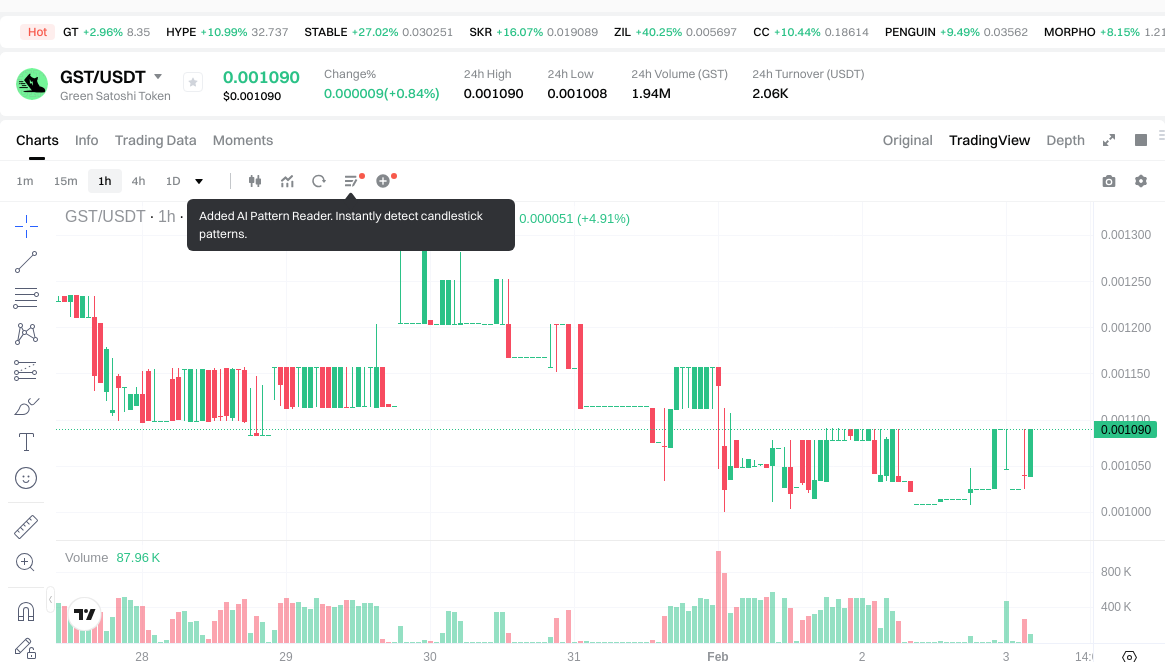
- GST Current Price: $0.001039
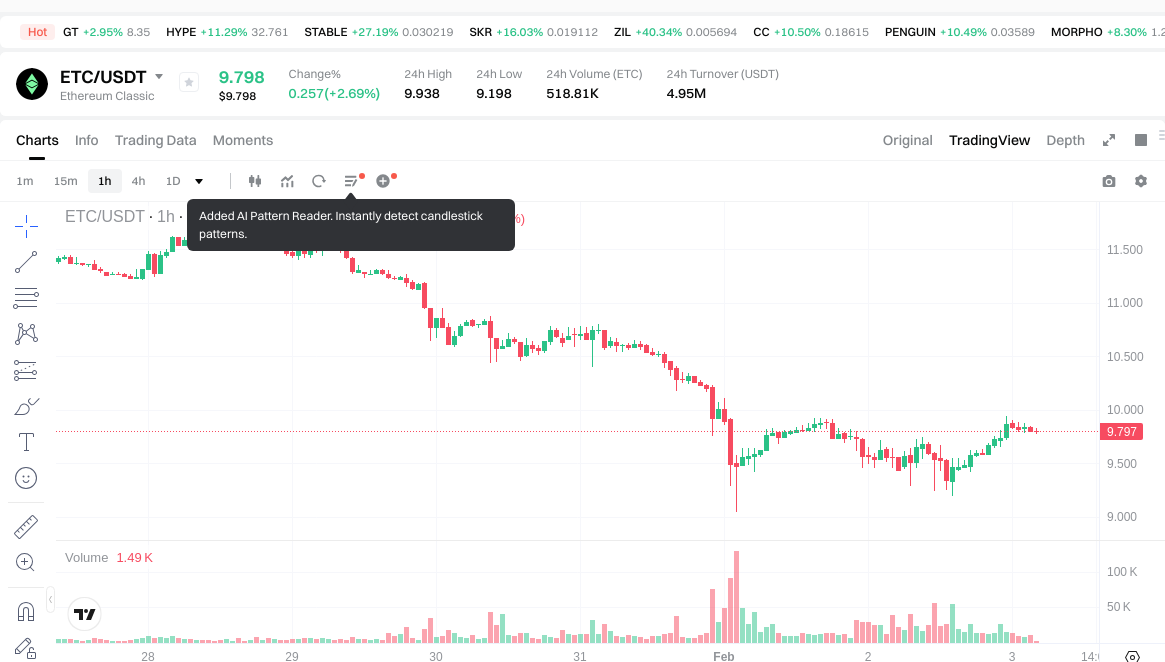
- ETC Current Price: $9.812
- 24-Hour Trading Volume: GST recorded $2,047.81 compared to ETC's significantly higher volume of $4,976,789.88
- Market Capitalization: GST stands at approximately $1.19 million, while ETC maintains a market cap of approximately $1.52 billion
- Market Sentiment Index (Fear & Greed Index): 14 (Extreme Fear)
View real-time prices:
II. Core Factors Influencing GST vs ETC Investment Value
Supply Mechanism Comparison (Tokenomics)
- GST (Green Satoshi Token): Unlimited supply mechanism. As a functional token within the STEPN ecosystem, users earn GST through physical activity and movement-based engagement.
- ETC (Ethereum Classic): Limited supply model with a programmed cap, following a deflationary issuance schedule similar to Bitcoin's halving mechanism.
- 📌 Historical Pattern: Supply mechanisms play a role in shaping price cycle dynamics, with limited supply models potentially creating scarcity-driven value appreciation during market expansion phases, while unlimited supply tokens depend more heavily on ecosystem demand and utility.
Institutional Adoption and Market Application
- Institutional Holdings: ETC has gained some recognition among institutional investors as an established blockchain platform, while GST remains primarily within its ecosystem-specific use cases.
- Enterprise Adoption: ETC has applications in smart contract deployment and decentralized application development, whereas GST focuses on fitness and health-related utility within the STEPN platform. Cross-border payment and settlement applications vary significantly between the two assets.
- Regulatory Landscape: Different jurisdictions maintain varying regulatory approaches toward utility tokens versus smart contract platforms, with ETC generally receiving broader recognition as an established blockchain network.
Technology Development and Ecosystem Building
- GST Technology Evolution: Development focuses on enhancing user engagement mechanisms and expanding fitness-related utilities within the STEPN ecosystem.
- ETC Technology Development: Maintains compatibility with Ethereum-based smart contracts while emphasizing immutability and resistance to protocol changes.
- Ecosystem Comparison: ETC supports DeFi protocols, NFT platforms, and smart contract applications, while GST operates within a more specialized fitness and movement-to-earn framework. The breadth of use cases differs substantially between the two platforms.
Macroeconomic Environment and Market Cycles
- Performance in Inflationary Environments: Supply mechanisms and market positioning influence how each asset responds to inflationary pressures, though conclusive long-term patterns require further observation.
- Macroeconomic Monetary Policy: Interest rate adjustments and US dollar index movements can affect risk appetite for cryptocurrency assets, potentially impacting both GST and ETC through different channels based on their market positioning.
- Geopolitical Factors: Cross-border transaction demand and international developments may influence broader cryptocurrency market sentiment, with established platforms potentially seeing different effects compared to ecosystem-specific tokens.
III. 2026-2031 Price Forecast: GST vs ETC
Short-term Forecast (2026)
- GST: Conservative $0.00080003 - $0.001039 | Optimistic $0.001039 - $0.00110134
- ETC: Conservative $8.53209 - $9.807 | Optimistic $9.807 - $14.02401
Mid-term Forecast (2028-2029)
- GST may enter a gradual growth phase, with estimated prices ranging from $0.000678915848 to $0.001346701928 in 2028, and $0.0010453634594 to $0.00164798474776 in 2029
- ETC may enter a consolidation phase, with estimated prices ranging from $7.59553866225 to $13.6968729975 in 2028, and $10.459430289 to $13.5972593757 in 2029
- Key drivers: institutional capital flows, ETF developments, ecosystem expansion
Long-term Forecast (2030-2031)
- GST: Baseline scenario $0.001007238439116 - $0.00143891205588 (2030) | Optimistic scenario $0.001042491784485 - $0.001985698637114 (2031)
- ETC: Baseline scenario $10.66861889478 - $13.335773618475 (2030) | Optimistic scenario $8.20950223953321 - $18.54739394857503 (2031)
View detailed price predictions for GST and ETC
Disclaimer
GST:
| Year |
Predicted High Price |
Predicted Average Price |
Predicted Low Price |
Price Change |
| 2026 |
0.00110134 |
0.001039 |
0.00080003 |
0 |
| 2027 |
0.0011557836 |
0.00107017 |
0.0005778918 |
3 |
| 2028 |
0.001346701928 |
0.0011129768 |
0.000678915848 |
7 |
| 2029 |
0.00164798474776 |
0.001229839364 |
0.0010453634594 |
18 |
| 2030 |
0.001870585672644 |
0.00143891205588 |
0.001007238439116 |
38 |
| 2031 |
0.001985698637114 |
0.001654748864262 |
0.001042491784485 |
59 |
ETC:
| Year |
Predicted High Price |
Predicted Average Price |
Predicted Low Price |
Price Change |
| 2026 |
14.02401 |
9.807 |
8.53209 |
0 |
| 2027 |
12.98790045 |
11.915505 |
8.22169845 |
21 |
| 2028 |
13.6968729975 |
12.451702725 |
7.59553866225 |
26 |
| 2029 |
13.5972593757 |
13.07428786125 |
10.459430289 |
33 |
| 2030 |
17.069790231648 |
13.335773618475 |
10.66861889478 |
35 |
| 2031 |
18.54739394857503 |
15.2027819250615 |
8.20950223953321 |
54 |
IV. Investment Strategy Comparison: GST vs ETC
Long-term vs Short-term Investment Strategies
- GST: May appeal to investors interested in emerging ecosystem-specific utility tokens with focus on fitness and move-to-earn applications. The asset exhibits higher volatility characteristics and remains closely tied to STEPN platform development and user adoption trends.
- ETC: May appeal to investors seeking exposure to established blockchain infrastructure with smart contract functionality. The asset offers positioning within the proof-of-work consensus mechanism landscape and broader decentralized application ecosystem participation.
Risk Management and Asset Allocation
- Conservative Investors: GST 5-10% vs ETC 15-25%, with consideration for maintaining substantial positions in established cryptocurrencies and traditional assets to balance portfolio risk exposure.
- Aggressive Investors: GST 15-25% vs ETC 25-35%, potentially suitable for those with higher risk tolerance and extended investment horizons, though individual circumstances vary significantly.
- Hedging Instruments: Stablecoin allocations for liquidity management, options strategies for downside protection, and cross-asset diversification to mitigate concentration risk.
V. Potential Risk Comparison
Market Risk
- GST: Subject to substantial volatility related to STEPN ecosystem performance, user engagement levels, and fitness application market trends. The token's price movements demonstrate sensitivity to platform-specific developments and broader sentiment toward move-to-earn models.
- ETC: Experiences volatility influenced by blockchain infrastructure market dynamics, competing smart contract platforms, and broader cryptocurrency market cycles. Price movements reflect both platform-specific developments and sector-wide trends affecting layer-1 blockchains.
Technical Risk
- GST: Scalability considerations relate to ecosystem expansion capacity and platform infrastructure development. Network stability depends on STEPN's technical architecture and user activity management capabilities.
- ETC: Network security considerations include mining concentration patterns and ongoing blockchain maintenance requirements. Scalability developments continue as the platform evolves its technical infrastructure.
Regulatory Risk
- Global regulatory frameworks demonstrate varying approaches toward utility tokens versus smart contract platforms. ETC's positioning as an established blockchain network may encounter different regulatory considerations compared to GST's ecosystem-specific utility model. Jurisdictional differences in cryptocurrency regulation continue to evolve, potentially affecting both assets through distinct channels based on their respective classifications and use cases.
VI. Conclusion: Which Is the Better Buy?
📌 Investment Value Summary:
- GST Characteristics: Positioning within move-to-earn ecosystem, unlimited supply mechanism, specialized fitness application focus, current market capitalization approximately $1.19 million, and price level of $0.001039.
- ETC Characteristics: Established blockchain platform with smart contract capabilities, limited supply model with deflationary issuance, broader ecosystem applications including DeFi and NFT support, market capitalization approximately $1.52 billion, and price level of $9.812.
✅ Investment Considerations:
- Beginning Investors: May consider starting with established blockchain platforms that demonstrate broader market recognition and liquidity characteristics, while maintaining diversified exposure across asset classes. Position sizing should reflect individual risk tolerance and investment objectives.
- Experienced Investors: May evaluate opportunities based on portfolio diversification needs, risk-adjusted return expectations, and conviction regarding specific ecosystem developments. Asset allocation decisions should incorporate thorough due diligence and align with overall investment strategy.
- Institutional Investors: May assess both assets within broader cryptocurrency allocation frameworks, considering factors including liquidity requirements, regulatory compliance considerations, custody solutions, and portfolio construction objectives. Risk management protocols and governance processes remain essential.
⚠️ Risk Disclosure: Cryptocurrency markets exhibit substantial volatility and carry significant investment risks. This content does not constitute investment advice, and individuals should conduct independent research and consult qualified financial professionals before making investment decisions.
VII. FAQ
Q1: What are the fundamental differences between GST and ETC that investors should understand?
GST and ETC represent distinctly different cryptocurrency asset classes. GST is an ecosystem-specific utility token within the STEPN move-to-earn platform with an unlimited supply mechanism and a current market cap of approximately $1.19 million. ETC is an established layer-1 blockchain platform supporting smart contracts, featuring a limited supply model with deflationary issuance and a market cap of approximately $1.52 billion. The key distinction lies in their use cases: GST focuses on fitness-related rewards within a single application, while ETC provides infrastructure for decentralized applications, DeFi protocols, and NFT platforms across a broader ecosystem.
Q2: How do the supply mechanisms of GST and ETC impact their long-term investment potential?
The supply mechanisms create fundamentally different scarcity dynamics. GST's unlimited supply means token value depends heavily on continuous ecosystem demand and user engagement within the STEPN platform, with no inherent scarcity mechanism to support price appreciation. ETC's limited supply model follows a deflationary issuance schedule similar to Bitcoin's halving mechanism, potentially creating scarcity-driven value during market expansion phases. Historical patterns suggest that limited supply models may offer more predictable long-term value preservation characteristics, though actual performance depends on sustained network adoption and utility demand.
Q3: Which asset demonstrates stronger institutional adoption and market liquidity?
ETC shows significantly stronger institutional recognition and market liquidity compared to GST. The 24-hour trading volume data illustrates this disparity: ETC recorded $4,976,789.88 versus GST's $2,047.81. ETC has gained recognition among institutional investors as an established blockchain platform with applications in smart contract deployment and decentralized application development. GST remains primarily confined to ecosystem-specific use cases within the STEPN fitness platform. The liquidity differential means ETC offers easier entry and exit opportunities for larger position sizes, while GST may present challenges for substantial capital deployment or liquidation.
Q4: What are the primary risk factors that differentiate GST and ETC investments?
GST carries concentrated ecosystem risk, with price performance heavily dependent on STEPN platform development, user engagement trends, and the broader move-to-earn market sentiment. Its substantially lower market capitalization ($1.19 million) and higher volatility profile create amplified downside risk during adverse market conditions. ETC faces risks related to blockchain infrastructure competition, mining concentration patterns, and smart contract platform market dynamics, but benefits from broader ecosystem diversification across DeFi, NFTs, and decentralized applications. Regulatory considerations also differ: GST's utility token classification may face distinct regulatory treatment compared to ETC's positioning as an established blockchain network with wider recognition across jurisdictions.
Q5: How do macroeconomic factors affect GST and ETC differently?
Macroeconomic conditions impact these assets through different channels based on their market positioning. ETC, as an established blockchain platform with broader institutional recognition, tends to respond more directly to cryptocurrency market-wide sentiment shifts driven by interest rate changes, US dollar movements, and risk appetite fluctuations. GST's performance remains more insulated from broad macro trends but highly sensitive to platform-specific adoption metrics and move-to-earn sector sentiment. During periods of monetary tightening and reduced risk appetite, established platforms like ETC may maintain relatively better liquidity and institutional support compared to ecosystem-specific tokens like GST that depend on sustained user engagement and platform growth.
Q6: What investment horizon is most appropriate for GST versus ETC?
The appropriate investment horizons differ significantly due to their distinct risk-return profiles. GST may suit shorter-term, higher-risk strategies focused on STEPN ecosystem developments and move-to-earn market trends, though its unlimited supply and concentrated use case create substantial uncertainty for extended holding periods. ETC's established blockchain infrastructure, broader ecosystem applications, and limited supply mechanism may align better with medium to long-term investment horizons for those seeking exposure to proof-of-work smart contract platforms. Price forecasts suggest ETC may offer more stable baseline scenarios through 2031 ($8.21-$18.55), while GST projections ($0.001-$0.002) remain highly dependent on platform-specific adoption trajectories.
Q7: How should portfolio allocation between GST and ETC vary based on risk tolerance?
Portfolio allocation recommendations reflect the substantial risk differential between these assets. Conservative investors might consider ETC allocations of 15-25% within cryptocurrency portfolios while limiting GST exposure to 5-10% or avoiding it entirely, maintaining substantial positions in established cryptocurrencies and traditional assets. Aggressive investors with higher risk tolerance and extended investment horizons might allocate 25-35% to ETC and 15-25% to GST, though such positioning requires careful consideration of individual circumstances, liquidity needs, and loss tolerance. The 24-hour trading volume disparity ($4.98 million for ETC versus $2,047 for GST) emphasizes the importance of position sizing relative to available liquidity, particularly for GST where larger positions may face execution challenges.
Q8: What technical developments could significantly impact the relative value of GST versus ETC?
Technical developments affecting relative value differ substantially between these assets. For GST, critical factors include STEPN platform scalability improvements, user engagement mechanism enhancements, ecosystem expansion beyond fitness applications, and potential integration with broader Web3 infrastructure. For ETC, significant developments involve network security improvements, scalability solutions, smart contract functionality upgrades, interoperability enhancements with other blockchain networks, and adoption growth across DeFi and NFT applications. ETC's broader technical ecosystem and established developer community suggest more diverse potential value drivers compared to GST's concentrated dependence on single-platform innovation and move-to-earn market evolution.
* The information is not intended to be and does not constitute financial advice or any other recommendation of any sort offered or endorsed by Gate.