This comprehensive analysis compares HELLO and DOGE meme coins, two distinct cryptocurrency assets with different market positions and investor profiles. DOGE dominates with $32.26M daily trading volume and institutional recognition through the 21Shares Dogecoin ETF on Nasdaq, while HELLO operates at $13K volume within the Web3 entertainment ecosystem. The article examines tokenomics disparities—DOGE's unlimited supply versus emerging alternatives—and institutional adoption advantages favoring DOGE. Historical price comparison reveals DOGE trading at $0.10761 versus HELLO at $0.001473 as of February 2026. Detailed analysis covers technology ecosystems, macroeconomic factors, and 2026-2031 price projections showing DOGE's potential appreciation to $0.2035-$0.2743 compared to HELLO's $0.00259-$0.00373. Strategic recommendations favor DOGE for conservative investors prioritizing liquidity and regulation compliance, while experienced traders may evaluate HELLO within diversified Web3 portfolios. Comprehensive ris
Introduction: HELLO vs DOGE Investment Comparison
In the cryptocurrency market, the comparison between HELLO and DOGE has been a topic that investors cannot avoid. The two not only have obvious differences in market cap ranking, application scenarios, and price performance, but also represent different crypto asset positioning.
HELLO (HELLO): Launched in 2013, it has gained market recognition by positioning itself as a Web3 ecosystem built around producing, incubating and distributing exclusive TV shows, games, NFTs and live events.
DOGE (DOGE): Since its inception in 2013, it has been regarded as a fun and light-hearted cryptocurrency, and is one of the cryptocurrencies with high global trading volume and market capitalization.
This article will comprehensively analyze the investment value comparison between HELLO and DOGE around historical price trends, supply mechanisms, institutional adoption, technical ecosystems and future predictions, and attempt to answer the question that investors are most concerned about:
"Which is the better buy right now?"
I. Historical Price Comparison and Current Market Status
HELLO (Coin A) and DOGE (Coin B) Historical Price Trends
- 2024: HELLO reached a notable price level of $0.210264 on January 1, 2024, representing a significant milestone in its trading history.
- 2021: DOGE experienced substantial price movement influenced by increased social media attention and celebrity endorsements, reaching $0.731578 on May 8, 2021.
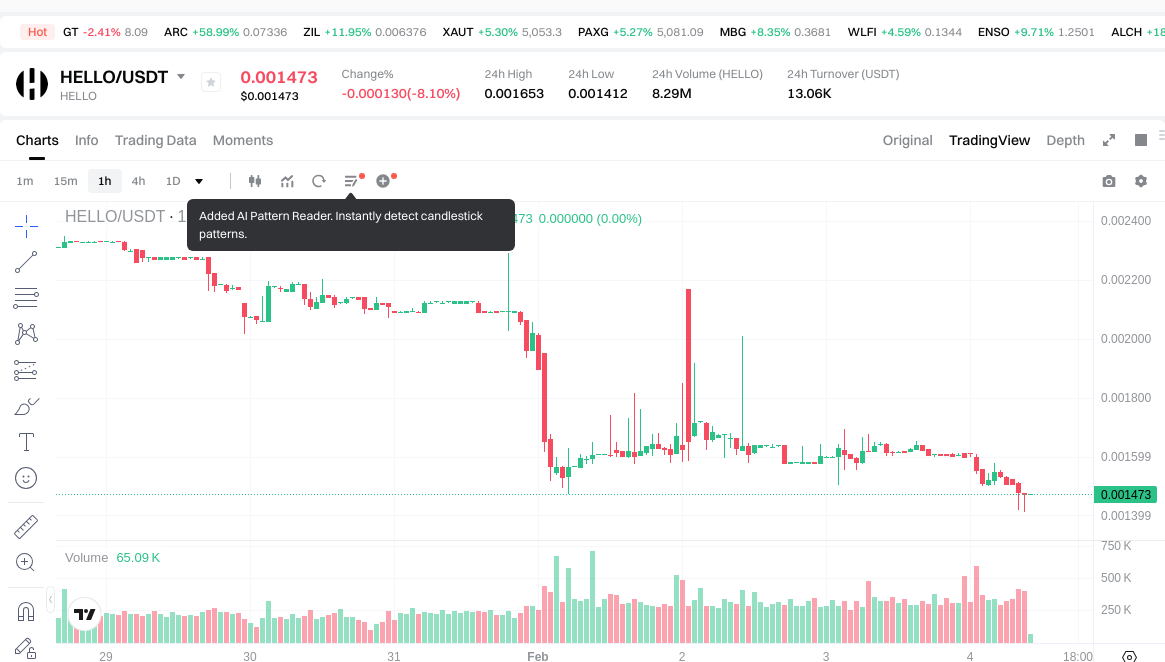
- Comparative Analysis: During recent market cycles, HELLO has declined from its peak of $0.210264 to a lower level of $0.00148635 recorded on February 4, 2026, while DOGE has declined from its high of $0.731578 to its current trading range.
Current Market Status (February 4, 2026)
- HELLO current price: $0.001473
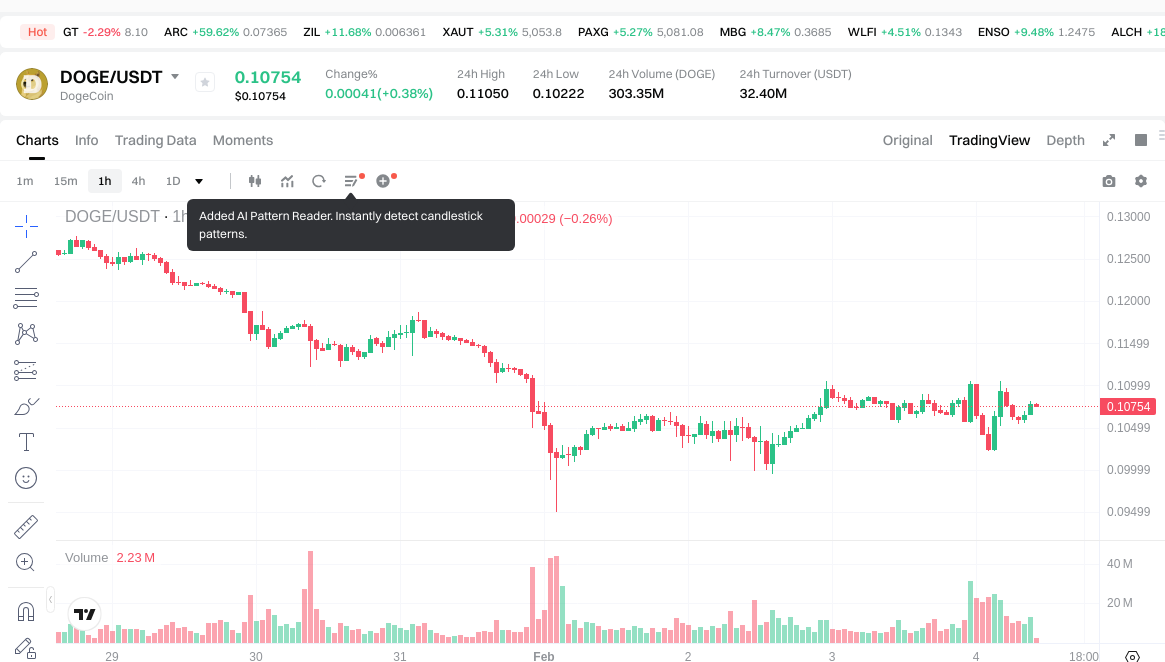
- DOGE current price: $0.10761
- 24-hour trading volume: HELLO $13,088.01 vs DOGE $32,262,119.71
- Market Sentiment Index (Fear & Greed Index): 14 (Extreme Fear)
View real-time prices:
- Check HELLO current price Market Price
- Check DOGE current price Market Price
II. Core Factors Influencing HELLO vs DOGE Investment Value
Supply Mechanism Comparison (Tokenomics)
- DOGE: Dogecoin operates under an inflationary model with no maximum supply cap. Approximately 5 billion new DOGE tokens are mined annually, creating continuous supply expansion that may exert downward pressure on unit price over extended periods.
- HELLO: Supply mechanism details for HELLO were not available in the provided materials.
- 📌 Historical Pattern: Supply mechanics play a structural role in price cyclicality. DOGE's unlimited issuance contrasts with deflationary or capped-supply models, potentially influencing long-term value retention characteristics.
Institutional Adoption and Market Application
- Institutional Holdings: DOGE has attracted institutional attention, evidenced by large-scale "whale" accumulation exceeding 1.08 billion DOGE tokens and inclusion in multiple diversified crypto indices. The launch of the 21Shares Dogecoin ETF on Nasdaq in January 2026 under ticker symbol 'TDOG' marks formal institutional recognition, offering compliant access for retirement accounts (IRA/401k) and institutional-grade custody.
- Corporate Adoption: DOGE benefits from sustained support by Tesla CEO Elon Musk, who has publicly confirmed personal holdings and described it as "the people's cryptocurrency." Potential integration of DOGE into X platform (formerly Twitter) payment services represents a catalyst for utility expansion. SpaceX maintains substantial Bitcoin positions, reinforcing connections between the Musk ecosystem and digital assets.
- National Policy: The 21Shares Dogecoin ETF represents regulatory acceptance in the U.S. market, transitioning DOGE from speculative instrument to recognized asset class alongside Bitcoin and Ethereum.
Technology Development and Ecosystem Construction
- DOGE Technology Development: Technical analysis indicators such as the "Supertrend" signal have shown bullish patterns reminiscent of historical rallies in 2017 and 2021, though these reflect market sentiment rather than fundamental protocol upgrades.
- HELLO Technology Development: No technology development information for HELLO was available in the provided materials.
- Ecosystem Comparison: DOGE's ecosystem centers on payment utility and cultural momentum rather than DeFi or smart contract functionality. Potential X platform integration could establish DOGE as a transactional medium within a major social network.
Macroeconomic Environment and Market Cycles
- Performance Under Inflation: During periods of macroeconomic uncertainty characterized by global inflation concerns and geopolitical tensions, demand for digital assets as value storage mechanisms may increase, potentially supporting both DOGE and similar tokens. However, DOGE's inflationary supply model presents structural differences compared to fixed-supply assets.
- Macroeconomic Monetary Policy: Market sentiment indicators currently reflect "extreme fear," with technical forecasts suggesting bearish potential if DOGE breaks below the critical support level of $0.117. Interest rate decisions and dollar index movements influence crypto market dynamics, as evidenced by the Federal Reserve's January 2026 rate hold exerting pressure on risk assets.
- Geopolitical Factors: Cross-border transaction demand and international developments contribute to cryptocurrency market flows, though specific HELLO or DOGE exposure to these factors was not detailed in the materials.
III. 2026-2031 Price Prediction: HELLO vs DOGE
Short-term Prediction (2026)
- HELLO: Conservative $0.00140 - $0.00147 | Optimistic $0.00147 - $0.00188
- DOGE: Conservative $0.0743 - $0.1077 | Optimistic $0.1077 - $0.1238
Mid-term Prediction (2028-2029)
- HELLO may enter a consolidation phase, with estimated price range of $0.00139 - $0.00269 in 2028, potentially expanding to $0.00181 - $0.00286 by 2029
- DOGE may enter a growth phase, with estimated price range of $0.1234 - $0.1650 in 2028, potentially reaching $0.1280 - $0.2114 by 2029
- Key drivers: institutional capital inflows, ETF developments, ecosystem expansion
Long-term Prediction (2030-2031)
- HELLO: Baseline scenario $0.00215 - $0.00259 | Optimistic scenario $0.00259 - $0.00373
- DOGE: Baseline scenario $0.0987 - $0.1828 | Optimistic scenario $0.2035 - $0.2743
View detailed price predictions for HELLO and DOGE
Disclaimer
HELLO:
| Year |
Predicted High Price |
Predicted Average Price |
Predicted Low Price |
Price Change |
| 2026 |
0.00188032 |
0.001469 |
0.00139555 |
0 |
| 2027 |
0.0022272978 |
0.00167466 |
0.0015574338 |
13 |
| 2028 |
0.002692350882 |
0.0019509789 |
0.001385195019 |
32 |
| 2029 |
0.00285564781593 |
0.002321664891 |
0.00181089861498 |
57 |
| 2030 |
0.003727665148989 |
0.002588656353465 |
0.002148584773375 |
75 |
| 2031 |
0.003568721648886 |
0.003158160751227 |
0.002147549310834 |
114 |
DOGE:
| Year |
Predicted High Price |
Predicted Average Price |
Predicted Low Price |
Price Change |
| 2026 |
0.123809 |
0.10766 |
0.0742854 |
0 |
| 2027 |
0.17128706 |
0.1157345 |
0.06018194 |
7 |
| 2028 |
0.165037397 |
0.14351078 |
0.1234192708 |
33 |
| 2029 |
0.211355501245 |
0.1542740885 |
0.128047493455 |
43 |
| 2030 |
0.25959700871895 |
0.1828147948725 |
0.09871998923115 |
69 |
| 2031 |
0.274295318226699 |
0.221205901795725 |
0.203509429652067 |
105 |
IV. Investment Strategy Comparison: HELLO vs DOGE
Long-term vs Short-term Investment Strategies
- HELLO: May appeal to investors seeking exposure to Web3 ecosystem projects focused on entertainment content, NFT distribution, and live event platforms, though current market metrics suggest limited liquidity and trading activity.
- DOGE: Suitable for investors prioritizing established market presence, institutional recognition through ETF availability, and payment utility scenarios, particularly those monitoring potential integration with major social platforms.
Risk Management and Asset Allocation
- Conservative Investors: HELLO 5-10% vs DOGE 15-20% within diversified crypto portfolio allocations, with remaining positions in established assets and stablecoins.
- Aggressive Investors: HELLO 10-15% vs DOGE 25-35% for higher risk tolerance profiles willing to accept volatility in pursuit of growth potential.
- Hedging Instruments: Stablecoin reserves (USDT, USDC) for capital preservation, options contracts for downside protection, cross-asset combinations balancing inflationary and deflationary tokenomics.
V. Comparative Risk Analysis
Market Risk
- HELLO: Lower liquidity evidenced by 24-hour trading volume of $13,088.01 may result in wider bid-ask spreads and difficulty executing larger position sizes without price impact. Current extreme fear sentiment (Fear & Greed Index: 14) compounds volatility exposure.
- DOGE: While exhibiting substantially higher liquidity ($32.26 million daily volume), DOGE remains susceptible to sentiment-driven price swings influenced by social media narratives and celebrity commentary. Technical indicators suggest bearish risk if support at $0.117 fails to hold.
Technical Risk
- HELLO: Limited information regarding network architecture, scalability solutions, or developer activity creates uncertainty around protocol resilience and long-term technical viability.
- DOGE: Network stability benefits from decade-long operational history, though mining concentration patterns and absence of smart contract functionality limit ecosystem expansion compared to newer blockchain platforms.
Regulatory Risk
- The January 2026 launch of 21Shares Dogecoin ETF (ticker: TDOG) on Nasdaq represents favorable regulatory development for DOGE, providing compliant access channels for institutional and retirement account investors. HELLO's regulatory status and compliance framework were not detailed in available materials, potentially presenting jurisdictional uncertainty for certain investor categories. Global regulatory evolution continues to influence classification, taxation treatment, and permissible use cases for both assets.
VI. Conclusion: Which Is the Better Buy?
📌 Investment Value Summary:
- HELLO Advantages: Positioning within Web3 entertainment sector aligns with content tokenization trends and NFT ecosystem development, though current market metrics indicate early-stage adoption challenges.
- DOGE Advantages: Established market infrastructure with institutional recognition via ETF product, substantial liquidity supporting entry and exit flexibility, ongoing corporate advocacy from prominent technology figures, and potential utility expansion through social platform payment integration.
✅ Investment Recommendations:
- Novice Investors: Consider DOGE for greater liquidity, institutional validation, and clearer regulatory framework, while maintaining exposure below 10-15% of total portfolio allocation. Utilize dollar-cost averaging to mitigate timing risk in volatile conditions.
- Experienced Investors: Evaluate DOGE for tactical positions aligned with technical pattern recognition and sentiment catalysts, while assessing HELLO within diversified Web3 thematic baskets if risk tolerance accommodates illiquidity and early-stage uncertainty.
- Institutional Investors: DOGE ETF structure offers compliant exposure mechanism with custody solutions and tax reporting infrastructure suitable for regulated portfolios, though position sizing should reflect digital asset volatility characteristics relative to traditional holdings.
⚠️ Risk Disclosure: Cryptocurrency markets demonstrate elevated volatility characteristics. This analysis does not constitute investment advice. Investors should conduct independent due diligence, assess personal risk tolerance, and consult qualified financial advisors before making allocation decisions.
VII. FAQ
Q1: Which cryptocurrency has better institutional support—HELLO or DOGE?
DOGE demonstrates significantly stronger institutional support. DOGE gained formal institutional recognition through the January 2026 launch of the 21Shares Dogecoin ETF (ticker: TDOG) on Nasdaq, providing compliant access for retirement accounts (IRA/401k) and institutional-grade custody solutions. Additionally, DOGE has attracted substantial "whale" accumulation exceeding 1.08 billion tokens and benefits from sustained corporate advocacy by Tesla CEO Elon Musk. In contrast, HELLO lacks documented institutional adoption, ETF products, or comparable corporate backing based on available market data.
Q2: What are the main differences in liquidity between HELLO and DOGE?
DOGE exhibits substantially superior liquidity compared to HELLO. As of February 4, 2026, DOGE's 24-hour trading volume reached $32,262,119.71, while HELLO recorded only $13,088.01—a difference exceeding 2,400 times. This liquidity disparity means DOGE investors can execute larger position sizes with minimal price impact and tighter bid-ask spreads, while HELLO holders may face difficulties entering or exiting positions without significant slippage, particularly during volatile market conditions.
Q3: How do the supply mechanisms of HELLO and DOGE differ in terms of long-term value retention?
DOGE operates under an inflationary tokenomics model with no maximum supply cap, minting approximately 5 billion new tokens annually. This continuous supply expansion may exert structural downward pressure on unit price over extended periods, contrasting with deflationary or fixed-supply cryptocurrencies. Unfortunately, supply mechanism details for HELLO were not available in the provided materials, preventing direct comparison. Investors should recognize that unlimited issuance models like DOGE's require sustained demand growth to maintain price appreciation, whereas capped-supply assets may benefit from scarcity dynamics.
Q4: What is the potential impact of X platform (formerly Twitter) integration on DOGE's value?
Potential integration of DOGE into X platform payment services represents a significant utility expansion catalyst. If implemented, this integration would establish DOGE as a transactional medium within a major social network, transitioning it from primarily speculative asset to functional payment instrument with real-world use cases. Given X's substantial user base and Elon Musk's ownership of both the platform and documented DOGE holdings, such integration could drive adoption velocity and transaction volume. However, investors should note this remains a potential development rather than confirmed implementation as of February 2026.
Q5: Which asset is more suitable for conservative investors—HELLO or DOGE?
DOGE is generally more appropriate for conservative crypto investors. Recommended allocation for conservative profiles suggests 15-20% DOGE versus only 5-10% HELLO within diversified cryptocurrency portfolios. DOGE's advantages for risk-averse investors include: (1) ETF structure offering regulated exposure with institutional custody, (2) decade-long operational history demonstrating network stability, (3) superior liquidity enabling efficient position management, and (4) clearer regulatory framework following SEC approval of ETF product. HELLO's limited liquidity, early-stage ecosystem development, and lack of institutional validation present elevated uncertainty unsuitable for conservative risk tolerance.
Q6: What are the key technical risks facing HELLO compared to DOGE?
HELLO faces greater technical uncertainty due to limited available information regarding network architecture, scalability solutions, and developer activity. This opacity creates ambiguity around protocol resilience and long-term technical viability. In contrast, DOGE benefits from decade-long operational history providing evidence of network stability and security, though it lacks smart contract functionality that limits ecosystem expansion potential. HELLO investors must accept elevated technical risk stemming from insufficient transparency, while DOGE investors face limitations in programmability and advanced blockchain features despite proven operational reliability.
Q7: How does current market sentiment affect HELLO and DOGE investment decisions?
As of February 4, 2026, the Fear & Greed Index registers 14, indicating "extreme fear" sentiment. This environment typically amplifies volatility for both assets, with HELLO's lower liquidity potentially magnifying price swings during panic selling. Technical analysis suggests DOGE faces bearish risk if the critical support level of $0.117 fails to hold. Conservative investors may consider delaying entry until sentiment stabilizes, while experienced traders might view extreme fear as contrarian buying opportunity. Dollar-cost averaging strategies can mitigate timing risk in such volatile conditions, particularly for DOGE given its superior liquidity for incremental position building.
Q8: What are the projected long-term price differences between HELLO and DOGE through 2031?
Price predictions through 2031 show divergent trajectories. HELLO's baseline scenario projects $0.00215-$0.00259 by 2030-2031 (optimistic: $0.00259-$0.00373), representing modest growth from current $0.001473 levels. DOGE's baseline scenario forecasts $0.0987-$0.1828 by 2030-2031 (optimistic: $0.2035-$0.2743), suggesting potential appreciation from current $0.10761. However, these projections carry substantial uncertainty given cryptocurrency market volatility. DOGE's institutional infrastructure and utility catalysts may support stronger growth fundamentals, while HELLO's Web3 entertainment positioning depends on sector-specific adoption trends. Investors should treat long-term predictions as speculative scenarios rather than guaranteed outcomes.
* The information is not intended to be and does not constitute financial advice or any other recommendation of any sort offered or endorsed by Gate.