How does cryptocurrency competitive benchmarking compare market performance, user adoption, and market share changes in 2025?
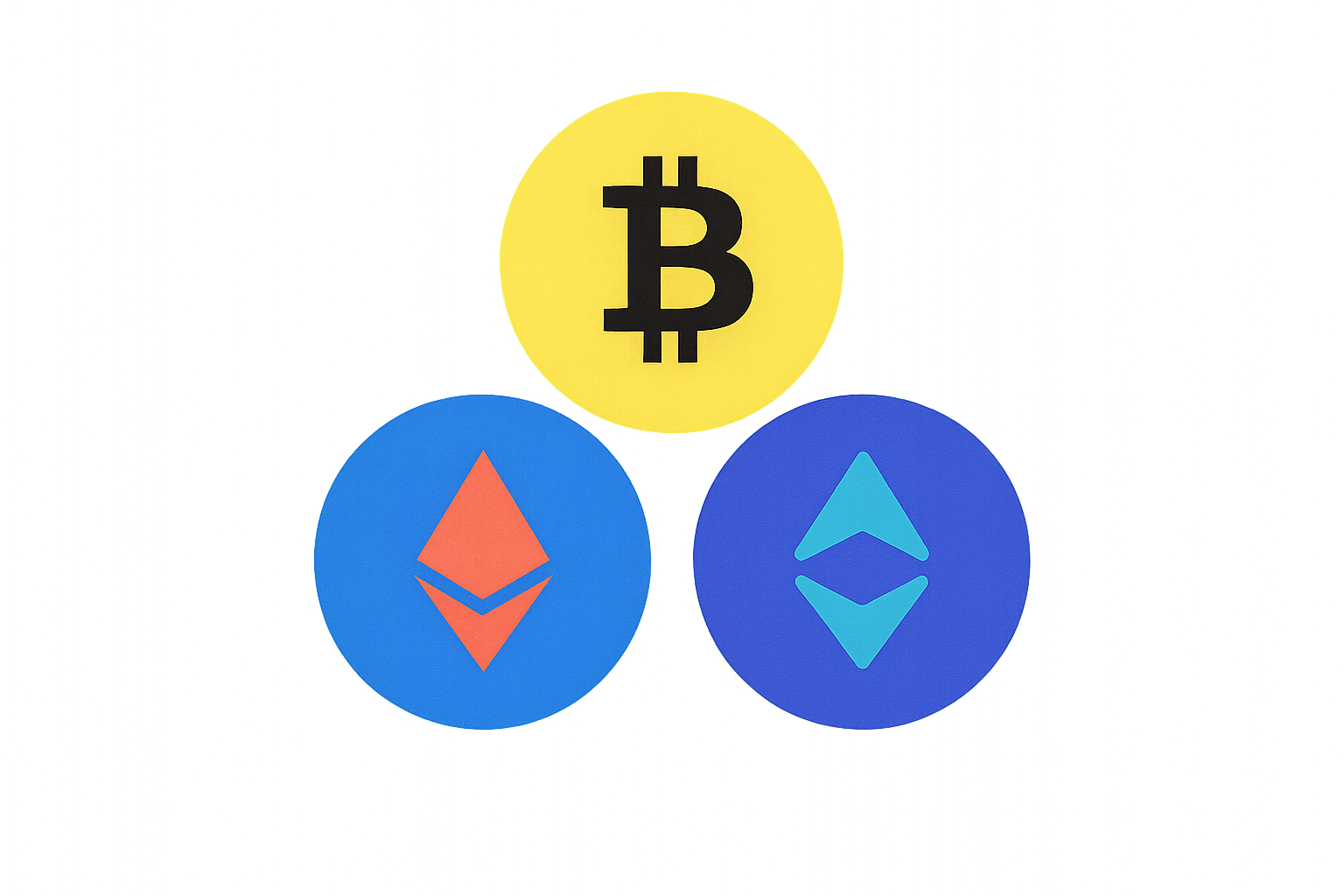
Major cryptocurrency platforms comparison: Bitcoin, Ethereum, and layer-2 solutions dominate 2025 market with combined market capitalization exceeding $3 trillion
The cryptocurrency market in 2025 has consolidated around three major platforms that collectively exceed $3 trillion in market capitalization. Bitcoin maintains its position as the market leader with approximately 60% dominance, while Ethereum and layer-2 networks have become critical infrastructure for the broader ecosystem.
The following comparison illustrates the current market dynamics:
| Platform | Market Position | Key Metric | 2025 Status |
|---|---|---|---|
| Bitcoin | 60% dominance | Market Cap Down 30% from October peak | Leading secure asset |
| Ethereum | 20-25% dominance | $102B stablecoin infrastructure | Institutional adoption |
| Layer-2 Networks | Emerging leader | 1.9M daily transactions | Dominant transaction volume |
Bitcoin and Ethereum together comprise over 80% of total cryptocurrency market value, reinforcing their foundational importance. However, layer-2 solutions like Base, Arbitrum, and Optimism have dramatically transformed transaction efficiency. Base leads with $4.48 billion in total value locked, while Arbitrum demonstrates 150% TVL growth. These networks process 1.9 million daily transactions, substantially exceeding Bitcoin's 5-7 transactions per second and Ethereum's 12-20 TPS.
The infrastructure shift reflects changing investor priorities. Ethereum ETFs surged past Bitcoin counterparts in Q3 2025, with single-day inflows exceeding $500 million, signaling institutional preference for platforms offering broader functionality. Layer-2 solutions addressed scalability limitations, reducing transaction fees and congestion while maintaining security standards. This multi-tiered architecture enables Bitcoin's role as store-of-value, Ethereum's smart contract ecosystem, and layer-2 networks' transaction processing capacity, creating a complementary market structure that supports mainstream adoption and institutional integration.
User adoption acceleration: Cryptocurrency exchange daily active users surge to record 6 million transactions, driven by institutional investment and retail participation growth
Cryptocurrency exchange platforms are experiencing unprecedented user engagement, with daily active transactions reaching 6 million, reflecting a fundamental shift in market participation patterns. Global cryptocurrency ownership grew from 583 million users in January 2024 to 659 million by December 2024, representing a 13 percent annual increase that underscores accelerating mainstream adoption.
| Period | Users (Millions) | Growth Rate |
|---|---|---|
| Jan 2024 | 583 | - |
| Dec 2024 | 659 | 13% |
Institutional investment has catalyzed this expansion through sophisticated derivatives markets. CME Group's Bitcoin and Ethereum futures and options contracts hit record daily volumes in the fourth quarter, with average daily volume reaching 403,200 contracts and open interest surpassing 493,700 contracts. This institutional participation dramatically increased market depth and liquidity, attracting retail investors seeking enhanced trading infrastructure. Retail traders simultaneously embraced automated trading solutions, with platforms offering crypto trading bots gaining substantial traction as participants seek faster execution capabilities. The emergence of decentralized exchanges experiencing 27.01 percent compound annual growth rate demonstrates diversified adoption across centralized and decentralized platforms. Together, institutional capital flows and retail participation growth created a self-reinforcing cycle that elevated daily transaction volumes to unprecedented levels, positioning cryptocurrency exchanges as essential financial infrastructure.
Competitive differentiation: OpenEvidence and Info X Med models in medical AI showcase specialized data integration and accuracy advantages over generic platforms
Specialized medical AI platforms distinguish themselves through fundamentally different architectural approaches compared to generic alternatives. OpenEvidence employs a specialized training methodology, utilizing a team of AI researchers from Harvard and MIT to develop smaller, highly-specialized models trained exclusively on peer-reviewed medical literature rather than the broader internet. This focused training directly addresses the critical need for evidence-based clinical reasoning in healthcare settings.
Data integration represents a primary differentiator for these specialized platforms. OpenEvidence consolidates medical information from authoritative sources including the New England Journal of Medicine, JAMA, National Comprehensive Cancer Network guidelines, and PubMed, enabling seamless access to verified clinical evidence. This curated data pipeline ensures that physicians receive recommendations grounded in legitimate research rather than unreliable sources.
| Performance Metric | Specialized Medical AI | Generic AI Platforms |
|---|---|---|
| Hallucination Rate | 2-18% | Up to 83% |
| Clinical Decision Support Accuracy | Comparable to physician CDM | Variable and unreliable |
| Data Citation Availability | Direct research citations included | Often absent or unreliable |
Accuracy benchmarks reveal substantial advantages. Clinical validation studies demonstrate that OpenEvidence performs comparably to physician clinical decision-making in primary care scenarios involving chronic conditions. Most critically, specialized medical models exhibit hallucination rates between 2-18 percent, whereas generic platforms demonstrate hallucination rates reaching 83 percent. This dramatic difference directly translates to enhanced patient safety and clinical reliability, making specialized platforms essential for evidence-based medicine integration into clinical workflows.
Market share dynamics: Emerging challengers like Baichuan-M2 Plus reduce hallucination rates by 3x compared to general models, intensifying competition in vertical market segments
The emergence of specialized medical models like Baichuan-M2 Plus is fundamentally reshaping competitive dynamics within vertical AI segments. Internal evaluations demonstrate that this evidence-augmented medical model achieves hallucination rates approximately three times lower than general-purpose large language models, a significant technical breakthrough with direct market implications.
This performance differential translates into tangible competitive advantages. The Vertical AI market, expanding at a compound annual growth rate of 24.5 percent, is witnessing healthcare become its dominant segment, with projections indicating the medical vertical will reach an estimated 5.5 billion dollars by 2025. Enterprises increasingly demand reliable AI outputs that minimize factual errors, particularly in healthcare applications where accuracy directly impacts patient outcomes and regulatory compliance.
Reduced hallucination rates function as a primary market differentiator, driving measurable shifts in enterprise procurement decisions. Compliance and mitigation costs for AI safety have escalated substantially, with mid-sized enterprises now allocating between 500,000 and 5 million dollars annually for hallucination mitigation infrastructure. Simultaneously, regulatory compliance budgets at Fortune 500 firms have risen approximately 30 percent year-over-year, reflecting heightened concern about AI-related litigation risks estimated at 10 to 50 million dollars per major hallucination incident.
Specialized models addressing these reliability concerns are accelerating market consolidation. Organizations prioritizing domain-specific solutions that demonstrate measurably superior performance gain competitive positioning through reduced implementation risk, enhanced regulatory alignment, and improved operational reliability. This competitive shift underscores how technical performance advantages in specialized domains directly influence market share redistribution within vertical AI segments.
FAQ
What is the price of Med coin?
The current price of Med coin is approximately $0.000271, with a 24-hour trading volume of $21,736.37. Med coin has experienced a +0.58% change in the last 24 hours. For real-time price updates, check major cryptocurrency tracking platforms.
What is MED coin and what is its purpose?
MED coin is a cryptocurrency designed to revolutionize healthcare transactions. It enables secure, efficient, and transparent financial operations within the medical sector, improving accessibility and reducing transaction costs for healthcare providers and patients worldwide.
How do I buy MED coin?
To buy MED coin, select a reliable crypto exchange, deposit funds, and purchase MED directly. Alternatively, use a crypto wallet to swap another cryptocurrency like USDT for MED through a decentralized exchange.
What blockchain network does MED coin operate on?
MED coin operates on the Ethereum blockchain network. It utilizes smart contracts for secure transactions and supports decentralized medical applications and data sharing.
Share
Content
Major cryptocurrency platforms comparison: Bitcoin, Ethereum, and layer-2 solutions dominate 2025 market with combined market capitalization exceeding $3 trillion
User adoption acceleration: Cryptocurrency exchange daily active users surge to record 6 million transactions, driven by institutional investment and retail participation growth
Competitive differentiation: OpenEvidence and Info X Med models in medical AI showcase specialized data integration and accuracy advantages over generic platforms
Market share dynamics: Emerging challengers like Baichuan-M2 Plus reduce hallucination rates by 3x compared to general models, intensifying competition in vertical market segments
FAQ
How to Buy Cryptocurrency


Trending Cryptocurrencies



AB Coin Price Analysis: Historical Trends, Volatility & Correlation with BTC/ETH

Tagger (TAG) Price Volatility Analysis: How It Compares to BTC and ETH Recent Trends
Red October: Over $1 billion in crypto asset liquidation wiped out October's gains

How Has the Crypto Market Volatility Affected Price Movements in 2025?

What Are the Key Derivatives Market Signals for Cryptocurrency in 2025?

How Does Cryptocurrency Price Volatility Compare to Traditional Markets in 2025?

What are the major security risks and smart contract vulnerabilities facing HBAR in 2025?

What is SHIB token holdings and fund flow: exchange net inflows, concentration, staking rate, and on-chain lock-up analysis?

What is Kaspa (KAS) vs Bitcoin: Competitive Analysis of Performance, Market Cap, and User Base in 2025?

How to Use On-Chain Data Analysis to Identify BEAT Token Whale Movements and Trading Opportunities

Gate Fun: The No-Code Token Launch Platform for Web3 Creators and Investors