How does OpenSea compare to Blur and Magic Eden: market share and valuation analysis in 2026
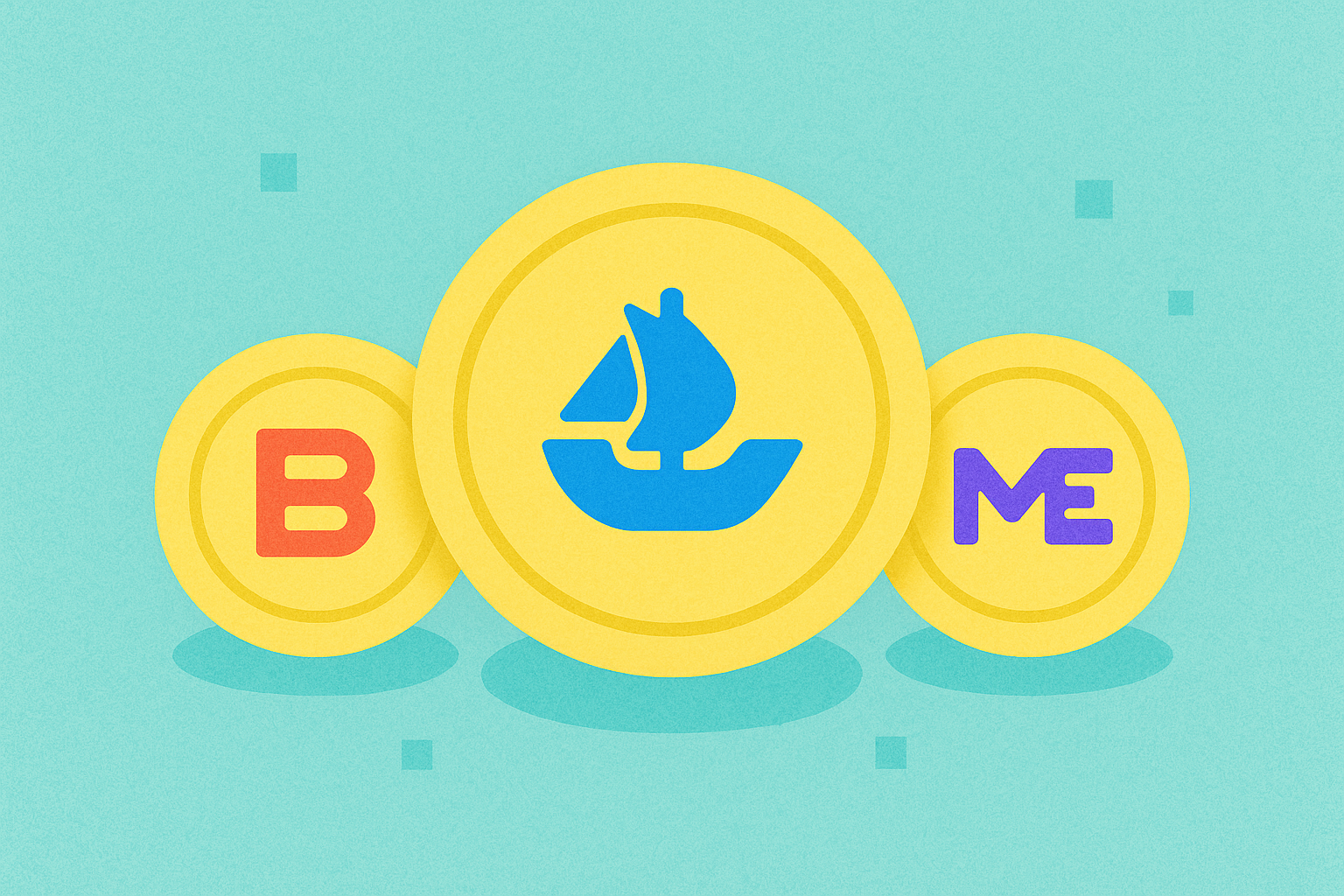
OpenSea's $3 billion valuation dominates the NFT marketplace ecosystem compared to Blur ($105M market cap) and Magic Eden ($57M market cap)
The valuation landscape of the NFT marketplace ecosystem reveals a striking disparity that underscores OpenSea's commanding position in the digital asset trading space. With a $3 billion valuation recognized by CB Insights, OpenSea's market standing towers exponentially above its nearest competitors. In contrast, Blur operates with a $105 million market cap, while Magic Eden maintains a $57 million valuation as of January 2026, creating a roughly 29-to-1 advantage for OpenSea in terms of marketplace valuation.
This substantial gap reflects more than mere financial metrics; it demonstrates the different market strategies and user bases each platform serves. OpenSea has maintained its position as the largest NFT marketplace by sustaining broad appeal across diverse blockchain networks and user experience levels. The platform processes approximately 1.7 million NFTs monthly, establishing itself as the clear leader in transaction volume and user adoption across multi-chain environments.
Meanwhile, Blur has carved out dominance in specific segments by targeting professional traders who prioritize speed and minimal fees, securing approximately 58% of Ethereum/EVM NFT marketplace volume at late 2025. Magic Eden distinguishes itself through specialization in Solana-based NFTs and gaming assets, capturing a dedicated user segment within the broader ecosystem. Each platform's valuation reflects its respective market penetration and revenue-generating capabilities within these targeted segments, though OpenSea's diversified approach and first-mover advantage have translated into substantially higher institutional valuation assessments.
Market share leadership: OpenSea maintains historical dominance while competitors gain traction with higher 30-day trading volumes
OpenSea's position as the market leader in 2026 remains uncontested, commanding approximately 90% of total NFT trading volume with $14.68 billion in annual transactions. Its 30-day trading volume of $175.7 million significantly exceeds competitors, reflecting its commanding control over the NFT marketplace landscape. With over 70% of active wallets engaging exclusively on its platform, OpenSea has successfully reclaimed and reinforced its dominance following earlier competitive pressures.
While Blur and Magic Eden have intensified their competitive efforts and gained meaningful traction within their specialized niches, they have not fundamentally eroded OpenSea's core market position. The distinction lies in how dominance is measured: OpenSea's leadership is anchored in absolute transaction volume and wallet engagement rather than growth velocity. Blur's emergence as a zero-fee alternative attracted professional traders, and Magic Eden's focus on Solana-native assets carved out a dedicated segment, yet these gains represent market expansion rather than share erosion from OpenSea's existing base. The platform's superior blockchain breadth, established liquidity pools, and diversified service offerings continue to attract both institutional and retail traders seeking comprehensive NFT marketplace solutions.
Token launch strategy: SEA token planned for Q1 2026 signals OpenSea's transformation and competitive differentiation in the market
OpenSea's SEA token represents a pivotal shift in its competitive positioning within the broader onchain economy. The token launch strategy, scheduled for Q1 2026, allocates 50% of supply directly to the community—particularly OG users and existing rewards program participants—demonstrating a community-first approach that emphasizes shared value creation. Coupled with the commitment to dedicate 50% of platform revenue to SEA buybacks, this mechanism creates a direct linkage between platform growth and token demand, establishing sustainable tokenomics. This structure enables users to stake SEA across their favorite collections or projects, deepening platform engagement and creating differentiation through utility-driven mechanics. The strategic timing and allocation underscore OpenSea's transformation from a pure NFT marketplace into a multi-chain trading platform supporting tokens, NFTs, and diverse digital assets. With the platform now processing $2.6 billion in monthly trading volume—over 90% from token trades rather than NFTs—the SEA launch validates this market shift. This token launch strategy fundamentally distinguishes OpenSea's competitive positioning by tying governance and economic incentives to platform utility rather than speculative value, a model that addresses evolving market demands in the decentralized trading landscape.
FAQ
What are OpenSea, Blur, and Magic Eden, and what are their respective main characteristics and advantages?
OpenSea is the largest NFT marketplace offering extensive asset support and broad user base. Blur targets professional traders with advanced pricing tools and lower fees. Magic Eden features user-friendly interface and strong artist support, excelling on Solana ecosystem.
2024-2026年这三个NFT交易平台的市场份额分别是多少,市场格局如何变化?
In 2024-2026, OpenSea maintained dominant market share around 50-55%, while Blur and Magic Eden gained ground with 20-25% and 15-20% respectively. The market shifted toward gaming and sports NFTs, with increased DeFi integration and real-world asset adoption.
What are the main differences between OpenSea, Blur and Magic Eden in transaction fees, user experience and features?
OpenSea offers the broadest multi-chain selection with user-friendly interface. Magic Eden specializes in Solana NFTs with low fees and fast transactions. Blur provides advanced professional tools and real-time analytics for experienced traders seeking deeper market insights.
Based on 2026 development trends, which of these three platforms is most competitive and why?
Blur demonstrates strongest competitiveness through superior trading volume efficiency and lower fees, capturing market share from OpenSea while Magic Eden dominates specialized segments. Blur's technological innovation and user experience drive dominance in 2026.
How does Magic Eden's development on Solana ecosystem and Bitcoin network affect its overall market position?
Magic Eden's dominance on Solana strengthens its market position significantly, while its Bitcoin presence remains emerging. The multi-chain strategy enhances competitiveness, positioning Magic Eden as a leading cross-chain NFT platform with expanded market reach and potential revenue diversification.
What advantages does Blur's incentive mechanism and professional trader strategy have compared to OpenSea?
Blur incentivizes liquidity through token rewards and lower fees, attracting professional traders with faster order matching and collection bidding features. OpenSea maintains broader user base but Blur's pro-trader focus drives higher secondary trading volume.
What is the valuation forecast for the NFT market in 2026, and what valuation levels might these three platforms reach respectively?
The 2026 NFT market valuation is projected to reach hundreds of billions of dollars. OpenSea, Blur, and Magic Eden are estimated to achieve valuations of 50-80 billion, 30-50 billion, and 20-40 billion dollars respectively, driven by institutional adoption and data monetization.
What are the differences between these three platforms in terms of security, user protection, and compliance?
OpenSea prioritizes multi-signature wallets and insurance funds. Blur emphasizes real-time fraud detection and KYC verification. Magic Eden focuses on decentralized security protocols and regulatory compliance. All three maintain different security standards and user protection mechanisms tailored to their respective ecosystems.
Share
Content
OpenSea's $3 billion valuation dominates the NFT marketplace ecosystem compared to Blur ($105M market cap) and Magic Eden ($57M market cap)
Market share leadership: OpenSea maintains historical dominance while competitors gain traction with higher 30-day trading volumes
Token launch strategy: SEA token planned for Q1 2026 signals OpenSea's transformation and competitive differentiation in the market
FAQ
How to Buy Cryptocurrency


Trending Cryptocurrencies



How to Withdraw Money from Crypto Exchanges in 2025: A Beginner's Guide

Hedera Hashgraph (HBAR): Founders, Technology, and Price Outlook to 2030
Jasmy Coin: A Japanese Crypto Tale of Ambition, Hype, and Hope

IOTA (MIOTA) – From Tangle Origins to 2025 Price Outlook
Bitcoin Price in 2025: Analysis and Market Trends

How to Trade Bitcoin in 2025: A Beginner's Guide
What is Polygon?

What is a Price Pattern?

6 Best Web3 Marketing Agencies To Support Your Crypto Project
7 Ways to Earn Passive Income with Cryptocurrencies

What is EYWA: A Comprehensive Guide to the Revolutionary Ecosystem for Digital Asset Management and Decentralized Finance