This comprehensive guide compares HTM (Hatom) and GRT (The Graph) as cryptocurrency investment opportunities. HTM, launched in 2023, positions itself as a DeFi ecosystem builder on MultiversX offering lending protocols and liquid staking. GRT, established in 2020, functions as decentralized blockchain data indexing infrastructure within the Ethereum ecosystem. The analysis examines historical price performance—HTM declined from $3.788 to $0.01793, while GRT fell from $2.84 to $0.03069—alongside critical factors including trading volume, supply mechanisms, institutional adoption, and technological development. The article provides detailed investment strategies tailored for beginner, experienced, and institutional investors, offering 70-80% GRT and 20-30% HTM allocation for conservative portfolios. Price forecasts through 2031 suggest both tokens' growth potential under optimistic scenarios. Risk assessments address market volatility, regulatory considerations, and liquidity disparities, establishing GRT's sup
Introduction: HTM vs GRT Investment Comparison
In the cryptocurrency market, the comparison between HTM and GRT has been a topic that investors cannot avoid. The two not only have significant differences in market cap ranking, application scenarios, and price performance, but also represent different crypto asset positioning.
HTM (Hatom): Launched in 2023, it has gained market recognition through its positioning in building a complete DeFi ecosystem on MultiversX, offering lending protocols, liquid staking, native stablecoins, and other DeFi services.
GRT (The Graph): Since its launch in 2020, it has been regarded as a decentralized protocol for indexing and querying blockchain data, becoming one of the key infrastructure projects in the Ethereum ecosystem.
This article will comprehensively analyze the investment value comparison of HTM vs GRT around historical price trends, supply mechanisms, institutional adoption, technical ecosystem, and future predictions, and attempt to answer the question that investors care about most:
"Which is the better buy right now?"
I. Historical Price Comparison and Current Market Status
HTM (Coin A) and GRT (Coin B) Historical Price Trends
- 2023: HTM reached its historical high of $3.788 on November 23, 2023, marking a significant peak in its market performance.
- 2021: GRT experienced notable price movement when it achieved its all-time high of $2.84 on February 12, 2021, driven by increasing adoption of blockchain data indexing services.
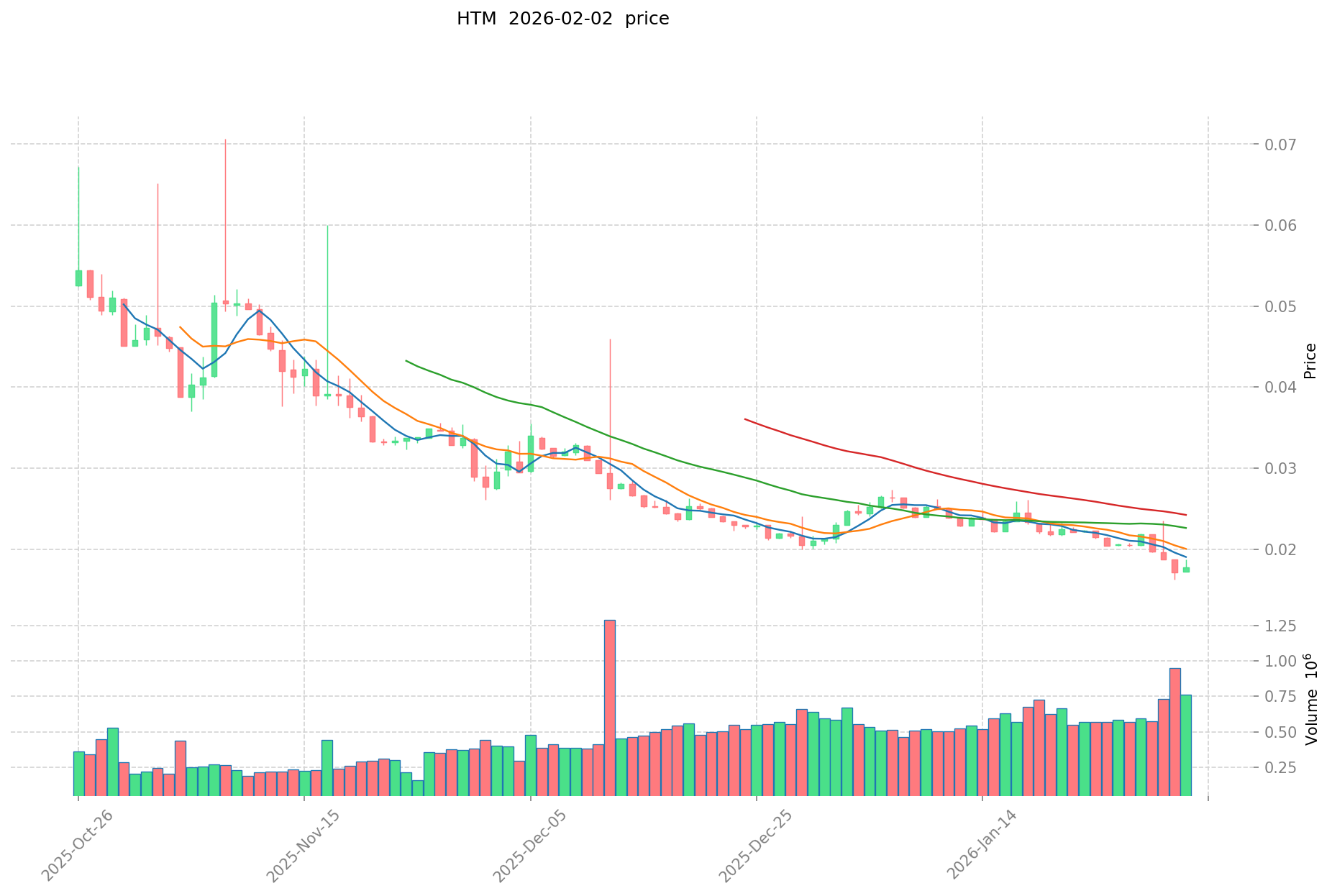
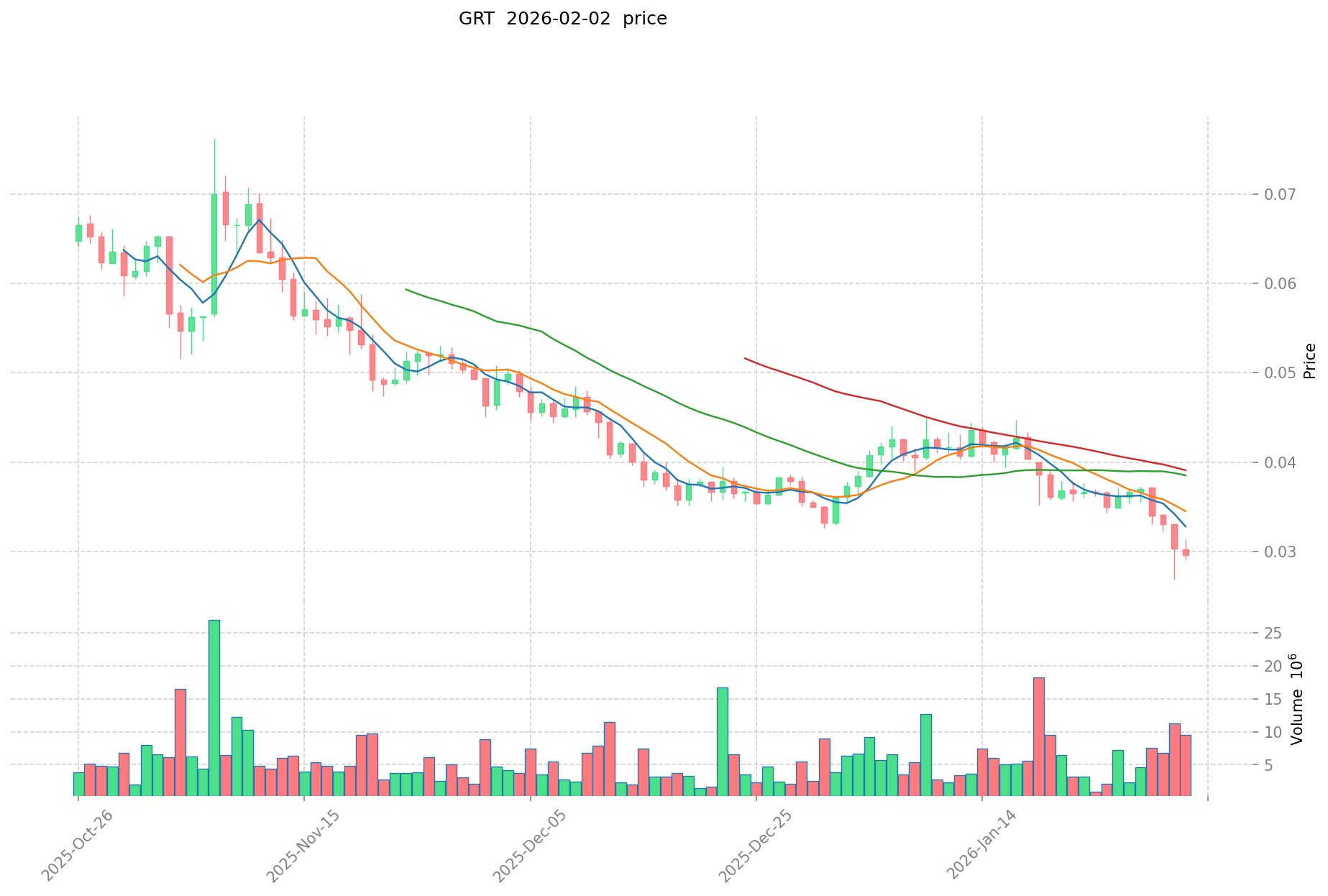
- Comparative Analysis: During the recent market cycle, HTM declined from $3.788 to its current level of $0.01793, representing substantial downward pressure. Meanwhile, GRT experienced a similar trend, dropping from $2.84 to approximately $0.03069, though maintaining a relatively higher price point compared to its historical range.
Current Market Status (February 3, 2026)
- HTM current price: $0.01793
- GRT current price: $0.03069
- 24-hour trading volume: HTM recorded $12,536.86 compared to GRT's significantly higher volume of $373,386.23
- Market sentiment index (Fear & Greed Index): 14 (Extreme Fear)
View real-time prices:
II. Core Factors Influencing HTM vs GRT Investment Value
Supply Mechanism Comparison (Tokenomics)
- HTM: Supply mechanism information is not available in the provided materials.
- GRT: Supply mechanism information is not available in the provided materials.
- 📌 Historical Pattern: Supply mechanisms can influence price cycles through scarcity dynamics and emission schedules, though specific data for these tokens remains unavailable.
Institutional Adoption and Market Application
- Institutional Holdings: Comparative data on institutional preference between HTM and GRT is not available in the provided materials.
- Enterprise Adoption: Information regarding enterprise-level adoption of HTM or GRT in cross-border payments, settlements, or investment portfolios is not available.
- National Policies: Regulatory attitudes toward these specific tokens across different jurisdictions are not documented in the provided materials.
Technological Development and Ecosystem Building
- HTM Technology Upgrades: According to available materials, HTM relates to healthcare technology management benchmarking practices, suggesting applications in clinical engineering departments rather than blockchain technology. Specific upgrade information is not available.
- GRT Technology Development: Technology development details and potential impacts for GRT are not available in the provided materials.
- Ecosystem Comparison: Comparative analysis of DeFi, NFT, payment systems, and smart contract implementations between HTM and GRT is not available in the provided materials.
Macroeconomic Factors and Market Cycles
- Performance in Inflationary Environments: The provided materials discuss general investment principles, noting that lower operational risks and efficient capital deployment can enhance value. However, specific anti-inflation attributes of HTM or GRT are not documented.
- Macroeconomic Monetary Policy: According to investment framework materials, factors such as interest rates and capital costs can affect asset valuations. The specific impact on HTM and GRT remains undocumented in available sources.
- Geopolitical Factors: While the materials reference global economic conditions and cross-border considerations in various contexts, specific geopolitical impacts on HTM and GRT investments are not available.
III. 2026-2031 Price Forecast: HTM vs GRT
Short-term Forecast (2026)
- HTM: Conservative $0.0129-$0.0179 | Optimistic $0.0179-$0.0249
- GRT: Conservative $0.0212-$0.0307 | Optimistic $0.0307-$0.0429
Mid-term Forecast (2028-2029)
- HTM may enter a gradual growth phase, with estimated price range of $0.0136-$0.0330 in 2028 and $0.0213-$0.0303 in 2029
- GRT may enter a consolidation phase, with estimated price range of $0.0316-$0.0449 in 2028 and $0.0264-$0.0562 in 2029
- Key drivers: institutional capital inflows, ETF developments, ecosystem expansion
Long-term Forecast (2030-2031)
- HTM: Baseline scenario $0.0187-$0.0292 (2030), $0.0323-$0.0359 (2031) | Optimistic scenario $0.0426 (2030), $0.0470 (2031)
- GRT: Baseline scenario $0.0398-$0.0497 (2030), $0.0313-$0.0614 (2031) | Optimistic scenario $0.0731 (2030), $0.0817 (2031)
View detailed price predictions for HTM and GRT
Disclaimer
HTM:
| Year |
Predicted High Price |
Predicted Average Price |
Predicted Low Price |
Price Change |
| 2026 |
0.0248671 |
0.01789 |
0.0128808 |
0 |
| 2027 |
0.024799118 |
0.02137855 |
0.01710284 |
19 |
| 2028 |
0.03301703262 |
0.023088834 |
0.01362241206 |
28 |
| 2029 |
0.0302971679748 |
0.02805293331 |
0.0213202293156 |
56 |
| 2030 |
0.042595573937904 |
0.0291750506424 |
0.018672032411136 |
62 |
| 2031 |
0.047009759100099 |
0.035885312290152 |
0.032296781061136 |
100 |
GRT:
| Year |
Predicted High Price |
Predicted Average Price |
Predicted Low Price |
Price Change |
| 2026 |
0.042924 |
0.03066 |
0.0211554 |
0 |
| 2027 |
0.04635792 |
0.036792 |
0.01876392 |
19 |
| 2028 |
0.0449009568 |
0.04157496 |
0.0315969696 |
35 |
| 2029 |
0.05620934592 |
0.0432379584 |
0.026375154624 |
40 |
| 2030 |
0.0730937686752 |
0.04972365216 |
0.039778921728 |
62 |
| 2031 |
0.081673584855408 |
0.0614087104176 |
0.031318442312976 |
100 |
IV. Investment Strategy Comparison: HTM vs GRT
Long-term vs Short-term Investment Strategies
- HTM: May suit investors seeking exposure to DeFi ecosystem developments on MultiversX, particularly those interested in lending protocols and liquid staking innovations. The token's historical volatility suggests it may appeal to investors with higher risk tolerance and longer investment horizons.
- GRT: May suit investors focused on blockchain infrastructure and data indexing services within the Ethereum ecosystem. Given its established position since 2020, it may attract investors seeking exposure to fundamental Web3 infrastructure components.
Risk Management and Asset Allocation
- Conservative Investors: HTM 20-30% vs GRT 70-80% allocation may balance exposure between emerging DeFi protocols and established infrastructure projects
- Aggressive Investors: HTM 50-60% vs GRT 40-50% allocation could provide higher risk-reward potential while maintaining diversification across different blockchain ecosystems
- Hedging Tools: Stablecoin reserves for portfolio rebalancing, options strategies for downside protection, cross-asset portfolio construction incorporating both infrastructure and DeFi segments
V. Potential Risk Comparison
Market Risks
- HTM: Exhibits substantial price volatility, declining from $3.788 to $0.01793, representing exposure to market sentiment shifts and limited liquidity as evidenced by 24-hour trading volume of $12,536.86. The current Extreme Fear sentiment (Fear & Greed Index: 14) may amplify downside volatility.
- GRT: Demonstrates significant price fluctuation from $2.84 to $0.03069, though maintains higher trading volume of $373,386.23, suggesting relatively better liquidity compared to HTM. Market sentiment remains influenced by broader cryptocurrency market conditions.
Technical Risks
- HTM: Specific technical infrastructure details regarding scalability and network stability are not documented in available materials. As a DeFi protocol on MultiversX, it may face challenges related to smart contract security and protocol upgrades.
- GRT: Technical risk factors including network expansion capabilities and potential security vulnerabilities are not detailed in provided materials. As a decentralized indexing protocol, it may encounter challenges related to data accuracy and query efficiency.
Regulatory Risks
- Global regulatory frameworks continue to evolve, with differing approaches across jurisdictions potentially impacting both tokens. DeFi-focused projects like HTM may face scrutiny regarding lending protocols and stablecoin operations, while infrastructure protocols like GRT may encounter regulatory considerations related to data management and cross-chain operations. Specific regulatory impacts remain subject to ongoing policy developments.
VI. Conclusion: Which Is the Better Buy?
📌 Investment Value Summary:
- HTM Advantages: Exposure to comprehensive DeFi ecosystem on MultiversX including lending protocols, liquid staking, and native stablecoins; launched in 2023 with focus on emerging DeFi infrastructure
- GRT Advantages: Established position since 2020 as decentralized protocol for blockchain data indexing; recognized as key infrastructure within Ethereum ecosystem; higher trading volume indicating better liquidity
✅ Investment Recommendations:
- Beginner Investors: Consider starting with GRT due to its established infrastructure role, higher liquidity, and longer operational history. Allocate smaller portions to HTM only after understanding DeFi protocols and MultiversX ecosystem dynamics.
- Experienced Investors: May construct diversified portfolios incorporating both tokens, with GRT providing infrastructure exposure and HTM offering DeFi ecosystem participation. Consider 60-70% GRT and 30-40% HTM allocation based on risk tolerance and market outlook.
- Institutional Investors: Evaluate both tokens within broader cryptocurrency infrastructure and DeFi segments. GRT may align with infrastructure-focused strategies, while HTM could serve as tactical allocation for DeFi ecosystem exposure, subject to thorough due diligence and risk assessment frameworks.
⚠️ Risk Disclaimer: The cryptocurrency market exhibits extreme volatility. This content does not constitute investment advice. Investors should conduct independent research and consult qualified financial advisors before making investment decisions.
VII. FAQ
Q1: What are the main differences between HTM and GRT in terms of their fundamental use cases?
HTM and GRT serve fundamentally different purposes within the cryptocurrency ecosystem. HTM focuses on building a comprehensive DeFi ecosystem on MultiversX, offering services including lending protocols, liquid staking, and native stablecoins since its 2023 launch. In contrast, GRT operates as a decentralized protocol for indexing and querying blockchain data, functioning as critical infrastructure within the Ethereum ecosystem since 2020. While HTM targets financial service applications within DeFi, GRT addresses the foundational need for organized blockchain data accessibility across Web3 applications.
Q2: Which token demonstrates better liquidity and why does this matter for investors?
GRT exhibits significantly better liquidity with a 24-hour trading volume of $373,386.23 compared to HTM's $12,536.86. This liquidity difference matters substantially for investors because higher trading volumes typically enable easier entry and exit positions, reduce slippage during trades, and indicate broader market participation. For investors seeking to execute larger transactions or requiring the flexibility to adjust positions quickly in response to market conditions, GRT's superior liquidity provides meaningful practical advantages over HTM.
Q3: How have HTM and GRT performed since their respective all-time highs?
Both tokens have experienced substantial declines from their historical peaks. HTM reached its all-time high of $3.788 on November 23, 2023, and has since declined to $0.01793, representing approximately 99.5% downward movement. GRT achieved its peak of $2.84 on February 12, 2021, and currently trades at $0.03069, marking roughly 98.9% decline. These significant retracements reflect both broader cryptocurrency market cycles and individual project-specific factors. Despite similar percentage declines, GRT maintains a higher absolute price point and demonstrates greater trading activity.
Q4: What allocation strategy should conservative investors consider between HTM and GRT?
Conservative investors should consider a weighted allocation favoring GRT at 70-80% with HTM comprising 20-30% of the combined position. This strategy prioritizes GRT's established infrastructure role, longer operational history since 2020, and superior liquidity metrics. The smaller HTM allocation provides exposure to emerging DeFi ecosystem developments on MultiversX while limiting risk exposure to the newer protocol. Conservative investors should also maintain stablecoin reserves for portfolio rebalancing and implement risk management tools appropriate to their investment timeline and risk tolerance.
Q5: What are the projected price ranges for HTM and GRT through 2031?
Price forecasts suggest divergent trajectories for both tokens through 2031. For HTM, conservative estimates project ranges from $0.0129-$0.0179 in 2026, expanding to $0.0187-$0.0292 by 2030, with optimistic scenarios reaching $0.0470 by 2031. GRT forecasts indicate conservative ranges from $0.0212-$0.0307 in 2026, growing to $0.0398-$0.0497 by 2030, with optimistic projections reaching $0.0817 by 2031. These projections depend on multiple factors including institutional capital flows, ecosystem expansion, and broader market conditions. Investors should note that cryptocurrency price predictions carry substantial uncertainty and should not constitute the sole basis for investment decisions.
Q6: What market risks should investors consider when comparing HTM and GRT?
Both tokens face significant market risks characteristic of cryptocurrency assets. HTM exhibits extreme volatility, having declined approximately 99.5% from its peak, coupled with limited liquidity as reflected in its $12,536.86 daily trading volume. GRT demonstrates substantial price fluctuation as well, though its higher trading volume of $373,386.23 provides relatively better market depth. The current market sentiment shows Extreme Fear (Fear & Greed Index: 14), potentially amplifying downside volatility for both tokens. Investors should recognize that cryptocurrency markets can experience rapid, significant price movements driven by sentiment shifts, regulatory developments, technological changes, or macroeconomic factors affecting the broader digital asset sector.
Q7: How do regulatory risks differ between HTM and GRT?
Regulatory risks affect HTM and GRT differently based on their operational focuses. HTM, as a DeFi-focused protocol offering lending services and stablecoins, may face scrutiny regarding financial service regulations, securities classifications, and consumer protection frameworks that various jurisdictions apply to decentralized lending platforms. GRT, operating as a data indexing infrastructure protocol, may encounter regulatory considerations related to data management standards, cross-chain operation compliance, and potential classification as utility infrastructure. Both tokens remain subject to evolving global regulatory frameworks for cryptocurrency assets, with specific impacts depending on jurisdictional approaches to DeFi protocols versus blockchain infrastructure services.
Q8: What factors should experienced investors evaluate when constructing a portfolio including both HTM and GRT?
Experienced investors should conduct comprehensive evaluation across multiple dimensions when incorporating both tokens. Critical factors include ecosystem positioning—GRT's infrastructure role versus HTM's DeFi application focus—providing complementary exposure across cryptocurrency sectors. Liquidity analysis reveals GRT's significant advantage in trading volume, affecting position management capabilities. Historical performance patterns demonstrate both tokens' exposure to market cycles and volatility characteristics. Technical development trajectories, including MultiversX ecosystem growth for HTM and Ethereum infrastructure expansion for GRT, influence long-term value propositions. Risk-adjusted allocation strategies might employ 60-70% GRT and 30-40% HTM ratios, adjusted based on individual risk tolerance, market outlook, and correlation analysis with broader portfolio holdings. Implementation should include defined rebalancing triggers, stop-loss parameters, and ongoing monitoring of project developments affecting fundamental investment theses.
* The information is not intended to be and does not constitute financial advice or any other recommendation of any sort offered or endorsed by Gate.