Artrade (ATR) is a Solana-based utility token for the first marketplace dedicated to art real-world assets (RWA) tokenization, launched in March 2022. This comprehensive analysis examines whether ATR represents a viable investment opportunity by evaluating its market performance, technical fundamentals, and future potential. The token has experienced significant volatility, declining 96.04% from its all-time high of $0.104 to current levels near $0.001192, while maintaining a market cap of approximately $1.5 million with limited trading volume on Gate and three other exchanges. The analysis addresses core investment considerations including supply dynamics, ecosystem development, short to long-term price forecasts (ranging from $0.00101-$0.00302 by 2031), and substantial risk factors such as regulatory uncertainty and liquidity constraints. Strategic recommendations are provided for beginners, experienced traders, and institutional investors, alongside essential risk management protocols and secure storage so
Introduction: Artrade (ATR)'s Investment Position and Market Outlook
Artrade (ATR) represents a notable asset in the cryptocurrency sector, having launched in March 2022 as the first marketplace for art real-world assets (RWA). As of February 2026, ATR maintains a market capitalization of approximately $1.50 million, with a circulating supply of around 1.26 billion tokens, and trades at approximately $0.001192. Positioned as a pioneering platform in the art RWA space, ATR has become a focal point for investors exploring "Is Artrade (ATR) a good investment?" The token serves as the utility mechanism within the Artrade ecosystem, facilitating transactions and interactions in the art tokenization marketplace. This article provides a comprehensive analysis of ATR's investment characteristics, historical price movements, future price outlook, and associated investment risks to inform investor decision-making.
I. Artrade (ATR) Price History Review and Current Investment Value
- 2024: ATR reached a notable price level of $0.104 on April 3, 2024 → Investors experienced significant gains during this period, reflecting positive market sentiment towards the project's art RWA marketplace positioning.
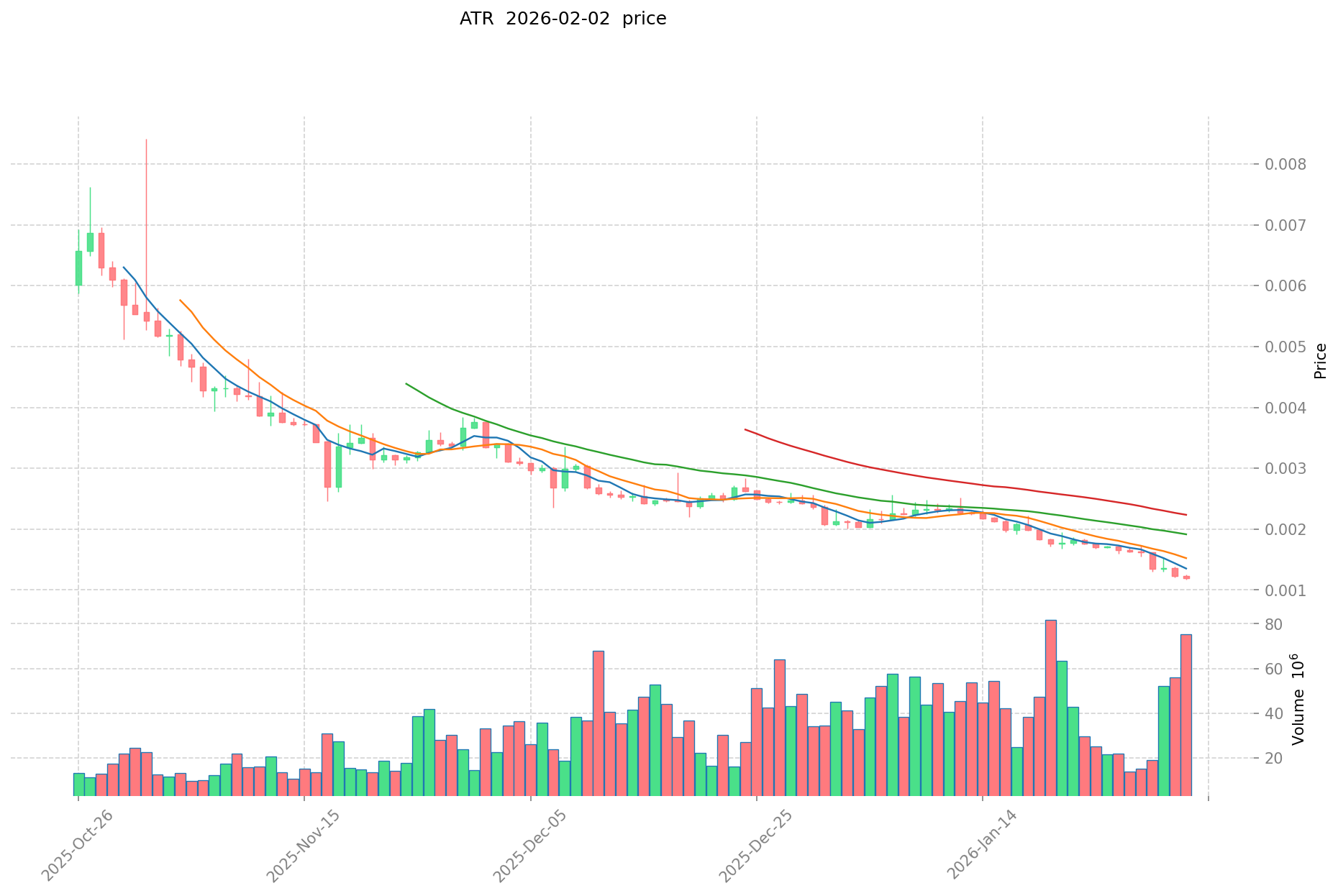
- 2025-2026: Market correction phase → ATR price declined from elevated levels to $0.001168 recorded on February 1, 2026, representing a substantial adjustment in valuation.
- Past year performance: Market cycle transition → Price movement showed a decline of approximately 96.04% over the one-year period, indicating challenging market conditions for the token.
Current ATR Investment Market Status (February 2026)
- ATR current price: $0.001192
- Market sentiment (Fear & Greed Index): Data not available in reference materials
- 24-hour trading volume: $89,523.10
- Institutional investor holdings: Holder count stands at 12,777 addresses
Click to view real-time ATR market price
II. Core Factors Affecting Whether ATR is a Good Investment
Supply Mechanism and Scarcity (ATR Investment Scarcity)
- Maximum Supply and Circulating Supply → Impact on Price and Investment Value
- According to the reference materials, ATR has a maximum supply of 1,800,000,000 tokens, with a circulating supply of approximately 1,260,104,055 tokens as of February 2, 2026. The circulating ratio stands at approximately 70.01%, indicating that a significant portion of the total supply is already in circulation. This supply distribution may influence the token's scarcity profile.
- Historical Price Performance: ATR reached a notable price level of $0.104 on April 3, 2024, while experiencing a lower price point of $0.001168 on February 1, 2026. The current price as of February 2, 2026, is $0.001192, reflecting various market dynamics over time.
- Investment Significance: The relationship between circulating supply and maximum supply, combined with market cap to fully diluted valuation ratio of 70.01%, represents factors that investors may consider when evaluating long-term scarcity dynamics.
- Recent Price Movements: Over the past 24 hours, ATR experienced a price change of -4.28%, with a trading volume of $89,523.10. The 7-day price change shows -30.75%, while the 30-day change indicates -44.31%, and the 1-year change reflects -96.04%.
- Price Volatility: The 24-hour high was $0.001257 and the 24-hour low was $0.001168, demonstrating price fluctuation within the recent trading period.
- Market Capitalization: As of February 2, 2026, ATR's market capitalization stands at approximately $1,502,044, with a fully diluted market cap of approximately $2,138,725. The market dominance is recorded at 0.000078%.
Technology and Ecosystem Development (Technology & Ecosystem for ATR Investment)
- Platform Foundation: ATR operates within the Solana ecosystem as an SPL token, as indicated by the algorithm designation "SOL" and the contract address on the Solana blockchain (ATRLuHph8dxnPny4WSNW7fxkhbeivBrtWbY6BfB4xpLj).
- Project Focus: Artrade positions itself as a marketplace for art RWA (real world assets), powered by the ATR token. This represents a specialized application within the broader blockchain ecosystem.
- Holder Base: As of the reference date, ATR has approximately 12,777 token holders, which may reflect the current level of community participation and token distribution.
- Development Resources: The project maintains a presence on GitHub (https://github.com/artradeapp/Artrade-base-smart-contract), providing transparency regarding its technical development efforts.
Market Accessibility and Exchange Presence
- Exchange Availability: ATR is listed on 4 exchanges according to the reference materials, which represents the current level of market accessibility for potential investors.
- Initial Offering: The token's publish price was recorded at $0.0401 on March 23, 2022, providing context for its price development since launch.
- Trading Infrastructure: The token is available for trading on Gate.com, as indicated by the "is_gate" parameter, offering one avenue for market participants to access ATR.
III. ATR Future Investment Forecast and Price Outlook (Is Artrade(ATR) worth investing in 2026-2031)
Short-term Investment Forecast (2026, short-term ATR investment outlook)
- Conservative forecast: $0.00101 - $0.00118
- Neutral forecast: $0.00118 - $0.00135
- Optimistic forecast: $0.00135 - $0.00150
Based on market data as of February 2, 2026, ATR is trading at $0.001192, showing notable volatility with a 30.75% decline over the past seven days. The short-term outlook suggests continued price consolidation within the range of $0.001007 to $0.001505, with technical indicators pointing to elevated market volatility.
Mid-term Investment Outlook (2027-2028, mid-term Artrade(ATR) investment forecast)
- Market stage expectation: Recovery and stabilization phase, with potential gradual upward momentum as the art RWA marketplace gains traction
- Investment return forecast:
- 2027: $0.000699 - $0.00165 (estimated 12% annual growth)
- 2028: $0.00114 - $0.00177 (estimated 25% cumulative growth from 2026)
- Key catalysts: Platform development progress, expansion of art tokenization services, regulatory clarity for RWA assets, and broader market recovery trends
The mid-term outlook anticipates ATR could experience moderate growth if the project successfully executes its marketplace strategy and gains adoption among art collectors and investors seeking fractional ownership opportunities.
Long-term Investment Outlook (Is ATR a good long-term investment?)
- Base scenario: $0.00150 - $0.00208 by 2031 (assuming steady development and moderate market adoption)
- Optimistic scenario: $0.00208 - $0.00302 by 2031 (assuming successful platform expansion, increased art tokenization volume, and favorable RWA sector growth)
- Risk scenario: $0.00070 - $0.00100 (under adverse conditions such as prolonged market downturn, regulatory challenges, or failure to achieve user adoption targets)
Click to view ATR long-term investment and price forecast: Price Prediction
2026-02-02 to 2031 Long-term Outlook
- Base scenario: $0.00150 - $0.00208 (corresponding to steady progress and gradual mainstream application enhancement)
- Optimistic scenario: $0.00208 - $0.00302 (corresponding to large-scale adoption and favorable market conditions)
- Transformative scenario: Above $0.00302 (contingent upon breakthrough ecosystem developments and mainstream penetration)
- 2031-12-31 forecast high: $0.00302 (based on optimistic development assumptions)
Disclaimer: Price forecasts are based on historical data analysis and predictive models. Cryptocurrency investments carry substantial risk due to extreme volatility, regulatory uncertainties, and market unpredictability. Past performance does not guarantee future results. The information provided is for reference purposes only and does not constitute investment advice. Investors should conduct thorough due diligence, assess their risk tolerance, and consult qualified financial advisors before making investment decisions. Never invest more than you can afford to lose.
| Year |
Predicted High Price |
Predicted Average Price |
Predicted Low Price |
Price Change |
| 2026 |
0.00150495 |
0.001185 |
0.00100725 |
0 |
| 2027 |
0.00165431925 |
0.001344975 |
0.000699387 |
12 |
| 2028 |
0.0017695836075 |
0.001499647125 |
0.001139731815 |
25 |
| 2029 |
0.002206730744437 |
0.00163461536625 |
0.001291346139337 |
37 |
| 2030 |
0.002247187474752 |
0.001920673055343 |
0.001574951905381 |
61 |
| 2031 |
0.003021698884319 |
0.002083930265048 |
0.001500429790834 |
74 |
IV. Artrade (ATR) Investment Strategy and Risk Management (How to invest in Artrade)
Investment Methodology (Artrade investment strategy)
Long-term Holding (HODL Artrade)
For conservative investors seeking steady exposure to the art RWA marketplace sector, a long-term holding strategy may be considered. This approach involves:
- Accumulating ATR tokens during market downturns or consolidation phases
- Focusing on the project's fundamental development rather than short-term price movements
- Maintaining positions through market cycles to potentially benefit from the growth of art tokenization adoption
Given ATR's significant price decline of 96.04% over the past year and current trading near its historical low of $0.001168, long-term investors should carefully evaluate the project's roadmap and market positioning before committing capital.
Active Trading
For traders with technical analysis expertise, ATR presents opportunities through:
- Short-term swing trading: Capitalizing on the token's volatility, with recent 24-hour price ranges between $0.001168 and $0.001257
- Technical indicator monitoring: Tracking support and resistance levels, particularly around the historical low price point
- Volume analysis: With 24-hour trading volume of approximately $89,523, traders should assess liquidity conditions before executing larger positions
Risk Management (Risk management for Artrade investment)
Asset Allocation Recommendations
Conservative Investors:
- Allocate no more than 1-2% of total crypto portfolio to ATR
- Prioritize established cryptocurrencies with higher market capitalizations
- Consider ATR as a speculative micro-cap position
Aggressive Investors:
- May allocate 3-5% to small-cap tokens like ATR within a diversified crypto portfolio
- Balance exposure with more stable assets
- Set strict stop-loss parameters given the token's volatility
Professional Investors:
- Conduct thorough due diligence on the art RWA sector
- Consider ATR as part of a thematic basket of tokenized asset platforms
- Implement dynamic rebalancing strategies based on market conditions
Risk Hedging Strategies
- Multi-asset portfolio construction: Combine ATR exposure with uncorrelated crypto assets and traditional investments
- Hedging tools: Consider using stablecoin reserves to quickly exit positions during adverse market movements
- Position sizing: Given ATR's ranking at #2242 by market capitalization and a market cap of approximately $1.5 million, limit position sizes to manage concentration risk
Secure Storage Solutions
Cold Wallet Storage:
- Hardware wallets compatible with Solana-based tokens (ATR contract address: ATRLuHph8dxnPny4WSNW7fxkhbeivBrtWbY6BfB4xpLj)
- Ledger and Trezor devices with Solana support
- Paper wallets for long-term holdings with proper backup procedures
Hot Wallet Options:
- Phantom Wallet or Solflare for active trading and DApp interactions
- Enable two-factor authentication and use strong passwords
- Keep only trading amounts in hot wallets, transfer majority to cold storage
Best Practices:
- Verify contract addresses on Solana Explorer before transactions
- Never share private keys or seed phrases
- Regularly update wallet software and firmware
V. Artrade (ATR) Investment Risks and Challenges (Risks of investing in Artrade)
Market Risks
High Volatility:
- ATR has experienced substantial price fluctuations, with a 30.75% decline over 7 days and 44.31% decline over 30 days as of February 2, 2026
- The token's 24-hour price range shows intraday volatility between $0.001168 and $0.001257
- Historical data indicates a 96.04% decline from all-time high of $0.104 (reached on April 3, 2024) to current levels
Price Manipulation Concerns:
- With a relatively low 24-hour trading volume of $89,523 and market capitalization of approximately $1.5 million, the token may be susceptible to price manipulation
- Limited exchange availability (listed on 4 exchanges) may concentrate liquidity and increase manipulation risks
- Market dominance of 0.000078% indicates minimal institutional participation
Liquidity Risks:
- Lower trading volumes may result in wider bid-ask spreads
- Difficulty executing large orders without significant price impact
- Potential challenges when attempting to exit positions during market stress
Regulatory Risks
Policy Uncertainty Across Jurisdictions:
- The art RWA (Real World Assets) sector faces evolving regulatory frameworks globally
- Securities regulations may apply to tokenized art assets, creating compliance obligations
- Different countries maintain varying approaches to crypto asset classification and taxation
Compliance Challenges:
- Art tokenization platforms may require adherence to both cryptocurrency and traditional art market regulations
- Anti-money laundering (AML) and know-your-customer (KYC) requirements may evolve
- Cross-border transaction regulations could impact platform accessibility
Technical Risks
Network Security Vulnerabilities:
- As a Solana-based token, ATR's security is partly dependent on the underlying blockchain's stability
- Smart contract vulnerabilities in the ATR token contract (ATRLuHph8dxnPny4WSNW7fxkhbeivBrtWbY6BfB4xpLj) could pose risks
- Historical blockchain network outages or congestion may affect transaction processing
Platform-Specific Risks:
- The success of ATR is tied to the Artrade marketplace's adoption and user growth
- Technical issues with the art tokenization platform could impact token utility
- Integration challenges between blockchain technology and traditional art market infrastructure
Upgrade and Development Risks:
- Dependence on continuous platform development and feature releases
- Potential bugs or issues during protocol upgrades
- Competition from other art tokenization platforms may affect market position
Project-Specific Concerns
Circulating Supply Dynamics:
- Current circulating supply: 1,260,104,055 ATR (70.01% of maximum supply)
- Remaining 29.99% of tokens may enter circulation, potentially creating selling pressure
- Token unlock schedules and vesting periods should be monitored
Market Position:
- Ranking #2242 indicates limited market recognition compared to established projects
- Approximately 12,777 holders suggest a relatively small community base
- Market cap to fully diluted valuation ratio of 70.01% indicates moderate token distribution
VI. Conclusion: Is Artrade (ATR) a Good Investment?
Investment Value Summary
Artrade (ATR) represents a specialized exposure to the emerging art RWA (Real World Assets) marketplace sector. As the first platform focused on art tokenization, the project addresses a niche market at the intersection of traditional art markets and blockchain technology.
Long-term Potential Considerations:
- The tokenization of real-world art assets represents an innovative application of blockchain technology
- Growth of the RWA sector could provide tailwinds for specialized platforms
- Current valuation near historical lows may present entry opportunities for risk-tolerant investors
Short-term Volatility Factors:
- The token has experienced substantial price declines, with a 96.04% decrease from its all-time high
- Current price of $0.001192 remains close to the historical low of $0.001168
- Recent negative momentum across multiple timeframes (1H: -0.42%, 24H: -4.28%, 7D: -30.75%, 30D: -44.31%) indicates ongoing selling pressure
Investor Recommendations
✅ Beginners:
- Consider dollar-cost averaging (DCA) to mitigate timing risks
- Allocate only capital you can afford to lose completely
- Prioritize secure storage using hardware wallets compatible with Solana
- Educate yourself on art tokenization and RWA concepts before investing
- Start with minimal exposure while learning about the project's development
✅ Experienced Investors:
- Implement swing trading strategies based on technical analysis
- Monitor key support levels around the historical low price point
- Diversify across multiple crypto sectors rather than concentrating in micro-cap tokens
- Set predetermined profit targets and stop-loss levels
- Track on-chain metrics and trading volume trends for entry/exit signals
✅ Institutional Investors:
- Conduct comprehensive due diligence on the art RWA sector's regulatory landscape
- Evaluate ATR as part of a thematic allocation to tokenized assets
- Assess the competitive positioning of Artrade within the art tokenization space
- Consider strategic positioning with small allocations pending further market validation
- Monitor token unlock schedules and circulating supply changes
Key Considerations
Risk Factors to Monitor:
- Continued price decline and proximity to all-time lows
- Limited liquidity with $89,523 in 24-hour trading volume
- Small market capitalization of approximately $1.5 million
- Dependence on art market adoption of blockchain technology
Potential Opportunities:
- First-mover advantage in the art RWA marketplace niche
- Possible undervaluation relative to sector potential
- Growing institutional interest in tokenized real-world assets
⚠️ Important Disclaimer: Cryptocurrency investments carry substantial risks, including the potential for complete loss of capital. Artrade (ATR) is a micro-cap token with high volatility and limited liquidity. This analysis is for informational purposes only and does not constitute financial advice, investment recommendations, or an endorsement to buy, sell, or hold any cryptocurrency. Always conduct your own research, consult with qualified financial advisors, and consider your personal financial situation, risk tolerance, and investment objectives before making any investment decisions. Past performance does not guarantee future results.
VII. FAQ
Q1: What is Artrade (ATR) and what makes it unique in the cryptocurrency market?
Artrade (ATR) is the native utility token of the first marketplace dedicated to art real-world assets (RWA) tokenization, launched in March 2022. As a Solana-based SPL token, ATR facilitates transactions and interactions within the Artrade ecosystem, which specializes in fractional ownership of art assets through blockchain technology. What distinguishes ATR from other cryptocurrencies is its focused application in bridging traditional art markets with decentralized finance, allowing collectors and investors to access previously illiquid art markets through tokenization. The platform operates on the Solana blockchain (contract address: ATRLuHph8dxnPny4WSNW7fxkhbeivBrtWbY6BfB4xpLj), providing a specialized infrastructure for art asset digitization.
Q2: What has been ATR's historical price performance and current market status?
ATR reached its all-time high of $0.104 on April 3, 2024, but has since experienced significant price correction, currently trading at approximately $0.001192 as of February 2, 2026, representing a 96.04% decline from peak levels. Recent performance shows continued negative momentum with a 30.75% decrease over 7 days and 44.31% decline over 30 days. The token maintains a market capitalization of approximately $1.50 million with 12,777 holders, ranking #2242 in the cryptocurrency market. With 24-hour trading volume at $89,523 and a circulating supply of 1.26 billion tokens (70.01% of maximum supply), ATR currently trades near its historical low of $0.001168, presenting both risk and potential opportunity for investors evaluating entry points.
Q3: What are the main risks associated with investing in ATR?
ATR presents several significant investment risks that potential investors should carefully consider. First, high volatility and price decline have been substantial, with the token losing 96.04% of its value from all-time highs and showing continued downward pressure across multiple timeframes. Second, liquidity concerns arise from relatively low trading volume ($89,523 daily) and limited exchange availability (4 exchanges), which may result in wider spreads and difficulty executing large orders. Third, regulatory uncertainty surrounding art RWA tokenization across different jurisdictions creates compliance challenges. Fourth, project-specific risks include dependence on Artrade platform adoption, competition from other tokenization platforms, and the remaining 29.99% of tokens yet to enter circulation. Finally, as a micro-cap token with a market capitalization of only $1.5 million, ATR is susceptible to potential price manipulation and extreme market volatility.
Q4: What investment strategies are appropriate for different types of ATR investors?
Investment strategies for ATR should vary based on investor experience and risk tolerance. For beginners, a dollar-cost averaging (DCA) approach is recommended, allocating only 1-2% of crypto portfolio with capital you can afford to lose completely, while prioritizing secure storage using Solana-compatible hardware wallets. For experienced investors, active trading strategies may include swing trading based on technical analysis, monitoring support levels around the historical low ($0.001168), and implementing strict stop-loss parameters given the token's volatility. For institutional investors, a more strategic approach involves comprehensive due diligence on the art RWA sector, thematic allocation to tokenized assets (small positions pending market validation), and continuous monitoring of token unlock schedules and regulatory developments. Regardless of investor type, diversification across multiple crypto sectors and secure storage practices are essential risk management measures.
Q5: What is the long-term price outlook for ATR through 2031?
Based on analytical modeling, ATR's long-term price forecast presents several scenarios. In the base scenario, ATR could trade between $0.00150-$0.00208 by 2031, assuming steady development and moderate market adoption in the art tokenization sector. The optimistic scenario projects $0.00208-$0.00302 by 2031, contingent upon successful platform expansion, increased art tokenization volume, and favorable RWA sector growth. The risk scenario suggests potential trading between $0.00070-$0.00100 under adverse conditions such as prolonged market downturn or failure to achieve user adoption targets. For 2026 specifically, short-term forecasts indicate consolidation between $0.00101-$0.00150. However, investors should note that these projections carry substantial uncertainty due to the token's current volatility, limited track record, and dependence on nascent art tokenization market development.
Q6: How does ATR's tokenomics and supply structure affect its investment potential?
ATR's tokenomics feature a maximum supply of 1.8 billion tokens, with approximately 1.26 billion currently in circulation (70.01% of total supply). This means roughly 540 million tokens (29.99%) remain to be released, which could create future selling pressure depending on unlock schedules and vesting terms. The current market cap to fully diluted valuation ratio of 70.01% indicates moderate token distribution compared to projects with significantly lower circulation ratios. With a relatively small holder base of 12,777 addresses, the token's distribution may be concentrated, potentially affecting price stability. The combination of current price near historical lows ($0.001192 versus initial publish price of $0.0401 in March 2022), substantial circulating supply, and remaining tokens yet to enter the market creates a complex scarcity profile that investors should carefully evaluate when assessing long-term value proposition.
Q7: What secure storage solutions are recommended for holding ATR tokens?
Since ATR is a Solana-based SPL token, secure storage requires wallets compatible with the Solana blockchain. For cold storage (recommended for long-term holdings), hardware wallets such as Ledger and Trezor devices with Solana support provide maximum security by keeping private keys offline. Always verify the contract address (ATRLuHph8dxnPny4WSNW7fxkhbeivBrtWbY6BfB4xpLj) on Solana Explorer before transactions. For hot wallets (suitable for active trading), Phantom Wallet and Solflare offer convenient access to DApps and trading interfaces. Best practices include enabling two-factor authentication, using strong unique passwords, keeping only trading amounts in hot wallets while transferring majority holdings to cold storage, regularly updating wallet software and firmware, never sharing private keys or seed phrases, and maintaining proper backup procedures for recovery phrases. Given ATR's limited exchange availability (4 exchanges), proper self-custody becomes particularly important for investors holding positions outside of trading activities.
Q8: Is ATR suitable for portfolio diversification in 2026?
ATR's suitability for portfolio diversification depends heavily on individual risk tolerance and investment objectives. As a micro-cap token ($1.5 million market cap) in the specialized art RWA niche, ATR offers exposure to an emerging sector at the intersection of traditional art markets and blockchain technology, potentially providing uncorrelated returns to mainstream cryptocurrencies. However, several factors limit its diversification benefits: the token's extreme volatility (96.04% decline from peaks), limited liquidity ($89,523 daily volume), and concentrated risk in a single use case. For conservative portfolios, ATR represents excessive risk and should constitute no more than 1-2% allocation if included at all. For aggressive portfolios seeking speculative growth opportunities, 3-5% allocation may be considered as part of a broader small-cap cryptocurrency basket. Institutional portfolios might include minimal strategic positions pending market validation of the art tokenization thesis. Overall, ATR functions better as a satellite holding within a well-diversified crypto portfolio rather than a core position.
* The information is not intended to be and does not constitute financial advice or any other recommendation of any sort offered or endorsed by Gate.