This comprehensive analysis examines whether BitcoinOS (BOS) represents a viable investment opportunity within the cryptocurrency landscape. The article evaluates BOS's zero-knowledge proof technology enabling Bitcoin programmability, current market position ($0.002008, $1.79M market cap), and institutional adoption potential with $1B in BTC TVL subscriptions. It reviews price history from October 2025 launch through February 2026, analyzes key investment factors including token supply mechanics and multi-chain expansion strategy across Cardano and EVM ecosystems, and provides short to long-term price forecasts spanning 2026-2031. The analysis addresses critical investment considerations including asset allocation strategies, storage solutions, regulatory risks, technical dependencies, market volatility, and security considerations. Suitable for investors seeking structured reference information on emerging Bitcoin infrastructure investments, complemented by detailed FAQ covering differentiation factors, risk
Introduction: BitcoinOS (BOS) Investment Position and Market Outlook
BitcoinOS (BOS) represents a platform approach within the cryptocurrency sector, having launched in 2025 to enable programmability on Bitcoin through zero-knowledge proof technology without modifying its base protocol. As of February 01, 2026, BOS maintains a market capitalization of approximately $1.79 million, with a circulating supply of 890.4 million tokens and a current price of approximately $0.002008. The project positions itself as a bridge between Bitcoin's security and programmable functionality, supporting smart contracts, DeFi applications, and cross-chain interoperability. With deployments on Ethereum and Cardano networks and plans to expand to EVM and SVM ecosystems, BOS has attracted attention in discussions around institutional Bitcoin adoption and Bitcoin layer infrastructure. This article examines the investment characteristics, historical price movements, future price considerations, and associated risks of BOS, providing reference information for those evaluating its role in the digital asset landscape.
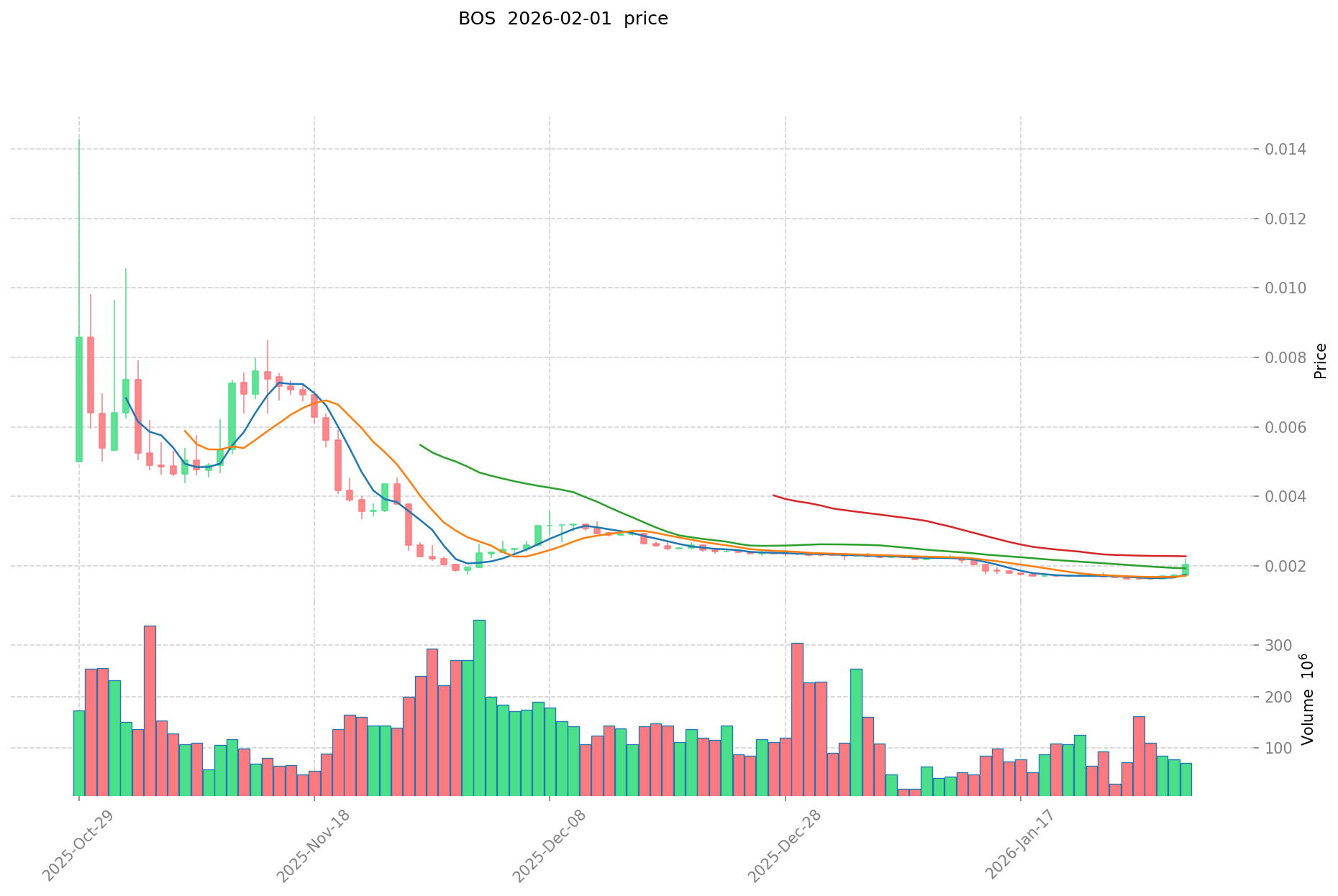
I. BitcoinOS (BOS) Price History Review and Current Investment Value
- October 2025: BOS launched on exchanges at an initial trading phase, establishing early market presence
- October 2025: The token reached a price level of $0.0143, representing a notable early-stage valuation point
- January 2026: Market dynamics shifted downward from the October pricing level to approximately $0.001596, reflecting broader market adjustments and token distribution patterns
Current BOS Investment Market Status (February 2026)
- BOS Current Price: $0.002008
- Market Sentiment (Fear & Greed Index): Data indicates neutral positioning
- 24-Hour Trading Volume: $80,313.88
- Circulating Supply: 890,400,000 BOS tokens
- Market Capitalization: $1,787,923
- Fully Diluted Valuation: $42,168,000
- Trading Availability: Listed on 9 exchanges
- Holder Count: 2,880 addresses
Click to view real-time BOS market price
II. Core Factors Influencing Whether BOS is a Good Investment (Is BitcoinOS(BOS) a Good Investment)
Supply Mechanism and Scarcity (BOS investment scarcity)
- Token Supply Structure → BitcoinOS implements a total supply of 21,000,000,000 BOS tokens with a maximum supply cap of 21,000,000,000 tokens. As of February 1, 2026, the circulating supply stands at 890,400,000 BOS, representing approximately 4.24% of the total supply. This controlled release mechanism may influence token scarcity dynamics over time.
- Buy-and-Burn Mechanism → The BOS token incorporates a buy-and-burn mechanism designed to activate once the platform reaches maturity. This deflationary feature could potentially influence long-term supply economics and token scarcity, though its impact will depend on platform adoption levels and activation timing.
- Investment Significance → The combination of limited circulating supply relative to total supply, coupled with the planned burn mechanism, represents structural elements that may support long-term investment considerations, though actual outcomes will depend on market conditions and platform development progress.
Institutional Investment and Mainstream Adoption (Institutional investment in BOS)
- Institutional Interest Indicators → BitcoinOS reports nearly $1 billion in BTC Total Value Locked (TVL) subscriptions focused on institutional-grade Bitcoin applications. This initial use case targeting institutional participants suggests early-stage interest from larger market participants.
- Multi-Chain Expansion Strategy → BOS plans to launch first on Cardano before expanding to EVM and SVM ecosystems. This phased deployment across multiple blockchain environments could influence accessibility for different institutional and retail participants across various platforms.
- Holder Distribution → As of February 1, 2026, BitcoinOS has approximately 2,880 token holders. The relatively concentrated holder base may indicate early-stage adoption characteristics typical of newer projects.
Macroeconomic Environment's Impact on BOS Investment
- Monetary Policy Context → Changes in interest rates and monetary policy generally influence risk appetite across cryptocurrency markets. As a newer project with lower market capitalization, BOS may exhibit sensitivity to broader macroeconomic shifts affecting capital allocation to digital assets.
- Cryptocurrency Market Correlation → BOS operates within the broader cryptocurrency ecosystem, which historically demonstrates sensitivity to macroeconomic factors including inflation expectations and currency market dynamics. These systemic factors may influence BOS alongside other digital assets.
- Geopolitical Considerations → Uncertainty in traditional financial markets has historically influenced demand patterns for cryptocurrency assets. BOS, as part of the broader crypto market, may experience indirect effects from such macroeconomic shifts.
Technology and Ecosystem Development (Technology & Ecosystem for BOS investment)
- Zero-Knowledge Proof Technology → BitcoinOS utilizes zero-knowledge proof technology to enable programmability on Bitcoin without modifying its base protocol. This technical approach aims to unlock smart contracts, DeFi applications, and cross-chain interoperability while maintaining Bitcoin network security properties.
- Cross-Chain Interoperability → The platform's design focuses on enabling functionality across multiple blockchain ecosystems, initially targeting Cardano with planned expansion to EVM and SVM networks. This multi-chain approach may influence the breadth of potential use cases and user accessibility.
- DeFi and Application Ecosystem → BitcoinOS aims to facilitate DeFi applications and smart contract functionality within the Bitcoin context. The development and adoption rate of these applications will likely influence the platform's utility proposition and long-term value considerations for investors.
III. BOS Future Investment Forecast and Price Outlook (Is BitcoinOS(BOS) worth investing in 2026-2031)
Short-term Investment Forecast (2026, short-term BOS investment outlook)
- Conservative forecast: $0.00182 - $0.00200
- Neutral forecast: $0.00200 - $0.00218
- Optimistic forecast: $0.00218 - $0.00236
Mid-term Investment Outlook (2027-2029, mid-term BitcoinOS(BOS) investment forecast)
- Market phase expectation: The platform may experience gradual ecosystem expansion as it integrates with multiple blockchain networks. The buy-and-burn mechanism could become active during this phase, potentially influencing token dynamics.
- Investment return forecast:
- 2027: $0.00114 - $0.00251
- 2028: $0.00214 - $0.00305
- 2029: $0.00167 - $0.00367
- Key catalysts: Integration progress with Cardano, EVM, and SVM ecosystems; institutional Bitcoin adoption; zero-knowledge proof technology development; market sentiment toward Bitcoin layer-2 solutions.
Long-term Investment Outlook (Is BOS a good long-term investment?)
- Base scenario: $0.00191 - $0.00389 (assuming steady ecosystem development and moderate adoption)
- Optimistic scenario: $0.00389 - $0.00568 (assuming successful multi-chain integration and increased institutional participation)
- Risk scenario: Below $0.00160 (under adverse market conditions or delayed ecosystem development)
Check BOS long-term investment and price forecast: Price Prediction
2026-02-01 - 2031 Long-term Outlook
- Base scenario: $0.00191 - $0.00389 (corresponding to steady progress and mainstream application growth)
- Optimistic scenario: $0.00389 - $0.00568 (corresponding to large-scale adoption and favorable market environment)
- Transformative scenario: Above $0.00568 (if ecosystem achieves breakthrough development and mainstream popularity)
- 2031-12-31 forecast high: $0.00568 (based on optimistic development assumptions)
Disclaimer: This forecast is for informational purposes only and does not constitute investment advice. Cryptocurrency markets are volatile and unpredictable. Past performance does not guarantee future results. Investors should conduct their own research and consider their risk tolerance before making investment decisions.
| Year |
Predicted High Price |
Predicted Average Price |
Predicted Low Price |
Price Change |
| 2026 |
0.00236472 |
0.002004 |
0.00182364 |
0 |
| 2027 |
0.002512014 |
0.00218436 |
0.0011358672 |
8 |
| 2028 |
0.0030526431 |
0.002348187 |
0.00213685017 |
16 |
| 2029 |
0.003672564468 |
0.00270041505 |
0.001674257331 |
34 |
| 2030 |
0.00458854525296 |
0.003186489759 |
0.0019118938554 |
58 |
| 2031 |
0.00567577555873 |
0.00388751750598 |
0.002371385678647 |
93 |
IV. BitcoinOS Investment Strategy and Risk Management (How to invest in BitcoinOS)
Investment Methodology (BitcoinOS investment strategy)
Long-term Holding (HODL BOS)
Long-term holding may be suitable for investors seeking a patient approach to cryptocurrency investments. This strategy involves acquiring BOS tokens and maintaining positions over extended periods, potentially benefiting from the platform's development trajectory as it expands from Cardano to EVM and SVM ecosystems. Given BOS's early-stage positioning with a circulating supply ratio of 4.24% (890.4 million of 21 billion total supply), long-term holders should consider the token's planned buy-and-burn mechanism that activates once the platform reaches maturity.
Active Trading
Active trading approaches for BOS involve technical analysis and momentum-based strategies. Recent price performance shows notable volatility, with 7-day gains of approximately 19.59% contrasting with 30-day declines of around 13.11%. The 24-hour trading range between $0.001933 and $0.002098 indicates potential opportunities for short-term position adjustments. Traders should monitor the token's price action relative to its all-time high of $0.0143 (October 29, 2025) and all-time low of $0.001596 (January 28, 2026).
Risk Management (Risk management for BOS investment)
Asset Allocation Ratios
Conservative Investors: May consider allocating 1-3% of cryptocurrency portfolio to BOS, given its relatively small market capitalization of approximately $1.79 million and early development stage.
Moderate Investors: Potential allocation of 3-7% for those comfortable with higher volatility in exchange for exposure to Bitcoin programmability solutions.
Aggressive Investors: May allocate up to 10-15% for those seeking concentrated exposure to emerging Bitcoin infrastructure projects, while understanding the associated risks.
Risk Hedging Approaches
Portfolio diversification remains a fundamental risk management tool when investing in BOS. Investors might consider:
- Multi-asset positioning across established cryptocurrencies and emerging tokens
- Balanced exposure across different blockchain ecosystems (Cardano, EVM, SVM)
- Consideration of Bitcoin-correlated assets given BOS's relationship to Bitcoin infrastructure
- Regular portfolio rebalancing based on market conditions and risk tolerance
Secure Storage Solutions
BOS tokens are deployed on multiple chains, requiring appropriate storage solutions:
Hot Wallets: Suitable for active trading portions, with support for Ethereum (ERC-20) and Cardano (ADA) networks. Users should verify wallet compatibility with contract addresses: 0x13239c268beddd88ad0cb02050d3ff6a9d00de6d (Ethereum) and the corresponding Cardano token address.
Cold Storage: Recommended for long-term holdings, utilizing hardware wallets that support both Ethereum and Cardano networks to secure BOS tokens offline.
Hardware Wallet Recommendations: Devices supporting multi-chain assets provide enhanced security for BOS storage, particularly those compatible with ERC-20 tokens and Cardano native assets.
V. BitcoinOS Investment Risks and Challenges (Risks of investing in BitcoinOS)
Market Risks
High Volatility: BOS demonstrates significant price fluctuations, with recent data showing 19.59% gains over 7 days alongside 13.11% declines over 30 days. The relatively low 24-hour trading volume of approximately $80,313 may contribute to price instability and potential liquidity constraints.
Price Discovery Phase: Trading at $0.002008 as of February 1, 2026, BOS remains substantially below its all-time high of $0.0143 recorded on October 29, 2025. The token's early-stage market presence and small circulating supply of 890.4 million tokens (4.24% of total supply) may result in price volatility as market participants assess the platform's value proposition.
Limited Market Depth: With a market capitalization of approximately $1.79 million and ranking at #2125, BOS operates in a relatively nascent market environment where trading activity may be influenced by limited liquidity and participant concentration.
Regulatory Risks
The regulatory landscape for cryptocurrency projects varies significantly across jurisdictions, and several factors may impact BOS:
Policy Uncertainty: Bitcoin-related programmability solutions exist in an evolving regulatory environment. Different countries maintain varying approaches to cryptocurrency regulation, which may affect BOS's operational capabilities and market access.
Multi-Chain Compliance: BOS's deployment across Ethereum and Cardano networks, with planned expansion to EVM and SVM ecosystems, introduces complexity in navigating multiple regulatory frameworks applicable to different blockchain environments.
Institutional Focus: With approximately $1 billion in BTC TVL subscriptions targeting institutional use cases, regulatory developments affecting institutional cryptocurrency participation may significantly impact BOS's adoption trajectory.
Technical Risks
Platform Development Dependencies: BOS's value proposition relies on successfully implementing zero-knowledge proof technology to enable programmability on Bitcoin without protocol modifications. Technical execution challenges during development phases may affect the platform's functionality and adoption.
Network Security Considerations: While leveraging Bitcoin's security infrastructure, the platform's smart contract functionality and cross-chain interoperability features introduce additional technical complexity that requires ongoing security assessment and maintenance.
Multi-Chain Integration: The planned phased launch starting with Cardano before expanding to EVM and SVM ecosystems presents integration challenges across different blockchain architectures and technical standards.
Smart Contract Risks: As a platform enabling smart contracts and DeFi applications, BOS faces potential vulnerabilities inherent in programmable blockchain systems, including code exploits and protocol-level security concerns.
VI. Conclusion: Is BitcoinOS a Good Investment?
Investment Value Summary
BitcoinOS represents an early-stage platform addressing Bitcoin programmability through zero-knowledge proof technology. The project's positioning at the intersection of Bitcoin infrastructure and cross-chain functionality presents potential opportunities alongside significant uncertainties. With a current price of $0.002008 and market capitalization of approximately $1.79 million, BOS remains in early development stages with a circulating supply representing 4.24% of total supply.
The platform's technical approach—enabling smart contracts, DeFi applications, and cross-chain interoperability without modifying Bitcoin's base protocol—addresses a specific market need. The reported subscription of nearly $1 billion in BTC TVL for institutional use cases suggests market interest, though actual implementation and adoption remain to be demonstrated over time.
Recent price performance shows mixed signals: 7-day gains of approximately 19.59% contrast with 30-day declines of around 13.11%, reflecting the volatility characteristic of emerging cryptocurrency projects. The token's planned buy-and-burn mechanism, set to activate upon platform maturity, represents a potential long-term value accrual mechanism, though its impact depends on platform adoption and usage.
Investor Recommendations
✅ Beginners: Consider starting with small allocations through dollar-cost averaging approaches. Prioritize understanding secure storage solutions compatible with both Ethereum (ERC-20) and Cardano networks before investing. Focus on learning about Bitcoin programmability concepts and zero-knowledge proof technology to better assess BOS's value proposition.
✅ Experienced Investors: May evaluate BOS within a diversified cryptocurrency portfolio, utilizing technical analysis for position timing while maintaining awareness of the project's early development stage. Consider phased entry strategies aligned with platform milestones, such as the Cardano launch and subsequent EVM/SVM expansions.
✅ Institutional Investors: Might assess BOS as part of strategic exposure to Bitcoin infrastructure development, evaluating the platform's institutional use case focus and cross-chain capabilities within broader portfolio objectives. Due diligence regarding technical implementation, regulatory considerations, and competitive positioning remains essential.
⚠️ Important Notice: Cryptocurrency investments involve substantial risks including potential loss of principal. This content provides informational perspectives based on available data and does not constitute investment advice. Market conditions, project developments, and regulatory environments may change significantly. Investors should conduct independent research, assess personal risk tolerance, and consider consulting financial professionals before making investment decisions. Past performance does not indicate future results.
VII. FAQ
Q1: What makes BitcoinOS (BOS) different from other Bitcoin layer-2 solutions?
BitcoinOS distinguishes itself by utilizing zero-knowledge proof technology to enable programmability on Bitcoin without modifying its base protocol, while supporting smart contracts, DeFi applications, and cross-chain interoperability. Unlike many Bitcoin layer solutions that require protocol changes or operate as isolated sidechains, BOS maintains Bitcoin's core security properties while extending functionality across multiple blockchain ecosystems including Cardano, EVM, and SVM networks. The platform's multi-chain deployment strategy, starting with Cardano before expanding to other ecosystems, provides broader accessibility compared to single-chain Bitcoin scaling approaches.
Q2: How does the BOS token's buy-and-burn mechanism work and when does it activate?
The buy-and-burn mechanism is designed to activate once the BitcoinOS platform reaches maturity, though specific activation criteria and timelines have not been publicly detailed as of February 2026. This deflationary feature will systematically remove BOS tokens from circulation, potentially reducing supply over time. However, the actual impact on token economics depends on platform adoption levels, transaction volume, and the implementation parameters when the mechanism becomes operational. With current circulating supply at 890.4 million tokens (4.24% of 21 billion total supply), the burn mechanism represents a long-term structural element rather than an immediate factor.
Q3: What level of allocation should investors consider for BOS in their cryptocurrency portfolio?
Portfolio allocation depends on individual risk tolerance and investment objectives. Conservative investors might consider 1-3% allocation given BOS's small market capitalization ($1.79 million) and early development stage. Moderate investors comfortable with higher volatility could allocate 3-7% for exposure to Bitcoin programmability solutions. Aggressive investors seeking concentrated positions in emerging Bitcoin infrastructure projects may allocate 10-15%, understanding the elevated risks. These allocation ranges assume a diversified cryptocurrency portfolio and should be adjusted based on personal financial circumstances, investment timeline, and risk capacity.
Q4: What are the primary risks associated with investing in BitcoinOS?
BOS faces several significant investment risks. Market risks include high volatility (evidenced by 19.59% weekly gains against 13.11% monthly losses), limited liquidity with approximately $80,313 in 24-hour trading volume, and early-stage price discovery. Technical risks involve platform development dependencies, multi-chain integration challenges across Cardano, EVM, and SVM ecosystems, and smart contract security considerations. Regulatory uncertainty affecting Bitcoin-related programmability solutions and institutional cryptocurrency participation represents additional risk factors. The combination of small market capitalization, concentrated holder base (2,880 addresses), and early development stage amplifies these risk dimensions.
Q5: How does BitcoinOS's institutional focus influence its investment potential?
BitcoinOS reports nearly $1 billion in BTC TVL subscriptions targeting institutional-grade Bitcoin applications, indicating early-stage interest from larger market participants. This institutional orientation may influence adoption trajectory differently than retail-focused projects, potentially providing more stable growth patterns if institutional adoption materializes. However, institutional participation depends on regulatory clarity, technical maturity, and demonstrated security—factors that remain under development. The phased multi-chain launch strategy aligns with institutional requirements for operational flexibility across different blockchain environments, though actual institutional adoption rates will depend on platform performance and competitive positioning within the Bitcoin infrastructure landscape.
Q6: What technical milestones should investors monitor for BOS development progress?
Key technical milestones include the successful launch and integration on Cardano network as the initial deployment, followed by expansions to EVM and SVM ecosystems. Investors should monitor the implementation status of zero-knowledge proof technology enabling Bitcoin programmability without protocol modifications, the development and adoption of DeFi applications and smart contracts on the platform, and cross-chain interoperability functionality across supported networks. The activation timeline and parameters for the buy-and-burn mechanism represent another important milestone. Additionally, tracking institutional use case implementation, security audit results, and actual BTC TVL deployment versus subscribed amounts provides insight into platform maturation and adoption progress.
Q7: How does BOS's current price position relate to its historical performance and future outlook?
BOS currently trades at $0.002008 (February 1, 2026), representing approximately 86% below its all-time high of $0.0143 (October 29, 2025) and about 26% above its all-time low of $0.001596 (January 28, 2026). This positioning reflects early-stage price discovery and market volatility. Short-term forecasts suggest a range of $0.00182-$0.00236 for 2026, while mid-term projections extend from $0.00114-$0.00367 through 2029. Long-term optimistic scenarios project potential ranges up to $0.00568 by 2031, though these forecasts depend on successful platform development, ecosystem adoption, and favorable market conditions. The historical price volatility and relatively recent market entry suggest caution regarding near-term price stability expectations.
Q8: What storage solutions are recommended for BOS tokens and why?
BOS tokens require storage solutions compatible with multiple blockchain networks, as the token deploys on both Ethereum (ERC-20) and Cardano. For active trading portions, hot wallets supporting both networks provide accessibility, though users must verify compatibility with the Ethereum contract address (0x13239c268beddd88ad0cb02050d3ff6a9d00de6d) and corresponding Cardano token address. For long-term holdings, cold storage using hardware wallets that support multi-chain assets offers enhanced security by keeping tokens offline. Hardware wallets compatible with both ERC-20 tokens and Cardano native assets are recommended, particularly for investors holding significant positions. The multi-chain deployment necessitates careful attention to wallet compatibility to ensure proper token storage and transaction capabilities across different blockchain environments.
* The information is not intended to be and does not constitute financial advice or any other recommendation of any sort offered or endorsed by Gate.