Is BLAST (BLAST) a good investment?: A Comprehensive Analysis of Price Trends, Market Potential, and Risk Factors

Introduction: BLAST's Investment Position and Market Prospects
BLAST is an important asset in the cryptocurrency sector. As an Ethereum Layer 2 solution, it has gained significant attention in the crypto ecosystem. As of December 2025, BLAST has a fully diluted valuation of $67,350,000 with a circulating supply of approximately 51.96 billion tokens, trading at a current price of $0.0006735. Known as "the only Ethereum L2 with native yield for ETH and stablecoins," BLAST has gradually become a focal point when investors discuss whether BLAST is a good investment opportunity.
The project distinguishes itself by offering native yield mechanisms, with ETH earning 3.4% and stablecoins earning 8% on the Blast network. These yields are sourced from ETH staking and RWA (Real-World Assets) protocols, with the generated returns automatically passed back to Blast users. This yield-generating infrastructure represents a unique value proposition within the Layer 2 ecosystem.
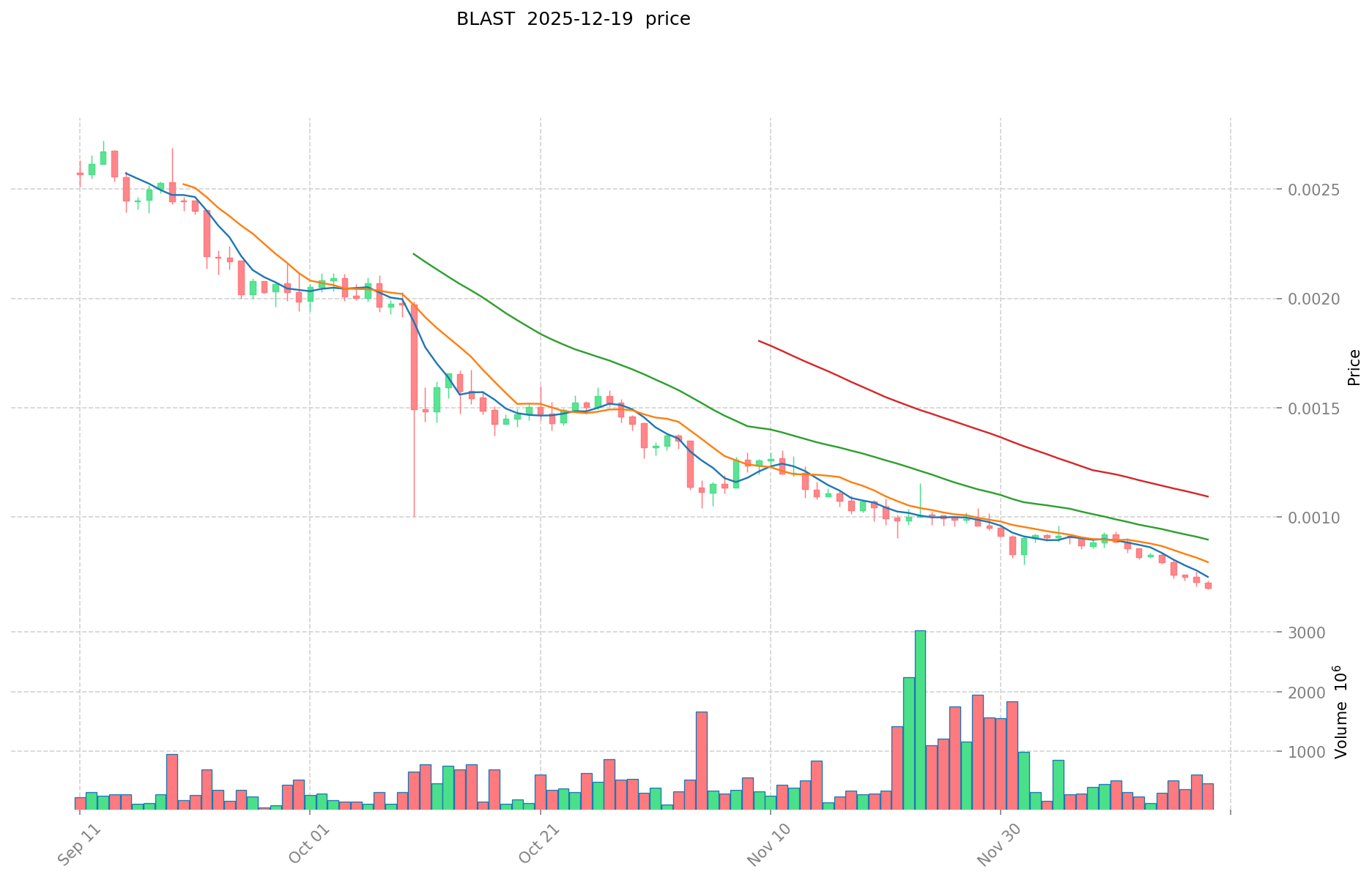
However, the token has experienced significant price volatility since its launch in June 2024, with a current price representing a 92.86% decline over the past year and a 37.09% decline over the past month. The token currently ranks 621st by market capitalization with 280,462 holders across 33 exchanges.
This article provides a comprehensive analysis of BLAST's investment value, price trends, future price forecasts, and investment risks to offer investors with reference perspectives on this evolving Layer 2 protocol.
BLAST Token Market Analysis Report
I. BLAST Price History Review and Current Investment Value
BLAST Historical Price Performance
Based on available data as of December 19, 2025:
- June 27, 2024: All-time high of $0.02817 reached, marking peak market enthusiasm
- December 18, 2025: All-time low of $0.0006661 recorded, representing a 92.86% decline from launch price
- Year-to-date performance: -92.86% decline, indicating substantial erosion of investor capital from annual perspective
Current BLAST Market Status (December 2025)
Price Metrics:
- Current price: $0.0006735
- 24-hour price change: -3.8%
- 1-hour price change: -0.16%
- 7-day price change: -21.33%
- 30-day price change: -37.09%
Market Capitalization:
- Circulating market cap: $34,994,466.53
- Fully diluted valuation (FDV): $67,350,000.00
- Market dominance: 0.0021%
- Current market ranking: #621 by market cap
Trading Activity:
- 24-hour trading volume: $311,125.99
- Trading pairs available: 33 exchanges
- Total token holders: 280,462
Access real-time BLAST market prices at https://www.gate.com/price/blast-blast
II. Project Overview and Core Value Proposition
Blast Platform Fundamentals
Blast is distinguished as the only Ethereum Layer 2 solution that provides native yield for both ETH and stablecoins. The protocol's revenue mechanisms operate as follows:
Yield Generation Model:
- ETH staking yield: 3.4% annually
- Stablecoin yield: 8% annually
- Revenue sources: ETH staking and Real World Asset (RWA) protocols
- Distribution mechanism: Yields from decentralized protocols are automatically returned to Blast users
Technical Specifications:
- Contract address (Blast network): 0xb1a5700fA2358173Fe465e6eA4Ff52E36e88E2ad
- Token standard: ERC-20
- Total supply: 100,000,000,000 BLAST
- Circulating supply: 51,959,118,832 BLAST (51.96% of total)
- Launch price: $0.02
- Circulation ratio: 51.96%
III. Ecosystem Status and Market Challenges
Ecosystem Development Concerns
Available market research indicates significant challenges facing the Blast ecosystem:
Token Price Impact on Ecosystem Health:
- BLAST and related tokens (such as BLUR) have declined over 90% from historical highs
- This severe price depreciation has substantially damaged investor and developer confidence
- In the cryptocurrency market, token price typically maintains a positive correlation with ecosystem activity levels
Notable Ecosystem Changes:
- Departure of major ecosystem flagships and protocols has been documented
- Price decline-ecosystem vitality cycle creates negative feedback loops, potentially hindering new development initiatives
IV. Contract Details and Platform Integration
Network Deployment:
- Primary network: BLASTETH (Blast Ethereum Layer 2)
- Block explorer: https://blastscan.io/
- Contract address: 0xb1a5700fA2358173Fe465e6eA4Ff52E36e88E2ad
Community and Information Channels:
- Official website: https://blast.io/zh-CN
- Twitter/X: https://x.com/Blast_L2
V. Summary Assessment
BLAST demonstrates substantial price volatility and significant value depreciation from peak levels. While the platform's native yield mechanism for ETH and stablecoins presents a distinctive technical proposition within the Layer 2 ecosystem, the ecosystem faces headwinds from sustained price pressure and developer confidence challenges. Market participants should conduct comprehensive due diligence regarding both technical implementation and ecosystem fundamentals before making investment decisions.
BLAST (BLAST) Investment Analysis Report
Report Date: December 19, 2025
I. Executive Summary
BLAST is an Ethereum Layer 2 network that provides native yield for ETH and stablecoins. As of December 19, 2025, BLAST is trading at $0.0006735 with a market capitalization of $34,994,466.53 USD. The token has experienced significant price decline over the past year, down 92.86% from its all-time high of $0.02817 reached on June 27, 2024.
Key Metrics:
- Current Price: $0.0006735 USD
- 24-Hour Change: -3.8%
- 7-Day Change: -21.33%
- 30-Day Change: -37.09%
- 1-Year Change: -92.86%
- Market Rank: 621
- Circulating Supply: 51,959,118,832 BLAST (51.96% of total supply)
- Total Supply: 100,000,000,000 BLAST
II. Core Factors Affecting BLAST as an Investment
Supply Mechanism and Scarcity
The BLAST token operates with a fixed maximum supply of 100 billion tokens. Currently, approximately 52 billion tokens are in circulation, representing 51.96% of the total supply. This dual-supply structure creates a potential dilution risk as additional tokens enter circulation over time.
Investment Implications:
- The remaining 48% of uncirculated supply presents ongoing dilution pressure
- Fixed supply cap may provide theoretical scarcity benefits in long-term scenarios
- Current circulating ratio suggests significant additional token releases are pending
Network Performance and Yield Mechanism
BLAST differentiates itself through native yield generation for users:
- ETH Yield Rate: 3.4% annually
- Stablecoin Yield Rate: 8% annually
- Yield Sources: ETH staking and RWA (Real World Assets) protocols through partnerships with Lido and MakerDAO
Investment Considerations:
- The yield mechanism provides passive income for token holders and users
- Automated yield distribution eliminates the need for manual staking mechanisms
- Integration with established protocols (Lido, MakerDAO) provides infrastructure stability
Ecosystem Challenges and User Adoption
According to available analysis, BLAST faces significant challenges despite its innovative technology:
- Declining User Base: The network has experienced declining user adoption since its launch in November 2023
- Security Issues: Security concerns have been reported within the BLAST ecosystem
- TVL Decline: Total Value Locked (TVL) has experienced substantial contraction from its peak of $2.7 billion
- Market Sentiment: The 7-day Relative Strength Index (RSI) reached 28.23 on December 12, 2025, indicating oversold conditions following a 67.8% decline over 90 days
Critical Assessment: The ecosystem faces a disconnect between technological innovation and practical adoption. Founder Tieshun Roquerre (known as "Pacman") has stated that the initial focus on crypto-native users was intentional to build network effects before mainstream adoption. However, critics question whether this strategy can sustain long-term growth without broader user expansion.
Technical Analysis Indicators
Current technical signals suggest weakness in price momentum:
- MACD histogram signals show negative momentum
- Extended downtrend over multiple timeframes (1-hour: -0.16%, 7-day: -21.33%, 30-day: -37.09%)
- Oversold conditions present potential for technical rebounds but do not guarantee price recovery
III. Price Performance and Market Dynamics
Historical Price Movement
| Period | Price Change | Current Price Level |
|---|---|---|
| 1-Hour | -0.16% | $0.0006735 |
| 24-Hour | -3.8% | $0.0006735 |
| 7-Day | -21.33% | From ~$0.00085 |
| 30-Day | -37.09% | From ~$0.00107 |
| 1-Year | -92.86% | From $0.02 (launch) |
| All-Time High | June 27, 2024 | $0.02817 |
| All-Time Low | December 18, 2025 | $0.0006661 |
The token has declined approximately 97.6% from its all-time high, with the most severe price pressure occurring in recent months.
Trading Volume and Liquidity
- 24-Hour Trading Volume: $311,125.98 USD
- Number of Exchanges: 33
- Token Holders: 280,462
- Market Dominance: 0.0021%
The relatively modest trading volume relative to market capitalization indicates limited liquidity, which could affect the ease of position entry and exit.
IV. Assessment Framework
Risk Factors
High-Risk Elements:
- Severe Price Decline: 92.86% decline over one year indicates significant loss of investor confidence
- Declining Ecosystem Activity: Reported decline in network users and security issues
- High Dilution Risk: 48% of total supply remains uncirculated
- Limited Market Penetration: 0.0021% market dominance reflects minimal adoption relative to broader crypto market
- Technical Weakness: Multiple oversold indicators and negative momentum signals
Structural Challenges:
- The network's focus on crypto-native users may limit addressable market size
- Integration with existing protocols (Lido, MakerDAO) creates dependency on third-party infrastructure
- Competitive pressure from other Layer 2 solutions (Arbitrum, Optimism, Polygon)
Positive Factors
- Native Yield Mechanism: The automatic yield distribution provides tangible utility
- Established Partnerships: Integration with Lido and MakerDAO provides protocol-level support
- Technical Innovation: Layer 2 scaling with native yield is a unique value proposition
- Oversold Technical Conditions: May present contrarian opportunities if sentiment reverses
V. Market Sentiment and Outlook
Current Market Condition
BLAST exhibits mixed technical signals with predominantly negative sentiment:
- Oversold RSI conditions (28.23) suggest potential exhaustion of selling pressure
- Negative MACD signals indicate ongoing downward momentum
- Continuous price weakness across all measured timeframes
Price Predictions from Market Analysts
Various forecasting sources present divergent outlooks:
- CoinCodex: Predicted price of $0.0008604 by December 10, 2025
- Long Forecast (3Commas): Expects average price of $0.00095599705 for the year, predicting price decline
- BLOX Forecast: Projects €0.000628 by end of 2026, rising to €0.001696 by end of 2027, and €0.001669 by end of 2030
Note: These predictions vary significantly and should not be considered reliable forecasts. The wide divergence in analyst predictions reflects fundamental uncertainty about BLAST's trajectory.
VI. Relevant Market Data
Holder Distribution:
- Total Holders: 280,462
- Market Concentration: Data indicates relatively distributed holdings
Exchange Availability:
- Trading across 33 exchanges
- Primary contract on BLASTETH chain: 0xb1a5700fA2358173Fe465e6eA4Ff52E36e88E2ad
Network Status:
- Launch Date: November 2023
- Time in Market: Approximately 13 months
VII. Conclusion
BLAST presents a complex investment case characterized by innovative technology alongside significant operational and market challenges. The Layer 2 network's native yield mechanism addresses a genuine user need within the crypto ecosystem. However, the severe price decline, reported user adoption challenges, ecosystem concerns, and high token dilution risk present substantial headwinds.
The current oversold technical conditions and divergent analyst predictions suggest uncertainty regarding near-term price direction. Any investment decision should account for:
- The high-risk nature of this asset class
- The significant existing price decline from peak valuations
- The execution risks associated with ecosystem adoption
- The pending dilution from uncirculated token supply
- The competitive dynamics within the Layer 2 sector
The distinction between technological merit and investment viability remains critical in evaluating BLAST as a potential allocation.
Report Generated: December 19, 2025
III. BLAST Future Investment Predictions and Price Outlook
Short-term Investment Prediction (2025, short-term BLAST investment outlook)
- Conservative forecast: $0.000566 - $0.000821
- Neutral forecast: $0.000674 (midpoint estimate)
- Optimistic forecast: $0.000822 - $0.001032
Mid-term Investment Outlook (2026-2028, mid-term BLAST investment forecast)
-
Market stage expectation: Gradual recovery phase with potential consolidation as the protocol establishes its native yield mechanisms for ETH and stablecoins
-
Investment return predictions:
- 2026: $0.000725 - $0.001032
- 2027: $0.000739 - $0.001041
- 2028: $0.000782 - $0.001352
-
Key catalysts: Expansion of native yield offerings, increased Total Value Locked (TVL) in the ecosystem, market adoption of ETH staking and RWA protocols on Blast network
Long-term Investment Outlook (Is BLAST a good long-term investment?)
-
Base case scenario: $0.001242 - $0.001532 USD (assuming steady ecosystem growth and moderate market conditions through 2030)
-
Optimistic scenario: $0.001483 - $0.001800+ USD (corresponding to significant L2 adoption and competitive positioning among Ethereum scaling solutions)
-
Risk scenario: $0.000500 - $0.000750 USD (extreme conditions including reduced DeFi activity or competitive pressure from other L2 solutions)
View BLAST long-term investment and price prediction: Price Prediction
2025-12-31 Long-term Outlook
-
Base case: $0.000822 - $0.001032 USD (corresponding to steady protocol development and sustained user engagement with yield mechanisms)
-
Optimistic scenario: $0.001352 - $0.001532 USD (corresponding to large-scale ecosystem adoption and favorable market conditions)
-
Transformative scenario: $0.002000+ USD (contingent on breakthrough protocol innovations and mainstream institutional adoption)
-
2030-12-31 price target: $0.001532 USD (based on optimistic development assumptions)
Disclaimer: This analysis is based on historical data and third-party forecasts. Past performance does not guarantee future results. Cryptocurrency markets are highly volatile and subject to various risk factors. This information should not be construed as investment advice. Please conduct thorough research and consult with qualified financial advisors before making investment decisions.
| 年份 | 预测最高价 | 预测平均价格 | 预测最低价 | 涨跌幅 |
|---|---|---|---|---|
| 2025 | 0.000821914 | 0.0006737 | 0.000565908 | 0 |
| 2026 | 0.00103197366 | 0.000747807 | 0.00072537279 | 11 |
| 2027 | 0.0010411716861 | 0.00088989033 | 0.0007386089739 | 32 |
| 2028 | 0.00135174341127 | 0.00096553100805 | 0.00078208011652 | 43 |
| 2029 | 0.001483055628364 | 0.00115863720966 | 0.000903737023534 | 72 |
| 2030 | 0.001532181846054 | 0.001320846419012 | 0.001241595633871 | 96 |
BLAST Token Research Report
I. Project Overview
Basic Information
BLAST is the only Ethereum Layer 2 solution that provides native yield for ETH and stablecoins. The project's yield infrastructure is powered by ETH staking and RWA (Real World Assets) protocols, with yields from these decentralized protocols automatically distributed to Blast users.
Key Metrics (As of December 19, 2025)
| Metric | Value |
|---|---|
| Current Price | $0.0006735 |
| Market Capitalization | $34,994,466.53 |
| Fully Diluted Valuation | $67,350,000.00 |
| Circulating Supply | 51,959,118,832 BLAST |
| Total Supply | 100,000,000,000 BLAST |
| 24h Trading Volume | $311,125.99 |
| Market Rank | #621 |
| Active Holders | 280,462 |
Yield Mechanism
- ETH Yield Rate: 3.4%
- Stablecoin Yield Rate: 8%
II. Price Performance Analysis
Historical Price Movement
| Time Period | Price Change | Change Amount |
|---|---|---|
| 1 Hour | -0.16% | -$0.000001079 |
| 24 Hours | -3.8% | -$0.000026604 |
| 7 Days | -21.33% | -$0.000182608 |
| 30 Days | -37.09% | -$0.000397077 |
| 1 Year | -92.86% | -$0.008759273 |
Price Range
- All-Time High: $0.02817 (June 27, 2024)
- All-Time Low: $0.0006661 (December 18, 2025)
- 24h High: $0.0007087
- 24h Low: $0.0006661
III. Investment Strategy and Risk Management
Investment Methodology
Long-Term Hold (HODL Strategy):
- Suitable for conservative investors seeking yield exposure
- Benefits from Blast's native yield mechanism (3.4% ETH, 8% stablecoins)
- Minimizes impact of short-term volatility
Active Trading:
- Dependent on technical analysis and swing trading opportunities
- Requires active market monitoring given high price volatility
Risk Management Framework
Asset Allocation Guidelines:
- Conservative Investors: 1-3% of portfolio allocation
- Active Investors: 3-5% of portfolio allocation
- Professional Investors: Strategic allocation based on risk tolerance and hedge positioning
Portfolio Diversification:
- Combine BLAST with other Layer 2 solutions and established cryptocurrencies
- Implement hedging strategies through derivatives and stablecoin allocations
Secure Storage:
- Hot Wallets: For active trading and frequent transactions
- Cold Wallets: For long-term yield accumulation
- Hardware Wallets: Recommended for holdings exceeding $10,000
IV. Investment Risks and Challenges
Market Risk
- Extreme Price Volatility: BLAST has experienced 92.86% annual decline, indicating severe price instability
- Illiquidity Concerns: 24-hour trading volume ($311,125.99) is relatively low compared to market capitalization
- Price Manipulation: Lower liquidity increases susceptibility to market manipulation
Regulatory Risk
- Policy Uncertainty: Layer 2 solutions face evolving regulatory frameworks across different jurisdictions
- Staking Regulations: Yield generation mechanisms may attract regulatory scrutiny regarding securities classification
Technology Risk
- Smart Contract Vulnerability: L2 solutions depend on complex smart contracts with potential security exploits
- Protocol Upgrades: Implementation of new features or upgrades carries execution risk
V. Conclusion: Is BLAST a Good Investment?
Investment Value Summary
BLAST presents a differentiated value proposition through its native yield mechanism for ETH and stablecoins on Layer 2 infrastructure. However, the token has experienced severe price depreciation (92.86% decline over one year), indicating significant market challenges despite the project's technical merits.
The yield infrastructure (3.4% for ETH, 8% for stablecoins) offers meaningful returns, but token holders must distinguish between protocol yield and token price appreciation potential.
Investor Recommendations
✅ Beginners:
- Dollar-cost averaging strategy to reduce timing risk
- Secure storage in hardware wallets for yield accumulation
- Limited portfolio allocation (1-2%)
✅ Experienced Investors:
- Swing trading strategies capitalizing on volatility
- Portfolio balancing with complementary Layer 2 and Layer 1 assets
- Active monitoring of protocol developments and regulatory changes
✅ Institutional Investors:
- Strategic long-term allocation for yield diversification
- Hedging positions against Layer 2 protocol risks
- Evaluation of BLAST's competitive position versus alternative L2 yield solutions
Important Disclaimer
⚠️ Risk Warning: Cryptocurrency investments carry substantial risks, including but not limited to price volatility, liquidity constraints, regulatory uncertainty, and technology failures. BLAST has demonstrated extreme volatility with 92.86% annual losses. This report is provided for informational purposes only and does not constitute investment advice, financial recommendation, or an offer to buy or sell securities. Investors should conduct independent research and consult qualified financial advisors before making investment decisions.
BLAST Token FAQ Report
I. FAQ - Frequently Asked Questions
Q1: What makes BLAST different from other Ethereum Layer 2 solutions?
A: BLAST distinguishes itself as the only Ethereum Layer 2 solution offering native yield mechanisms for both ETH and stablecoins. Users earn 3.4% annually on ETH and 8% annually on stablecoins through integration with ETH staking and RWA (Real World Assets) protocols. These yields are automatically distributed to users without requiring manual staking, creating a unique value proposition within the Layer 2 ecosystem that competitors like Arbitrum and Optimism do not currently offer.
Q2: Why has BLAST experienced such a severe price decline since launch?
A: BLAST has declined 92.86% from its all-time high of $0.02817 (reached June 27, 2024) to the current price of $0.0006735 as of December 19, 2025. Multiple factors contribute to this decline: (1) Reported challenges in user adoption and ecosystem activity; (2) Documented security concerns within the ecosystem; (3) Significant depreciation in related tokens (such as BLUR), damaging investor confidence; (4) Departure of major ecosystem protocols; (5) The network's initial focus on crypto-native users limiting addressable market expansion; and (6) Competitive pressure from established Layer 2 solutions.
Q3: Is BLAST a good investment opportunity at current price levels?
A: BLAST presents a complex investment case requiring careful consideration. Positive factors include the innovative native yield mechanism and partnerships with established protocols (Lido, MakerDAO). However, significant risks include the severe 92.86% price decline, ecosystem adoption challenges, oversold technical indicators, and high token dilution risk (48% of total supply remains uncirculated). Current oversold conditions (RSI of 28.23) suggest potential technical rebound, but do not guarantee price recovery. Conservative investors should limit allocation to 1-3% of portfolio; experienced investors may consider 3-5% allocation with appropriate risk management.
Q4: What are the main risks associated with BLAST token investment?
A: Key investment risks include: (1) Extreme Price Volatility—92.86% annual decline indicates severe instability; (2) Liquidity Constraints—24-hour trading volume of $311,125.99 is low relative to market cap, affecting position entry and exit ease; (3) Token Dilution—48% uncirculated supply creates ongoing dilution pressure; (4) Ecosystem Challenges—reported user adoption decline and security issues; (5) Regulatory Uncertainty—yield mechanisms may attract regulatory scrutiny; (6) Technology Risk—smart contract vulnerabilities and protocol upgrade execution risks; (7) Market Competition—competitive pressure from alternative Layer 2 solutions.
Q5: How do the yield mechanisms work, and what returns can users expect?
A: BLAST provides native yields sourced from two mechanisms: (1) ETH staking yield of 3.4% annually; (2) Stablecoin yield of 8% annually derived from RWA protocols. These yields are automatically distributed to Blast users without requiring manual staking or intervention. Revenue streams come from integrations with Lido for ETH staking and MakerDAO for RWA protocols. It is important to distinguish between protocol yield and token price appreciation—while yield mechanisms provide passive income, the BLAST token itself has experienced significant price depreciation.
Q6: What does technical analysis suggest about near-term price direction?
A: Current technical indicators present mixed signals with predominantly bearish momentum: (1) MACD histogram shows negative momentum; (2) Relative Strength Index (RSI) of 28.23 indicates severely oversold conditions, suggesting potential technical rebound; (3) Price weakness across all timeframes—1-hour (-0.16%), 7-day (-21.33%), 30-day (-37.09%); (4) Extended 90-day downtrend of 67.8%. Oversold conditions may signal exhaustion of selling pressure and potential for technical recovery, but do not guarantee price appreciation. Conservative forecast for 2025 suggests price range of $0.000566–$0.000821.
Q7: What are analyst price predictions for BLAST in 2026 and beyond?
A: Various forecasting sources provide divergent outlooks reflecting fundamental uncertainty: (1) Short-term (2025): Neutral forecast of $0.000674; (2) 2026: Predictions range $0.000725–$0.001032; (3) 2027: Predictions range $0.000739–$0.001041; (4) 2030: Long-term base case of $0.001532 (optimistic scenario assumes steady protocol development); (5) Alternative forecasts predict ranges from $0.000500–$0.000750 (risk scenario) to $0.001800+ (transformative scenario). These predictions vary significantly and should not be considered reliable forecasts. The wide divergence reflects uncertainty regarding BLAST's ecosystem execution and market adoption trajectory.
Q8: What investment strategy would be most appropriate for different investor types?
A: Recommended strategies vary by investor profile: (1) Conservative Investors—dollar-cost averaging strategy with 1-3% portfolio allocation and secure hardware wallet storage; (2) Experienced Investors—swing trading strategies capitalizing on volatility, complementary Layer 2 allocation, and active monitoring of protocol developments; (3) Beginners—focus on long-term hold strategy benefiting from yield mechanisms, limited allocation, and secure storage; (4) Institutional Investors—strategic long-term allocation for yield diversification with hedging positions against Layer 2 protocol risks. All investors should establish clear risk management protocols and position sizing appropriate to risk tolerance.
Disclaimer: This FAQ report is provided for informational purposes only and does not constitute investment advice, financial recommendations, or solicitation to buy or sell securities. Cryptocurrency investments carry substantial risks including price volatility, liquidity constraints, regulatory uncertainty, and technology failures. Past performance does not guarantee future results. Please conduct independent research and consult qualified financial advisors before making investment decisions.
Share
Content
Introduction: BLAST's Investment Position and Market Prospects
I. BLAST Price History Review and Current Investment Value
II. Project Overview and Core Value Proposition
III. Ecosystem Status and Market Challenges
IV. Contract Details and Platform Integration
V. Summary Assessment
I. Executive Summary
II. Core Factors Affecting BLAST as an Investment
III. Price Performance and Market Dynamics
IV. Assessment Framework
V. Market Sentiment and Outlook
VI. Relevant Market Data
VII. Conclusion
I. Project Overview
II. Price Performance Analysis
III. Investment Strategy and Risk Management
IV. Investment Risks and Challenges
V. Conclusion: Is BLAST a Good Investment?
I. FAQ - Frequently Asked Questions
How to Buy Cryptocurrency


Trending Cryptocurrencies


Is Puffer (PUFFER) a good investment?: A Comprehensive Analysis of Market Potential, Risk Factors, and Future Outlook for 2024

Eight Years with Ethereum: Insights into Top Cryptocurrencies for 2024

What is AERO: Understanding the Revolutionary Aerodynamic Technology in Modern Engineering

2025 LRC Price Prediction: Analyzing Market Trends, Tokenomics and Growth Potential in the Layer 2 Ecosystem
What is AURORA: Understanding the Natural Light Phenomenon of the Northern Skies

GLQ vs ARB: A Comparative Analysis of Quantum Computing Algorithms and Classical Bit-based Approaches
Guide to Purchasing Tether (USDT) with INR in India

Can Shiba Inu's Price Hit 1 Rupee? Future Predictions for SHIB
Bitcoin Rainbow Chart: Summary and Applications

Effortless NFT Minting Solutions for Solana and Beyond

Understanding Sand Coin (SAND): A Comprehensive Guide