This comprehensive analysis evaluates whether Colizeum (ZEUM) represents a viable investment opportunity for 2024 and beyond. The article examines ZEUM's investment performance since its May 2022 launch, current market metrics ($0.0004924 price, $205,128 market cap as of February 2026), and technical specifications (416.59M circulating tokens, ERC-20 on Ethereum). Key investment drivers include the platform's developer-focused blockchain gaming infrastructure addressing mobile game monetization gaps. The analysis presents diversified price forecasts through 2031, ranging from conservative ($0.000448) to optimistic scenarios ($0.000996+). Critical assessment covers market volatility, liquidity constraints ($15,481 daily volume), regulatory uncertainties, and technical risks inherent in early-stage gaming tokens. The guide provides tailored investment strategies for new, experienced, and institutional investors, emphasizing strict risk management, appropriate portfolio allocation (1-15% depending on risk profil
Introduction: Colizeum (ZEUM)'s Investment Position and Market Prospects
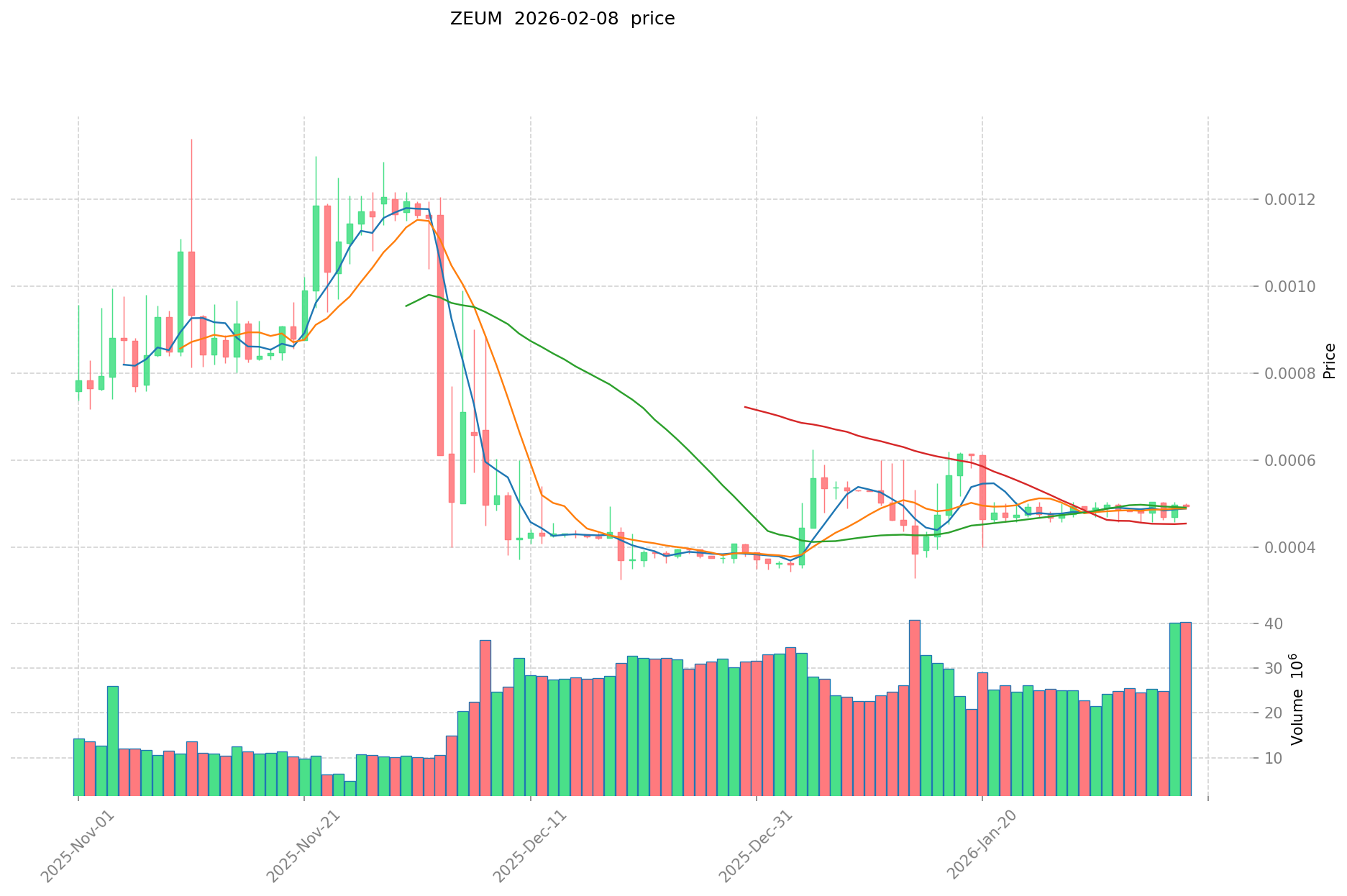
ZEUM is a digital asset in the cryptocurrency space that has been operational since its launch in May 2022. As of February 08, 2026, Colizeum has a market capitalization of approximately $205,128.63, with a circulating supply of around 416,589,429 tokens, and the current price is maintained at approximately $0.0004924. With its positioning as a decentralized blockchain game store that bridges the gap between traditional gaming and blockchain technology, ZEUM has gradually become a focal point for investors discussing "Is Colizeum (ZEUM) a good investment?" This article will comprehensively analyze ZEUM's investment value, historical trends, future price predictions, and investment risks to provide reference for investors.
I. ZEUM Price History Review and Current Investment Value
- 2022: Token launch and initial trading period → Price reached approximately $0.149149 in early May before experiencing significant volatility
- 2025: Market consolidation phase → Trading volume stabilized around $15,481.11 with circulating supply reaching 416.59 million tokens
- 2025-2026: Extended bearish cycle → Price declined from higher levels to approximately $0.0004924
Current ZEUM Investment Market Status (February 2026)
- ZEUM current price: $0.0004924
- 24-hour trading volume: $15,481.11
- Market capitalization: $205,128.63
- Circulating supply: 416,589,429 tokens (41.66% of total supply)
- Fully diluted market cap: $492,400.00
Click to view real-time ZEUM market price
II. Core Factors Influencing Whether ZEUM is a Good Investment (Is Colizeum(ZEUM) a Good Investment)
Supply Mechanism and Scarcity (ZEUM investment scarcity)
- Total supply capped at 1,000,000,000 ZEUM with a circulating supply of approximately 416,589,429 tokens → influences price dynamics and potential investment value
- Current circulating ratio stands at 41.66% → indicates significant remaining supply yet to enter the market
- Investment significance: the fixed maximum supply of 1 billion tokens provides a degree of scarcity that may support valuation considerations over time
Institutional Investment and Mainstream Adoption (Institutional investment in ZEUM)
- Token holder count: 1,643 holders as of the latest data → reflects limited but measurable community engagement
- Exchange availability: ZEUM is currently listed on 1 exchange platform → suggests limited mainstream adoption and accessibility compared to more widely traded assets
Macroeconomic Environment's Impact on ZEUM Investment
- Broader cryptocurrency market conditions → directly affect investor sentiment toward smaller-cap gaming tokens like ZEUM
- Market capitalization of approximately $205,128.63 with a dominance of 0.000019% → indicates ZEUM's minimal share of the overall crypto market
- Trading volume of $15,481.11 over 24 hours → reflects relatively low liquidity which may amplify price volatility during macroeconomic shifts
Technology and Ecosystem Development (Technology & Ecosystem for ZEUM investment)
- Colizeum's toolset enables developers to create blockchain mobile games without requiring dedicated blockchain development teams → addresses a key barrier for mobile game developers
- Infrastructure services include Play-to-Earn, Prediction Markets, Tokenized Tournaments, and Attention Marketplace → all deployable with one-click functionality
- Token deployed on Ethereum (contract address: 0x436dA116249044E8B4464F0Cf21Dd93311d88190) → benefits from the security and infrastructure of an established blockchain network
- Value proposition: the platform bridges traditional gaming and blockchain, offering game developers monetization alternatives while allowing players to earn and own in-game assets
- Ecosystem maturity: the project's focus on empowering influencers and developers to capture value without intermediaries represents a differentiated approach in the blockchain gaming sector
III. ZEUM Future Investment Forecast and Price Outlook (Is Colizeum(ZEUM) worth investing in 2026-2031)
Short-term Investment Forecast (2026, short-term ZEUM investment outlook)
Based on available market data, short-term forecasts for ZEUM suggest varied price trajectories depending on market conditions and adoption rates.
- Conservative forecast: $0.000448 - $0.000492
- Neutral forecast: $0.000492 - $0.000600
- Optimistic forecast: $0.000600 - $0.000714
Mid-term Investment Outlook (2027-2029, mid-term Colizeum(ZEUM) investment forecast)
- Market phase expectation: ZEUM may experience gradual growth as the blockchain gaming sector continues to develop, with potential increases in developer adoption and user engagement on the Colizeum platform.
- Investment return forecast:
- 2027: $0.000440 - $0.000718
- 2028: $0.000429 - $0.000680
- 2029: $0.000644 - $0.000939
- Key catalysts: Expansion of the developer toolset, increased mobile game integrations, broader user base growth, and potential partnerships within the blockchain gaming ecosystem.
Long-term Investment Outlook (Is ZEUM a good long-term investment?)
- Base scenario: $0.000675 - $0.000844 (assuming steady platform development and moderate market adoption)
- Optimistic scenario: $0.000845 - $0.000996 (assuming accelerated adoption, favorable market conditions, and successful ecosystem expansion)
- Risk scenario: Below $0.000448 (under adverse market conditions, regulatory challenges, or limited platform growth)
Click to view ZEUM long-term investment and price prediction: Price Prediction
2026-02-08 to 2031 Long-term Outlook
- Base scenario: $0.000675 - $0.000845 (corresponding to steady progress and gradual mainstream application growth)
- Optimistic scenario: $0.000845 - $0.000996 (corresponding to large-scale adoption and favorable market environment)
- Transformative scenario: Above $0.001 (if the ecosystem achieves breakthrough developments and mainstream prevalence)
- 2031-12-31 predicted high: $0.000996 (based on optimistic development assumptions)
Disclaimer: Price predictions are speculative and based on historical data, market trends, and mathematical models. Cryptocurrency markets are highly volatile and subject to numerous unpredictable factors. These forecasts should not be considered as financial advice or guarantees of future performance. Investors should conduct their own research and assess their risk tolerance before making investment decisions.
| Year |
Predicted High Price |
Predicted Average Price |
Predicted Low Price |
Price Change |
| 2026 |
0.00071398 |
0.0004924 |
0.000448084 |
0 |
| 2027 |
0.0007177961 |
0.00060319 |
0.0004403287 |
22 |
| 2028 |
0.0006803078415 |
0.00066049305 |
0.0004293204825 |
34 |
| 2029 |
0.00093856062405 |
0.00067040044575 |
0.00064358442792 |
36 |
| 2030 |
0.000973421447229 |
0.0008044805349 |
0.000675763649316 |
63 |
| 2031 |
0.000995625109992 |
0.000888950991064 |
0.000844503441511 |
80 |
IV. Colizeum Investment Strategy and Risk Management (How to invest in Colizeum)
Investment Methodology (Colizeum investment strategy)
Long-term Holding (HODL Colizeum)
Long-term holding strategies may appeal to investors seeking a measured approach to blockchain gaming assets. This methodology involves:
- Position Building: Accumulating ZEUM tokens during periods of lower volatility
- Holding Period: Maintaining positions through market cycles to potentially benefit from the development of Colizeum's decentralized gaming ecosystem
- Fundamental Focus: Emphasizing the platform's toolset for mobile game developers and the adoption rate of blockchain gaming solutions
This approach suits investors who believe in the long-term potential of blockchain-integrated gaming platforms and can tolerate significant price fluctuations inherent in the cryptocurrency market.
Active Trading
Active trading strategies involve more frequent position adjustments based on market dynamics:
- Technical Analysis: Utilizing chart patterns, volume indicators, and price action within ZEUM's trading ranges
- Swing Trading: Capitalizing on price movements between support and resistance levels
- Market Timing: Monitoring gaming industry developments and blockchain adoption trends that may impact token valuation
Given ZEUM's current 24-hour trading volume of approximately $15,481, traders should be aware of potential liquidity constraints that may affect order execution.
Risk Management (Risk management for Colizeum investment)
Asset Allocation Recommendations
Conservative Investors
- Allocation: 1-3% of cryptocurrency portfolio
- Focus on established cryptocurrencies with small experimental positions in gaming tokens
- Emphasis on capital preservation
Moderate Investors
- Allocation: 3-7% of cryptocurrency portfolio
- Balanced approach between established assets and emerging gaming platforms
- Regular rebalancing based on market conditions
Aggressive Investors
- Allocation: 7-15% of cryptocurrency portfolio
- Higher exposure to blockchain gaming sector
- Active monitoring of platform developments and gaming industry trends
Risk Mitigation Approaches
Diversified Portfolio Construction
- Combine ZEUM with other blockchain gaming tokens to reduce single-project risk
- Include established cryptocurrencies (BTC, ETH) as portfolio anchors
- Consider exposure to different blockchain gaming segments (platforms, in-game assets, gaming infrastructure)
Hedging Strategies
- Maintain stablecoin reserves for opportunistic buying during market downturns
- Consider position sizing based on volatility metrics
- Implement stop-loss levels based on individual risk tolerance
Secure Storage Solutions
Cold Wallet Storage
For long-term holdings, cold storage provides enhanced security:
- Hardware wallets compatible with ERC-20 tokens (ZEUM is deployed on Ethereum)
- Paper wallet generation for completely offline storage
- Multi-signature wallets for larger holdings
Hot Wallet Considerations
For active traders maintaining operational liquidity:
- Reputable software wallets with proven security track records
- Regular security updates and two-factor authentication
- Limited fund allocation (only amounts intended for near-term trading)
Hardware Wallet Recommendations
Popular options supporting ERC-20 tokens include established hardware wallet providers offering:
- Secure element chip protection
- Open-source firmware verification
- Multi-currency support including Ethereum-based tokens
V. Colizeum Investment Risks and Challenges (Risks of investing in Colizeum)
Market Risks
High Volatility
ZEUM exhibits substantial price volatility characteristic of lower market cap cryptocurrencies:
- Historical Price Range: The token has experienced significant price movements, with data showing fluctuations within its trading history
- Current Market Cap: With a market capitalization of approximately $205,128, the asset demonstrates susceptibility to rapid price changes from relatively modest trading volume
- Liquidity Constraints: The 24-hour trading volume of $15,481 indicates limited market depth, which can amplify price movements during buying or selling pressure
Price Manipulation Susceptibility
Smaller market cap tokens face inherent risks:
- Lower liquidity environments may experience more pronounced price swings from concentrated trading activity
- Limited exchange listings (currently available on 1 exchange) may restrict market efficiency
- The circulating supply of 416,589,429 tokens (41.66% of total supply) requires consideration when evaluating market dynamics
Regulatory Risks
Jurisdictional Uncertainty
Blockchain gaming platforms face evolving regulatory landscapes:
- Gaming Regulations: Different jurisdictions maintain varying approaches to blockchain-integrated gaming, with some regions imposing restrictions on play-to-earn models
- Securities Classification: Regulatory authorities in various countries may assess gaming tokens differently, potentially affecting trading accessibility
- Cross-border Operations: Decentralized gaming platforms operating globally must navigate multiple regulatory frameworks simultaneously
Compliance Evolution
The regulatory environment continues to develop:
- Gaming industry regulators increasingly scrutinize blockchain integration
- Token classification debates may impact how gaming assets are treated legally
- Compliance requirements may evolve, potentially affecting platform operations
Technical Risks
Network Security Considerations
As an Ethereum-based token (ERC-20), ZEUM inherits both benefits and risks:
- Smart Contract Vulnerabilities: Potential coding errors in token contracts or platform integrations could create security exposures
- Blockchain Dependencies: Performance and security depend on underlying Ethereum network conditions
- Platform Integration Risks: The toolset enabling developers to create blockchain mobile games introduces technical complexity that requires robust security practices
Upgrade and Development Risks
Platform evolution presents potential challenges:
- Implementation of new features for game developers may encounter technical obstacles
- Integration between traditional gaming systems and blockchain infrastructure requires ongoing maintenance
- Competition from other blockchain gaming platforms may affect adoption rates
Gaming Ecosystem Risks
Specific to blockchain gaming platforms:
- Developer Adoption: Platform success depends on mobile game developers choosing to integrate Colizeum's toolset
- Player Engagement: User adoption of blockchain gaming models remains in early stages across the industry
- Asset Ownership Infrastructure: Technical implementation of true asset ownership requires sustained development and security measures
VI. Conclusion: Is Colizeum a Good Investment?
Investment Value Summary
Colizeum represents an investment in the emerging blockchain gaming infrastructure sector. The platform's positioning as a decentralized game store with developer toolsets addresses specific challenges in mobile gaming monetization. However, potential investors should carefully weigh several factors:
Potential Considerations:
- The project targets the mobile gaming developer market, which includes numerous developers seeking alternative monetization and distribution channels
- Blockchain gaming adoption continues developing across the industry
- The platform's toolset approach aims to reduce technical barriers for traditional game developers
Risk Factors:
- ZEUM demonstrates significant price volatility with a relatively small market capitalization of approximately $205,128
- Limited trading volume ($15,481 over 24 hours) indicates constrained liquidity
- The circulating supply represents 41.66% of total supply, with implications for future token distribution
- Blockchain gaming sector faces ongoing technical, regulatory, and market adoption challenges
Investor Recommendations
✅ New Investors
Approach: Educational entry with strict risk management
- Strategy: Consider modest position sizing appropriate to personal risk tolerance
- Method: Dollar-cost averaging over extended periods to mitigate timing risk
- Storage: Prioritize secure wallet solutions compatible with ERC-20 tokens
- Education: Thoroughly research blockchain gaming sector dynamics before committing capital
✅ Experienced Investors
Approach: Tactical allocation within diversified cryptocurrency portfolios
- Strategy: Position sizing based on individual risk parameters and portfolio construction
- Method: Consider trading strategies aligned with volatility patterns and liquidity constraints
- Monitoring: Track gaming industry developments, platform adoption metrics, and regulatory changes
- Diversification: Balance exposure across multiple blockchain gaming projects and broader crypto assets
✅ Institutional Investors
Approach: Strategic sector exposure with comprehensive due diligence
- Strategy: Evaluate Colizeum within broader blockchain gaming infrastructure thesis
- Method: Consider position as part of venture-style allocation to emerging gaming technology
- Analysis: Conduct thorough technical, competitive, and regulatory assessment
- Risk Framework: Apply institutional-grade risk management protocols appropriate for speculative technology assets
⚠️ Important Disclosure
Cryptocurrency investments carry substantial risk, including potential loss of principal. ZEUM exhibits characteristics common to smaller market cap digital assets, including high volatility, limited liquidity, and dependence on early-stage technology adoption. This analysis provides informational context only and does not constitute financial advice, investment recommendations, or endorsements. Prospective investors should:
- Conduct independent research aligned with personal circumstances
- Consult qualified financial advisors before making investment decisions
- Only allocate capital that can be afforded as a complete loss
- Understand that past performance does not indicate future results
- Recognize that blockchain gaming represents an emerging and evolving sector with uncertain outcomes
VII. FAQ
Q1: What is ZEUM and how does it function in the blockchain gaming ecosystem?
ZEUM is the native token of Colizeum, a decentralized blockchain game store that provides infrastructure tools for mobile game developers. The platform enables developers to create blockchain-integrated mobile games without requiring dedicated blockchain development teams, offering one-click deployment of features like Play-to-Earn, Prediction Markets, Tokenized Tournaments, and Attention Marketplace. ZEUM operates as an ERC-20 token on the Ethereum network (contract address: 0x436dA116249044E8B4464F0Cf21Dd93311d88190), with a total supply capped at 1,000,000,000 tokens. As of February 2026, approximately 416,589,429 tokens (41.66%) are in circulation, with a current market price of $0.0004924 and a market capitalization of approximately $205,128.
Q2: Is ZEUM suitable for long-term investment based on its current market position?
ZEUM presents both opportunities and challenges for long-term investors. The platform's positioning in blockchain gaming infrastructure addresses real market needs, but significant risk factors exist. With a market capitalization of only $205,128 and 24-hour trading volume of $15,481, the token exhibits substantial liquidity constraints and price volatility. The circulating supply represents 41.66% of total supply, indicating significant remaining tokens yet to enter the market. Long-term viability depends on developer adoption, gaming industry trends, and regulatory developments. Conservative investors might consider 1-3% portfolio allocation, while more risk-tolerant investors could allocate 7-15%, always emphasizing that only capital affordable to lose should be committed to such speculative assets.
Q3: What are the primary risks associated with investing in ZEUM?
ZEUM investment carries multiple risk categories. Market risks include extreme volatility due to low market capitalization, limited liquidity from modest trading volume, and potential price manipulation given the constrained market depth. Regulatory risks encompass uncertain gaming token classifications across jurisdictions, evolving blockchain gaming regulations, and potential restrictions on play-to-earn models in some regions. Technical risks involve smart contract vulnerabilities inherent in ERC-20 tokens, platform integration complexities, and dependencies on Ethereum network performance. Additionally, ecosystem risks include uncertain developer adoption rates, early-stage blockchain gaming user engagement, and intense competition from other gaming platforms. Investors should implement strict risk management, diversification strategies, and secure storage solutions when considering ZEUM positions.
Q4: How does ZEUM's technology differentiate it from other blockchain gaming tokens?
Colizeum differentiates itself through developer-focused infrastructure rather than individual game development. The platform provides a comprehensive toolset enabling traditional mobile game developers to integrate blockchain features without specialized blockchain programming expertise. This one-click deployment approach for Play-to-Earn mechanics, tokenized tournaments, prediction markets, and attention marketplace features addresses a key barrier preventing mainstream gaming companies from blockchain adoption. Unlike gaming tokens tied to specific games, ZEUM functions as platform infrastructure supporting multiple games and developers. The project's focus on empowering influencers and developers to capture value without intermediaries represents a structural approach to blockchain gaming, though success depends on convincing traditional developers to adopt these tools over established distribution channels.
Q5: What price forecasts exist for ZEUM through 2031 and what assumptions underlie them?
Price forecasts for ZEUM through 2031 suggest varied trajectories depending on adoption scenarios. Short-term (2026) projections range from $0.000448 (conservative) to $0.000714 (optimistic). Mid-term forecasts show 2027 at $0.000440-$0.000718, 2028 at $0.000429-$0.000680, and 2029 at $0.000644-$0.000939. Long-term projections for 2031 suggest a high of $0.000996 under optimistic conditions, with base scenarios around $0.000675-$0.000845. These forecasts assume gradual blockchain gaming sector growth, increasing developer adoption, favorable regulatory environments, and successful platform expansion. However, these predictions are highly speculative and based on mathematical models rather than guaranteed outcomes. Cryptocurrency markets remain unpredictable, and actual performance may significantly diverge from projections due to regulatory changes, competitive pressures, technological challenges, or macroeconomic conditions.
Q6: How should different investor profiles approach ZEUM allocation?
Investment approaches to ZEUM should align with risk tolerance and experience levels. New investors should adopt an educational stance with strict capital limits, using dollar-cost averaging strategies, prioritizing secure ERC-20 compatible wallet storage, and thoroughly researching blockchain gaming dynamics before committing funds. Experienced investors might employ tactical allocation within diversified portfolios, with position sizing based on individual risk parameters (typically 3-7% for moderate risk profiles), tracking gaming industry developments and platform adoption metrics, and implementing appropriate trading strategies accounting for liquidity constraints. Institutional investors should treat ZEUM as venture-style exposure to emerging gaming infrastructure, conducting comprehensive technical, competitive, and regulatory due diligence, applying institutional-grade risk management protocols, and positioning within broader blockchain gaming sector thesis rather than concentrated exposure.
Q7: What factors could significantly impact ZEUM's future value?
Multiple factors may materially affect ZEUM's valuation trajectory. Developer adoption represents the primary driver—the platform's success depends on convincing mobile game developers to integrate Colizeum's toolset over traditional distribution channels. Gaming industry trends toward blockchain integration, player acceptance of play-to-earn models, and mainstream adoption of tokenized gaming assets will substantially influence demand. Regulatory developments across jurisdictions may either facilitate or constrain platform operations, particularly regarding gaming token classifications and play-to-earn mechanics. Technical execution including smart contract security, platform stability, and successful feature implementation will affect reputation and usage. Macroeconomic conditions influencing cryptocurrency markets broadly, competitive positioning against other blockchain gaming platforms, and potential partnerships with established gaming companies or developers could create significant value inflection points, either positive or negative.
Q8: What security considerations should ZEUM investors prioritize?
ZEUM security considerations span multiple dimensions. Storage security requires appropriate solutions based on holding duration and trading frequency—long-term holders should prioritize cold storage via hardware wallets supporting ERC-20 tokens, paper wallet generation, or multi-signature wallets for larger holdings, while active traders might use reputable software wallets with two-factor authentication but limit hot wallet holdings to amounts needed for near-term trading. Smart contract risk requires awareness that ZEUM's ERC-20 implementation and platform integrations carry potential coding vulnerabilities, emphasizing the importance of verifying contract addresses (0x436dA116249044E8B4464F0Cf21Dd93311d88190 for ZEUM) before transactions. Exchange security involves recognizing that ZEUM's limited exchange availability (currently 1 exchange) concentrates counterparty risk, necessitating evaluation of chosen exchange's security track record, regulatory compliance, and insurance provisions before maintaining significant balances on trading platforms.
* The information is not intended to be and does not constitute financial advice or any other recommendation of any sort offered or endorsed by Gate.