This comprehensive analysis examines whether Common Protocol (COMMON) represents a viable investment opportunity for cryptocurrency investors. COMMON, an AI-native tokenized workspace platform serving 3.8 million users across 50,000+ communities, currently trades at $0.000591 with significant price volatility. The article evaluates COMMON's market position through historical price trends, circulating supply mechanics, and institutional adoption factors, while presenting price forecasts ranging from $0.000529 to $0.001465 through 2031 across different scenarios. Critical investment considerations include extreme volatility (78% weekly decline), limited market liquidity, and ongoing token circulation dynamics affecting price discovery. The analysis provides tailored investment strategies for conservative, moderate, and aggressive investors, alongside comprehensive risk management frameworks addressing market, regulatory, and technical risks. Ultimately, COMMON remains a high-risk early-stage asset requiring tho
Introduction: Common Protocol (COMMON) Investment Position and Market Outlook
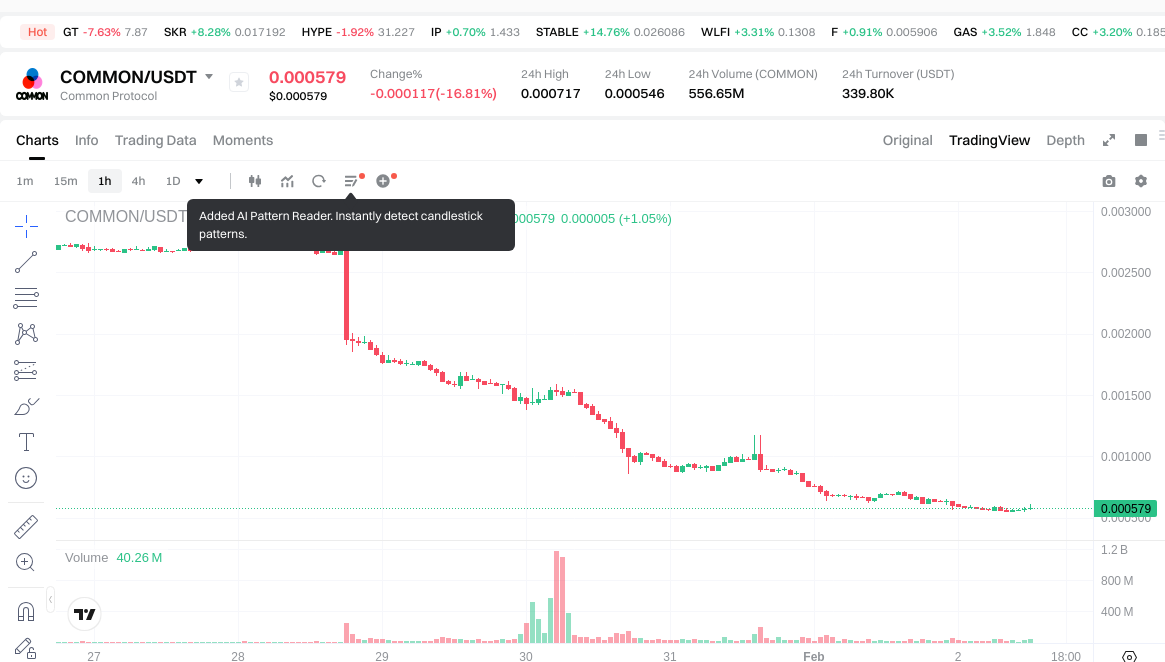
Common Protocol (COMMON) is an emerging digital asset in the cryptocurrency sector, representing an AI-native workspace where communities, projects, and threads are tokenized. As of February 2, 2026, COMMON is trading at approximately $0.000591, with a circulating market capitalization of about $1.46 million and a circulating supply of approximately 2.48 billion tokens. The project serves over 3.8 million users across more than 50,000 communities, positioning itself as a platform where users and AI agents can conduct research, trade, develop code based on feature requests, and earn rewards from ideas and bounties. With a current market ranking of 2246 and presence on 13 exchanges, COMMON has attracted attention from 3,554 token holders. This article provides a comprehensive analysis of COMMON's investment characteristics, historical price movements, future price outlook, and associated investment risks to serve as a reference for potential investors examining whether Common Protocol (COMMON) may fit their portfolio considerations.
I. COMMON Price History Review and Current Investment Value
Common Protocol (COMMON) emerged in the cryptocurrency market in October 2025, establishing itself as an AI-native tokenized workspace platform. The token experienced notable price volatility during its early trading phase:
- October 2025: Token launch and initial trading → COMMON reached a price level of $0.0412 during its early market debut
- November 2025: Market establishment phase → The token stabilized at approximately $0.005517 with a market capitalization of $68.5 million and circulating supply of 1.485 billion tokens
- February 2026: Market adjustment period → Price declined to $0.000591, representing a correction from earlier price levels
Current COMMON Investment Market Status (February 2026)
- COMMON current price: $0.000591
- 24-hour trading volume: $328,257.46
- Market capitalization: $1,464,330.60
- Circulating supply: 2,477,716,754 COMMON tokens
- Total supply: 12,418,259,242 COMMON tokens
- Circulating ratio: 19.95%
- Market dominance: 0.00027%
View real-time COMMON market price
The token has demonstrated significant price fluctuations across different timeframes: a 4.26% increase over 1 hour, a 14.22% decline over 24 hours, and a 78.34% decrease over 7 days. Common Protocol serves approximately 3.8 million users across 50,000+ communities, positioning itself within the AI-native workspace and tokenization sector. The project's market performance reflects its early-stage development and the inherent volatility typical of emerging cryptocurrency assets in the AI and blockchain intersection space.
II. Core Factors Influencing Whether COMMON is a Good Investment
Supply Mechanism and Scarcity (COMMON investment scarcity)
- Fixed maximum supply of 12,418,259,242 tokens with current circulating supply of 2,477,716,754 tokens (19.95% circulation ratio) → impacts price dynamics and investment considerations
- Current market cap to fully diluted valuation ratio stands at 19.95%, indicating substantial token unlock potential that may affect future price movements
- Investment significance: The token's scarcity profile reflects early-stage circulation with approximately 80% of tokens yet to enter circulation, which represents a key consideration for investment evaluation
Institutional Investment and Mainstream Adoption (Institutional investment in COMMON)
- Platform serves 3.8 million users across over 50,000 communities, representing a significant user base for an AI-native workspace
- Token listed on 13 exchanges with 3,554 current holders as of February 2, 2026
- Ecosystem focuses on tokenized communities where users and AI agents can conduct research, trade, code on feature requests, and monetize ideas through bounties
Macroeconomic Environment Impact on COMMON Investment
- Market conditions during late 2025 and early 2026 have been challenging, with COMMON experiencing a 78.34% decline over 7 days and 82.44% decline over 30 days
- Current trading price of $0.000591 reflects broader market pressures affecting the digital asset sector
- Price volatility with 24-hour range between $0.000546 and $0.000717 demonstrates sensitivity to market sentiment
Technology and Ecosystem Development (Technology & Ecosystem for COMMON investment)
- Infrastructure upgrades planned for 2026 may influence DAO adoption and ecosystem growth
- AI-native workspace model integrates community tokenization with practical utility for research, trading, and development activities
- Platform deployment on BASE blockchain with contract address 0x4c87da04887a1f9f21f777e3a8dd55c3c9f84701
- Technical forecast indicators for 2026 suggest bearish outlook based on multiple quantitative metrics, though future performance depends on infrastructure upgrade execution and adoption rates
III. COMMON Future Investment Forecast and Price Outlook (Is Common Protocol(COMMON) worth investing in 2026-2031)
Short-term Investment Outlook (2026, short-term COMMON investment outlook)
Based on available market data and technical indicators, short-term projections for COMMON in 2026 present the following scenarios:
- Conservative forecast: $0.000454 - $0.000583
- Neutral forecast: $0.000583 - $0.000680
- Optimistic forecast: $0.000680 - $0.000787
These projections reflect the token's current market position following recent price adjustments. The short-term outlook considers the circulating supply of approximately 2.48 billion tokens (19.95% of maximum supply) and current market capitalization levels.
Mid-term Investment Outlook (2027-2028, mid-term Common Protocol(COMMON) investment forecast)
- Market phase expectation: Platform consolidation period with focus on ecosystem development and user adoption metrics. This phase may witness gradual growth as the AI-native workspace functionality gains traction across the 50,000+ communities.
- Investment return forecast:
- 2027: $0.000534 - $0.000747
- 2028: $0.000480 - $0.000845
- Key catalysts: Platform development progress including MetaSearch features, user adoption rate among the 3.8 million users, AI agent integration effectiveness, and broader market sentiment toward AI-crypto integration projects.
Long-term Investment Outlook (Is COMMON a good long-term investment?)
- Baseline scenario: $0.000577 - $0.000983 (assuming steady platform development and moderate user growth)
- Optimistic scenario: $0.000881 - $0.001465 (assuming enhanced adoption rates and favorable market conditions for AI-native platforms)
- Risk scenario: Below $0.000529 (under circumstances of reduced user engagement or challenging market environments)
Click to view COMMON long-term investment and price forecast: Price Prediction
2026-02-02 - 2031 Long-term Outlook
- Base scenario: $0.000529 - $0.000881 USD (corresponding to steady progress and gradual mainstream application growth)
- Optimistic scenario: $0.000983 - $0.001465 USD (corresponding to large-scale adoption and favorable market environment)
- Transformative scenario: Above $0.001465 USD (subject to breakthrough ecosystem developments and mainstream adoption)
- 2031-12-31 projected high: $0.001465 USD (based on optimistic development assumptions)
Disclaimer: These projections are based on current market data, historical trends, and platform development indicators. Cryptocurrency markets involve substantial risk and volatility. Price forecasts should not be considered as investment advice. Users should conduct comprehensive research and risk assessment before making investment decisions.
| Year |
Predicted High Price |
Predicted Average Price |
Predicted Low Price |
Price Change |
| 2026 |
0.00078705 |
0.000583 |
0.00045474 |
-1 |
| 2027 |
0.00074667725 |
0.000685025 |
0.0005343195 |
15 |
| 2028 |
0.0008447043275 |
0.000715851125 |
0.00047962025375 |
21 |
| 2029 |
0.000983149935075 |
0.00078027772625 |
0.000577405517425 |
32 |
| 2030 |
0.001084508011714 |
0.000881713830662 |
0.000529028298397 |
49 |
| 2031 |
0.001464835272571 |
0.000983110921188 |
0.000727502081679 |
66 |
IV. Common Protocol (COMMON) Investment Strategy and Risk Management (How to invest in Common Protocol)
Investment Methodology (COMMON investment strategy)
Long-term Holding (HODL COMMON): This approach may suit investors with a longer time horizon who believe in the platform's vision of an AI-native tokenized workspace. Given the project's focus on integrating AI agents with community-driven development and bounty systems across 50,000+ communities, long-term holders would be betting on user adoption growth and ecosystem expansion. However, investors should be aware that COMMON has experienced significant price volatility, with a 78.34% decline over the past 7 days and an 82.44% decline over 30 days as of February 2, 2026.
Active Trading: Traders employing technical analysis and swing trading strategies should note COMMON's high volatility profile. The token showed a 4.26% increase over 1 hour but a 14.22% decline over 24 hours, indicating rapid price movements. The 24-hour trading range between $0.000546 and $0.000717 suggests opportunities for short-term position trading, though this requires careful monitoring and risk controls.
Risk Management (Risk management for COMMON investment)
Asset Allocation Ratios:
- Conservative investors: Consider limiting COMMON exposure to 1-3% of cryptocurrency portfolio due to high volatility and relatively low market ranking (2246)
- Moderate investors: May allocate 3-7% depending on risk tolerance and portfolio diversification
- Aggressive/Professional investors: Could consider up to 10-15% allocation while maintaining strict stop-loss mechanisms
Risk Hedging Strategies:
- Multi-asset portfolio approach: Combine COMMON with established cryptocurrencies and stablecoins
- Position sizing: Scale entries during different market conditions rather than single large positions
- Volatility hedging: Consider using derivatives or holding stablecoin reserves for rebalancing opportunities
Secure Storage:
- Cold wallet solutions: Hardware wallets supporting BASE chain tokens (such as Ledger or Trezor) for long-term holdings
- Hot wallet management: Use reputable wallets with BASE network compatibility for active trading positions
- Security practices: Enable two-factor authentication, maintain separate devices for wallet access, and regularly verify contract addresses (0x4c87da04887a1f9f21f777e3a8dd55c3c9f84701 on BASE)
V. COMMON Investment Risks and Challenges (Risks of investing in Common Protocol)
Market Risks:
- High volatility: COMMON has demonstrated extreme price fluctuations, with recent declines exceeding 78% over 7 days
- Liquidity considerations: With a 24-hour trading volume of approximately $328,257 and market capitalization of $1.46 million, the token may experience limited liquidity compared to larger-cap assets
- Price discovery phase: The token's relatively recent launch (October 2025) means it is still establishing stable price levels
- Market cap concentration: With only 19.95% of total supply currently circulating (2.48 billion out of 12.42 billion tokens), future token releases could impact price dynamics
Regulatory Risks:
- Jurisdictional uncertainty: Different countries maintain varying approaches to AI-integrated cryptocurrency platforms and tokenized community models
- Compliance evolution: Regulatory frameworks for AI-native workspaces and tokenized bounty systems remain under development in many regions
- Cross-border considerations: The platform's global community spanning 50,000+ groups may face diverse regulatory requirements
Technical Risks:
- Smart contract security: As a BASE chain token, COMMON relies on the underlying blockchain's security infrastructure
- Platform development risks: The integration of AI agents with tokenized communities represents a novel technical architecture that may encounter unforeseen challenges
- Adoption uncertainty: The success of the AI-native workspace model depends on sustained user engagement across the 3.8 million claimed user base
- Network dependencies: The project's reliance on BASE chain infrastructure means any network issues could affect COMMON's functionality
VI. Conclusion: Is Common Protocol a Good Investment?
Investment Value Summary: Common Protocol (COMMON) presents an experimental approach to combining AI-native workspaces with tokenized community engagement. The platform's vision of enabling 3.8 million users and AI agents to collaborate, trade, and earn across 50,000+ communities offers a distinctive value proposition in the evolving AI and cryptocurrency intersection. However, the token has experienced substantial price volatility, with recent declines exceeding 80% over 30 days. The limited circulating supply (19.95% of total) and relatively low market capitalization ($1.46 million) indicate COMMON remains in early stages of market development.
Investor Recommendations:
✅ Beginners: If considering COMMON, employ dollar-cost averaging with very small position sizes (under 2% of crypto portfolio) and prioritize secure storage using hardware wallets compatible with BASE chain. New investors should thoroughly research the platform's AI-native workspace model and understand the high-risk nature of early-stage cryptocurrency projects.
✅ Experienced Investors: May explore swing trading opportunities given COMMON's volatility patterns, while maintaining strict risk management protocols including stop-loss orders. Consider COMMON as a speculative allocation within a diversified cryptocurrency portfolio, with position sizes adjusted based on overall risk tolerance and market conditions.
✅ Institutional Investors: Should conduct comprehensive due diligence on the platform's technical architecture, user metrics verification, and long-term sustainability model before considering any allocation. Given the token's early stage and limited liquidity, institutional positions would require careful entry and exit planning.
⚠️ Disclaimer: Cryptocurrency investments carry substantial risk, including potential total loss of capital. This analysis is provided for informational purposes only and does not constitute investment advice. Market conditions can change rapidly, and past performance does not indicate future results. Investors should conduct independent research, assess their risk tolerance, and consider consulting financial advisors before making investment decisions involving COMMON or any cryptocurrency asset.
VII. FAQ
Q1: What is Common Protocol (COMMON) and how does its AI-native workspace model function?
Common Protocol (COMMON) is a tokenized platform that integrates artificial intelligence with community-driven workspaces, serving approximately 3.8 million users across more than 50,000 communities. The platform enables users and AI agents to collaborate on research, trading, code development based on feature requests, and monetization through idea-sharing and bounties. Built on the BASE blockchain with contract address 0x4c87da04887a1f9f21f777e3a8dd55c3c9f84701, COMMON represents each community, project, and discussion thread as a tokenized entity. This AI-native architecture allows for decentralized collaboration where participants can earn rewards through contributions, while AI agents enhance productivity and research capabilities within the ecosystem.
Q2: What explains COMMON's significant price volatility since its launch in October 2025?
COMMON's price has experienced substantial fluctuations, including a 78.34% decline over 7 days and 82.44% decline over 30 days as of February 2, 2026. Several factors contribute to this volatility: First, the token's early-stage market position with only 19.95% of total supply (2.48 billion out of 12.42 billion tokens) currently circulating creates uncertainty about future token releases. Second, the relatively limited liquidity with a market capitalization of $1.46 million and 24-hour trading volume of approximately $328,257 means smaller trades can cause larger price movements. Third, as an emerging AI-crypto integration project, COMMON faces market sentiment fluctuations and price discovery challenges typical of newly launched digital assets in experimental technology sectors.
Q3: What are the primary risks associated with investing in COMMON?
COMMON investment carries several significant risks: Market risks include extreme price volatility (78% weekly decline), limited liquidity compared to established cryptocurrencies, and ongoing price discovery following its recent October 2025 launch. Technical risks involve smart contract security on the BASE chain, unproven adoption of the AI-native workspace model, and dependency on underlying blockchain infrastructure. Regulatory uncertainty exists regarding AI-integrated cryptocurrency platforms across different jurisdictions. Additionally, with 80% of total supply yet to enter circulation, future token releases could substantially impact price dynamics. The token's low market ranking (2246) and relatively small holder base (3,554 holders) indicate early-stage development risks that require careful consideration.
Q4: How should investors approach position sizing for COMMON in their portfolio?
Position sizing for COMMON should reflect the token's high-risk profile and early-stage development status. Conservative investors might limit COMMON exposure to 1-3% of their total cryptocurrency portfolio, given the substantial volatility and relatively low market ranking. Moderate risk-tolerant investors could allocate 3-7% depending on their overall investment strategy and diversification approach. Aggressive or professional investors might consider up to 10-15% allocation while implementing strict stop-loss mechanisms and volatility hedging strategies. All investors should employ dollar-cost averaging rather than single large positions, maintain diversification across multiple assets including established cryptocurrencies and stablecoins, and use secure storage solutions such as hardware wallets compatible with BASE chain tokens.
Q5: What factors could influence COMMON's price performance through 2026-2031?
Multiple factors may shape COMMON's long-term trajectory: Platform development progress, particularly infrastructure upgrades planned for 2026, will impact DAO adoption and ecosystem growth. User adoption metrics among the claimed 3.8 million users and retention across 50,000+ communities serve as critical indicators. Technical integration effectiveness of AI agents with tokenized workspaces will determine practical utility. The token release schedule, with 80% of supply still locked, creates potential supply-side pressure. Broader market sentiment toward AI-crypto convergence projects and macroeconomic conditions affecting digital assets generally will influence price movements. Regulatory developments regarding tokenized community platforms and AI integration may create opportunities or constraints. Price forecasts suggest a range from $0.000529 to $0.001465 by 2031 under various scenarios, though actual performance depends on execution of platform vision and market conditions.
Q6: Where can investors purchase COMMON and what security measures should they implement?
COMMON is currently available on 13 cryptocurrency exchanges, with investors able to trade the token against various pairs. When purchasing COMMON, investors should verify the correct contract address (0x4c87da04887a1f9f21f777e3a8dd55c3c9f84701) on the BASE blockchain to avoid fraudulent tokens. For security, long-term holders should utilize cold storage solutions such as hardware wallets (Ledger or Trezor) that support BASE chain tokens. Active traders may use reputable hot wallets with BASE network compatibility while maintaining separate devices for wallet access. Essential security practices include enabling two-factor authentication on all exchange and wallet accounts, regularly verifying transaction addresses, and avoiding sharing private keys or seed phrases. Given COMMON's relatively limited liquidity, investors should monitor order books and consider using limit orders to control execution prices.
Q7: What distinguishes COMMON from other cryptocurrency projects in the AI and blockchain sector?
COMMON differentiates itself through its specific focus on tokenizing entire communities, projects, and discussion threads within an AI-native workspace environment, rather than simply adding AI features to existing blockchain platforms. The project's architecture enables direct collaboration between human users and AI agents on practical tasks including research, trading, code development, and bounty completion. With claimed deployment across 50,000+ communities serving 3.8 million users, COMMON positions itself as a social infrastructure layer where economic activity and intellectual collaboration intersect. Unlike traditional social platforms or standard blockchain projects, COMMON attempts to monetize community participation through tokenization while leveraging AI to enhance productivity. However, investors should note that this model remains largely experimental, and the project's early-stage development (launched October 2025) means its competitive positioning and long-term viability remain unproven.
Q8: What are the realistic expectations for COMMON's price recovery and growth potential?
Based on current market conditions and technical indicators, COMMON faces significant challenges for near-term price recovery following its 82.44% decline over 30 days. Short-term projections for 2026 suggest a trading range between $0.000454 and $0.000787 under various scenarios, indicating modest recovery potential from the current $0.000591 level. Mid-term forecasts through 2027-2028 remain relatively subdued at $0.000480 to $0.000845, reflecting the platform's need to demonstrate sustained user adoption and ecosystem growth. Long-term projections extending to 2031 show potential for growth to $0.000529 - $0.001465 range under optimistic assumptions, though this depends entirely on successful infrastructure upgrades, mainstream adoption of the AI-native workspace model, and favorable broader market conditions. Investors should recognize that these forecasts carry substantial uncertainty, and COMMON's actual performance may differ significantly based on execution risks, competitive dynamics, and evolving market sentiment toward AI-crypto integration projects.
* The information is not intended to be and does not constitute financial advice or any other recommendation of any sort offered or endorsed by Gate.