This comprehensive guide evaluates whether Coral Finance (CORL) presents a viable investment opportunity within the emerging DeFAI sector. The article examines CORL's market position as a decentralized finance AI application layer, analyzing its price trajectory from $0.287 at October 2025 launch to current levels around $0.001061, alongside current market metrics including $246,535.73 market capitalization and 232,361,670 circulating tokens. Key investment considerations encompass supply dynamics, ecosystem development, institutional adoption potential, and macroeconomic influences on the emerging DeFAI market. The analysis provides differentiated price forecasts across short-term (2026), mid-term (2027-2029), and long-term (2030-2031) horizons, ranging from conservative to optimistic scenarios. Strategic guidance addresses risk management approaches, portfolio allocation recommendations for conservative to aggressive investors, and secure storage practices on Binance Smart Chain. Critical risk factors inclu
Introduction: Coral Finance (CORL)'s Investment Position and Market Prospects
CORL represents a notable asset in the cryptocurrency sector, having been launched in 2025 as a decentralized finance AI application layer. As of February 2026, Coral Finance holds a market capitalization of approximately $246,535.73, with a circulating supply of around 232,361,670 tokens, and a current trading price of approximately $0.001061. Positioned as a platform that integrates AI-driven insights with decentralized finance, CORL has attracted attention among participants exploring opportunities in early-stage alpha and yield-generating mechanisms. The project currently ranks 3706 in the market and is traded on 3 exchanges, with a holder base of approximately 29,005 addresses. This article provides a comprehensive analysis of CORL's investment characteristics, historical price movements, future price considerations, and associated risks, serving as a reference for those evaluating the question "Is Coral Finance (CORL) a good investment?"
I. CORL Price History Review and Current Investment Value Status
- October 2025: CORL launched on exchanges at an initial trading price around $0.287, representing the early phase of market discovery for this DeFAI application layer token.
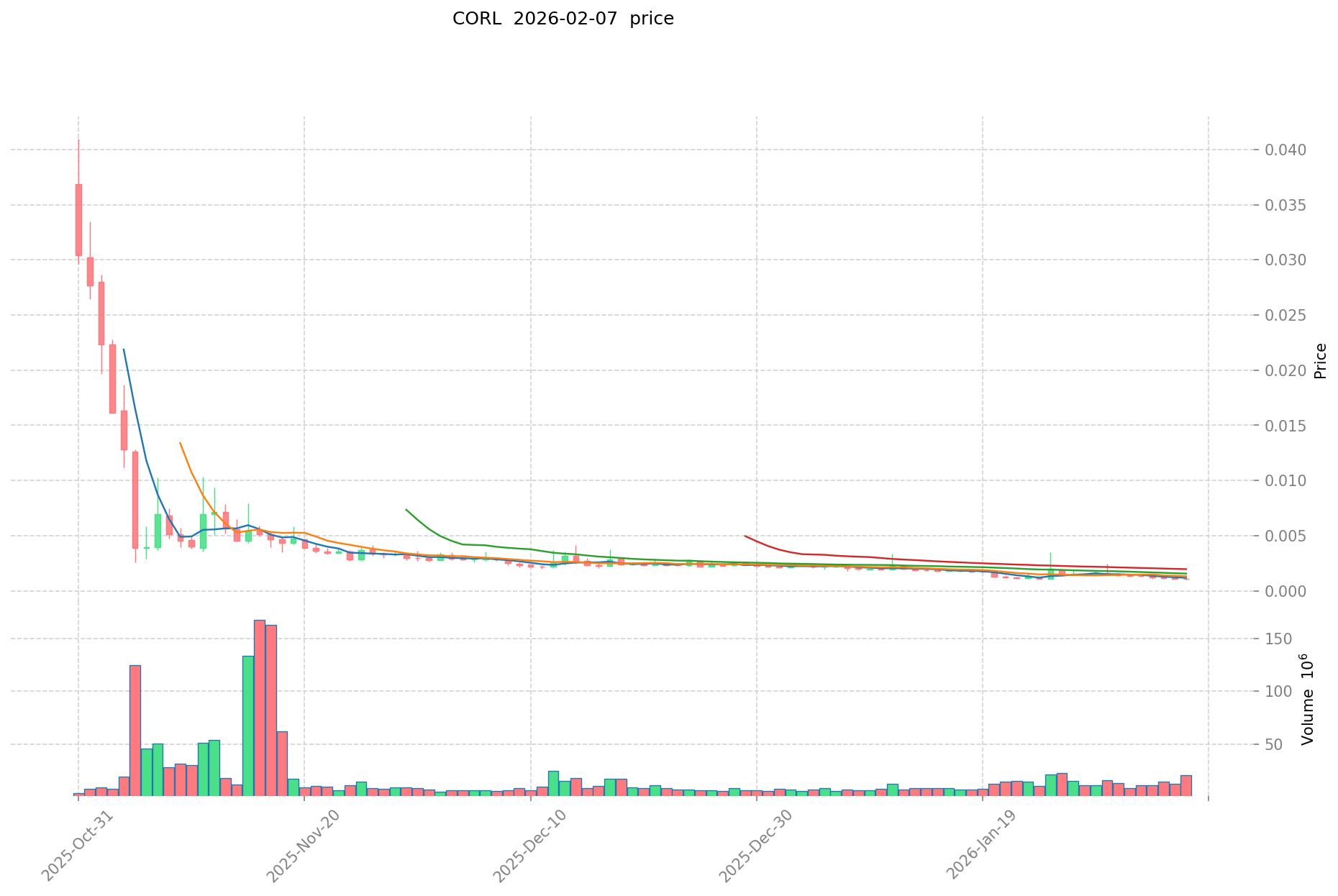
- October 2025 to February 2026: CORL experienced substantial price adjustments, declining from approximately $0.287 to current levels around $0.001061, reflecting a contraction period as the project established its market position.
- February 2026: CORL price stabilized near $0.001061 with 24-hour fluctuations between $0.001051 and $0.001149, suggesting potential consolidation phase following earlier volatility.
Current CORL Investment Market Status (February 2026)
- Current CORL Price: $0.001061
- 24-hour Trading Volume: $24,688.40
- Market Capitalization: $246,535.73
- Circulating Supply: 232,361,670 CORL (23.24% of total supply)
- Fully Diluted Valuation: $1,061,000
- Holder Count: 29,005 addresses
- Recent Price Performance: -0.47% (1H), -1.03% (24H), -26.91% (7D), -47.67% (30D)
Click to view real-time CORL market price
II. Core Factors Influencing Whether CORL is a Good Investment
Supply Mechanism and Scarcity (CORL Investment Scarcity)
- Total supply of 1,000,000,000 CORL tokens with a maximum supply cap → influences price dynamics and investment valuation
- Current circulating supply of 232,361,670 CORL represents approximately 23.24% of total supply → indicates controlled token release
- Historical price patterns show CORL trading at $0.001061 as of February 8, 2026, with previous price levels reaching $0.28699 in October 2025
- Investment consideration: The controlled supply release and defined maximum cap may provide structural support for long-term valuation dynamics
Institutional Investment and Mainstream Adoption (Institutional Investment in CORL)
- Token holder base of 29,005 addresses indicates growing community participation
- CORL is available on 3 exchanges, providing accessibility for market participants
- BEP-20 standard deployment on BSC infrastructure offers compatibility with established DeFi ecosystems
- Adoption trends: Integration with AI-driven financial solutions and decentralized finance applications may attract institutional interest in innovative financial technology
Macroeconomic Environment's Impact on CORL Investment
- Broader cryptocurrency market conditions influence CORL's investment profile, with market dominance at 0.000042%
- Recent price performance shows a decline of 26.91% over 7 days and 47.67% over 30 days, reflecting sensitivity to market sentiment
- Fully diluted market capitalization of $1,061,000 positions CORL within the emerging token segment
- Economic uncertainty and interest in AI-integrated financial solutions may affect demand for DeFi application layer tokens
Technology and Ecosystem Development (Technology & Ecosystem for CORL Investment)
- AI-driven insights integration: Coral Finance combines artificial intelligence with decentralized finance to provide analytical capabilities for early-stage opportunity discovery
- DeFi application layer functionality: The platform enables users to discover, trade, and engage with yield-generating opportunities within a dynamic ecosystem
- Perpetual trading strategy optimization through advanced market analysis tools enhances platform utility
- Ecosystem expansion potential: Integration of AI-powered features with DeFi infrastructure supports ongoing technological development and application diversity
III. CORL Future Investment Forecast and Price Outlook (Is Coral Finance (CORL) Worth Investing in 2026-2031)
Short-term Investment Forecast (2026, Short-term CORL Investment Outlook)
- Conservative Forecast: $0.000679 - $0.001061
- Neutral Forecast: $0.001061 - $0.001114
- Optimistic Forecast: $0.001114 - $0.002028
Mid-term Investment Outlook (2027-2029, Mid-term Coral Finance (CORL) Investment Forecast)
-
Market Stage Expectation: During the mid-term period, CORL may experience gradual development as the DeFAI application layer seeks broader adoption. Price movements could reflect increased ecosystem engagement and potential partnerships within the decentralized finance space.
-
Investment Return Forecast:
- 2027: $0.001011 - $0.001610
- 2028: $0.000836 - $0.001726
- 2029: $0.001353 - $0.002029
-
Key Catalysts: Platform feature rollouts, trading volume expansion, ecosystem partnerships, and broader market sentiment toward AI-driven DeFi solutions.
Long-term Investment Outlook (Is CORL a Good Long-term Investment?)
- Base Scenario: $0.001118 - $0.002501 (assuming steady ecosystem development and moderate market conditions)
- Optimistic Scenario: $0.001569 - $0.002829 (assuming accelerated user adoption and favorable market environment)
- Risk Scenario: Below $0.001118 (under adverse market conditions or limited platform traction)
Click to view CORL long-term investment and price forecast: Price Prediction
2026-2031 Long-term Outlook
- Base Scenario: $0.001118 - $0.002033 (corresponding to steady progress and gradual mainstream application)
- Optimistic Scenario: $0.001569 - $0.002283 (corresponding to large-scale adoption and favorable market environment)
- Transformative Scenario: Above $0.002501 (if the ecosystem achieves breakthrough progress and mainstream adoption)
- December 31, 2031 Forecast High: $0.002501 (based on optimistic development assumptions)
Disclaimer: Cryptocurrency investments are highly volatile and speculative. The forecasts provided are based on historical data and market analysis and should not be considered financial advice. Investors should conduct their own research and consider their risk tolerance before making investment decisions.
| Year |
Predicted High Price |
Predicted Average Price |
Predicted Low Price |
Price Change |
| 2026 |
0.00111405 |
0.001061 |
0.00067904 |
0 |
| 2027 |
0.001609537 |
0.001087525 |
0.00101139825 |
2 |
| 2028 |
0.00172611968 |
0.001348531 |
0.00083608922 |
27 |
| 2029 |
0.0020292694488 |
0.00153732534 |
0.0013528462992 |
44 |
| 2030 |
0.002282620664832 |
0.0017832973944 |
0.001569301707072 |
68 |
| 2031 |
0.002500539606427 |
0.002032959029616 |
0.001118127466288 |
91 |
IV. CORL Investment Strategy and Risk Management (How to invest in Coral Finance)
Investment Strategy (CORL investment strategy)
- Long-term Holding (HODL CORL): Suitable for Conservative Investors
For investors seeking stable exposure to DeFAI (Decentralized Finance AI) applications, a long-term holding strategy may be considered. This approach involves purchasing CORL tokens and maintaining positions through market cycles, potentially benefiting from the project's development and ecosystem expansion. Given Coral Finance's focus on AI-driven insights and yield-generating opportunities, long-term holders may participate in platform growth as the DeFAI sector matures.
- Active Trading: Relying on Technical Analysis and Swing Operations
Active traders may employ technical analysis to identify entry and exit points based on price movements and trading volumes. As of February 8, 2026, CORL demonstrates notable price fluctuations, with 24-hour trading volume at $24,688.40 and recent price changes showing -0.47% (1H), -1.03% (24H), and -26.91% (7D). Traders utilizing swing strategies should monitor these volatility patterns, support/resistance levels, and volume indicators to optimize position management.
Risk Management (Risk management for CORL investment)
- Asset Allocation Ratio: Conservative / Aggressive / Professional Investors
Investors should determine appropriate allocation percentages based on risk tolerance:
Conservative Investors: May allocate 1-3% of their cryptocurrency portfolio to CORL, balancing exposure to emerging DeFAI projects with established assets.
Aggressive Investors: Could consider 5-10% allocation, accepting higher volatility for potential growth opportunities in the AI-driven DeFi space.
Professional Investors: May implement dynamic allocation strategies, adjusting positions based on technical indicators, market conditions, and fundamental developments within the Coral Finance ecosystem.
- Risk Hedging Solutions: Multi-asset Portfolio + Hedging Tools
Diversification across different cryptocurrency categories (established tokens, DeFi protocols, stablecoins) can mitigate concentration risk. Investors may also consider:
-
Pairing CORL positions with stablecoin holdings to maintain liquidity
-
Diversifying across multiple DeFAI projects to reduce single-project exposure
-
Implementing stop-loss orders to limit downside risk during volatile periods
-
Secure Storage: Hot and Cold Wallets + Hardware Wallet Recommendations
Given CORL's BEP-20 token standard on Binance Smart Chain, investors should prioritize secure storage solutions:
Cold Wallets: Hardware wallets compatible with BSC (such as Ledger or Trezor devices) provide offline storage with enhanced security for long-term holdings.
Hot Wallets: For active trading, reputable BSC-compatible wallets (such as MetaMask or Trust Wallet) offer accessibility while requiring vigilant security practices including two-factor authentication and regular software updates.
Best Practices: Investors should never store significant holdings on exchanges, maintain backup seed phrases in secure physical locations, and verify contract addresses (0xfd9a3f94bec6b08711d90ff69cbba42fac96b45a) before transactions.
V. CORL Investment Risks and Challenges (Risks of investing in Coral Finance)
Market Risk: High Volatility and Price Manipulation
CORL exhibits significant price volatility, as evidenced by its 7-day decline of -26.91% and 30-day decrease of -47.67%. The token's historical price range spans from $0.001005 (February 6, 2026) to $0.28699 (October 12, 2025), representing substantial fluctuation within a relatively short period. With a 24-hour trading volume of approximately $24,688.40 and market capitalization of $246,535.73, the relatively modest liquidity may contribute to price instability and potential susceptibility to large order impacts.
Regulatory Risk: Policy Uncertainty Across Different Countries
As a DeFAI application integrating artificial intelligence with decentralized finance, Coral Finance operates in an evolving regulatory landscape. Different jurisdictions maintain varying approaches to cryptocurrency regulation, AI applications in financial services, and decentralized finance protocols. Regulatory developments affecting DeFi platforms, AI-driven financial services, or BEP-20 tokens could impact CORL's operations, accessibility, or compliance requirements across different markets.
Technical Risk: Network Security Vulnerabilities and Upgrade Failures
Coral Finance's infrastructure combines AI-driven components with blockchain-based DeFi protocols, introducing multiple technical considerations:
Smart Contract Risk: As a BEP-20 token on Binance Smart Chain, CORL relies on smart contract functionality that may contain vulnerabilities or coding errors potentially affecting token operations or user funds.
Platform Dependencies: The project's reliance on AI-driven insights and integration with decentralized finance protocols creates dependencies on multiple technical systems, where failures or vulnerabilities in any component could affect platform functionality.
Ecosystem Development: With a circulating supply of 232,361,670 tokens (23.24% of maximum supply) and 29,005 holders, the project's relatively early stage presents uncertainties regarding technical roadmap execution, feature implementation, and ecosystem expansion.
VI. Conclusion: Is Coral Finance a Good Investment?
Investment Value Summary
Coral Finance (CORL) presents opportunities within the emerging DeFAI sector, combining AI-driven insights with decentralized finance applications. The project's focus on enabling users to discover and engage in yield-generating opportunities addresses a growing market segment. However, the token has experienced considerable price volatility, with notable declines over recent periods (-26.91% over 7 days, -47.67% over 30 days). With a current market capitalization of approximately $246,535.73 and ranking of 3706, CORL represents an emerging project with associated growth potential and corresponding risks.
Investor Recommendations
✅ Beginners: Consider dollar-cost averaging strategies combined with secure wallet storage practices. New investors should start with small allocations within their risk tolerance, prioritizing education about DeFAI concepts and secure token management on Binance Smart Chain.
✅ Experienced Investors: May explore swing trading approaches utilizing technical analysis of CORL's price patterns and volume trends, while maintaining diversified portfolio allocations across multiple cryptocurrency categories and risk profiles.
✅ Institutional Investors: Could evaluate strategic positions as part of broader DeFAI sector exposure, conducting thorough due diligence on project fundamentals, technical architecture, and competitive positioning within the AI-driven decentralized finance landscape.
⚠️ Disclaimer: Cryptocurrency investments carry substantial risk due to market volatility, regulatory uncertainties, and technical complexities. This content is provided for informational purposes only and does not constitute investment advice, financial guidance, or recommendations to buy, sell, or hold any cryptocurrency. Investors should conduct independent research, assess their risk tolerance, and consider consulting qualified financial advisors before making investment decisions.
VII. FAQ
Q1: What is Coral Finance (CORL) and what makes it different from other DeFi tokens?
Coral Finance (CORL) is a decentralized finance AI application layer launched in 2025 that integrates artificial intelligence with DeFi protocols. The platform differentiates itself by combining AI-driven insights with decentralized finance, enabling users to discover early-stage opportunities, optimize perpetual trading strategies, and engage with yield-generating mechanisms. As a BEP-20 token on Binance Smart Chain, CORL provides accessibility to AI-powered financial analysis tools within a decentralized ecosystem, positioning itself within the emerging DeFAI (Decentralized Finance AI) sector rather than operating as a traditional DeFi protocol.
Q2: How has CORL's price performed since its launch, and what is its current market position?
CORL launched in October 2025 at approximately $0.287 and has experienced significant price adjustments, currently trading around $0.001061 as of February 8, 2026. The token has demonstrated substantial volatility, declining -26.91% over 7 days and -47.67% over 30 days. With a market capitalization of approximately $246,535.73, circulating supply of 232,361,670 tokens (23.24% of total supply), and ranking of 3706 in the overall cryptocurrency market, CORL represents an early-stage project with a 24-hour trading volume of $24,688.40 across 3 exchanges and approximately 29,005 token holders.
Q3: What are the key risk factors investors should consider before investing in CORL?
Market Risk: CORL exhibits high volatility with substantial price fluctuations, ranging from $0.001005 to $0.28699 historically. The relatively modest trading volume of $24,688.40 and market capitalization of $246,535.73 may contribute to liquidity constraints and susceptibility to large order impacts.
Regulatory Risk: As a DeFAI application combining AI with decentralized finance, CORL operates in an evolving regulatory landscape where policy changes affecting DeFi protocols, AI financial services, or BEP-20 tokens could impact operations and accessibility.
Technical Risk: The platform's reliance on smart contracts, AI-driven components, and blockchain infrastructure introduces potential vulnerabilities, including smart contract bugs, platform dependencies, and early-stage ecosystem development uncertainties.
Q4: What investment strategies are appropriate for different types of CORL investors?
Conservative Investors: Consider allocating 1-3% of cryptocurrency portfolio to CORL through dollar-cost averaging strategies, prioritizing secure cold wallet storage (hardware wallets compatible with BSC) and long-term holding approaches to participate in potential ecosystem growth.
Aggressive Investors: May allocate 5-10% of portfolio with active trading strategies utilizing technical analysis of price patterns, volume trends, and volatility indicators, implementing stop-loss orders and maintaining diversification across multiple DeFAI projects.
Professional Investors: Can employ dynamic allocation strategies with real-time position adjustments based on technical indicators, fundamental developments, and market conditions, while conducting thorough due diligence on project architecture, competitive positioning, and sector trends within the AI-driven decentralized finance landscape.
Q5: What are the price forecasts for CORL over the short, mid, and long-term periods?
Short-term (2026): Conservative forecast $0.000679 - $0.001061; Neutral forecast $0.001061 - $0.001114; Optimistic forecast $0.001114 - $0.002028.
Mid-term (2027-2029): 2027 forecasts range $0.001011 - $0.001610; 2028 forecasts $0.000836 - $0.001726; 2029 forecasts $0.001353 - $0.002029, with price movements potentially reflecting ecosystem engagement and platform development.
Long-term (2030-2031): Base scenario $0.001118 - $0.002033; Optimistic scenario $0.001569 - $0.002283; Predicted high by December 31, 2031 reaches $0.002501 under favorable development assumptions. These forecasts assume varying degrees of ecosystem adoption, feature implementation, and market conditions within the DeFAI sector.
Q6: How does CORL's tokenomics and supply mechanism affect its investment potential?
CORL maintains a total supply of 1,000,000,000 tokens with a maximum supply cap, providing structural parameters for long-term valuation dynamics. Currently, only 232,361,670 tokens are in circulation (23.24% of total supply), indicating controlled token release that may mitigate immediate inflation pressures. The fully diluted valuation stands at $1,061,000, while actual market capitalization remains at $246,535.73. This controlled supply release mechanism, combined with the defined maximum cap, creates a supply framework that may influence price dynamics as the remaining 76.76% of tokens enter circulation according to the project's token release schedule.
Q7: What factors could drive CORL's adoption and price appreciation in the future?
Technological Development: Integration of advanced AI-driven features, perpetual trading strategy optimization tools, and enhanced analytical capabilities within the DeFAI application layer could attract users seeking sophisticated market analysis solutions.
Ecosystem Expansion: Partnerships with other DeFi protocols, integration with additional blockchain networks beyond BSC, and development of yield-generating opportunities may broaden platform utility and user engagement.
Market Conditions: Growing institutional interest in AI-integrated financial solutions, broader cryptocurrency market sentiment, and increasing adoption of decentralized finance applications could create favorable conditions for CORL's growth.
Community Growth: Expansion beyond the current 29,005 holder base, increased exchange listings beyond the current 3 platforms, and enhanced trading volume could improve liquidity and market accessibility, potentially supporting price appreciation over time.
Q8: What security measures should investors implement when holding CORL tokens?
Cold Storage Solutions: Utilize hardware wallets compatible with Binance Smart Chain (such as Ledger or Trezor devices) for long-term holdings, providing offline storage with enhanced security against online threats and exchange vulnerabilities.
Hot Wallet Best Practices: For active trading, use reputable BSC-compatible wallets (MetaMask, Trust Wallet) with two-factor authentication enabled, regular software updates, and careful verification of the official CORL contract address (0xfd9a3f94bec6b08711d90ff69cbba42fac96b45a) before transactions.
Risk Management Protocols: Never store significant holdings on centralized exchanges; maintain backup seed phrases in secure physical locations separate from digital devices; implement transaction verification procedures; and regularly review wallet security settings to protect against phishing attempts and unauthorized access.
* The information is not intended to be and does not constitute financial advice or any other recommendation of any sort offered or endorsed by Gate.