Is Crust (CRU) a good investment?: A Comprehensive Analysis of the Decentralized Storage Platform's Potential and Risks


Introduction: Crust (CRU) Investment Position and Market Prospects
CRU is a notable digital asset in the cryptocurrency space, launched in 2020 as a decentralized storage network token. As of February 2026, Crust holds a market position with a circulating market capitalization of approximately $594,967 and a total market capitalization of $780,008. The current price stands at $0.02227, with a circulating supply of 26,716,087 CRU tokens and a total supply of 35,025,067 CRU. With its positioning as a Web3 decentralized storage solution supporting multiple storage layer protocols including IPFS, Crust has gradually attracted attention from investors exploring "Is Crust (CRU) a good investment?" This article provides a comprehensive analysis of CRU's investment value, historical price movements, future price projections, and associated investment risks to serve as a reference for potential investors.
I. Crust (CRU) Price History Review and Current Investment Status
CRU Historical Price Performance and Investment Returns (Crust(CRU) investment performance)
- 2021: CRU reached a significant price level of $179.24 on April 12, 2021 → Early investors experienced substantial returns during this period
- 2026: Market experienced notable volatility → CRU price declined to $0.02160223 on February 1, 2026
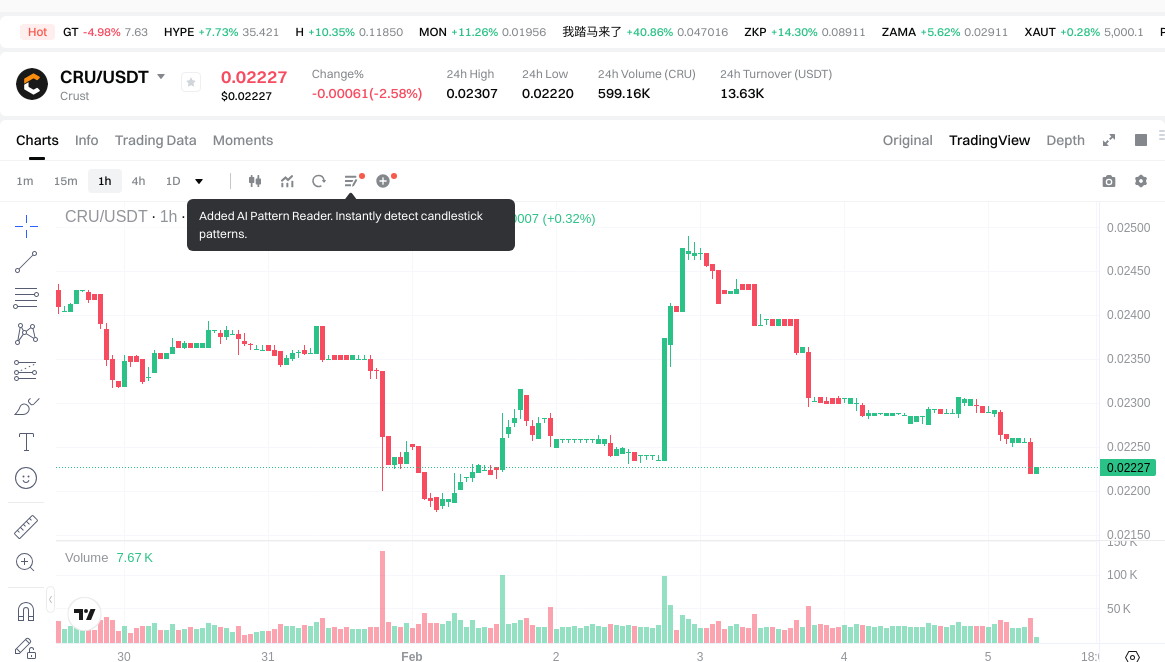
- Recent Period: Market consolidation phase → From recent levels around $0.02307 (24h high) to $0.0222 (24h low)
Current CRU Investment Market Status (February 2026)
- CRU current price: $0.02227
- Market sentiment (Fear & Greed Index): Market emotion indicator shows neutral sentiment (value: 1)
- 24-hour trading volume: $13,661.06
- Institutional investor holdings: Data shows 8,033 holders with circulating supply of 26,716,087.33 CRU
Click to view real-time CRU market price
II. Core Factors Influencing Whether CRU is a Good Investment
Supply Mechanism and Scarcity (CRU Investment Scarcity)
- Unlimited Maximum Supply → Potential inflationary pressure on long-term value
- Total supply of 35,025,067.043 CRU with current circulating supply of 26,716,087.3258026 CRU (approximately 76.3% in circulation)
- Circulating supply ratio indicates substantial tokens already in market circulation
- Investment consideration: The unlimited supply model may affect scarcity-based value appreciation compared to fixed-supply cryptocurrencies
Institutional Investment and Mainstream Adoption (Institutional Investment in CRU)
- Current holder base: 8,033 addresses recorded
- Limited exchange availability: Listed on 2 exchanges
- Market positioning: Lower liquidity profile compared to mainstream cryptocurrencies
- Adoption consideration: Relatively modest institutional visibility in the decentralized storage sector
Macroeconomic Environment's Impact on CRU Investment
- Recent price performance shows sensitivity to market conditions: -2.58% (24H), -8.58% (7D), -50.1% (30D), -90.82% (1Y)
- Market capitalization of $594,967.26 represents niche positioning within the broader crypto ecosystem
- Trading volume of $13,661.06 (24H) indicates moderate liquidity levels
- Market share of 0.000030% reflects limited current market penetration
Technology and Ecosystem Development (Technology & Ecosystem for CRU Investment)
- Decentralized Storage Infrastructure: Provides Web3 ecosystem storage network supporting multiple storage layer protocols including IPFS
- Application Layer Interface: Offers storage interfaces to application developers
- Technology Stack Extension: Capable of supporting decentralized computing layer functionality
- Ecosystem Focus: Builds distributed cloud ecosystem emphasizing data privacy and ownership
- Privacy-Centric Design: Positions project within data sovereignty and user control narratives
- Multi-Protocol Support: Technical flexibility may enhance long-term ecosystem integration potential
III. CRU Future Investment Forecast and Price Outlook (Is Crust(CRU) worth investing in 2026-2031)
Short-term Investment Forecast (2026, short-term CRU investment outlook)
- Conservative Forecast: $0.012 - $0.018
- Neutral Forecast: $0.020 - $0.023
- Optimistic Forecast: $0.023 - $0.029
Mid-term Investment Outlook (2027-2028, mid-term Crust(CRU) investment forecast)
- Market Stage Expectation: Based on available data, CRU may experience moderate volatility during this period, with price movements influenced by broader decentralized storage sector developments and network adoption trends.
- Investment Return Forecast:
- 2027: $0.020 - $0.026
- 2028: $0.020 - $0.034
- Key Catalysts: Expansion of decentralized storage use cases, growth in IPFS ecosystem adoption, and potential partnerships within Web3 infrastructure projects.
Long-term Investment Outlook (Is CRU a good long-term investment?)
- Base Scenario: $0.023 - $0.041 (Assuming steady development of Crust Network infrastructure and gradual market penetration in decentralized cloud storage sector)
- Optimistic Scenario: $0.038 - $0.051 (Assuming accelerated adoption of decentralized storage solutions and favorable regulatory environment for Web3 technologies)
- Risk Scenario: $0.018 - $0.024 (Under conditions of prolonged market downturns, competitive pressures from alternative storage networks, or technical setbacks)
Click to view CRU long-term investment and price forecast: Price Prediction
2026-02-05 - 2031 Long-term Outlook
- Base Scenario: $0.023 - $0.041 (Corresponding to steady progress and stable advancement in mainstream application adoption)
- Optimistic Scenario: $0.038 - $0.051 (Corresponding to large-scale adoption and favorable market environment)
- Transformative Scenario: Above $0.051 (If ecosystem achieves breakthrough progress and mainstream popularization)
- 2031-12-31 Forecast High: $0.051 (Based on optimistic development assumptions)
Disclaimer: These forecasts are based on historical data patterns and market analysis. Cryptocurrency markets are highly volatile and subject to numerous unpredictable factors. Past performance does not guarantee future results. Investors should conduct thorough research and consider their risk tolerance before making investment decisions.
| Year | Predicted High Price | Predicted Average Price | Predicted Low Price | Price Change |
|---|---|---|---|---|
| 2026 | 0.0229381 | 0.02227 | 0.0120258 | 0 |
| 2027 | 0.0255425765 | 0.02260405 | 0.0201176045 | 1 |
| 2028 | 0.0344248379475 | 0.02407331325 | 0.0199808499975 | 8 |
| 2029 | 0.038901270546337 | 0.02924907559875 | 0.017841936115237 | 31 |
| 2030 | 0.048727497493737 | 0.034075173072543 | 0.023171117689329 | 53 |
| 2031 | 0.0500956156926 | 0.04140133528314 | 0.037261201754826 | 85 |
IV. Crust Investment Strategy and Risk Management (How to invest in decentralized storage tokens)
Investment Methodology (Crust investment strategy)
-
Long-term Holding (HODL Crust): Suitable for conservative investors who believe in the long-term development of decentralized storage infrastructure and Web3 ecosystem growth. This approach involves accumulating CRU tokens during market downturns and holding through volatility cycles.
-
Active Trading: Relies on technical analysis and swing trading strategies. Traders may leverage support/resistance levels, moving averages, and volume indicators to identify entry and exit points, capitalizing on CRU's price movements within trending channels.
Risk Management (Risk management for Crust investment)
-
Asset Allocation Ratios:
- Conservative investors: Allocate 1-3% of crypto portfolio to CRU
- Moderate investors: Allocate 3-7% of crypto portfolio to CRU
- Aggressive investors: Allocate 7-15% of crypto portfolio to specialized infrastructure tokens like CRU
-
Risk Hedging Solutions: Maintain a diversified portfolio including major assets (BTC, ETH), other infrastructure tokens, and stablecoins. Consider correlation analysis with broader decentralized storage sector and Web3 infrastructure trends.
-
Secure Storage:
- Cold storage: Hardware wallets (Ledger, Trezor) for long-term holdings
- Hot wallets: Use reputable software wallets for active trading amounts only
- Multi-signature solutions: Recommended for institutional or large holdings
- Regular security audits: Verify wallet addresses and backup seed phrases securely
V. Crust Investment Risks and Challenges (Risks of investing in decentralized storage tokens)
-
Market Risks: CRU has demonstrated high volatility with a 1-year decline of 90.82% and 30-day decline of 50.1%. The token experienced 24-hour price fluctuations between $0.0222 and $0.02307, indicating significant short-term price movements. Trading volume of $13,661 suggests relatively limited liquidity compared to major cryptocurrencies, which may amplify price volatility.
-
Regulatory Risks: Decentralized storage networks operate across multiple jurisdictions with varying regulatory frameworks. Changes in data storage regulations, cross-border data transfer policies, or cryptocurrency classification may impact Crust's operational model and token utility.
-
Technical Risks: As an infrastructure project supporting multiple storage layer protocols including IPFS, Crust faces potential challenges including network security vulnerabilities, protocol upgrade complexities, and competition from alternative decentralized storage solutions. The project's reliance on maintaining technical superiority and network effects presents ongoing developmental risks.
-
Circulating Supply Dynamics: With a circulating supply of 26,716,087 CRU representing 133.58% of total supply (indicating token unlock or distribution mechanisms), potential additional token releases may create selling pressure affecting price stability.
VI. Conclusion: Is Decentralized Storage Token a Good Investment?
-
Investment Value Summary: Crust demonstrates potential in addressing Web3 ecosystem storage needs with its decentralized infrastructure supporting IPFS and multiple storage protocols. However, the token has experienced substantial price decline from its all-time high of $179.24 (April 2021) to current levels around $0.02227, reflecting significant market challenges. The project's focus on data privacy and distributed cloud ecosystem aligns with growing Web3 trends, though short-term price movements remain highly volatile.
-
Investor Recommendations:
✅ Beginners: Consider dollar-cost averaging (DCA) strategies to mitigate volatility risk. Store tokens in secure hardware wallets and avoid investing more than you can afford to lose. Research the fundamentals of decentralized storage technology before committing capital.
✅ Experienced Investors: Evaluate swing trading opportunities based on technical analysis while maintaining core long-term positions. Diversify across multiple Web3 infrastructure projects and monitor sector-wide developments affecting decentralized storage adoption.
✅ Institutional Investors: Assess strategic long-term allocation potential within broader Web3 infrastructure portfolios. Conduct thorough due diligence on network growth metrics, partnership developments, and competitive positioning within the decentralized storage landscape.
⚠️ Disclaimer: Cryptocurrency investments carry substantial risk with potential for significant losses. This content is for informational purposes only and does not constitute investment advice. Always conduct independent research and consult qualified financial advisors before making investment decisions.
VII. FAQ
Q1: Is Crust (CRU) a good investment for beginners in 2026?
CRU presents significant risks for beginners due to extreme volatility and limited liquidity. The token has declined 90.82% over the past year and maintains a modest 24-hour trading volume of only $13,661, indicating potential challenges in executing trades at desired prices. For newcomers to cryptocurrency investing, CRU should represent no more than 1-3% of a diversified portfolio, with dollar-cost averaging strategies employed to mitigate timing risks. Beginners must understand decentralized storage fundamentals and store tokens in secure hardware wallets rather than exchange accounts.
Q2: What distinguishes Crust from other decentralized storage projects?
Crust differentiates itself through multi-protocol support, particularly its integration with IPFS and capability to extend to decentralized computing layers. Unlike single-protocol storage networks, Crust provides storage interfaces for application developers while emphasizing data privacy and user ownership within the Web3 ecosystem. However, with only 2 exchange listings and 8,033 holders, Crust faces substantial competition from more established decentralized storage solutions with larger ecosystems and greater liquidity.
Q3: How does CRU's unlimited supply model affect long-term investment value?
The unlimited maximum supply creates potential inflationary pressure that may hinder scarcity-based value appreciation compared to fixed-supply cryptocurrencies like Bitcoin. Currently, 26,716,087 CRU tokens circulate from a total supply of 35,025,067, representing 76.3% already in circulation. The circulating supply showing 133.58% of total supply indicates ongoing token unlock mechanisms that could introduce additional selling pressure. Investors should monitor token emission schedules and network growth metrics to assess whether increased utility demand can offset supply expansion.
Q4: What are realistic price expectations for CRU by 2028?
Based on current market positioning and historical volatility patterns, conservative forecasts suggest CRU may trade between $0.020-$0.034 by 2028, assuming steady development of decentralized storage adoption and favorable Web3 infrastructure growth. This represents potential modest appreciation from current levels of $0.02227, though substantial risk remains given the token's 50.1% decline over the past 30 days. Price appreciation depends heavily on Crust achieving meaningful ecosystem partnerships, increasing network utilization, and expanding beyond its current limited exchange availability.
Q5: What technical analysis indicators should CRU traders monitor?
Active traders should focus on volume-weighted indicators given CRU's relatively low liquidity profile. Key metrics include 24-hour trading volume trends (current: $13,661), support levels around recent lows ($0.0222), and resistance at recent highs ($0.02307). The Fear & Greed Index currently shows neutral sentiment (value: 1), suggesting neither extreme fear nor greed dominates market psychology. Traders should also monitor broader decentralized storage sector momentum and correlation with major Web3 infrastructure tokens to identify sector-wide trends affecting CRU price movements.
Q6: How should investors assess Crust's competitive position in decentralized storage?
Investors should evaluate Crust's market share (currently 0.000030% of total crypto market capitalization), holder growth trajectory (8,033 addresses), and network utilization metrics compared to competitors like Filecoin, Arweave, and Storj. The project's emphasis on IPFS integration and multi-protocol support provides technical flexibility, but limited exchange listings (2 exchanges) and modest trading volume suggest early-stage market penetration. Fundamental analysis should include monitoring developer activity, partnership announcements, and actual storage capacity growth versus token price movements.
Q7: What risk management strategies are appropriate for CRU investment?
Conservative investors should limit CRU allocation to 1-3% of their crypto portfolio and employ strict stop-loss orders given the token's high volatility (90.82% annual decline). Diversification across multiple Web3 infrastructure projects reduces single-asset risk, while maintaining positions in major cryptocurrencies (BTC, ETH) and stablecoins provides stability. Hardware wallet storage (Ledger, Trezor) is essential for holdings exceeding $1,000, with multi-signature solutions recommended for institutional investors. Regular portfolio rebalancing ensures CRU exposure remains within predetermined risk tolerance thresholds despite price fluctuations.
Q8: What catalysts could drive CRU price appreciation in 2026-2027?
Key positive catalysts include expansion to additional major cryptocurrency exchanges, strategic partnerships with Web3 application developers, increased IPFS ecosystem adoption, and successful network upgrades enhancing storage capacity or reducing costs. Broader market trends favoring decentralized infrastructure and data sovereignty narratives could benefit Crust's positioning. However, investors should maintain realistic expectations given current market capitalization of $594,967 and recognize that significant adoption milestones are required to drive sustained price appreciation beyond short-term speculative movements.
Share
Content
Introduction: Crust (CRU) Investment Position and Market Prospects
I. Crust (CRU) Price History Review and Current Investment Status
II. Core Factors Influencing Whether CRU is a Good Investment
III. CRU Future Investment Forecast and Price Outlook (Is Crust(CRU) worth investing in 2026-2031)
IV. Crust Investment Strategy and Risk Management (How to invest in decentralized storage tokens)
V. Crust Investment Risks and Challenges (Risks of investing in decentralized storage tokens)
VI. Conclusion: Is Decentralized Storage Token a Good Investment?
VII. FAQ
How to Buy Cryptocurrency


Trending Cryptocurrencies



Top 10 DePIN Crypto Projects to Invest in 2025
How to Participate in a DePIN Project

What is DePIN?How Does DePIN Work?

What Does Onyxcoin's DApp Ecosystem Look Like in 2025?
How to Earn with The RWA DePin Protocol in 2025
TrendX (XTTA): An Innovative Investment Platform Integrating AI and DePIN

How to Avoid Slippage in Cryptocurrency Trading

What Is a Blockchain Game Guild? Should You Join a Game Guild?

Free Money for App Registration: Crypto Rewards Guide

Top 4 Cryptocurrency Exchanges for Free Registration Bonuses

What is Slippage? How Can We Avoid It While Trading Crypto?