Is Cryowar Token (CWAR) a good investment?: A comprehensive analysis of risks, potential returns, and market outlook for 2024
Introduction: Cryowar Token (CWAR)'s Investment Position and Market Prospects
CWAR is a digital asset in the cryptocurrency field that has been operational since 2021. As of February 2026, Cryowar Token holds a market capitalization of approximately $188,709, with a circulating supply of around 301.36 million tokens, and the current price stands at approximately $0.0006262. The token is associated with a real-time multiplayer PVP gaming experience developed using Unreal Engine. With approximately 10,081 holders and a fully diluted valuation of $626,200, CWAR has established a presence in the blockchain gaming sector. This article will analyze CWAR's investment characteristics, historical price movements, future price perspectives, and associated investment risks to provide reference information for those examining "Is Cryowar Token (CWAR) a good investment?"
I. Cryowar Token (CWAR) Price History and Current Investment Status
CWAR Historical Price Performance and Investment Returns
- 2021: CWAR launched in November with an initial offering price of $0.028 → Early investors experienced substantial gains as the token reached $6.29 on November 12, 2021
- 2021-2025: Prolonged market correction period → CWAR declined from November 2021 peak levels
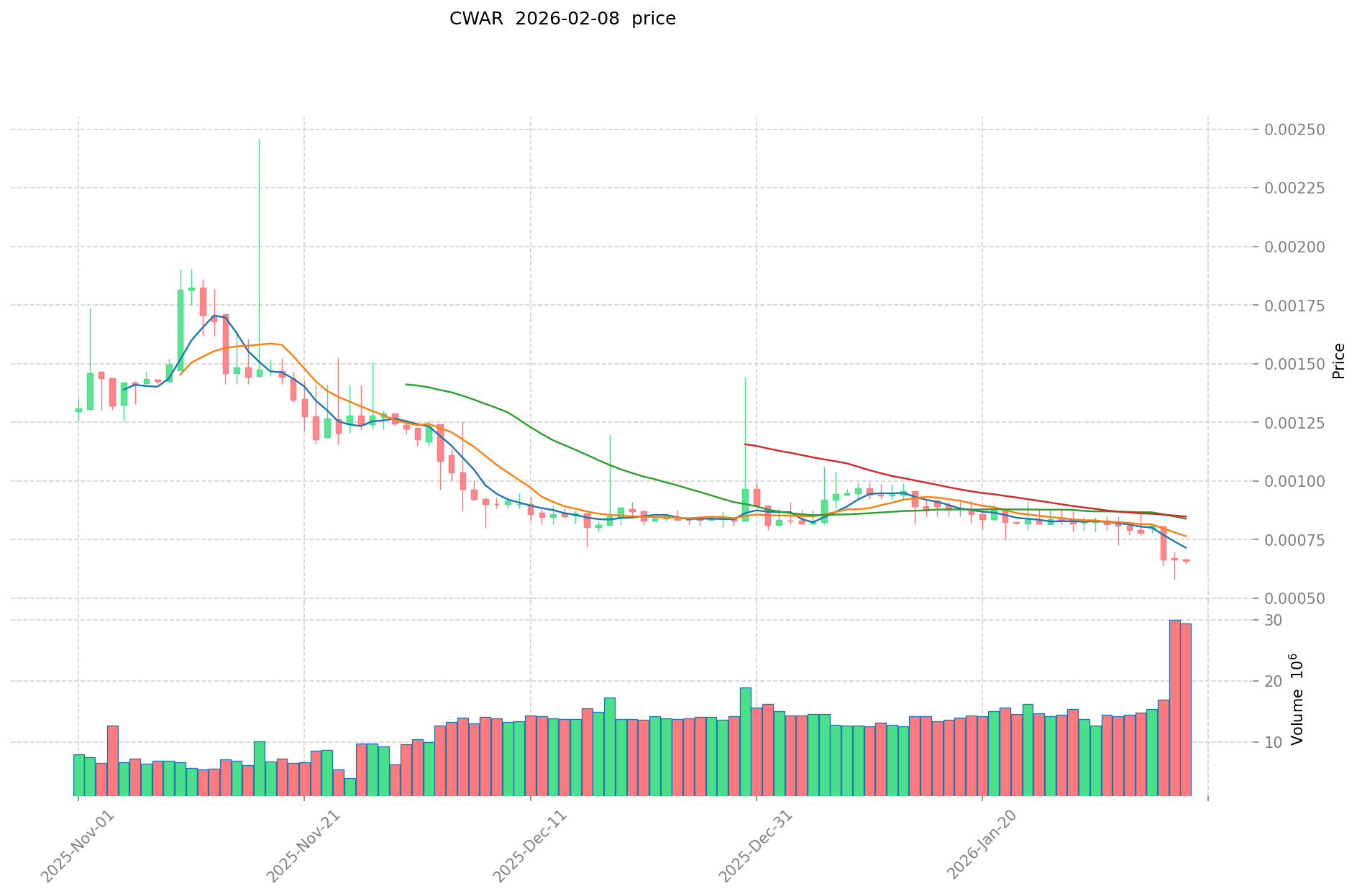
- 2026: Market volatility continues → As of February 6, 2026, CWAR traded near $0.00059758, followed by slight recovery to $0.0006262 by February 8, 2026
Current CWAR Market Status (February 2026)
- Current CWAR Price: $0.0006262
- 24-Hour Trading Volume: $12,337.38
- 24-Hour Price Range: $0.0005975 - $0.0006621
- Circulating Supply: 301,356,511.50 CWAR (30.14% of total supply)
- Market Capitalization: $188,709.45
- Fully Diluted Valuation: $626,200.00
- Total Supply: 1,000,000,000 CWAR
- Token Holders: 10,081
View real-time CWAR market price
II. Core Factors Influencing Whether CWAR Is a Good Investment (Is Cryowar Token(CWAR) a Good Investment)
Supply Mechanism and Scarcity (CWAR investment scarcity)
- Fixed total supply of 1,000,000,000 CWAR tokens with current circulating supply of approximately 301,356,511 tokens (30.14% of total supply) → influences price dynamics and potential investment value through supply constraints
- Historical context: CWAR experienced significant price fluctuations, with pricing recorded at $6.29 on November 12, 2021, and declining to $0.00059758 on February 6, 2026, reflecting market volatility patterns
- Investment significance: the predetermined supply cap and current limited circulation rate may contribute to considerations regarding scarcity dynamics as factors in long-term investment evaluation
Institutional Investment and Mainstream Adoption (Institutional investment in CWAR)
- Current holder data shows approximately 10,081 addresses holding CWAR tokens, indicating a distributed ownership structure
- Trading availability: CWAR is listed on one exchange platform, which may impact liquidity and accessibility for institutional participants
- The token's integration within the Solana ecosystem gaming sector positions it within a specific market segment that may attract specialized investment interest
Macroeconomic Environment's Impact on CWAR Investment
- As of February 8, 2026, CWAR holds a market capitalization of approximately $188,709 with a market dominance of 0.000024%, reflecting its positioning within the broader cryptocurrency market environment
- Recent price movements show a 24-hour change of -3.9%, 7-day change of -23.54%, 30-day change of -32.48%, and 1-year change of -70.67%, indicating sensitivity to market conditions
- The token's performance may be influenced by broader market sentiment and risk appetite in the digital asset space, particularly within gaming and metaverse-related tokens
Technology and Ecosystem Development (Technology & Ecosystem for CWAR investment)
- Platform foundation: Cryowar operates as a real-time multiplayer PVP gaming experience developed using Unreal Engine technology
- Blockchain infrastructure: the project is powered by the Solana network, which features processing capabilities and transaction cost structures designed to support gaming applications
- Gaming ecosystem integration: the token serves within a play-to-earn framework where players engage in competitive gameplay for rewards, positioning it within the GameFi sector of blockchain applications
- Contract deployment: CWAR tokens are deployed on Solana (contract address: HfYFjMKNZygfMC8LsQ8LtpPsPxEJoXJx4M6tqi75Hajo), enabling integration with Solana-based decentralized applications and wallet infrastructure
III. CWAR Future Investment Prediction and Price Outlook (Is Cryowar Token(CWAR) worth investing in 2026-2030)
Short-term Investment Prediction (2026, short-term CWAR investment outlook)
- Conservative forecast: $0.00050208 - $0.0006276
- Neutral forecast: $0.0006276 - $0.00069036
- Optimistic forecast: $0.00069036 - $0.00075312
Mid-term Investment Outlook (2027-2028, mid-term Cryowar Token(CWAR) investment forecast)
-
Market stage expectation: CWAR may experience moderate volatility as the project continues development within the Solana ecosystem. The gaming and NFT sectors could influence token performance during this period.
-
Investment return prediction:
- 2027: $0.0004211196 - $0.0009872148
- 2028: $0.000662642046 - $0.001249793226
-
Key catalysts: Gaming platform development progress, Solana network performance, adoption rate of play-to-earn mechanics, and overall cryptocurrency market sentiment.
Long-term Investment Outlook (Is CWAR a good long-term investment?)
- Base scenario: $0.000789013545987 - $0.001143497892735 (assuming steady project development and maintained community engagement)
- Optimistic scenario: $0.001143497892735 - $0.001555157134119 (assuming enhanced gaming features and broader user adoption)
- Risk scenario: Below $0.0006262 (under adverse market conditions or project development challenges)
Click to view CWAR long-term investment and price prediction: Price Prediction
2026-2031 Long-term Outlook
- Base scenario: $0.000789013545987 - $0.001143497892735 (corresponding to steady progress and gradual mainstream application growth)
- Optimistic scenario: $0.001143497892735 - $0.001555157134119 (corresponding to large-scale adoption and favorable market environment)
- Transformational scenario: Above $0.001997004719872 (in case of breakthrough ecosystem developments and mainstream popularization)
- 2031-12-31 predicted high: $0.001997004719872 (based on optimistic development assumptions)
Disclaimer: The price predictions provided are based on historical data analysis and market trends. Cryptocurrency investments carry substantial risk. This information is for reference purposes only and does not constitute financial or investment advice. Market conditions, regulatory changes, technological developments, and various unforeseen factors may significantly impact actual prices. Past performance does not guarantee future results. Investors should conduct thorough research and consider their risk tolerance before making any investment decisions.
| Year | Predicted High Price | Predicted Average Price | Predicted Low Price | Price Change |
|---|---|---|---|---|
| 2026 | 0.00075312 | 0.0006276 | 0.00050208 | 0 |
| 2027 | 0.0009872148 | 0.00069036 | 0.0004211196 | 10 |
| 2028 | 0.001249793226 | 0.0008387874 | 0.000662642046 | 33 |
| 2029 | 0.00124270547247 | 0.001044290313 | 0.00074144612223 | 66 |
| 2030 | 0.001555157134119 | 0.001143497892735 | 0.000789013545987 | 82 |
| 2031 | 0.001997004719872 | 0.001349327513427 | 0.001146928386413 | 115 |
IV. CWAR Investment Strategy and Risk Management (How to invest in blockchain gaming tokens)
Investment Methodology (CWAR investment strategy)
-
Long-term Holding (HODL CWAR): Suitable for conservative investors who believe in the long-term development of blockchain gaming ecosystems. This strategy focuses on accumulating tokens during market downturns and holding through market cycles.
-
Active Trading: Relies on technical analysis and swing trading strategies. Given CWAR's notable price fluctuations, traders may utilize support and resistance levels, volume indicators, and momentum signals to identify entry and exit points.
Risk Management (Risk management for CWAR investment)
-
Asset Allocation Ratio:
- Conservative investors: Allocate 1-3% of cryptocurrency portfolio to gaming tokens like CWAR
- Aggressive investors: May allocate 5-10% to high-risk, high-reward gaming assets
- Professional investors: Implement dynamic allocation based on market conditions and project development milestones
-
Risk Hedging Solutions: Diversify across multiple asset classes including established cryptocurrencies, stablecoins, and various gaming tokens. Consider using stop-loss orders and position sizing strategies to manage exposure.
-
Secure Storage:
- Cold wallets: Hardware wallets such as Ledger or Trezor for long-term holdings
- Hot wallets: Solana-compatible wallets like Phantom or Solflare for active trading
- Security practices: Enable two-factor authentication, regularly update wallet software, and never share private keys
V. CWAR Investment Risks and Challenges (Risks of investing in blockchain gaming tokens)
-
Market Risk: CWAR exhibits considerable price volatility, with recent data showing declines of 3.9% in 24 hours, 23.54% over 7 days, and 32.48% over 30 days. The token's trading volume of approximately $12,337 indicates relatively limited liquidity, which may amplify price movements. The circulating supply represents approximately 30.14% of the total supply, with potential future token releases possibly affecting price dynamics.
-
Regulatory Risk: Blockchain gaming tokens face evolving regulatory frameworks across different jurisdictions. Uncertainty regarding gaming token classification, securities laws, and cross-border gaming regulations may impact project operations and token utility.
-
Technical Risk: Dependence on the Solana network means CWAR is subject to network-related risks including potential outages, congestion, or security vulnerabilities. Smart contract risks, game development delays, and competition from other blockchain gaming platforms represent additional technical challenges. The project's ability to maintain player engagement and deliver on its gaming roadmap remains critical.
VI. Conclusion: Is blockchain gaming token a Good Investment?
-
Investment Value Summary: CWAR represents an investment in the emerging blockchain gaming sector, specifically the play-to-earn and competitive multiplayer gaming space on Solana. While the gaming sector shows growth potential, CWAR has experienced substantial price volatility, with a 70.67% decline over one year. The token's market capitalization of approximately $188,709 and relatively low trading volume suggest it remains a speculative asset within the broader cryptocurrency market.
-
Investor Recommendations:
✅ Beginners: Consider dollar-cost averaging with minimal allocation, prioritize secure wallet storage, and thoroughly research the project's gaming mechanics and tokenomics before investing.
✅ Experienced Investors: Implement swing trading strategies during volatility periods, maintain diversified portfolio allocation, and monitor project development milestones and gaming ecosystem growth.
✅ Institutional Investors: Evaluate strategic positioning within the blockchain gaming sector, assess competitive landscape, and consider long-term thesis based on gaming industry trends and blockchain adoption.
⚠️ Disclaimer: Cryptocurrency investments carry substantial risk, and blockchain gaming tokens are particularly volatile. This analysis is for informational purposes only and does not constitute investment advice. Investors should conduct independent research and consider their risk tolerance before making investment decisions.
VII. FAQ
Q1: What is the minimum recommended investment amount for CWAR tokens?
There is no official minimum investment amount, but risk management principles suggest allocating only 1-3% of your cryptocurrency portfolio for conservative investors, or 5-10% for more aggressive investors. Given CWAR's high volatility (down 70.67% over one year) and low market capitalization of $188,709, it's advisable to start with small amounts you can afford to lose. For beginners, dollar-cost averaging with minimal allocations is recommended to reduce exposure to price fluctuations.
Q2: How does CWAR's Solana blockchain integration affect its investment potential?
Solana's high-performance infrastructure provides faster transaction speeds and lower costs compared to many other blockchains, which is beneficial for gaming applications. However, this also means CWAR is subject to Solana network risks including potential outages and congestion. The Solana ecosystem's growth could positively impact CWAR adoption, but network-related issues or declining Solana market sentiment could negatively affect CWAR's price performance.
Q3: What are the main risks of investing in CWAR compared to major cryptocurrencies?
CWAR carries significantly higher risk than established cryptocurrencies. Key risks include: extreme price volatility (recent 32.48% decline in 30 days), very low liquidity with only $12,337 in 24-hour trading volume, limited exchange availability (listed on only one platform), and only 30.14% of tokens currently in circulation. Additionally, as a gaming-focused token, CWAR's success depends heavily on the project's ability to attract and retain players, which is uncertain in the competitive blockchain gaming market.
Q4: When is the best time to buy CWAR tokens for potential returns?
Timing the market is inherently difficult, but historical data suggests considering accumulation during broader market downturns when gaming tokens face increased selling pressure. Conservative forecasts suggest potential support levels around $0.00050208-$0.0006276 for 2026. However, given the token's volatility, dollar-cost averaging over time may be more prudent than attempting to time a single entry point. Monitor key project milestones, gaming platform updates, and overall cryptocurrency market sentiment before making purchase decisions.
Q5: How can I securely store CWAR tokens after purchase?
For long-term holdings, hardware wallets like Ledger or Trezor offer the highest security. For active trading, Solana-compatible hot wallets such as Phantom or Solflare provide convenient access while maintaining reasonable security. Essential security practices include: enabling two-factor authentication on all accounts, regularly updating wallet software, backing up recovery phrases in secure physical locations, never sharing private keys, and verifying contract addresses (CWAR Solana contract: HfYFjMKNZygfMC8LsQ8LtpPsPxEJoXJx4M6tqi75Hajo) before transactions.
Q6: What indicators should I monitor to evaluate CWAR's investment performance?
Key metrics to track include: trading volume changes (currently $12,337 daily), holder count growth (currently 10,081 addresses), token circulation rate (currently 30.14% of total supply), price volatility patterns, and project development milestones. Additionally, monitor broader indicators such as Solana network performance, blockchain gaming sector trends, overall cryptocurrency market sentiment, and competition from similar gaming tokens. Regular assessment of these factors can inform portfolio rebalancing decisions.
Q7: Is CWAR suitable for retirement or long-term wealth preservation portfolios?
CWAR is not recommended for retirement accounts or wealth preservation strategies due to its speculative nature and extreme volatility. The token has declined 70.67% over one year and carries significant risk factors including low liquidity, limited exchange availability, and dependency on gaming platform success. Long-term wealth preservation portfolios should prioritize established assets with proven track records. CWAR might be considered only as a small speculative component within a diversified cryptocurrency allocation for investors with high risk tolerance.
Q8: How does CWAR's play-to-earn model impact its investment value?
The play-to-earn mechanics create both opportunities and risks. Successful player adoption and engagement could drive token demand as users need CWAR for in-game activities and rewards. However, sustainability concerns exist around token economics—if rewards distribution significantly exceeds new player acquisition and token burning mechanisms, inflationary pressure may negatively impact price. The model's success depends on maintaining balanced token supply-demand dynamics while delivering engaging gameplay that retains users beyond financial incentives.
Share
Content
Introduction: Cryowar Token (CWAR)'s Investment Position and Market Prospects
I. Cryowar Token (CWAR) Price History and Current Investment Status
II. Core Factors Influencing Whether CWAR Is a Good Investment (Is Cryowar Token(CWAR) a Good Investment)
III. CWAR Future Investment Prediction and Price Outlook (Is Cryowar Token(CWAR) worth investing in 2026-2030)
IV. CWAR Investment Strategy and Risk Management (How to invest in blockchain gaming tokens)
V. CWAR Investment Risks and Challenges (Risks of investing in blockchain gaming tokens)
VI. Conclusion: Is blockchain gaming token a Good Investment?
VII. FAQ
How to Buy Cryptocurrency


Trending Cryptocurrencies



2025 Vertus daily combo code: Web3 gamers rewards guide

Today's Vertus Daily Combo Code: Boost Your Web3 Gaming Rewards (April 29, 2025)

GALA Coin (GALA) – Web3 Gaming Token Overview, Price Prediction & Trading on Gate.com
What is Gaming Crypto?How Gaming Crypto Works?

Detailed analysis of the top ten encryption game coins to be launched in 2025
Top 6 Best Gaming Currencies

Trending meme coins: Are you a dog person or a cat person? Which one should you invest in?

Cryptocurrency Platforms in 2025: A Comprehensive Guide to Top Platforms
Rafał Zaorski – Who Is He? What Is His Net Worth?
Games You Can Earn Money From – TOP 11 Games in 2025
Six Cryptocurrencies That Have Achieved Over 1,000x Total Growth