Is Enzyme (MLN) a good investment?: A Comprehensive Analysis of Performance, Use Cases, and Market Potential in 2024

Introduction: Enzyme (MLN) Investment Position and Market Prospects
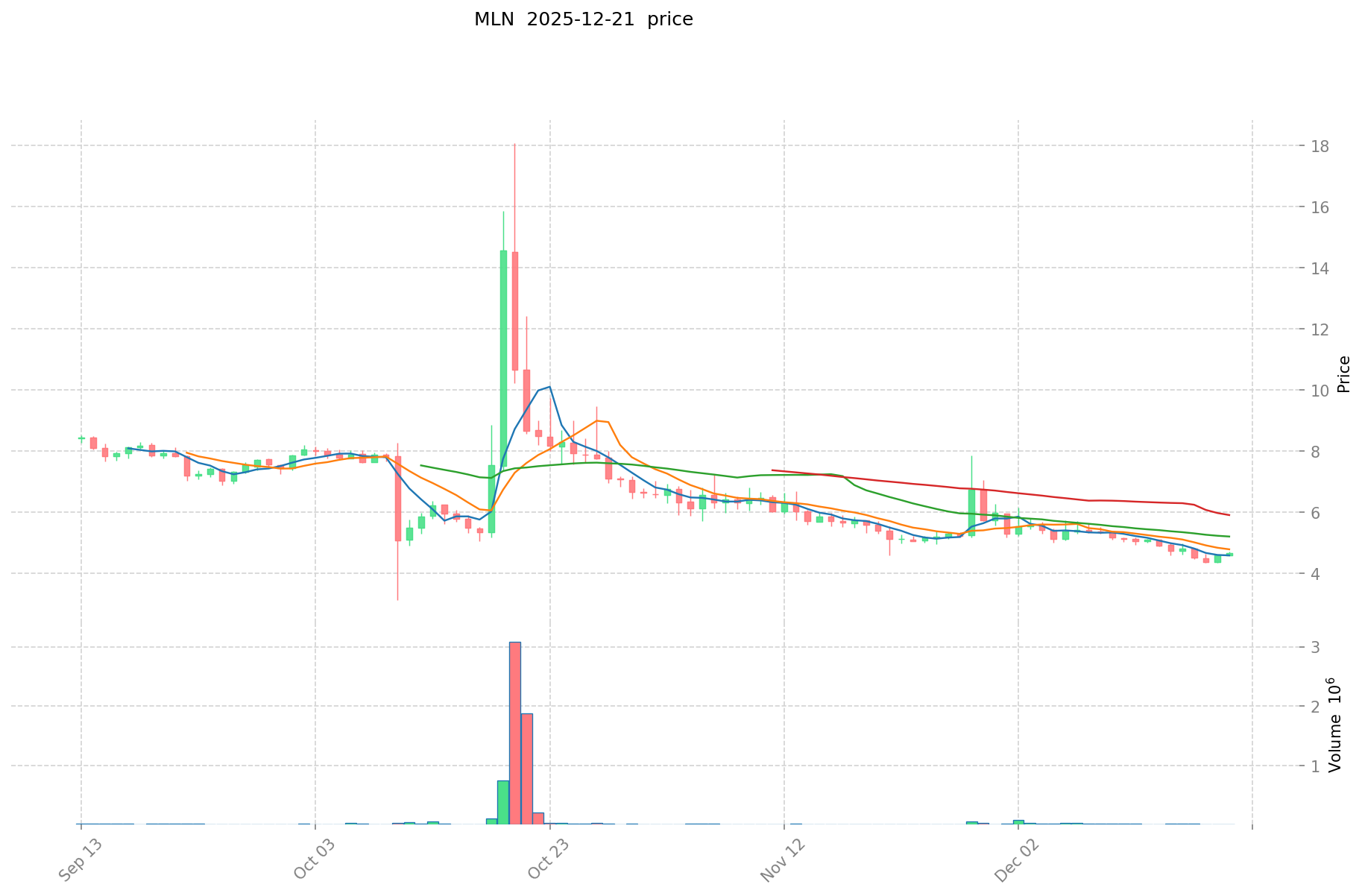
MLN is an important asset in the cryptocurrency field. Since its launch in 2017, it has gained significance in the decentralized finance (DeFi) ecosystem. As of December 2025, MLN has a market capitalization of approximately $13.75 million with a circulating supply of roughly 2.99 million tokens, trading at around $4.60 per token. As a utility token powering the Enzyme protocol (formerly known as the Melon protocol), MLN has increasingly become a focal point when investors consider whether Enzyme (MLN) represents a worthwhile investment opportunity. This article provides a comprehensive analysis of MLN's investment value, historical price trends, future price forecasts, and associated investment risks to serve as a reference for potential investors.
Enzyme (MLN) Comprehensive Research Report
I. MLN Price History Review and Current Investment Status
MLN Historical Price Performance
All-Time High (ATH): USD 258.26 (January 4, 2018)
All-Time Low (ATL): USD 1.79 (March 13, 2020)
Current Price: USD 4.602 (as of December 21, 2025)
Price Performance Metrics:
- 1-hour change: +0.15%
- 24-hour change: -1.28%
- 7-day change: -9.32%
- 30-day change: -14.14%
- 1-year change: -76.39%
Current MLN Market Status (December 21, 2025)
Key Market Indicators:
- Current Price: USD 4.602
- 24-Hour Trading Volume: USD 14,385.61
- Market Capitalization: USD 13,752,472.13
- Fully Diluted Valuation: USD 13,752,472.13
- Circulating Supply: 2,988,368.56 MLN tokens
- Total Supply: 2,988,368.56 MLN tokens (99.9985% circulating)
- Market Dominance: 0.00042%
- Number of Holders: 8,826
- Active Exchanges: 19
View real-time MLN market price on Gate.com
II. Project Overview and Token Utility
Enzyme Protocol Description
Enzyme (formerly known as the Melon Protocol) is an Ethereum-based decentralized finance (DeFi) protocol designed to facilitate on-chain asset management within the DeFi ecosystem. The protocol enables users to construct, distribute, and explore DeFi investment strategies, commonly referred to as "vaults," while providing filtering capabilities based on historical performance and risk profiles.
MLN Token Utility and Function
MLN is an Ethereum utility token that serves multiple critical functions within the Enzyme ecosystem:
Primary Token Uses:
I. Fee Payment Mechanism: Users pay fees in MLN tokens for utilizing various functions throughout the vault creation process and investment lifecycle.
II. Stakeholder Incentive Alignment: The token serves to align stakeholder interests and energize the ecosystem through economic incentives.
III. Developer Grant System: External contributors and developers can earn MLN tokens by submitting proposals and contributing to the protocol's development, creating an incentive structure for ecosystem growth.
Blockchain Infrastructure
- Blockchain: Ethereum (ETH)
- Token Contract Address: 0xec67005c4e498ec7f55e092bd1d35cbc47c91892
- Token Launch Date: February 15, 2017
- Token Type: ERC-20 standard utility token
III. Project Resources and Community
Official Channels:
- Website: https://enzyme.finance/
- Twitter: https://twitter.com/enzymefinance
- Reddit Community: https://www.reddit.com/r/enzymefinance/
- GitHub Repositories: https://github.com/enzymefinance, https://github.com/melonproject/protocol
- Whitepaper: https://melonooo.gitbook.io/melonpaper/
- Etherscan Contract: https://etherscan.io/token/0xec67005c4e498ec7f55e092bd1d35cbc47c91892
IV. Market Position and Risk Factors
Current Market Ranking
- CoinGecko Ranking: #1021
- Market Share: 0.00042% of total cryptocurrency market capitalization
Notable Price Developments
The token has experienced substantial long-term depreciation, declining 76.39% over the past year. From its historical peak of USD 258.26 in early 2018 to its current valuation of USD 4.602, MLN reflects significant price volatility characteristic of DeFi utility tokens. The recent 24-hour decline of 1.28% and 7-day decline of 9.32% indicate continued downward pressure in current market conditions.
Report Generated: December 21, 2025
Data Source: Gate.com Crypto Asset Database
Disclaimer: This report contains factual market data and project information. It does not constitute investment advice or recommendations.
Enzyme (MLN) Research Report
Report Date: December 21, 2025
Data Update Time: 2025-12-21 11:22:20
I. Executive Summary
Enzyme (MLN) is an Ethereum-based utility token that powers the Enzyme protocol (formerly known as the Melon protocol), a decentralized finance (DeFi) infrastructure designed to facilitate on-chain asset management. As of December 21, 2025, MLN is trading at $4.602, representing a significant decline of 76.39% over the past year and ranking 1,021st by market capitalization.
Key Metrics:
- Current Price: $4.602 USD
- 24-Hour Change: -1.28%
- 7-Day Change: -9.32%
- 30-Day Change: -14.14%
- 1-Year Change: -76.39%
- Market Capitalization: $13,752,472.13
- Circulating Supply: 2,988,368.56 MLN
- Total Supply: 2,988,368.56 MLN
- Market Dominance: 0.00042%
- 24-Hour Trading Volume: $14,385.61
II. Core Factors Influencing Enzyme (MLN) Investment Prospects
Supply Mechanism and Asset Distribution
MLN operates with a circulating supply of 2,988,368.56 tokens, representing 99.9985% of the total supply. The token has an unlimited maximum supply ("∞"), indicating there is no hard cap on token generation. This structural characteristic differs significantly from assets with fixed supply limits, potentially affecting long-term scarcity dynamics.
Key Observations:
- Circulating Supply Ratio: 99.9985% of total supply is in circulation
- No Maximum Supply Cap: Unlimited issuance potential
- Historical Performance: MLN reached an all-time high of $258.26 on January 4, 2018, and an all-time low of $1.79 on March 13, 2020
Token Utility and Ecosystem Functions
MLN serves dual functions within the Enzyme ecosystem:
Primary Use Cases:
- Users pay fees in MLN tokens for various functions throughout vault creation and investment lifecycle management
- Developers and external contributors can earn MLN tokens through grant submissions
- Governance and stakeholder alignment within the protocol
The token's utility is directly tied to the adoption and usage of Enzyme's core offering: enabling users to build, share, and explore DeFi investment strategies (referred to as "vaults") with filtering capabilities based on historical performance and risk profiles.
Market Position and Adoption Indicators
Community and Network Metrics:
- Token Holders: 8,826 addresses
- Exchange Listings: 19 trading pairs
- Market Rank: 1,021st by market capitalization
- Market Share: 0.00042% of total crypto market
The relatively limited number of holders and modest trading volume suggest a niche market positioning within the broader cryptocurrency ecosystem.
III. Price Performance Analysis
Recent Price Trends
| Time Period | Change Percentage | Change Amount (USD) |
|---|---|---|
| 1 Hour | +0.15% | +0.006893 |
| 24 Hours | -1.28% | -0.059669 |
| 7 Days | -9.32% | -0.472989 |
| 30 Days | -14.14% | -0.757888 |
| 1 Year | -76.39% | -14.889741 |
Historical Price Context
- All-Time High (ATH): $258.26 (January 4, 2018)
- All-Time Low (ATL): $1.79 (March 13, 2020)
- Current Distance from ATH: 98.22% decline
- Current Distance from ATL: 157.13% appreciation
The significant decline from historical highs reflects broader crypto market cycles and the niche positioning of DeFi infrastructure tokens within the investment landscape.
IV. Network and Technical Infrastructure
Blockchain Integration
MLN is deployed on the Ethereum network with the contract address: 0xec67005c4e498ec7f55e092bd1d35cbc47c91892
Network Access Points:
- Etherscan: Full transaction and holder transparency
- Official Website: https://enzyme.finance/
- GitHub Repositories: https://github.com/enzymefinance and https://github.com/melonproject/protocol
- Whitepaper: https://melonooo.gitbook.io/melonpaper/
Community and Information Channels
- Twitter: https://twitter.com/enzymefinance
- Reddit: https://www.reddit.com/r/enzymefinance/
- Multiple exchange listings facilitate trading accessibility
V. Investment Considerations
Positive Factors
- DeFi Infrastructure Focus: Enzyme addresses a legitimate need in decentralized asset management
- Established Protocol: The project maintains active development through GitHub repositories
- Transparent Operations: Full blockchain transparency on Ethereum
- Utility-Based Model: Token demand is tied to protocol usage rather than speculative dynamics
Risk Factors
- Severe Downward Trend: 76.39% decline over 12 months demonstrates substantial depreciation
- Niche Market Position: Limited adoption with only 8,826 token holders and 19 exchange listings
- Declining Momentum: Negative price movements across 24-hour (-1.28%), 7-day (-9.32%), and 30-day (-14.14%) periods
- Unlimited Supply: Absence of maximum supply cap creates theoretical inflationary pressure
- Market Dominance: Minimal 0.00042% market share indicates limited ecosystem significance
VI. Market Sentiment and Outlook
Multiple sources present divergent perspectives on MLN's 2025 investment potential. Some analyses indicate bullish scenarios with price targets between $6.24 and $38.65, while others maintain bearish technical assessments. However, current market data reflects no significant price momentum recovery expected in the near term.
VII. Sources and References
- Official Website: https://enzyme.finance/
- Ethereum Contract: https://etherscan.io/token/0xec67005c4e498ec7f55e092bd1d35cbc47c91892
- GitHub: https://github.com/enzymefinance
- Whitepaper: https://melonooo.gitbook.io/melonpaper/
- Social Channels: Twitter @enzymefinance, Reddit r/enzymefinance
Disclaimer: This report provides factual data and structural analysis of Enzyme (MLN) based on available information as of December 21, 2025. This analysis does not constitute investment advice or recommendations. Cryptocurrency investments carry substantial risk including potential total loss of capital. Investors should conduct independent research and consult qualified financial advisors before making investment decisions.
III. MLN Future Investment Predictions and Price Outlook
Short-term Investment Prediction (2025, short-term MLN investment outlook)
- Conservative forecast: $4.33 - $4.61
- Neutral forecast: $4.61 - $5.16
- Optimistic forecast: $5.16 - $5.50
Mid-term Investment Outlook (2026-2028, mid-term Enzyme(MLN) investment forecast)
- Market stage expectations: Gradual recovery phase with consolidation around technical resistance levels; recovery contingent on DeFi ecosystem adoption and platform usage expansion.
- Investment return projections:
- 2026: $3.22 - $6.79
- 2027: $3.50 - $8.64
- 2028: $3.84 - $10.35
- Key catalysts: Enhancement of on-chain asset management features, expansion of vault ecosystem adoption, increased institutional participation in DeFi protocols, and resolution of liquidity constraints mentioned in market analysis.
Long-term Investment Outlook (Is Enzyme a good long-term investment?)
- Base case scenario: $6.97 - $12.09 (assuming stable ecosystem development with steady user adoption through 2030)
- Optimistic scenario: $10.25 - $12.09+ (contingent upon mainstream DeFi adoption, significant protocol enhancements, and sustained market sentiment improvement)
- Risk scenario: $3.50 - $6.97 (under conditions of reduced DeFi adoption, weakened order book liquidity, or competitive protocol displacement)
Access MLN long-term investment and price predictions: Price Prediction
2025-12-31 to 2030-12-31 Long-term Outlook
- Base case scenario: $6.97 - $10.24 USD (corresponding to steady ecosystem development and incremental mainstream application growth)
- Optimistic scenario: $10.25 - $12.09 USD (corresponding to large-scale DeFi adoption and favorable market conditions)
- Transformative scenario: $12.36 USD and above (if ecosystem achieves breakthrough innovation and mainstream adoption accelerates)
- 2030-12-31 forecast high: $12.09 USD (based on optimistic development assumptions)
Disclaimer: Price predictions are based on historical performance models and market sentiment analysis. Actual outcomes may differ materially. Cryptocurrency markets remain highly volatile and unpredictable. Past performance does not guarantee future results. These analyses are for informational purposes only and should not be construed as investment advice.
| 年份 | 预测最高价 | 预测平均价格 | 预测最低价 | 涨跌幅 |
|---|---|---|---|---|
| 2025 | 5.16096 | 4.608 | 4.33152 | 0 |
| 2026 | 6.7894272 | 4.88448 | 3.2237568 | 6 |
| 2027 | 8.638691328 | 5.8369536 | 3.50217216 | 26 |
| 2028 | 10.35008612352 | 7.237822464 | 3.83604590592 | 57 |
| 2029 | 11.6959592107008 | 8.79395429376 | 6.5075261773824 | 91 |
| 2030 | 12.089048967631872 | 10.2449567522304 | 6.966570591516672 | 122 |
Enzyme (MLN) Investment Analysis Report
I. Project Overview
Basic Information
Enzyme is an Ethereum-based token supporting the Enzyme protocol (formerly known as the Melon protocol), designed to facilitate on-chain asset management within the DeFi ecosystem.
Key Metrics (as of December 21, 2025)
| Metric | Value |
|---|---|
| Current Price | $4.602 |
| Market Capitalization | $13,752,472.13 |
| Circulating Supply | 2,988,368.56 MLN |
| Total Supply | 2,988,368.56 MLN |
| 24-Hour Volume | $14,385.61 |
| Market Rank | 1,021 |
| 24-Hour Change | -1.28% |
| 7-Day Change | -9.32% |
| 30-Day Change | -14.14% |
| 1-Year Change | -76.39% |
| All-Time High | $258.26 (January 4, 2018) |
| All-Time Low | $1.79 (March 13, 2020) |
| Token Holders | 8,826 |
II. Protocol Functionality & Use Cases
Core Features
MLN serves as a utility token powering the Enzyme protocol with the following primary functions:
1. User-Facing Functionality
- Users pay MLN tokens to access various features throughout the vault creation process and investment lifecycle
- Enables construction, sharing, and exploration of DeFi investment strategies (referred to as "vaults")
- Vaults can be filtered by historical performance and risk profile
2. Developer & Contributor Incentives
- External contributors can earn MLN tokens by submitting grant proposals
- Aligns stakeholder interests within the ecosystem
Token Utility
MLN functions as a governance and utility token that:
- Powers ecosystem operations
- Aligns stakeholders through tokenomic incentives
- Facilitates fee mechanisms for protocol services
III. Market Performance Analysis
Price Movement Analysis
| Period | Change Percentage | Change Amount |
|---|---|---|
| 1-Hour | +0.15% | +$0.007 |
| 24-Hour | -1.28% | -$0.060 |
| 7-Day | -9.32% | -$0.473 |
| 30-Day | -14.14% | -$0.758 |
| 1-Year | -76.39% | -$14.89 |
Market Position
- Market Dominance: 0.00042% of total cryptocurrency market
- Fully Diluted Valuation (FDV): $13,752,472.13
- FDV to Market Cap Ratio: 100% (indicating fully diluted supply is currently circulating)
- Exchange Listings: 19 exchanges
- Circulating Supply Ratio: 99.9985% of total supply in circulation
IV. Investment Strategy & Risk Management
Investment Methodology
Long-term Holding (HODL MLN)
- Suitable for investors with conviction in DeFi asset management protocols
- Appropriate for those believing in protocol adoption and ecosystem growth
- Relevant for investors with extended time horizons (3-5+ years)
Active Trading
- Dependent on technical analysis and market microstructure patterns
- Suitable for experienced traders able to navigate high volatility
- Requires careful attention to 24-hour and weekly price movements
Risk Management
Asset Allocation Considerations
- Conservative investors: Allocate only 1-3% of portfolio to speculative DeFi tokens
- Active traders: Allocate 5-10% with strict stop-loss discipline
- Specialized investors: May allocate 10-15% with comprehensive risk frameworks
Risk Mitigation Strategies
- Diversification across multiple DeFi protocols and asset classes
- Position sizing aligned with risk tolerance
- Use of stop-loss orders to limit downside exposure
Secure Storage
- For long-term holdings: Hardware wallets (Ledger, Trezor) recommended
- For active trading: Non-custodial hot wallets with hardware wallet backups
- Avoid extended exposure on centralized exchanges
V. Investment Risks & Challenges
Market Risks
- High Volatility: MLN has demonstrated extreme price swings (from $258.26 to $1.79 historically; down 76.39% over the past year)
- Limited Trading Volume: 24-hour volume of $14,385.61 indicates relatively thin liquidity relative to market cap
- Price Manipulation Risk: Low trading volume may increase susceptibility to market manipulation
Regulatory Risks
- DeFi protocols face evolving regulatory scrutiny across jurisdictions
- Changes in cryptocurrency regulations could impact protocol adoption and token utility
- Uncertainty regarding regulatory treatment of governance and utility tokens
Technology Risks
- Smart contract vulnerabilities in the Enzyme protocol could impact token value
- Dependency on Ethereum network security and performance
- Potential obsolescence if competing asset management protocols emerge
Adoption Risks
- Limited current trading activity suggests modest platform adoption
- Success depends on institutional and retail adoption of DeFi vault strategies
- Competition from centralized and decentralized asset management solutions
VI. Conclusion: Is Enzyme (MLN) a Good Investment?
Investment Value Summary
MLN represents a specialized utility token within the DeFi asset management sector. The protocol addresses a genuine need for on-chain investment strategy infrastructure. However, the token has experienced significant drawdowns (76.39% over one year), and current trading activity remains modest. The token exhibits characteristics of an early-stage DeFi project with execution risk balanced against potential long-term utility value growth.
Investor Recommendations
✅ Beginners:
- Consider dollar-cost averaging small positions (1-3% portfolio allocation)
- Store tokens in hardware wallets for security
- Focus on understanding the protocol's competitive positioning before investing
✅ Experienced Traders:
- Implement disciplined technical analysis with clear entry/exit rules
- Use position sizing tied to volatility metrics (stop-losses 10-15% below entry)
- Consider the token as part of a diversified DeFi sector allocation
✅ Institutional Investors:
- Evaluate protocol fundamentals, developer team, and competitive moat
- Conduct comprehensive due diligence on smart contract security
- Consider strategic allocation only after thorough risk assessment
Important Disclaimer
⚠️ Critical Notice: Cryptocurrency investments carry substantial risks including total loss of capital. MLN exhibits high volatility and limited trading liquidity. This analysis is provided for informational purposes only and does not constitute investment advice. Past performance does not guarantee future results. Investors must conduct independent research and consult with qualified financial advisors before making investment decisions. Only invest capital you can afford to lose entirely.
Report Date: December 21, 2025
Data Source: Cryptocurrency market data provider
Disclaimer: This report presents factual data and general analysis without making investment recommendations or predictions.
Enzyme (MLN) Comprehensive FAQ Guide
FAQ
Q1: What is Enzyme (MLN) and what problems does it solve?
Answer: Enzyme (MLN) is an Ethereum-based utility token powering the Enzyme protocol (formerly known as the Melon protocol), a decentralized finance infrastructure designed to facilitate on-chain asset management. The protocol enables users to construct, distribute, and explore DeFi investment strategies called "vaults," which can be filtered by historical performance and risk profiles. MLN serves multiple functions including fee payments for protocol services, developer incentives through grant programs, and stakeholder alignment within the ecosystem.
Q2: What is the current market status of MLN as of December 2025?
Answer: As of December 21, 2025, MLN is trading at $4.602 USD with a market capitalization of approximately $13.75 million. The token has a circulating supply of 2,988,368.56 MLN (99.9985% of total supply) and ranks 1,021st by market cap. However, MLN has experienced significant depreciation, declining 76.39% over the past year and 98.22% from its all-time high of $258.26 reached in January 2018. The 24-hour trading volume stands at $14,385.61 across 19 active exchange listings.
Q3: How does MLN token utility function within the Enzyme ecosystem?
Answer: MLN operates as a multi-functional utility token with three primary uses: First, users pay MLN tokens for accessing various features during vault creation and investment lifecycle management. Second, the token serves as an incentive mechanism for external developers and contributors who can earn MLN through grant proposals and protocol development. Third, MLN aligns stakeholder interests within the ecosystem through economic incentives, creating a sustainable model where token demand is tied to actual protocol usage rather than speculative dynamics.
Q4: What are the key investment risks associated with MLN?
Answer: MLN presents several significant risks for investors: (1) Extreme volatility with a 76.39% decline over one year and limited liquidity ($14,385.61 daily volume), (2) Niche market positioning with only 8,826 token holders and 0.00042% market dominance, (3) Unlimited maximum supply with no hard cap, creating theoretical inflationary pressure, (4) Regulatory uncertainty surrounding DeFi protocols and governance tokens, (5) Technology risks including smart contract vulnerabilities and Ethereum network dependency, and (6) Adoption risk dependent on institutional and retail uptake of DeFi asset management solutions.
Q5: What are the price forecast projections for MLN through 2030?
Answer: MLN price forecasts vary by timeframe and scenario. Short-term (2025) conservative forecast: $4.33–$4.61; neutral: $4.61–$5.16; optimistic: $5.16–$5.50. Mid-term (2026–2028): $3.22–$6.79 (2026), $3.50–$8.64 (2027), $3.84–$10.35 (2028). Long-term (2030): Base case $6.97–$10.24, optimistic scenario $10.25–$12.09, transformative scenario $12.36+. These projections assume steady DeFi ecosystem development, increased protocol adoption, and stable market conditions. Actual outcomes may differ materially, and past performance does not guarantee future results.
Q6: What allocation percentage should investors consider for MLN holdings?
Answer: Allocation recommendations depend on investor profile and risk tolerance: Conservative investors should allocate only 1–3% of their portfolio to MLN as a speculative DeFi token position. Active traders with technical analysis expertise may consider 5–10% allocation with strict stop-loss discipline (typically 10–15% below entry price). Specialized institutional investors focusing on DeFi exposure may allocate 10–15% following comprehensive due diligence and risk frameworks. All investors should ensure their total allocation to high-risk cryptocurrency assets aligns with their overall risk tolerance and only invest capital they can afford to lose entirely.
Q7: How should investors securely store and manage MLN tokens?
Answer: Storage security depends on investment strategy: For long-term holdings (HODL), hardware wallets such as Ledger or Trezor are recommended to minimize security risks. For active traders requiring frequent access, non-custodial hot wallets with hardware wallet backups provide reasonable security. Centralized exchange storage should be avoided for extended periods due to counterparty risk and security vulnerabilities. All investors should implement proper key management practices, enable two-factor authentication, and maintain backup recovery phrases in secure offline locations. Never share private keys or seed phrases with any third parties.
Q8: Is Enzyme (MLN) recommended as an investment for different investor types?
Answer: MLN suitability varies by investor profile: Beginners should consider dollar-cost averaging small positions (1–3% portfolio allocation) while developing understanding of the protocol's competitive positioning and storing tokens securely in hardware wallets. Experienced traders can implement disciplined technical analysis with clear entry/exit rules and position sizing tied to volatility metrics. Institutional investors should conduct comprehensive due diligence on protocol fundamentals, developer team capabilities, smart contract security audits, and competitive moat before considering strategic allocation. However, all investor types must recognize that MLN presents substantial risk including potential total loss of capital and should conduct independent research before committing funds.
Report Date: December 21, 2025
Disclaimer: This FAQ provides factual information and general analysis for educational purposes only and does not constitute investment advice, financial recommendations, or investment guidance. Cryptocurrency investments carry substantial risks. Investors must conduct independent research and consult qualified financial advisors before making investment decisions.
Share
Content
Introduction: Enzyme (MLN) Investment Position and Market Prospects
I. MLN Price History Review and Current Investment Status
II. Project Overview and Token Utility
III. Project Resources and Community
IV. Market Position and Risk Factors
I. Executive Summary
II. Core Factors Influencing Enzyme (MLN) Investment Prospects
III. Price Performance Analysis
IV. Network and Technical Infrastructure
V. Investment Considerations
VI. Market Sentiment and Outlook
VII. Sources and References
III. MLN Future Investment Predictions and Price Outlook
I. Project Overview
II. Protocol Functionality & Use Cases
III. Market Performance Analysis
IV. Investment Strategy & Risk Management
V. Investment Risks & Challenges
VI. Conclusion: Is Enzyme (MLN) a Good Investment?
FAQ
How to Buy Cryptocurrency


Trending Cryptocurrencies



when a crypto coin gets an ETF..

Best Crypto to Buy Right Now: 2025 Guide for Smart Investors

2025 UNIPrice Prediction: Analyzing Key Factors That Will Shape Uniswap's Token Valuation in the Post-Bull Market Era

2025 COMP Price Prediction: Will Compound Finance Token Reach New Heights in the DeFi Market?

2025 ZRX Price Prediction: Analyzing Market Trends and Potential Growth Factors for 0x Protocol
2025 UNI Price Prediction: Analyzing the Potential Growth and Challenges for Uniswap's Native Token

Understanding Grok Crypto: Ultimate Guide to Its Token Basics

What is Token Economics Model: How do Token Distribution, Inflation Design, and Burn Mechanisms Work?

Understanding Popcat Meme Crypto: A Guide to Solana's Cat Coin

How to measure crypto community and ecosystem activity with Twitter, Telegram, and GitHub data?

Exploring ITLG: A Human-Centric Blockchain Token Utilizing Personhood Verification