ETHS is the core asset of Facet protocol, a decentralized Ethereum Layer 1 scaling solution funded by the Ethereum Foundation, currently trading at $0.04186 with a market cap of $879,060. This comprehensive analysis examines whether ETHS represents a viable investment opportunity by evaluating its fixed 21M token supply, historical price movements (from $13.9 high to current lows), and institutional positioning within Ethereum's scaling ecosystem. The article provides detailed price forecasts through 2031, ranging from conservative estimates of $0.022341 to optimistic scenarios reaching $0.095553552, while addressing critical investment factors including market volatility, limited liquidity across 1 exchange, and protocol development catalysts. Key investment strategies include long-term holding for believers in Facet's fundamentals, dollar-cost averaging to mitigate timing risks, and active trading for experienced investors. However, substantial risks persist, including -74.63% monthly decline, regulatory un
Introduction: ETHS Investment Position and Market Outlook
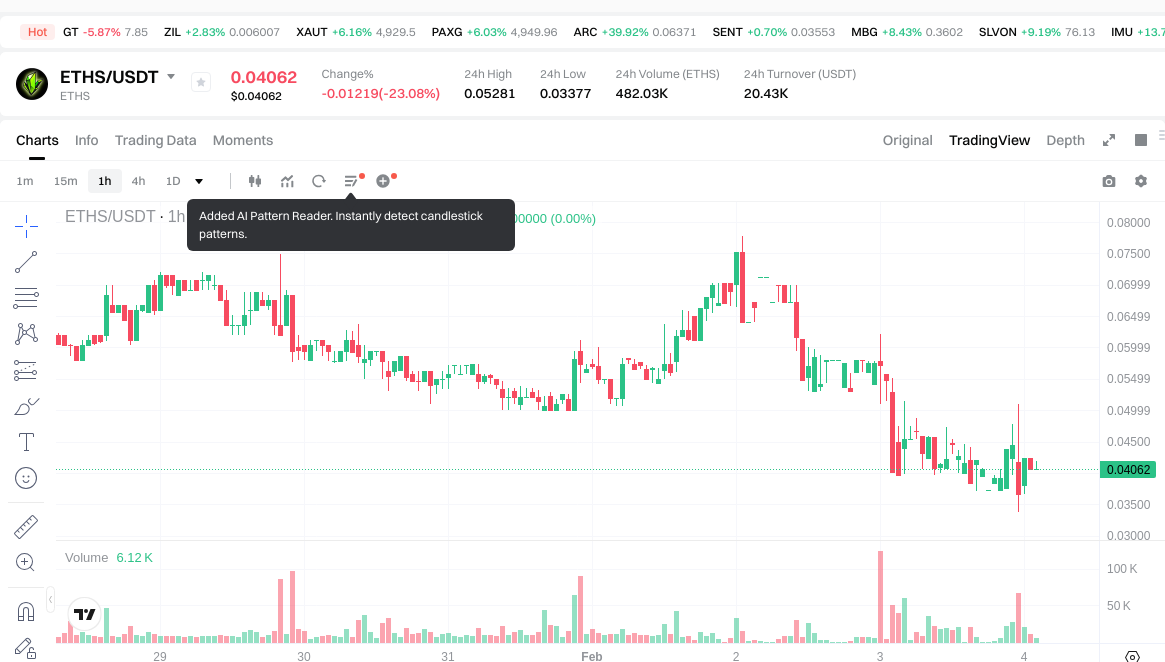
ETHS represents a notable asset within the cryptocurrency ecosystem, serving as the core asset of the Facet protocol, a decentralized Ethereum L1 scaling solution that has received funding from the Ethereum Foundation as an unstoppable rollup. As of February 04, 2026, ETHS maintains a market capitalization of approximately $879,060, with a circulating supply of 21,000,000 tokens and a current price around $0.04186. The asset has experienced price movements ranging from an all-time low of $0.03377 recorded on February 03, 2026, to a previous high of $13.9 observed on January 05, 2024. With its positioning as a pioneering asset in empowering the secure expansion of the Ethereum mainnet and driving the next generation of data and value layers, ETHS has emerged as a subject of analysis when investors consider "Is ETHS a good investment?" This article provides a comprehensive examination of ETHS's investment characteristics, historical price patterns, future price outlook, and associated investment risks to serve as a reference for market participants.
I. ETHS Price History Review and Current Investment Value
- 2023: Token launch period → Early investors entered at deployment phase
- 2024: Price reached approximately $13.9 during market expansion → ETHS experienced significant appreciation during crypto market uptrend
- 2025-2026: Market correction phase → Price declined from elevated levels to $0.04186, reflecting broader market adjustment patterns
Current ETHS Investment Market Status (February 2026)
- ETHS current price: $0.04186
- Market sentiment (Fear & Greed Index): Data not available in reference materials
- 24-hour trading volume: $20,723.82
- Institutional investor holdings: Information regarding institutional participation is not available in provided materials
Click to view real-time ETHS market price
II. Core Factors Influencing Whether ETHS is a Good Investment
Supply Mechanism and Scarcity (ETHS investment scarcity)
- ETHS operates with a fixed maximum supply of 21,000,000 tokens, with 100% already in circulation, creating a hard cap similar to Bitcoin's scarcity model
- This finite supply structure may contribute to potential value appreciation dynamics when demand increases, as no additional tokens can be minted
- The complete circulation of all tokens eliminates future dilution concerns, which can be relevant for long-term investment considerations
- Investment significance: The scarcity model represents a foundational characteristic that some investors consider when evaluating digital assets with fixed supplies
Institutional Investment and Mainstream Adoption (Institutional investment in ETHS)
- ETHS is positioned as the core asset of Facet protocol, a decentralized Ethereum L1 scaling solution that has received funding from the Ethereum Foundation
- The Ethereum Foundation's recognition and financial support of Facet as an "Unstoppable Rollup" may signal validation of the underlying infrastructure
- As of February 04, 2026, ETHS is listed on 1 exchange with a 24-hour trading volume of approximately $20,723.82, indicating relatively limited liquidity compared to major cryptocurrencies
- Market capitalization stands at approximately $879,060, ranking #2605 globally, reflecting a relatively small market position
Macroeconomic Environment Impact on ETHS Investment
- As a crypto asset, ETHS may be influenced by broader monetary policy trends affecting risk asset appetite
- The project's connection to Ethereum's ecosystem means it could be affected by factors impacting Layer 1 and Layer 2 scaling solutions
- During periods of uncertainty, smaller-cap digital assets typically experience different volatility patterns compared to larger cryptocurrencies
Technology and Ecosystem Development (Technology & Ecosystem for ETHS investment)
- ETHS serves as the core asset for Facet protocol, which aims to enable secure expansion of the Ethereum mainnet
- The project positions itself as a pioneering asset driving next-generation data and value layers within the Ethereum ecosystem
- ETHS is associated with the Ethscriptions protocol, utilizing what is referenced as "BRC20" technology in its implementation
- The protocol's focus on Layer 1 scaling may be relevant as Ethereum continues to address scalability challenges through various technical approaches
III. ETHS Future Investment Forecast and Price Outlook (Is ETHS worth investing in 2026-2031)
Short-term ETHS Investment Outlook (2026)
- Conservative forecast: $0.022341 - $0.04062
- Neutral forecast: $0.04062 - $0.0481347
- Optimistic forecast: $0.04062 - $0.0556494
Mid-term ETHS Investment Forecast (2027-2028)
- Market stage expectation: The asset may experience gradual recovery from current lows, with potential stabilization dependent on broader Ethereum ecosystem developments and Layer 1 scaling protocol adoption.
- Investment return forecast:
- 2027: $0.03850776 - $0.060649722
- 2028: $0.0326353266 - $0.06472673109
- Key catalysts: Facet protocol development progress, Ethereum mainnet scaling adoption, and overall market sentiment toward Layer 1 solutions.
Long-term Investment Outlook (Is ETHS a good long-term investment?)
- Base scenario: $0.037683277 - $0.073383224 (assuming steady ecosystem development and moderate market conditions)
- Optimistic scenario: $0.06611101 - $0.095553552 (assuming accelerated Ethereum scaling adoption and favorable regulatory environment)
- Risk scenario: Below $0.03377 (under extreme market downturns or protocol development setbacks)
View ETHS long-term investment and price forecast: Price Prediction
2026-2031 Long-term Outlook
- Base scenario: $0.037683277 - $0.069747118 (corresponding to steady progress and gradual mainstream application growth)
- Optimistic scenario: $0.06611101 - $0.095553552 (corresponding to large-scale adoption and favorable market environment)
- Transformative scenario: Above $0.095553552 (in case of breakthrough ecosystem developments and mainstream adoption)
- 2031-12-31 predicted high: $0.095553552 (based on optimistic development assumptions)
Disclaimer: Price predictions are based on historical data and market analysis models. Cryptocurrency markets are highly volatile and subject to various unpredictable factors. These forecasts should not be considered as investment advice. Investors should conduct thorough research and assess their risk tolerance before making investment decisions.
| Year |
Predicted High Price |
Predicted Average Price |
Predicted Low Price |
Price Change |
| 2026 |
0.0556494 |
0.04062 |
0.022341 |
-2 |
| 2027 |
0.060649722 |
0.0481347 |
0.03850776 |
14 |
| 2028 |
0.06472673109 |
0.054392211 |
0.0326353266 |
29 |
| 2029 |
0.0726625546749 |
0.059559471045 |
0.035735682627 |
42 |
| 2030 |
0.073383224274544 |
0.06611101285995 |
0.037683277330171 |
57 |
| 2031 |
0.095553552437128 |
0.069747118567247 |
0.046730569440055 |
66 |
IV. ETHS Investment Strategy and Risk Management (How to invest in ETHS)
Investment Methodology (ETHS investment strategy)
Long-term Holding (HODL ETHS)
Long-term holding may suit investors who believe in the fundamental value proposition of ETHS as a core asset of the Facet protocol, a decentralized Ethereum L1 scaling solution. This approach typically involves:
- Purchasing ETHS and maintaining positions through market cycles
- Focusing on the protocol's development progress rather than short-term price movements
- Regularly reviewing the project's technical milestones and ecosystem growth
Active Trading
Active trading strategies rely on technical analysis and market timing:
- Utilizing chart patterns, trading volumes, and momentum indicators
- Implementing swing trading approaches to capture price movements
- Setting predetermined entry and exit points based on technical levels
- Monitoring 24-hour trading volume (currently $20,723.82) for liquidity assessment
Risk Management (Risk management for ETHS investment)
Asset Allocation Ratios
Conservative Investors:
- Allocate 1-3% of total crypto portfolio to ETHS
- Prioritize established assets with lower volatility
- Focus on capital preservation over high returns
Moderate Investors:
- Consider 3-7% allocation to ETHS
- Balance between growth potential and established assets
- Regular portfolio rebalancing based on market conditions
Aggressive Investors:
- May allocate 7-15% to ETHS
- Higher tolerance for volatility in pursuit of potential returns
- Active monitoring and adjustment strategies
Risk Hedging Solutions
Multi-Asset Portfolio:
- Diversification across different cryptocurrency sectors
- Combination of Layer 1, Layer 2, and DeFi assets
- Inclusion of stablecoins for liquidity management
Risk Mitigation Tools:
- Position sizing based on volatility levels
- Stop-loss orders to limit potential downside
- Regular profit-taking at predetermined levels
Secure Storage
Cold and Hot Wallet Solutions:
- Hot wallets for active trading and immediate access
- Cold storage for long-term holdings and larger amounts
- Multi-signature wallets for enhanced security
Hardware Wallet Recommendations:
- Research reputable hardware wallet providers
- Ensure proper backup of recovery phrases
- Store backup information in secure, separate locations
- Regular firmware updates for security patches
V. ETHS Investment Risks and Challenges (Risks of investing in ETHS)
Market Risks
High Volatility:
- Recent 24-hour price change of -23.44% demonstrates significant short-term volatility
- 7-day decline of -34.79% indicates substantial price swings
- 30-day performance showing -74.63% reflects extended downward pressure
- Price fluctuation between $0.03377 and $0.05468 within 24 hours illustrates intraday volatility
Price Manipulation Concerns:
- Relatively low market capitalization of $879,060 may increase susceptibility to large orders
- Limited exchange availability (1 exchange) may affect price discovery
- Lower trading volumes compared to major cryptocurrencies may impact market depth
Regulatory Risks
Policy Uncertainty Across Jurisdictions:
- Cryptocurrency regulations vary significantly by country and region
- Potential changes in classification of digital assets may affect trading and taxation
- Evolving compliance requirements for scaling solutions and Layer 1 protocols
- Uncertain regulatory treatment of protocol-native assets
Compliance Considerations:
- KYC/AML requirements may differ across trading platforms
- Cross-border transaction restrictions in certain jurisdictions
- Potential impact of future regulatory frameworks on protocol operations
Technical Risks
Network Security Vulnerabilities:
- Smart contract risks inherent in blockchain protocols
- Potential exploits in protocol implementation
- Dependency on Ethereum mainnet security
Upgrade Challenges:
- Technical complexities in protocol development and deployment
- Potential coordination issues in decentralized governance
- Risk of delays or complications in planned improvements
- Compatibility considerations with Ethereum ecosystem updates
VI. Conclusion: Is ETHS a Good Investment?
Investment Value Summary
ETHS represents the core asset of the Facet protocol, a decentralized Ethereum L1 scaling solution that has received recognition through Ethereum Foundation funding. The asset's role in enabling secure expansion of the Ethereum mainnet positions it within the broader narrative of blockchain scalability.
However, significant price volatility remains evident, with recent performance showing substantial declines across multiple timeframes. The current price of $0.04186 represents a considerable decrease from the historical high of $13.9, indicating substantial downward movement. The circulating supply of 21,000,000 ETHS is fully distributed, representing 100% of maximum supply.
Investor Recommendations
✅ New Investors:
- Consider dollar-cost averaging to mitigate timing risks
- Prioritize secure wallet storage solutions
- Start with small allocations to understand market dynamics
- Conduct thorough research on the Facet protocol and its development roadmap
✅ Experienced Investors:
- Evaluate swing trading opportunities based on technical patterns
- Implement portfolio diversification strategies
- Monitor protocol development milestones and ecosystem growth
- Utilize risk management tools including stop-losses and position sizing
✅ Institutional Investors:
- Assess ETHS within broader blockchain infrastructure allocation strategies
- Conduct comprehensive due diligence on protocol fundamentals
- Consider long-term strategic positioning in Ethereum scaling solutions
- Evaluate liquidity constraints given current market depth
⚠️ Disclosure: Cryptocurrency investments involve substantial risks, including potential loss of principal. Market volatility, regulatory changes, and technical challenges may significantly impact asset values. This content provides informational context and does not constitute investment advice. Individuals should conduct independent research and consult qualified financial advisors before making investment decisions.
VII. FAQ
Q1: What is ETHS and what makes it different from other Ethereum-related tokens?
ETHS is the core asset of the Facet protocol, a decentralized Ethereum Layer 1 scaling solution that has received funding from the Ethereum Foundation as an "unstoppable rollup." Unlike typical ERC-20 tokens, ETHS is associated with the Ethscriptions protocol and focuses specifically on enabling secure expansion of the Ethereum mainnet. Its fixed maximum supply of 21,000,000 tokens (100% already circulated) creates a scarcity model similar to Bitcoin. The key differentiator is its role in driving next-generation data and value layers within the Ethereum ecosystem, positioning it as infrastructure rather than just another token.
Q2: Given the recent price decline of -74.63% over 30 days, is now a good time to invest in ETHS?
The answer depends on your investment strategy and risk tolerance. The recent significant decline from a high of $13.9 to the current $0.04186 represents substantial downside movement, potentially indicating either a buying opportunity or continued bearish pressure. Conservative investors should wait for price stabilization and positive momentum indicators before entering. Aggressive investors might consider dollar-cost averaging to mitigate timing risks, starting with small allocations (1-3% of crypto portfolio). The all-time low of $0.03377 recorded on February 03, 2026, suggests the asset may be near a potential support level, but no guarantees exist in volatile cryptocurrency markets.
Q3: What are the main risks I should be aware of before investing in ETHS?
The primary risks include: (1) High volatility – recent 24-hour price changes of -23.44% demonstrate extreme short-term swings; (2) Limited liquidity – trading on only 1 exchange with $20,723.82 daily volume increases price manipulation susceptibility; (3) Small market capitalization – at $879,060, ETHS ranks #2605 globally, making it vulnerable to large orders; (4) Regulatory uncertainty – evolving cryptocurrency regulations may impact protocol operations; (5) Technical risks – smart contract vulnerabilities and protocol upgrade challenges inherent in blockchain infrastructure. The recent performance showing -34.79% over 7 days further emphasizes the asset's volatility profile.
Q4: How does ETHS's price prediction for 2026-2031 compare to current prices?
Current price forecasts suggest mixed outlooks. For 2026, conservative estimates range from $0.022341 to $0.0556494, with the neutral forecast at $0.04062 – relatively close to current levels. Mid-term projections show potential gradual recovery, with 2027 predicted at $0.03850776 to $0.060649722 and 2028 at $0.0326353266 to $0.06472673109. Long-term optimistic scenarios for 2031 reach $0.095553552, representing potential upside from current levels. However, these predictions are based on assumptions of steady protocol development and favorable market conditions. The base scenario suggests relatively modest growth, while downside risks remain if the price falls below the recent low of $0.03377.
Q5: What investment strategy works best for ETHS given its volatility?
For ETHS, three primary strategies apply based on risk profile: (1) Long-term holding (HODL) – suitable for those believing in Facet protocol's fundamental value, focusing on development milestones rather than price movements; (2) Dollar-cost averaging – recommended for most investors to mitigate timing risks by making regular small purchases regardless of price; (3) Active trading – utilizing technical analysis and swing trading for experienced traders who can monitor the relatively low liquidity environment. Conservative investors should limit ETHS to 1-3% of their crypto portfolio, moderate investors 3-7%, and aggressive investors 7-15%. Regardless of strategy, secure storage using hardware wallets for long-term holdings and implementing stop-loss orders for risk management are essential.
Q6: How does ETHS's relationship with the Ethereum Foundation impact its investment potential?
ETHS's connection to the Ethereum Foundation through Facet protocol funding provides both potential benefits and considerations. The Foundation's recognition and financial support of Facet as an "Unstoppable Rollup" may signal validation of the underlying infrastructure, potentially enhancing credibility. This association positions ETHS within the broader Ethereum scaling narrative, which could benefit from increased adoption of Layer 1 solutions. However, this relationship doesn't guarantee success – ETHS must still demonstrate technical execution and market adoption. The protocol's focus on empowering secure expansion of the Ethereum mainnet aligns with Ethereum's long-term scalability goals, but the current market capitalization of $879,060 and limited exchange availability suggest the market has not yet fully priced in this relationship.
Q7: What are the key milestones or catalysts that could drive ETHS price appreciation?
Several potential catalysts could influence ETHS valuation: (1) Protocol development progress – successful implementation of Facet's scaling solutions and technical milestones; (2) Ethereum ecosystem adoption – increased usage of Layer 1 scaling protocols as Ethereum addresses scalability challenges; (3) Exchange listings – expansion beyond the current single exchange could improve liquidity and price discovery; (4) Institutional participation – entry of larger investors into the Ethereum scaling infrastructure sector; (5) Broader market sentiment – recovery in cryptocurrency markets generally benefits smaller-cap assets. The fixed supply of 21,000,000 tokens with 100% circulation means supply-side dynamics won't change, making demand-driven catalysts particularly important for price appreciation.
Q8: Should I prioritize ETHS or other Ethereum Layer 2 solutions for investment?
This decision requires comparing ETHS's unique positioning against established Layer 2 alternatives. ETHS offers: (1) Scarcity – fixed 21M supply versus unlimited token models in some L2s; (2) Early-stage potential – lower market cap may offer higher growth potential but with correspondingly higher risk; (3) Ethereum Foundation backing – validation through funding support. However, established Layer 2 solutions typically provide: (1) Higher liquidity – better trading infrastructure and deeper markets; (2) Proven track records – operational history and demonstrated usage; (3) Lower volatility – more stable price movements. For diversified exposure to Ethereum scaling, investors might consider allocating to both established L2 solutions and smaller positions in earlier-stage protocols like ETHS, ensuring the combined allocation fits within their overall risk management framework.
* The information is not intended to be and does not constitute financial advice or any other recommendation of any sort offered or endorsed by Gate.