This comprehensive analysis examines FARCANA (FAR), a decentralized AI and gaming token launched in January 2024, currently trading at $0.0009126 with a market cap of $658,672. The article evaluates FAR's investment potential through multiple dimensions: historical price trends showing 78.46% 1-year decline despite recent 10.05% recovery; tokenomics with 14.44% circulating supply creating scarcity potential; and ecosystem development in decentralized AI computing and AI-gaming systems. Price forecasts range from conservative to optimistic scenarios through 2031, with detailed risk analysis addressing market volatility, regulatory uncertainty, and technical challenges. The guide provides investment strategies for different investor types—from dollar-cost averaging for beginners to strategic positioning for institutions—alongside essential risk management recommendations and storage security best practices for optimal portfolio positioning.
Introduction: FARCANA (FAR) Investment Position and Market Outlook
FAR is a digital asset in the cryptocurrency sector, launched in January 2024, and has developed within the decentralized AI and gaming technology space. As of February 2026, FAR holds a market capitalization of approximately $658,672, with a circulating supply of around 721,753,536 tokens, and the current price is maintained at approximately $0.0009126. Positioned as a token powering the FAR ecosystem—a decentralized compute network for open-source AI models—FAR has gradually become a focal point for investors discussing "Is FARCANA (FAR) a good investment?" This article will comprehensively analyze FAR's investment value, historical trends, future price projections, and investment risks to provide reference for investors.
I. FARCANA (FAR) Historical Price Review and Current Investment Value
- 2024: FAR experienced a notable price movement after its launch in January 2024, with the price reaching elevated levels during the first quarter. The token showed volatility characteristic of emerging blockchain gaming assets during this period.
- 2024-2025: The token underwent a significant price adjustment phase, declining from higher levels observed in early 2024 to lower price ranges by mid-2025, reflecting broader market conditions and sector-specific challenges in the blockchain gaming space.
- 2025-2026: As of early 2026, FAR has demonstrated recent short-term recovery signals, with a 7-day price change showing positive momentum of approximately 10.05%, though the token remains substantially below previous price levels observed in 2024.
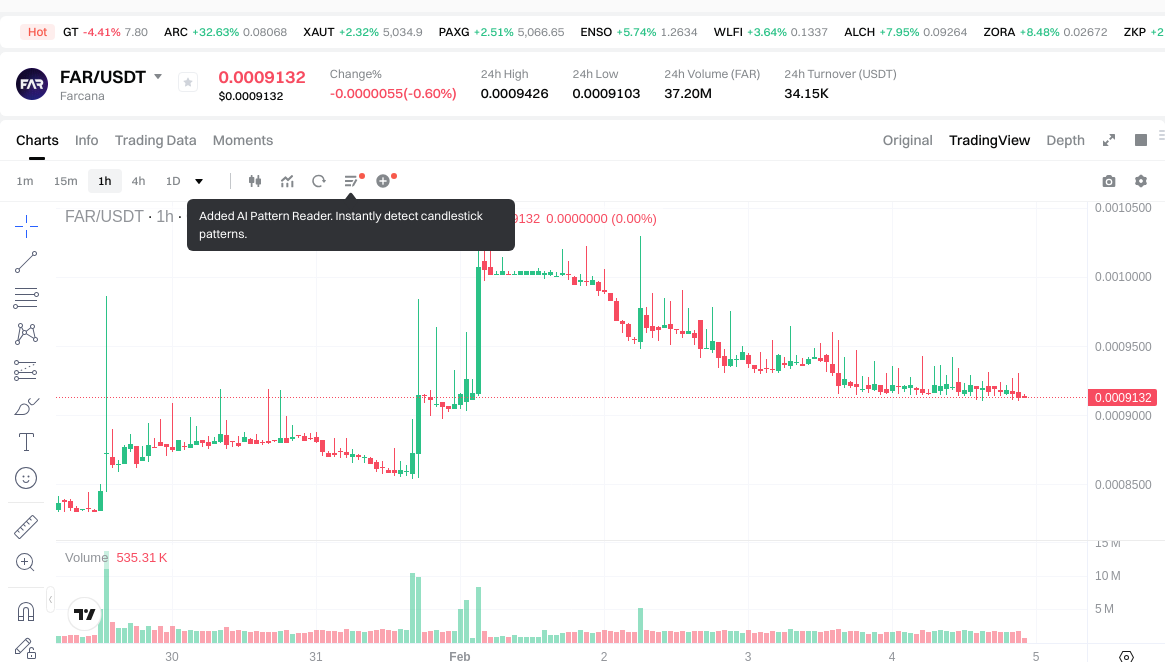
Current FAR Investment Market Status (February 2026)
- FAR current price: $0.0009126
- 24-hour price change: -0.33%
- 24-hour trading volume: $34,236.53
- Market capitalization: $658,672.28
- Circulating supply: 721,753,536 FAR (14.44% of total supply)
Click to view real-time FAR market price
II. Core Factors Influencing Whether FAR is a Good Investment
Supply Mechanism and Scarcity (FAR Investment Scarcity)
- FAR has a maximum supply of 5,000,000,000 tokens, with a current circulating supply of 721,753,536 tokens, representing a circulation ratio of approximately 14.44%.
- The limited circulating supply relative to total supply may create a perception of scarcity in the short term, though the majority of tokens remain locked or unvested.
- The token's price has experienced fluctuations since launch, with historical data showing a price range from $0.00015 to $0.21, indicating volatility that impacts investment considerations.
- The fully diluted market cap stands at approximately $4,563,000, suggesting potential dilution effects as more tokens enter circulation over time.
Institutional Investment and Mainstream Adoption (Institutional Investment in FAR)
- The token is currently listed on 3 exchanges and holds 1,162 holders, indicating relatively limited distribution and adoption at present.
- FAR Labs operates within the decentralized AI and gaming sector, developing AI gaming systems with dynamic NPCs, advanced AI agents, and digital twins.
- The project focuses on building a decentralized compute network for AI models, positioning itself within emerging technology sectors that may attract institutional interest over time.
- The FAR ecosystem connects developers, users, and node operators through the $FAR token, creating a framework for potential network effects as adoption expands.
Macroeconomic Environment's Impact on FAR Investment
- As a smaller-cap cryptocurrency project, FAR may exhibit higher sensitivity to broader market conditions and risk appetite in the crypto sector.
- Market sentiment indicators suggest a bearish outlook for 2026 according to various technical analyses, reflecting cautious investor positioning.
- The token's performance shows a 1-year decline of 78.46%, while demonstrating shorter-term volatility with a 7-day increase of 10.05% and a 30-day decrease of 16.29%.
- Global monetary policy shifts and risk-off sentiment in traditional markets could impact capital flows into speculative crypto assets like FAR.
Technology and Ecosystem Development (Technology & Ecosystem for FAR Investment)
- FAR AI operates as a decentralized compute network running open-source AI models, aiming to provide faster and more efficient computing compared to traditional cloud providers.
- The project's technological focus on AI-powered gaming systems, including adaptive worlds and human-AI interaction technologies, represents an emerging application area within blockchain.
- All products and compute utilities within the FAR ecosystem are powered by the $FAR token, creating potential utility value as the platform develops.
- The project's development roadmap and technical implementation progress may influence long-term investment viability, though specific milestone achievements require ongoing monitoring.
III. FAR Future Investment Forecast and Price Outlook (Is FARCANA (FAR) Worth Investing in 2026-2031)
Short-term Investment Forecast (2026, Short-term FAR Investment Outlook)
- Conservative Forecast: $0.00050226 - $0.0009132
- Neutral Forecast: $0.0009132
- Optimistic Forecast: $0.0009132 - $0.000995388
Mid-term Investment Outlook (2027-2029, Mid-term FARCANA (FAR) Investment Forecast)
-
Market Stage Expectation: The mid-term outlook reflects potential gradual development as FAR Labs continues to advance its decentralized AI computing network and AI gaming systems. Market performance may be influenced by adoption rates of FAR AI's compute network and the broader decentralized AI ecosystem evolution.
-
Investment Return Forecast:
- 2027: $0.00059166228 - $0.00104018046
- 2028: $0.0006581765718 - $0.0013861597497
- 2029: $0.00110827959556 - $0.00166837788579
-
Key Catalysts: Expansion of the FAR ecosystem, increased adoption of decentralized AI compute services, development of AI gaming systems with dynamic NPCs and advanced AI agents, growth in node operator participation, and broader integration of the $FAR token within the decentralized AI economy.
Long-term Investment Outlook (Is FAR a Good Long-term Investment?)
- Base Scenario: $0.001058228258986 - $0.002073555372339 (assuming steady progress in decentralized AI technology adoption and ecosystem development through 2030)
- Optimistic Scenario: $0.001664206941075 - $0.002277335814103 (assuming accelerated adoption of FAR AI compute network, successful implementation of AI gaming systems, and favorable market conditions for decentralized AI solutions through 2031)
- Risk Scenario: Below $0.00050226 (under conditions of significant market downturn, competitive pressure from alternative AI computing solutions, or slower-than-expected ecosystem development)
For more details on FAR long-term investment and price forecasts: Price Prediction
2026-2031 Long-term Outlook
- Base Scenario: $0.001058228258986 - $0.002073555372339 (corresponding to steady progress and gradual mainstream application growth)
- Optimistic Scenario: $0.001664206941075 - $0.002277335814103 (corresponding to large-scale adoption and favorable market environment)
- Transformative Scenario: Above $0.002277335814103 (if ecosystem achieves breakthrough developments and mainstream adoption)
- 2031-12-31 Forecast High: $0.002277335814103 (based on optimistic development assumptions)
Disclaimer: The above forecasts are based on available data and analytical models. Cryptocurrency markets involve significant volatility and risk. Past performance does not guarantee future results. This analysis does not constitute investment advice, and investors should conduct their own research and risk assessment before making any investment decisions.
| Year |
Predicted High Price |
Predicted Average Price |
Predicted Low Price |
Price Change |
| 2026 |
0.000995388 |
0.0009132 |
0.00050226 |
0 |
| 2027 |
0.00104018046 |
0.000954294 |
0.00059166228 |
4 |
| 2028 |
0.0013861597497 |
0.00099723723 |
0.0006581765718 |
9 |
| 2029 |
0.00166837788579 |
0.00119169848985 |
0.00110827959556 |
30 |
| 2030 |
0.002073555372339 |
0.00143003818782 |
0.001058228258986 |
56 |
| 2031 |
0.002277335814103 |
0.001751796780079 |
0.001664206941075 |
91 |
IV. FAR Investment Strategy and Risk Management (How to invest in AI-powered gaming tokens)
Investment Methodology (FAR investment strategy)
-
Long-term Holding (HODL FAR): Suitable for conservative investors who believe in the long-term vision of decentralized AI computing and AI-enhanced gaming ecosystems. This approach focuses on accumulating tokens during market downturns and holding through volatility cycles.
-
Active Trading: Relies on technical analysis and swing trading strategies. Given FAR's historical price volatility (with 24-hour fluctuations around 0.33% and 7-day changes of approximately 10.05%), traders may identify entry and exit points based on support and resistance levels, moving averages, and trading volume patterns.
Risk Management (Risk management for FAR investment)
-
Asset Allocation Ratio:
- Conservative investors: Allocate no more than 1-3% of total crypto portfolio to FAR
- Aggressive investors: May allocate 5-10% depending on risk tolerance and market conviction
- Professional investors: Could consider higher allocations with proper hedging strategies in place
-
Risk Hedging Solutions: Implement multi-asset portfolio diversification across different crypto sectors (DeFi, Layer 1/Layer 2, gaming tokens). Consider stablecoin positions for liquidity management and potential hedging instruments available on exchanges.
-
Secure Storage:
- Hot wallets: For active trading portions, use reputable exchange wallets or mobile wallets with two-factor authentication
- Cold storage: For long-term holdings, consider hardware wallets (Ledger, Trezor) or paper wallets
- Best practice: Store the majority of holdings in cold storage and only keep necessary amounts in hot wallets for trading
V. FAR Investment Risks and Challenges (Risks of investing in AI gaming tokens)
-
Market Risks: FAR exhibits high volatility characteristics common in emerging crypto projects. The token has experienced significant price swings, with 1-year performance showing approximately -78.46% change. Price manipulation risks exist due to relatively lower trading volume (around $34,236.53 in 24-hour volume as of February 4, 2026) and limited exchange listings (3 exchanges).
-
Regulatory Risks: The intersection of AI technology, gaming, and cryptocurrency creates complex regulatory considerations. Different jurisdictions maintain varying approaches to crypto assets, and future regulations regarding AI-powered gaming platforms and decentralized compute networks remain uncertain. Policy changes in major markets could impact token utility and adoption.
-
Technical Risks: As a project building decentralized AI infrastructure and gaming systems, FAR faces multiple technical challenges:
- Network security vulnerabilities in the decentralized compute network
- Smart contract risks associated with the BSC deployment
- Potential technical failures during system upgrades or new feature implementations
- Integration challenges between AI models, gaming systems, and blockchain infrastructure
VI. Conclusion: Is AI-Powered Gaming Token a Good Investment?
-
Investment Value Summary: FAR presents an interesting proposition at the intersection of decentralized AI computing and next-generation gaming experiences. The project's focus on running open-source AI models through a decentralized network addresses efficiency concerns in traditional cloud computing. However, the token has experienced substantial volatility, with significant price depreciation over the past year. The relatively low market capitalization (around $658,672.28) and circulating supply of approximately 721.75 million tokens (14.44% of max supply) suggest the project is still in early stages of development and adoption.
-
Investor Recommendations:
-
✅ Beginners: Consider dollar-cost averaging (DCA) strategy with small, regular purchases rather than lump-sum investments. Prioritize secure storage solutions immediately after purchase, using hardware wallets for holdings intended for long-term investment.
-
✅ Experienced Investors: May employ swing trading strategies based on technical indicators while maintaining a core long-term position. Consider portfolio allocation within a broader AI and gaming token basket to manage sector-specific risks.
-
✅ Institutional Investors: Could evaluate strategic long-term positioning based on comprehensive due diligence of the project's technical roadmap, team credentials, and competitive positioning within the decentralized AI computing landscape.
⚠️ Disclaimer: Cryptocurrency investments carry high levels of risk due to market volatility, regulatory uncertainty, and technical complexities. This content is provided for informational purposes only and does not constitute investment advice. Investors should conduct thorough research and consider their own financial situation and risk tolerance before making any investment decisions.
VII. FAQ
Q1: What is the current market performance of FARCANA (FAR) and what factors influence its price?
As of February 2026, FAR trades at approximately $0.0009126 with a market capitalization of $658,672.28 and a circulating supply of 721,753,536 tokens (14.44% of total supply). The token demonstrates notable price volatility, with a 7-day increase of 10.05% but a 1-year decline of 78.46%. Key factors influencing FAR's price include its limited exchange listings (3 exchanges), relatively low trading volume ($34,236.53 in 24-hour volume), adoption rate of the decentralized AI compute network, development progress of AI gaming systems, broader cryptocurrency market sentiment, and regulatory developments affecting AI-blockchain projects.
Q2: How does FAR's tokenomics structure impact its investment potential?
FAR has a maximum supply of 5,000,000,000 tokens with only 14.44% currently in circulation, creating potential scarcity dynamics in the short term. However, the low circulation ratio also presents dilution risk as additional tokens enter the market through vesting schedules. The fully diluted market cap stands at approximately $4,563,000, suggesting significant upside potential if the project achieves mainstream adoption, but also indicating substantial dilution effects as locked tokens gradually release. The limited holder base (1,162 holders) reflects early-stage adoption, which could provide growth opportunities but also concentration risks.
Q3: What are the realistic price projections for FAR from 2026 to 2031?
Conservative forecasts for 2026 suggest a price range of $0.00050226 - $0.0009132. Mid-term projections indicate gradual growth: 2027 ($0.00059166228 - $0.00104018046), 2028 ($0.0006581765718 - $0.0013861597497), and 2029 ($0.00110827959556 - $0.00166837788579). Long-term base scenario for 2030-2031 estimates $0.001058228258986 - $0.002277335814103, assuming steady ecosystem development. These projections depend heavily on adoption of FAR's decentralized AI computing network, successful implementation of AI gaming systems, competitive positioning, and broader market conditions for blockchain-AI projects.
Q4: What investment strategies are most suitable for different types of FAR investors?
Conservative investors should limit FAR allocation to 1-3% of total crypto portfolio and consider dollar-cost averaging (DCA) with hardware wallet storage for long-term holdings. Aggressive investors may allocate 5-10% and employ swing trading strategies based on technical analysis, given FAR's historical volatility (24-hour fluctuations around 0.33% and 7-day changes of approximately 10.05%). Professional investors might consider higher allocations with proper hedging through multi-asset diversification across DeFi, Layer 1/Layer 2, and gaming token sectors. All investors should maintain majority holdings in cold storage and only keep necessary amounts in hot wallets for trading purposes.
Q5: What are the primary risks associated with investing in FAR?
Market risks include high volatility (78.46% decline over 1 year), price manipulation potential due to low liquidity, and limited exchange listings. Regulatory risks stem from uncertain policy frameworks regarding AI-blockchain convergence, gaming platforms, and decentralized compute networks across different jurisdictions. Technical risks encompass network security vulnerabilities in the decentralized compute infrastructure, smart contract vulnerabilities on BSC deployment, potential failures during system upgrades, and integration challenges between AI models, gaming systems, and blockchain components. The project's early-stage development status (14.44% token circulation) also presents execution and adoption risks.
Q6: How does FAR's technology differentiate it within the AI and gaming blockchain sector?
FAR operates as a decentralized compute network specifically designed for running open-source AI models, claiming faster and more efficient computing compared to traditional cloud providers. The project focuses on AI-powered gaming systems featuring dynamic NPCs, advanced AI agents, digital twins, and adaptive worlds that respond to human-AI interaction. The $FAR token serves as the utility layer powering all products and compute services within the ecosystem, connecting developers, users, and node operators. This technological positioning targets the intersection of decentralized AI infrastructure and next-generation gaming experiences, though competitive differentiation depends on successful implementation and adoption versus alternative AI computing solutions.
Q7: What key milestones should investors monitor when evaluating FAR's investment potential?
Critical indicators include expansion of exchange listings beyond current 3 platforms, growth in holder count beyond 1,162 addresses, increases in 24-hour trading volume (currently $34,236.53), technological milestone achievements in the decentralized AI compute network, successful deployment of AI gaming systems with measurable user adoption, formation of strategic partnerships with gaming studios or AI development communities, node operator network growth, and token unlock schedules affecting circulating supply. Additionally, monitor broader market trends in decentralized AI computing adoption, competitive developments from alternative AI-blockchain projects, and regulatory clarity regarding AI-powered gaming platforms and decentralized compute networks.
* The information is not intended to be and does not constitute financial advice or any other recommendation of any sort offered or endorsed by Gate.