Is Force Protocol (FOR) a good investment?: A Comprehensive Analysis of Features, Risk Factors, and Market Potential in 2024

Introduction: The Force Protocol (FOR) Investment Position and Market Outlook
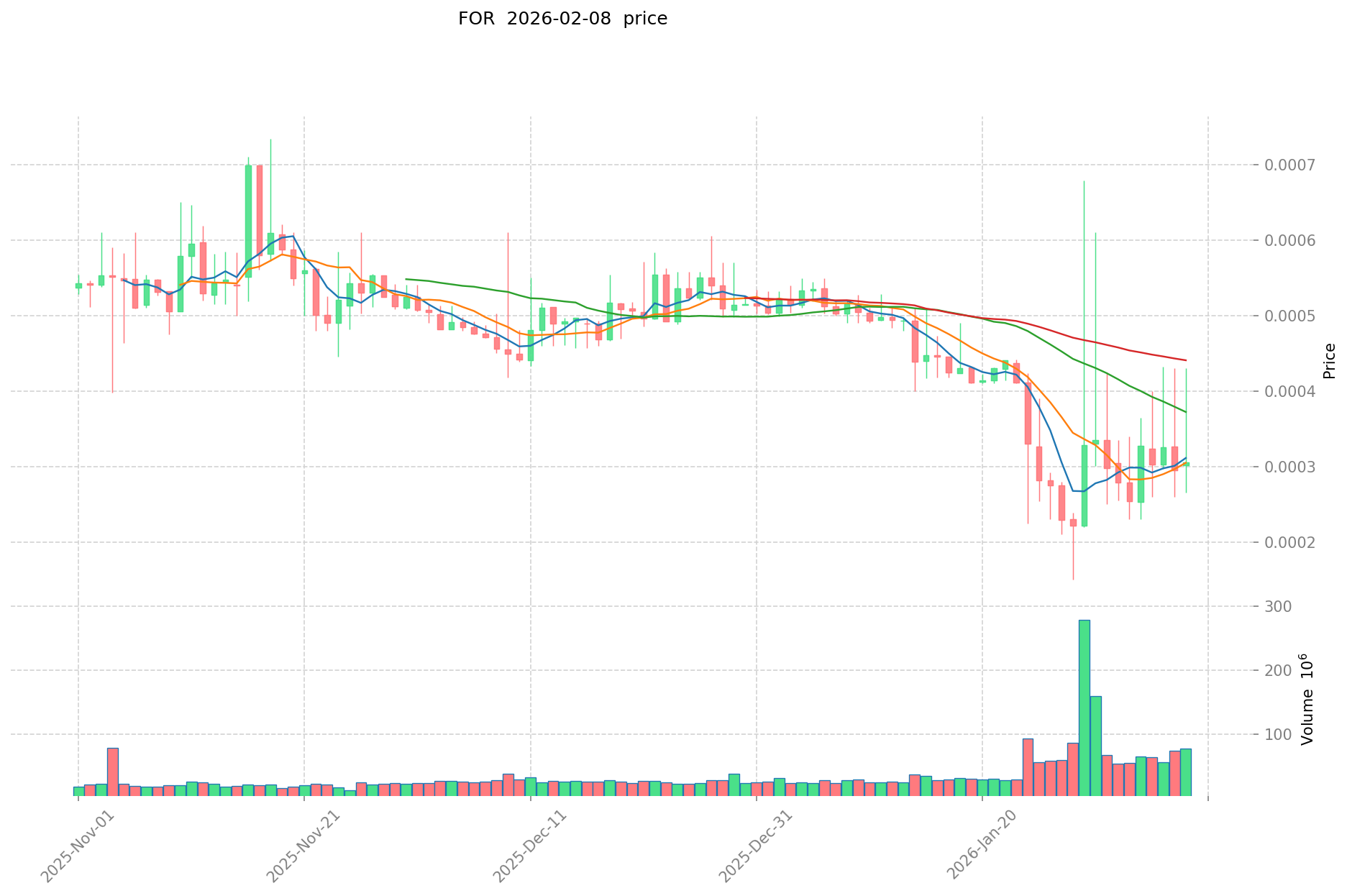
FOR is a notable asset in the cryptocurrency sector. Launched in 2019, it has been developing in the decentralized finance (DeFi) infrastructure space. As of February 9, 2026, FOR maintains a market capitalization of approximately $187,605, with a circulating supply of around 563.72 million tokens, and the current price stands at approximately $0.0003328. Positioned as a distributed encrypted digital financial service protocol, FOR has gradually become a subject of discussion among investors considering "Is ForTube (FOR) a good investment?" This article will comprehensively analyze FOR's investment value, historical trends, future price predictions, and investment risks to provide reference for investors.
I. FOR Price History Review and Investment Value Status
FOR Historical Price Trends and Investment Returns (ForTube (FOR) Investment Performance)
- 2021: FOR reached a notable price level of $0.167203 on April 12, 2021 → investors who entered at the initial offering price of $0.02 in 2019 experienced substantial gains during this period
- 2026: Market cycle adjustment → FROM previous elevated levels, the token experienced significant price compression, with the price declining to $0.00016742 on January 28, 2026
- Current period: Following the market correction, FOR showed a recovery pattern → the token rebounded from its recent low point, with a 7-day increase of 14.52% as of February 9, 2026
Current FOR Investment Market Status (February 2026)
- FOR current price: $0.0003328
- Market sentiment (Fear & Greed Index): data not available in provided materials
- 24-hour trading volume: $15,213.44
- Institutional investor holdings: data indicates 22,696 holders, though specific institutional allocation information was not provided in the reference materials
Click to view real-time FOR market price
II. Core Factors Influencing Whether FOR is a Good Investment
Supply Mechanism and Scarcity (FOR Investment Scarcity)
- Total supply: 1,000,000,000 FOR tokens with a maximum supply cap of 1,000,000,000 tokens → impacts price dynamics and potential investment value
- Current circulating supply: approximately 563,718,021 FOR (56.37% of total supply) → indicates substantial token circulation in the market
- Investment significance: the fixed maximum supply of 1 billion tokens may provide a foundation for long-term scarcity considerations
Macroeconomic Environment Impact on FOR Investment
- Market capitalization: approximately $187,605 with a fully diluted valuation of $332,800 → reflects current market positioning
- 24-hour trading volume: $15,213 → indicates trading activity levels
- Market dominance: 0.000013% → represents minimal market share within the broader crypto ecosystem
- Price volatility: 24-hour range between $0.0002801 and $0.0004099 → reflects price fluctuation patterns
Technology and Ecosystem Development (Technology & Ecosystem for FOR Investment)
- Protocol foundation: The Force Protocol operates as a distributed encrypted digital financial service protocol
- Technical infrastructure: built on mainstream public chain systems and underlying cross-chain protocols
- Service offerings: provides SDK and API solutions for decentralized financial application development
- Ecosystem applications: addresses cross-platform asset circulation, transaction depth sharing, cross-chain encrypted asset collateral for stablecoin issuance, token bond issuance, on-chain payment, and transaction settlement needs
III. FOR Future Investment Forecast and Price Outlook (Is ForTube (FOR) worth investing in 2026-2031)
Short-term FOR investment outlook (2026)
- Conservative forecast: $0.000219 - $0.000305
- Neutral forecast: $0.000353 - $0.000373
- Optimistic forecast: $0.000392 - $0.000409
Mid-term ForTube (FOR) investment forecast (2027-2028)
-
Market stage expectations: Based on historical price movements, FOR may experience moderate volatility during the mid-term period, with potential price stabilization influenced by broader crypto market trends and protocol development progress.
-
Investment return forecast:
- 2027: $0.000306 - $0.000414
- 2028: $0.000373 - $0.000432
-
Key catalysts: Market adoption trends, developments in decentralized financial services protocols, cross-chain interoperability enhancements, and overall crypto market sentiment.
Long-term investment outlook (Is FOR a good long-term investment?)
- Base scenario: $0.000273 - $0.000479 (assuming steady protocol development and moderate market conditions)
- Optimistic scenario: $0.000421 - $0.000545 (assuming increased adoption and favorable market environment)
- Risk scenario: $0.000219 - $0.000373 (under challenging market conditions or limited adoption)
View FOR long-term investment and price forecast: Price Prediction
2026-02-09 to 2031 Long-term Outlook
- Base scenario: $0.000273 - $0.000496 (corresponding to steady progress and gradual mainstream application growth)
- Optimistic scenario: $0.000421 - $0.000545 (corresponding to large-scale adoption and favorable market environment)
- Transformative scenario: Above $0.000545 (in case of breakthrough ecosystem development and mainstream adoption)
- 2031-12-31 predicted high: $0.000540 (based on optimistic development assumptions)
Disclaimer: Cryptocurrency price predictions are speculative and subject to market volatility. Historical performance does not guarantee future results. Investors should conduct thorough research and consider their risk tolerance before making investment decisions.
| Year | Predicted High Price | Predicted Average Price | Predicted Low Price | Price Change |
|---|---|---|---|---|
| 2026 | 0.000392052 | 0.0003532 | 0.000218984 | 6 |
| 2027 | 0.00041361486 | 0.000372626 | 0.00030555332 | 11 |
| 2028 | 0.000432432473 | 0.00039312043 | 0.0003734644085 | 18 |
| 2029 | 0.00054486491598 | 0.0004127764515 | 0.00037975433538 | 24 |
| 2030 | 0.000512338131601 | 0.00047882068374 | 0.000272927789731 | 43 |
| 2031 | 0.000540181554361 | 0.00049557940767 | 0.00042124249652 | 48 |
IV. FOR Investment Strategy and Risk Management (How to invest in DeFi Protocol Token)
Investment Methodology (FOR investment strategy)
Long-term Holding (HODL FOR): Suitable for conservative investors
For investors seeking long-term exposure to decentralized finance infrastructure, FOR may represent a strategic allocation within a diversified crypto portfolio. This approach involves holding the token through market cycles, focusing on the protocol's fundamental development rather than short-term price movements. Given FOR's role in The Force Protocol ecosystem—which encompasses cross-chain asset circulation, on-chain payment solutions, and decentralized financial services—long-term holders may benefit from network expansion and increased protocol adoption over time.
Active Trading: Relying on technical analysis and swing trading
Active traders may approach FOR through technical analysis frameworks, utilizing price action patterns, volume indicators, and momentum signals. With a 24-hour price change of 9.43% and notable volatility (24-hour range: $0.0002801 - $0.0004099), FOR presents opportunities for swing trading strategies. However, traders should note the relatively limited trading volume ($15,213.44) and exchange availability (2 exchanges), which may impact liquidity and execution quality during volatile periods.
Risk Management (Risk management for FOR investment)
Asset Allocation Ratio: Conservative / Aggressive / Professional investors
- Conservative investors: Consider limiting FOR exposure to 1-3% of total crypto portfolio, given the token's significant volatility and current market position (ranking: 4038)
- Aggressive investors: May allocate 5-10% to higher-risk DeFi protocol tokens like FOR, balancing potential upside with substantial downside risk
- Professional investors: Can structure position sizing based on risk-adjusted metrics, potentially employing hedging strategies or derivatives for exposure management
Risk Hedging Solutions: Multi-asset portfolio + hedging tools
Investors should consider diversification across different DeFi protocol categories, blockchain ecosystems, and asset classes to mitigate concentration risk. Portfolio construction may include established layer-1 tokens, stablecoins, and traditional hedging instruments. Given FOR's correlation with broader DeFi market movements, investors may employ defensive positioning during periods of elevated market uncertainty.
Secure Storage: Hot/cold wallets + hardware wallet recommendations
FOR tokens exist on the Ethereum blockchain (contract address: 0x1fcdce58959f536621d76f5b7ffb955baa5a672f), requiring appropriate ERC-20 compatible storage solutions. For significant holdings, hardware wallets (such as Ledger or Trezor devices) provide enhanced security against online threats. Investors should implement multi-signature wallets for institutional-grade security and maintain separate hot wallets for active trading purposes with minimal balances.
V. FOR Investment Risks and Challenges (Risks of investing in DeFi Protocol Token)
Market Risk: High volatility and price manipulation concerns
FOR exhibits substantial price volatility, with a 30-day decline of 33.85% and a 1-year decrease of 85.3%. The token's price has fluctuated significantly from its historical range ($0.00016742 to $0.167203), indicating exposure to extreme market swings. The relatively low market capitalization ($187,605.36) and limited trading volume may increase susceptibility to large order impacts and price manipulation scenarios. Investors should recognize that DeFi protocol tokens often experience amplified volatility compared to major cryptocurrencies during market downturns.
Regulatory Risk: Policy uncertainty across different jurisdictions
Decentralized finance protocols operate in an evolving regulatory landscape, with varying approaches across jurisdictions. Regulatory developments concerning DeFi services, cross-chain protocols, token classifications, and financial service licensing may materially impact FOR's utility and value proposition. Potential restrictions on DeFi protocol operations, enhanced compliance requirements, or unfavorable token classification decisions could affect the protocol's adoption trajectory and token economics.
Technical Risk: Network security vulnerabilities and upgrade failures
As a protocol facilitating cross-chain asset circulation, decentralized financial services, and on-chain payment solutions, The Force Protocol faces inherent technical risks including smart contract vulnerabilities, cross-chain bridge security challenges, and protocol upgrade complications. Historical incidents within the DeFi sector have demonstrated how technical exploits can result in significant value loss. Additionally, dependency on underlying blockchain infrastructure (such as Ethereum) exposes FOR to network congestion, high transaction costs, and potential systemic vulnerabilities.
VI. Conclusion: Is DeFi Protocol Token a Good Investment?
Investment Value Summary: FOR presents investment characteristics typical of emerging DeFi protocol tokens, with potential linked to decentralized finance adoption and cross-chain infrastructure development, balanced against substantial price volatility and market positioning challenges.
Investor Recommendations:
✅ Beginners: Consider dollar-cost averaging into established DeFi protocols before exploring higher-risk tokens like FOR; prioritize secure wallet storage and fundamental understanding of DeFi mechanics
✅ Experienced Investors: May incorporate FOR into a diversified DeFi portfolio strategy with appropriate position sizing; utilize swing trading approaches during periods of elevated volatility while maintaining risk management discipline
✅ Institutional Investors: Conduct comprehensive due diligence on protocol fundamentals, team credentials, and competitive positioning; structure exposure through risk-adjusted allocation frameworks with appropriate hedging mechanisms
⚠️ Disclaimer: Cryptocurrency investments carry significant risks, including potential total loss of capital. This content is provided for informational purposes only and does not constitute investment advice. Investors should conduct independent research and consult qualified financial advisors before making investment decisions.
VII. FAQ
Q1: What is the current price of FOR and how has it performed historically?
As of February 9, 2026, FOR is trading at approximately $0.0003328 with a market capitalization of $187,605. The token reached its historical high of $0.167203 on April 12, 2021, representing substantial gains for early investors who entered at the $0.02 initial offering price in 2019. However, FOR has experienced significant price compression during recent market cycles, declining to $0.00016742 on January 28, 2026. Despite this downturn, the token has shown recent recovery momentum with a 7-day increase of 14.52%, though it remains down 85.3% over the 1-year period and 33.85% over 30 days.
Q2: What are the main use cases and technological advantages of The Force Protocol?
The Force Protocol operates as a distributed encrypted digital financial service protocol built on mainstream public chain systems and underlying cross-chain protocols. Its primary use cases include cross-platform asset circulation, transaction depth sharing, cross-chain encrypted asset collateral for stablecoin issuance, token bond issuance, on-chain payment, and transaction settlement. The protocol provides SDK and API solutions for decentralized financial application development, positioning itself as infrastructure for DeFi services. With 22,696 holders and an ERC-20 token on Ethereum (contract: 0x1fcdce58959f536621d76f5b7ffb955baa5a672f), FOR aims to facilitate interoperability across blockchain ecosystems.
Q3: Is FOR suitable for long-term investment or short-term trading?
FOR can accommodate both strategies depending on investor risk tolerance and objectives. For long-term holders, FOR represents exposure to DeFi infrastructure development with a fixed maximum supply of 1 billion tokens (56.37% currently circulating), potentially offering scarcity value over time. Conservative investors might allocate 1-3% of their crypto portfolio to FOR, while aggressive investors could consider 5-10% allocation. For active traders, FOR's substantial volatility (24-hour range: $0.0002801-$0.0004099) presents swing trading opportunities, though limited trading volume ($15,213.44) and exchange availability (2 exchanges) may impact liquidity and execution quality during volatile periods.
Q4: What are the price predictions for FOR from 2026 to 2031?
Short-term forecasts for 2026 range from $0.000219-$0.000409 depending on market conditions. Mid-term predictions suggest $0.000306-$0.000414 for 2027 and $0.000373-$0.000432 for 2028. Long-term projections toward 2031 indicate a predicted high of $0.000540, average of $0.000496, and low of $0.000421 under optimistic scenarios assuming increased protocol adoption and favorable market environment. Base scenario projections range from $0.000273-$0.000496, while risk scenarios suggest $0.000219-$0.000373 under challenging market conditions. However, investors should note that cryptocurrency price predictions are highly speculative and subject to significant market volatility and uncertainty.
Q5: What are the major risks associated with investing in FOR?
FOR faces three primary risk categories: (I) Market risk—substantial price volatility with 30-day decline of 33.85% and 1-year decrease of 85.3%, combined with low market capitalization ($187,605) and limited trading volume increasing susceptibility to price manipulation; (II) Regulatory risk—evolving DeFi regulatory landscape across jurisdictions may impact protocol operations, token classification, and compliance requirements; (III) Technical risk—smart contract vulnerabilities, cross-chain bridge security challenges, protocol upgrade complications, and dependency on underlying blockchain infrastructure (Ethereum) exposing FOR to network congestion and systemic vulnerabilities. Historical DeFi sector incidents demonstrate how technical exploits can result in significant value loss.
Q6: How should I securely store FOR tokens?
FOR tokens exist on the Ethereum blockchain as ERC-20 tokens (contract address: 0x1fcdce58959f536621d76f5b7ffb955baa5a672f), requiring appropriate ERC-20 compatible storage solutions. For significant holdings, hardware wallets such as Ledger or Trezor devices provide enhanced security against online threats and are recommended for long-term storage. Investors should implement multi-signature wallets for institutional-grade security and maintain separate hot wallets for active trading purposes with minimal balances. Never store substantial amounts on exchange platforms for extended periods, and always verify contract addresses before transactions to avoid phishing scams or fraudulent tokens.
Q7: What factors could drive FOR's price appreciation in the future?
Several key catalysts could potentially drive FOR's value: (I) Increased adoption of The Force Protocol's DeFi services and cross-chain infrastructure by developers and users; (II) Successful implementation of protocol upgrades and enhanced cross-chain interoperability features; (III) Broader cryptocurrency market recovery and positive sentiment toward DeFi sector; (IV) Strategic partnerships or integrations with major blockchain ecosystems; (V) Growing demand for decentralized financial services, on-chain payment solutions, and cross-platform asset circulation. However, realization of these catalysts remains uncertain and dependent on competitive positioning, execution capability, and overall market conditions. The token's fixed maximum supply of 1 billion may provide scarcity dynamics if adoption increases significantly.
Q8: Who should consider investing in FOR?
FOR may be suitable for different investor profiles with appropriate risk management: Beginners should prioritize learning DeFi fundamentals and consider dollar-cost averaging into established protocols before exploring higher-risk tokens like FOR; Experienced investors may incorporate FOR into a diversified DeFi portfolio strategy with 5-10% allocation, utilizing swing trading approaches during volatile periods while maintaining strict risk management discipline; Institutional investors should conduct comprehensive due diligence on protocol fundamentals, team credentials, and competitive positioning, structuring exposure through risk-adjusted allocation frameworks with appropriate hedging mechanisms. All investors must recognize that FOR carries substantial volatility and potential for total capital loss, requiring thorough independent research and consultation with qualified financial advisors before making investment decisions.
Share
Content
Introduction: The Force Protocol (FOR) Investment Position and Market Outlook
I. FOR Price History Review and Investment Value Status
II. Core Factors Influencing Whether FOR is a Good Investment
III. FOR Future Investment Forecast and Price Outlook (Is ForTube (FOR) worth investing in 2026-2031)
IV. FOR Investment Strategy and Risk Management (How to invest in DeFi Protocol Token)
V. FOR Investment Risks and Challenges (Risks of investing in DeFi Protocol Token)
VI. Conclusion: Is DeFi Protocol Token a Good Investment?
VII. FAQ
How to Buy Cryptocurrency


Trending Cryptocurrencies



What will be the market capitalization of USDC in 2025? Analysis of the stablecoin market landscape.

How is DeFi different from Bitcoin?

What is DeFi: Understanding Decentralized Finance in 2025

USDC stablecoin 2025 Latest Analysis: Principles, Advantages, and Web3 Eco-Applications

Development of Decentralized Finance Ecosystem in 2025: Integration of Decentralized Finance Applications with Web3

2025 USDT USD Complete Guide: A Must-Read for Newbie Investors

Top 10 Solana Meme Coins to Watch

What is GALO: A Comprehensive Guide to Global Automated Logistics Optimization

What is Balancer

What is SLICE: A Comprehensive Guide to Understanding This Powerful Data Analysis Framework

What is LKI: A Comprehensive Guide to Understanding Lymphokine-Activated Killer Cells and Their Role in Immunotherapy