This comprehensive analysis evaluates whether Fuse Network (FUSE) represents a viable investment opportunity as of February 2026. The article examines FUSE's price history, current market status ($0.00436 with $1.36M market cap), and core investment factors including tokenomics, institutional adoption, and ecosystem development. It presents tiered price forecasts through 2031 across conservative, neutral, and optimistic scenarios, alongside detailed investment strategies for different investor profiles. The analysis highlights critical risks including 82.3% annual price decline, low liquidity ($20,645 daily volume), unlimited supply mechanism, and minimal institutional participation. Investors receive actionable guidance on asset allocation, risk management, secure storage solutions, and regulatory considerations, with emphasis that FUSE constitutes high-risk exposure requiring thorough due diligence and minimal portfolio allocation for most investors.
Introduction: Fuse Network (FUSE) Investment Position and Market Outlook
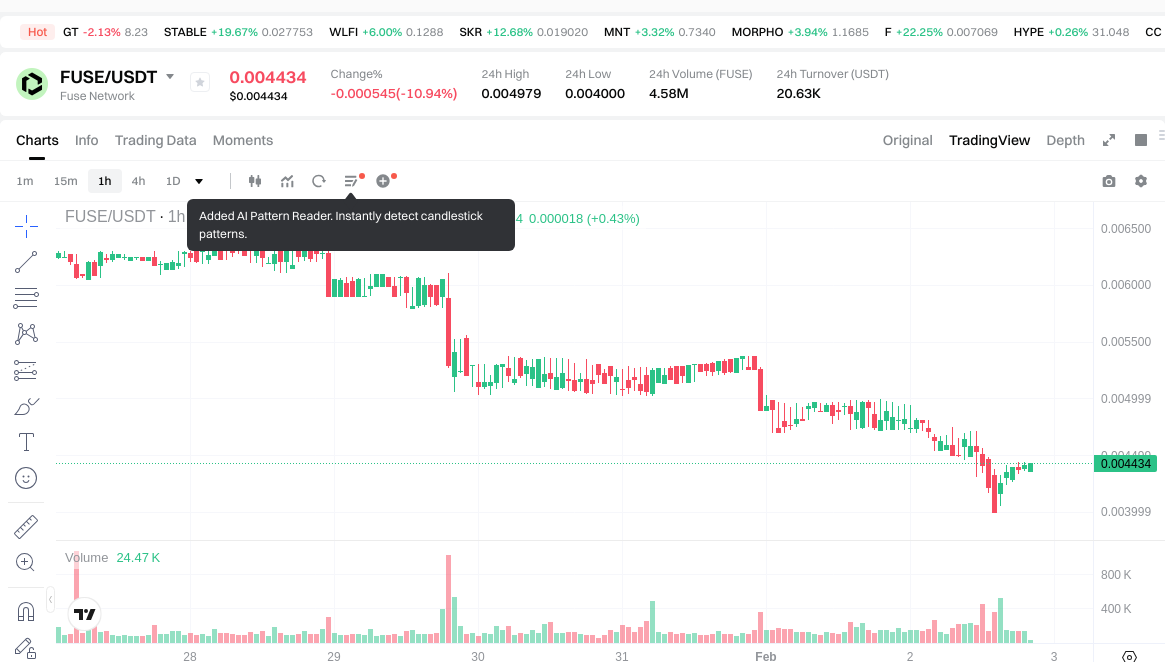
FUSE is a notable asset in the cryptocurrency sector, launched in 2019 with a focus on mobile payment solutions for communities worldwide. As of February 2026, Fuse Network holds a market capitalization of approximately $1.36 million, with a circulating supply of about 312.74 million tokens, and the current price stands around $0.00436. With its positioning as a platform enabling anyone to launch and manage payment networks through accessible tools, FUSE has gradually become a subject of discussion among investors exploring "Is Fuse Network (FUSE) a good investment?" This article provides a comprehensive analysis of FUSE's investment value, historical price movements, future price projections, and associated investment risks to offer reference insights for investors.
I. FUSE Price History and Current Investment Value
- 2021: Launch period with initial trading activity → Early investors experienced significant volatility as the project established market presence
- 2022: Market capitalization fluctuations amid broader crypto market corrections → Price movements reflected sector-wide sentiment shifts
- 2024-2025: Extended downward pressure → Trading patterns showed price compression from higher levels to current range without reaching extreme thresholds
Current FUSE Investment Market Status (February 2026)
- Current FUSE price: $0.00436
- 24-hour trading volume: $20,645.55
- Market capitalization: $1,363,567.44
- Circulating supply: 312,744,826.48 FUSE (80.32% of total supply)
- Fully diluted market cap: $1,697,623.07
Click to view real-time FUSE market price
II. Core Factors Influencing Whether FUSE is a Good Investment
Supply Mechanism and Scarcity (FUSE Investment Scarcity)
- FUSE employs an unlimited maximum supply mechanism (indicated by ∞), with a total supply of approximately 389.36 million tokens and a circulating supply of around 312.74 million tokens, representing a circulation ratio of approximately 80.32%.
- The unlimited supply structure may exert ongoing pressure on token scarcity, potentially influencing long-term price appreciation dynamics.
- For investors evaluating scarcity-driven value, the absence of a fixed supply cap represents a consideration that differs from deflationary or capped-supply crypto assets.
Institutional Investment and Mainstream Adoption (Institutional Investment in FUSE)
- Public data regarding institutional holdings or corporate adoption of FUSE remains limited in the provided materials.
- The project's holder count stands at approximately 3,125 addresses, while exchange availability is noted at two platforms.
- The current market capitalization of approximately $1.36 million and a market dominance of 0.000062% suggest relatively modest institutional participation compared to larger crypto assets.
Macroeconomic Environment's Impact on FUSE Investment
- Broader macroeconomic conditions—including monetary policy shifts, interest rate adjustments, and inflation trends—can influence investor appetite for alternative assets including smaller-cap tokens like FUSE.
- In environments characterized by heightened inflation or currency instability, certain crypto assets have historically attracted interest as potential hedging instruments, though FUSE's limited liquidity and market presence may affect its role in such strategies.
- Geopolitical uncertainties and regulatory developments in the crypto space may also impact investment sentiment toward emerging blockchain projects.
Technology and Ecosystem Development (Technology & Ecosystem for FUSE Investment)
- Fuse was established in 2019 with a mission to enable mobile payment capabilities for global communities through accessible and user-friendly tools.
- The project operates on its own blockchain infrastructure (Fuse Network) with an Ethereum-based ERC-20 token (contract address: 0x970b9bb2c0444f5e81e9d0efb84c8ccdcdcaf84d) also available.
- Long-term investment value may be influenced by the project's ability to expand its ecosystem, including potential applications in decentralized finance (DeFi), payment solutions, and community-driven economic networks, though specific ongoing technical upgrades or ecosystem partnerships were not detailed in the available materials.
III. FUSE Future Investment Forecast and Price Outlook (Is Fuse Network(FUSE) worth investing in 2026-2031)
Short-term Investment Forecast (2026, short-term FUSE investment outlook)
- Conservative Forecast: $0.00328116 - $0.004434
- Neutral Forecast: $0.004434 - $0.00523212
- Optimistic Forecast: $0.00523212 - $0.00603024
Mid-term Investment Outlook (2027-2028, mid-term Fuse Network(FUSE) investment forecast)
- Market Phase Expectation: During the mid-term period, FUSE may experience gradual recovery with potential price fluctuations reflecting broader market dynamics and ecosystem development progress.
- Investment Return Forecast:
- 2027: $0.0032962356 - $0.0077435376
- 2028: $0.003373670976 - $0.007590759696
- Key Catalysts: Ecosystem expansion, potential technological upgrades, and increased adoption of mobile payment solutions could serve as important drivers for price movement.
Long-term Investment Outlook (Is FUSE a good long-term investment?)
- Base Scenario: $0.007805169462182 - $0.008862119493519 (assuming steady ecosystem development and moderate market conditions)
- Optimistic Scenario: $0.008496252174979 - $0.011045127827473 (assuming enhanced adoption and favorable market environment)
- Risk Scenario: Below $0.003373670976 (under adverse market conditions or significant competitive pressure)
Click to view FUSE long-term investment and price forecast: Price Prediction
2026-02-02 - 2031 Long-term Outlook
- Base Scenario: $0.007805169462182 - $0.008862119493519 (corresponding to steady progress and gradual mainstream application enhancement)
- Optimistic Scenario: $0.008496252174979 - $0.011045127827473 (corresponding to large-scale adoption and favorable market conditions)
- Transformative Scenario: Above $0.011045127827473 (in case of breakthrough ecosystem developments and mainstream adoption)
- 2031-12-31 Forecast High: $0.011045127827473 (based on optimistic development assumptions)
Disclaimer: The above forecasts are for reference purposes only and do not constitute investment advice. Cryptocurrency markets are highly volatile, and actual prices may differ materially from predictions. Investors should conduct thorough research and consider their risk tolerance before making investment decisions.
| Year |
Predicted High Price |
Predicted Average Price |
Predicted Low Price |
Price Change |
| 2026 |
0.00603024 |
0.004434 |
0.00328116 |
1 |
| 2027 |
0.0077435376 |
0.00523212 |
0.0032962356 |
20 |
| 2028 |
0.007590759696 |
0.0064878288 |
0.003373670976 |
48 |
| 2029 |
0.00922147546488 |
0.007039294248 |
0.00436436243376 |
61 |
| 2030 |
0.008862119493519 |
0.00813038485644 |
0.007805169462182 |
86 |
| 2031 |
0.011045127827473 |
0.008496252174979 |
0.007816552000981 |
94 |
IV. FUSE Investment Strategy and Risk Management (How to invest in FUSE Network)
Investment Strategy (FUSE investment strategy)
Long-term Holding (HODL FUSE): Suitable for Conservative Investors
Long-term holding represents a passive investment approach that may be appropriate for investors seeking to minimize active management. This strategy involves acquiring FUSE tokens and maintaining positions over extended periods, potentially reducing exposure to short-term price fluctuations. Historical data indicates FUSE has experienced significant price movements, with the token trading at $0.00436 as of February 2, 2026, representing an 82.3% decline over the past year from previous levels.
Active Trading: Technical Analysis and Swing Trading
Active trading strategies involve regular position adjustments based on technical indicators and market analysis. FUSE has demonstrated notable volatility, with 24-hour price movements of -8.55% and weekly fluctuations of -30.45%. Traders employing this approach typically utilize chart patterns, volume analysis, and momentum indicators to identify potential entry and exit points. The token's 24-hour trading range between $0.004 and $0.004979 illustrates the intraday volatility that active traders may encounter.
Risk Management (Risk management for FUSE investment)
Asset Allocation Ratios: Conservative / Aggressive / Professional Investors
Asset allocation varies significantly based on investor risk tolerance and experience level. Conservative investors may consider limiting exposure to FUSE and similar assets to a small percentage of their overall portfolio. More aggressive investors might allocate higher proportions while maintaining diversification across multiple asset classes. Professional investors typically implement sophisticated allocation models that account for correlation, volatility, and portfolio optimization metrics.
Risk Hedging Solutions: Multi-asset Portfolio + Risk Management Tools
Diversification across multiple cryptocurrencies, traditional assets, and hedging instruments can help mitigate concentration risk. Given FUSE's market capitalization of approximately $1.36 million and its ranking at position 2,310, investors should be aware of liquidity considerations. Portfolio construction that includes assets with low correlation to FUSE may help reduce overall portfolio volatility.
Secure Storage: Hot and Cold Wallets + Hardware Wallet Recommendations
Proper storage of FUSE tokens is essential for asset security. FUSE exists as an ERC-20 token on the Ethereum network (contract address: 0x970b9bb2c0444f5e81e9d0efb84c8ccdcdcaf84d), which allows for storage in various Ethereum-compatible wallets. Cold storage solutions, including hardware wallets, provide enhanced security by keeping private keys offline. Hot wallets offer convenience for active trading but require additional security measures such as two-factor authentication and secure network connections.
V. FUSE Investment Risks and Challenges (Risks of investing in FUSE Network)
Market Risk: High Volatility and Price Dynamics
FUSE has exhibited substantial price volatility, with the token declining 82.3% over the past year and 40.30% over the past 30 days. The current price of $0.00436 represents a significant decrease from its historical high of $2.13 recorded on January 21, 2022. This level of volatility presents challenges for both short-term traders and long-term investors, requiring careful consideration of position sizing and risk tolerance.
Regulatory Risk: Policy Uncertainty Across Jurisdictions
The regulatory landscape for cryptocurrencies continues to evolve globally, with different jurisdictions implementing varying frameworks for digital assets. Changes in regulatory approaches, including potential restrictions on trading, taxation policies, or compliance requirements, may impact the accessibility and utility of FUSE tokens. Investors should monitor regulatory developments in their respective jurisdictions and assess how policy changes might affect their holdings.
Technical Risk: Network Security and Upgrade Considerations
As with any blockchain-based project, technical risks include potential vulnerabilities in smart contract code, network security issues, and challenges associated with protocol upgrades. While FUSE Network has an active development presence on GitHub and maintains blockchain infrastructure, investors should be aware that technical issues or failed upgrades could impact token functionality and value. The project's circulating supply of approximately 312.7 million tokens represents 80.32% of the total supply of 389.4 million, with ongoing token economics that warrant monitoring.
VI. Conclusion: Is FUSE Network a Good Investment?
Investment Value Summary: FUSE Network presents a high-risk investment opportunity characterized by significant price volatility and market uncertainty. The token has experienced substantial value decline over the past year, with limited trading volume of approximately $20,646 over 24 hours as of February 2, 2026. With a relatively small market capitalization and low exchange availability (listed on 2 exchanges), liquidity considerations are relevant for potential investors.
Investor Recommendations:
✅ Beginners: If considering exposure to FUSE, new investors should thoroughly research the project fundamentals, start with minimal allocation, utilize secure wallet storage solutions, and understand the risks associated with small-cap cryptocurrencies.
✅ Experienced Investors: Those with trading experience might evaluate FUSE within a broader portfolio context, employing risk management strategies such as position sizing limits, stop-loss mechanisms, and regular portfolio rebalancing.
✅ Institutional Investors: Institutions should conduct comprehensive due diligence including technical audits, regulatory compliance assessment, and liquidity analysis before considering any allocation to FUSE tokens.
⚠️ Disclaimer: Cryptocurrency investments carry substantial risk, including the potential loss of principal. This content is provided for informational purposes only and does not constitute investment advice, financial advice, trading advice, or recommendation to buy, sell, or hold any cryptocurrency. Investors should conduct their own research and consult with qualified financial advisors before making investment decisions.
VII. FAQ
Q1: What is FUSE Network and what problem does it aim to solve?
FUSE Network is a blockchain platform launched in 2019 that focuses on enabling mobile payment solutions for communities worldwide. The project allows anyone to launch and manage payment networks through accessible and user-friendly tools. FUSE operates on its own blockchain infrastructure while also maintaining an ERC-20 token on the Ethereum network (contract address: 0x970b9bb2c0444f5e81e9d0efb84c8ccdcdcaf84d). The platform specifically targets the challenge of providing decentralized, community-driven payment systems that are easy to implement and manage, particularly for mobile users seeking alternative financial infrastructure.
Q2: Why has FUSE's price declined significantly over the past year?
FUSE has experienced an 82.3% price decline over the past year, dropping from higher levels to its current price of approximately $0.00436 as of February 2, 2026. This substantial decrease reflects several factors including broader cryptocurrency market corrections, limited liquidity (24-hour trading volume of only $20,645.55), low market capitalization ($1.36 million), and restricted exchange availability (listed on only 2 exchanges). The token's market dominance of 0.000062% indicates minimal institutional participation compared to larger crypto assets. Additionally, the unlimited supply mechanism (approximately 312.74 million tokens in circulation from a total supply of 389.36 million) may create ongoing selling pressure that affects price stability.
Q3: How liquid is FUSE and what are the implications for investors?
FUSE demonstrates relatively low liquidity characteristics. The token's 24-hour trading volume stands at approximately $20,646, with availability on only 2 exchanges. This limited liquidity presents several implications for investors: difficulty executing large orders without significant price impact, wider bid-ask spreads that increase trading costs, potential challenges when attempting to exit positions quickly, and heightened vulnerability to price manipulation. The holder count of approximately 3,125 addresses further indicates a relatively small community of active participants. Investors should carefully consider these liquidity constraints when determining position sizes and may experience challenges converting holdings to cash during periods of market stress.
Q4: What is FUSE's tokenomics structure and how does it affect investment value?
FUSE employs an unlimited maximum supply mechanism, with a total supply of approximately 389.36 million tokens and a circulating supply of around 312.74 million tokens (80.32% circulation ratio). Unlike cryptocurrencies with fixed or deflationary supply caps, FUSE's unlimited supply structure creates potential ongoing pressure on token scarcity, which may influence long-term price appreciation dynamics. The current fully diluted market capitalization stands at approximately $1.69 million. This tokenomics model differs significantly from scarcity-driven assets like Bitcoin, and investors should evaluate whether the absence of a fixed supply cap aligns with their investment thesis regarding value accrual mechanisms in cryptocurrency assets.
Q5: What are the primary risks associated with investing in FUSE?
FUSE investment involves multiple risk categories: Market Risk includes extreme volatility (82.3% annual decline, 40.30% monthly decline) and a historical price drop from an all-time high of $2.13 to the current $0.00436. Liquidity Risk stems from low trading volumes and limited exchange availability, making position entry and exit challenging. Regulatory Risk encompasses evolving cryptocurrency regulations across jurisdictions that may affect accessibility and utility. Technical Risk includes potential smart contract vulnerabilities, network security concerns, and protocol upgrade challenges. Additionally, the small market capitalization ($1.36 million) and low market dominance (0.000062%) indicate heightened exposure to market manipulation and price volatility compared to established cryptocurrencies.
Q6: Is FUSE suitable as a long-term investment?
FUSE's suitability as a long-term investment depends heavily on individual risk tolerance and investment objectives. Long-term price forecasts suggest potential price ranges from a conservative $0.007805 to an optimistic $0.011045 by 2031, assuming favorable ecosystem development and market conditions. However, investors must weigh several factors: the token's significant historical price decline (82.3% annually), limited institutional adoption evidence, small market presence, and unlimited supply mechanism that may constrain value appreciation. Conservative investors might consider FUSE only as a minimal portfolio allocation within a diversified strategy, while the high-risk profile makes it generally unsuitable as a core long-term holding. Thorough due diligence regarding the project's technological development, adoption metrics, and competitive positioning is essential before considering any long-term commitment.
Q7: How can investors safely store FUSE tokens?
FUSE tokens can be stored using various security methods appropriate to different use cases. As an ERC-20 token on the Ethereum network, FUSE is compatible with Ethereum-supporting wallets. Cold storage solutions, particularly hardware wallets from reputable manufacturers, provide the highest security level by keeping private keys offline and isolated from internet-connected devices. For active traders, hot wallets offer convenience but require implementing additional security measures including two-factor authentication, strong password protocols, and secure network connections. Investors should avoid keeping significant holdings on exchanges due to counterparty risk, and should verify the correct contract address (0x970b9bb2c0444f5e81e9d0efb84c8ccdcdcaf84d) when adding FUSE to wallets to prevent phishing attempts or token substitution fraud.
Q8: What factors should investors monitor when evaluating FUSE's future prospects?
Investors should track several key indicators when assessing FUSE's investment potential: Ecosystem Development including new partnerships, technical upgrades, and expansion of payment network applications; Adoption Metrics such as growth in holder addresses (currently ~3,125), transaction volumes, and community engagement; Exchange Listings and liquidity improvements that could enhance accessibility; Development Activity through GitHub commits and roadmap execution; Competitive Positioning relative to other payment-focused blockchain projects; Market Conditions including broader cryptocurrency market trends and regulatory developments; and Tokenomics Changes such as supply adjustments or governance proposals. Regular monitoring of these factors can help investors make informed decisions about position management and risk assessment in this high-volatility asset.
* The information is not intended to be and does not constitute financial advice or any other recommendation of any sort offered or endorsed by Gate.