Heurist (HEU) is a decentralized AI-as-a-Service platform token operating on Base and zkSync Era networks, aggregating GPU computing resources to provide serverless AI infrastructure for developers. As of February 2026, HEU trades at $0.00724, down 89.2% from its December 2024 all-time high, reflecting significant early-stage volatility with a market cap of $1.42 million and limited liquidity of $40,885 daily volume. This comprehensive analysis examines investment fundamentals including price trends, technology architecture, supply mechanics with only 19.61% circulating supply, and market positioning across 4 exchanges with 47,505 holders. The article evaluates investment strategies for conservative, experienced, and institutional investors, alongside detailed risk assessment covering market volatility, regulatory uncertainty, and technical challenges inherent to early-stage infrastructure projects. Price forecasts range from $0.0071-$0.0171 through 2031 under various scenarios, with critical emphasis on the
Introduction: Heurist (HEU) Investment Position and Market Prospects
HEU is an asset in the cryptocurrency field. Since its launch in 2023, it has been developing in the decentralized AI service sector. As of February 2, 2026, Heurist has a market capitalization of approximately $1.42 million, with a circulating supply of about 196.09 million tokens, and the current price is around $0.00724. With its positioning as a decentralized AI-as-a-Service cloud platform, HEU has gradually become a point of discussion among investors when considering "Is Heurist (HEU) a good investment?" This article will comprehensively analyze the investment value, historical trends, future price forecasts, and investment risks of HEU to provide reference for investors.
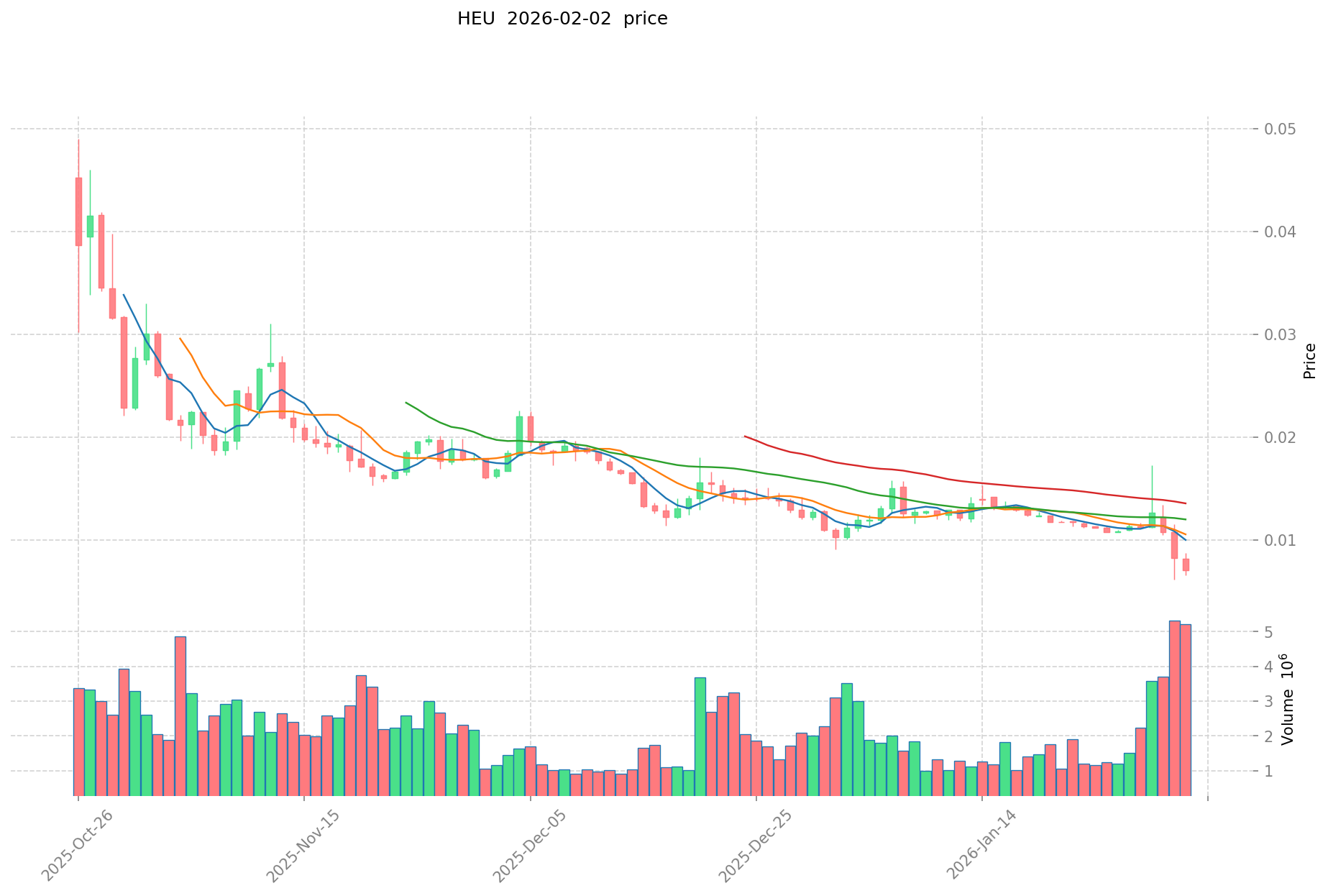
I. Heurist (HEU) Price History Review and Current Investment Value
- 2024: Token launch at $0.07 → Early adopters experienced initial volatility as the decentralized AI service platform entered the market
- December 2024: Platform milestone achievement → HEU price reached $0.462, reflecting growing interest in decentralized AI infrastructure
- 2025-2026: Market correction cycle → Price declined from December 2024 levels to $0.00724, representing significant retracement during broader crypto market adjustments
Current HEU Investment Market Status (February 2026)
- HEU Current Price: $0.00724
- Market Sentiment (Fear & Greed Index): Data not available in provided materials
- 24-Hour Trading Volume: $40,885.22
- Institutional Investor Holdings: Data not available in provided materials
Click to view real-time HEU market price
II. Core Factors Influencing Whether HEU is a Good Investment
Supply Mechanism and Scarcity (HEU investment scarcity)
- Total Supply: 1,000,000,000 HEU with a maximum supply cap of 1,000,000,000 HEU
- Current Circulating Supply: 196,088,747 HEU (approximately 19.61% of total supply)
- Market Cap to Fully Diluted Valuation Ratio: 19.61%, indicating substantial tokens remain unlocked
- Circulating supply represents less than one-fifth of total supply, suggesting future token releases may impact scarcity dynamics
- Investment Consideration: The gradual token release schedule and current circulation ratio are factors to consider when evaluating scarcity-based valuation
Institutional Investment and Mainstream Adoption (Institutional investment in HEU)
- Exchange Listings: Currently listed on 4 cryptocurrency exchanges
- Holder Base: 47,505 token holders as of February 2, 2026
- Platform Positioning: Operates as a decentralized AI-as-a-Service cloud platform aggregating compute resources from individual GPU owners and data centers
- Adoption Context: The project provides serverless AI services through API-first infrastructure for developers
- Market presence remains relatively modest compared to established cryptocurrencies, with limited exchange availability
Macroeconomic Environment's Impact on HEU Investment
- Price Performance Context: HEU has experienced notable volatility, with 24-hour decline of 9.95%, 7-day decline of 32.78%, and 30-day decline of 37.41%
- Market Position: Ranks #2,271 with market dominance of 0.00027%
- Trading Volume: 24-hour volume of $40,885.22
- Price Range: Trading at $0.00724 as of February 2, 2026, with recent fluctuations between $0.00657 (24h low) and $0.00872 (24h high)
- Broader market conditions and investor sentiment toward AI-related tokens may influence HEU's performance patterns
Technology and Ecosystem Development (Technology & Ecosystem for HEU investment)
- Core Technology: ERC-20 token standard implementation
- Multi-Chain Deployment: Contract addresses deployed on BASEEVM and ZKSERA networks
- Platform Infrastructure: API-first serverless AI infrastructure eliminating the need for developers to manage GPU machines directly
- Ecosystem Function: Aggregates computational resources to provide cost-efficient AI services for developers
- Application Focus: Enables censorship-free AI integration through standardized APIs
- The platform's technical framework supports decentralized AI service delivery, though the long-term adoption and competitive positioning within the AI infrastructure sector remain factors to monitor
III. HEU Future Investment Forecast and Price Outlook (Is Heurist(HEU) worth investing in 2026-2031)
Short-term Investment Forecast (2026, short-term HEU investment outlook)
- Conservative Forecast: $0.0056 - $0.0073
- Neutral Forecast: $0.0073 - $0.0087
- Optimistic Forecast: $0.0087 - $0.0094
Mid-term Investment Outlook (2027-2029, mid-term Heurist(HEU) investment forecast)
- Market Stage Expectation: The token may experience gradual growth as the decentralized AI-as-a-Service infrastructure continues to develop and attract developer adoption.
- Investment Return Forecast:
- 2027: $0.0075 - $0.0100
- 2028: $0.0088 - $0.0131
- 2029: $0.0068 - $0.0147
- Key Catalysts: Expansion of GPU resource aggregation, increased API adoption among developers, and broader integration of serverless AI services.
Long-term Investment Outlook (Is HEU a good long-term investment?)
- Baseline Scenario: $0.0071 - $0.0147 (assuming steady platform development and moderate adoption growth)
- Optimistic Scenario: $0.0147 - $0.0171 (assuming accelerated developer adoption and favorable market conditions for decentralized AI infrastructure)
- Risk Scenario: Below $0.0056 (in case of intense competition, regulatory challenges, or significant market downturns)
Click to view HEU long-term investment and price forecast: Price Prediction
2026-2031 Long-term Outlook
- Base Scenario: $0.0071 - $0.0149 (corresponding to steady progress and gradual mainstream application adoption)
- Optimistic Scenario: $0.0149 - $0.0171 (corresponding to large-scale adoption and favorable market environment)
- Transformative Scenario: Above $0.0171 (in case of breakthrough ecosystem developments and mainstream popularization)
- 2031-12-31 Predicted High: $0.0171 (based on optimistic development assumptions)
Disclaimer: Cryptocurrency price forecasts involve speculation about future values and are subject to significant uncertainty. These predictions are based on historical data, current trends, and analytical models, but actual prices may vary substantially due to market volatility, regulatory changes, technological developments, and other unpredictable factors. This information should not be construed as investment advice, and investors should conduct their own research and consider their risk tolerance before making any investment decisions.
| Year |
Predicted High Price |
Predicted Average Price |
Predicted Low Price |
Price Change |
| 2026 |
0.0094299 |
0.00731 |
0.0055556 |
0 |
| 2027 |
0.0099602405 |
0.00836995 |
0.007532955 |
15 |
| 2028 |
0.0131060862075 |
0.00916509525 |
0.00879849144 |
26 |
| 2029 |
0.01469897976195 |
0.01113559072875 |
0.006792710344537 |
53 |
| 2030 |
0.016792470818955 |
0.01291728524535 |
0.007104506884942 |
78 |
| 2031 |
0.017083109736975 |
0.014854878032152 |
0.009655670720899 |
105 |
IV. Heurist Investment Strategy and Risk Management (How to invest in Heurist)
Investment Methodology (Heurist investment strategy)
Long-term Holding (HODL Heurist)
For conservative investors considering Heurist (HEU), a long-term holding strategy may involve careful position sizing given the token's nascent stage and significant volatility. As of February 2, 2026, HEU trades at $0.00724, representing an 89.2% decline from its all-time high of $0.462 reached on December 28, 2024. The circulating supply stands at 196,088,747 tokens (19.61% of total supply), with a market capitalization of approximately $1.42 million.
Investors adopting a HODL approach should consider the project's fundamental value proposition as a decentralized AI-as-a-Service platform aggregating GPU compute resources. The token's utility within the Heurist ecosystem and the broader adoption trajectory of decentralized AI infrastructure may influence long-term value accrual.
Active Trading
Active traders may approach HEU through technical analysis and momentum-based strategies, given the token's pronounced price movements. Recent performance shows:
- 1-hour change: -0.94%
- 24-hour change: -9.95%
- 7-day change: -32.78%
- 30-day change: -37.41%
The 24-hour trading range of $0.00657 to $0.00872 indicates intraday volatility of approximately 32.7%, potentially creating opportunities for short-term traders. Daily trading volume of $40,885 suggests relatively limited liquidity, which traders should factor into execution strategies and potential slippage considerations.
Risk Management (Risk management for Heurist investment)
Asset Allocation Ratios
Conservative Investors: Given HEU's micro-cap status (market cap under $2 million) and significant volatility, conservative portfolios might limit exposure to 0.5-1% of total crypto holdings, or 0.1-0.25% of overall investment portfolio.
Aggressive Investors: Those with higher risk tolerance and conviction in decentralized AI infrastructure may allocate 3-5% of their crypto portfolio to HEU, while maintaining awareness of concentration risk.
Professional Investors: Institutional or professional participants might approach HEU as a venture-stage exposure within a diversified crypto infrastructure thesis, potentially allocating 1-3% within a specialized AI/compute sector basket.
Risk Hedging Strategies
Multi-asset Portfolio Construction: Investors may balance HEU exposure with:
- Established Layer-1 protocols (Bitcoin, Ethereum)
- Stable revenue-generating DeFi protocols
- Traditional market hedges (stablecoins, fixed income)
Volatility Management: Given HEU's 89.2% drawdown from ATH, investors might consider:
- Dollar-cost averaging to mitigate timing risk
- Position scaling based on technical support/resistance levels
- Correlation analysis with broader AI and GPU-related assets
Secure Storage Solutions
HEU is deployed as an ERC-20 token on Base (contract: 0xef22cb48b8483df6152e1423b19df5553bbd818b) and zkSync Era (contract: 0xabec5ecbe08b6c02f5c9a2ff82696e1e7db6f9bf).
Cold Storage Options:
- Hardware wallets supporting Base and zkSync Era networks (Ledger, Trezor)
- Multi-signature wallets for larger holdings
- Paper wallet generation for long-term storage
Hot Wallet Solutions:
- MetaMask or other Web3 wallets for active trading
- Exchange custody for short-term positions (noting counterparty risk)
- Mobile wallets with biometric security for moderate amounts
V. Heurist Investment Risks and Challenges (Risks of investing in Heurist)
Market Risk
High Volatility: HEU has demonstrated substantial price fluctuations, with a 32.78% decline over seven days and an 89.2% decrease from its all-time high over approximately one year. The token reached a historical low of $0.00613 on January 31, 2026, followed by an 18.1% recovery to current levels.
Limited Liquidity: With 24-hour trading volume of approximately $40,885 across 4 exchanges and a market cap of $1.42 million, HEU faces liquidity constraints that may amplify price impact during larger transactions.
Price Discovery Phase: Trading publicly since December 2024 (launch price: $0.07), HEU remains in early price discovery, with the fully diluted valuation of $7.24 million representing significant discount to initial valuation expectations.
Concentration Risk: Market cap to FDV ratio of 19.61% indicates that 80.39% of total supply remains unvested or undistributed, creating potential future selling pressure as tokens enter circulation.
Regulatory Risk
Jurisdictional Uncertainty: As a decentralized AI infrastructure project, Heurist operates at the intersection of cryptocurrency regulation and emerging AI governance frameworks. Different jurisdictions maintain varying approaches to:
- Classification of utility tokens versus securities
- AI service provider licensing requirements
- Cross-border compute resource aggregation
- Data privacy and AI output compliance
GPU Mining/Staking Considerations: Projects aggregating individual GPU resources may face scrutiny regarding:
- Know Your Customer (KYC) requirements for compute providers
- Tax treatment of GPU mining rewards
- Potential classification as unregistered securities offerings
Policy Evolution: The rapid development of AI regulation globally creates uncertainty for AI-focused crypto projects, as frameworks like the EU AI Act and various national AI strategies may impact operational parameters.
Technical Risk
Network Security: As a platform aggregating distributed GPU resources, Heurist faces technical challenges including:
- Validation of compute work authenticity
- Prevention of malicious node participation
- API infrastructure resilience and uptime
- Smart contract security on Base and zkSync Era deployments
Protocol Development: With approximately 47,505 token holders and relatively limited market penetration, the project's ability to execute its technical roadmap depends on:
- Developer community growth and retention
- Successful integration of AI models and services
- Competitive differentiation against centralized alternatives
- Network effect achievement in GPU provider recruitment
Integration Risks: The ERC-20 token deployment across Base and zkSync Era introduces:
- Cross-chain bridging vulnerabilities
- Liquidity fragmentation between chains
- Potential smart contract upgrade complications
Technology Obsolescence: The rapidly evolving AI infrastructure landscape presents risks that decentralized compute approaches may be superseded by more efficient centralized or alternative decentralized solutions.
VI. Conclusion: Is Heurist a Good Investment?
Investment Value Summary
Heurist (HEU) represents an early-stage exposure to decentralized AI infrastructure, targeting the intersection of GPU compute aggregation and censorship-resistant AI services. As of February 2, 2026, the token trades at $0.00724, down 89.2% from its December 2024 all-time high, reflecting significant price compression during its initial months of public trading.
The project's fundamental thesis—providing serverless, API-first AI services through distributed GPU resources—addresses potential market needs for cost-efficient and open AI infrastructure. However, the token faces substantial headwinds including limited liquidity ($40,885 daily volume), micro-cap market capitalization ($1.42 million), and a circulating supply representing only 19.61% of total token supply.
Short-term price action shows continued volatility, with 30-day performance down 37.41% and recent 7-day decline of 32.78%. This price behavior, combined with the token's historical low of $0.00613 reached on January 31, 2026, suggests ongoing price discovery and market uncertainty regarding valuation.
Investor Recommendations
✅ Novice Investors
Approach: Exercise extreme caution with micro-cap, high-volatility tokens
- Consider dollar-cost averaging with minimal allocation (0.1-0.5% of portfolio)
- Prioritize secure storage using hardware wallets compatible with Base or zkSync Era
- Avoid leverage or borrowed funds for HEU exposure
- Maintain long-term perspective given early project stage
✅ Experienced Investors
Approach: Tactical allocation within diversified crypto infrastructure thesis
- Potential for swing trading strategies capitalizing on high volatility (24-hour range: $0.00657-$0.00872)
- Portfolio weighting of 1-3% within crypto holdings, balanced against established assets
- Monitor on-chain metrics including holder growth (current: 47,505) and token unlock schedules
- Set clear risk parameters and stop-loss levels given liquidity constraints
✅ Institutional Investors
Approach: Venture-stage exposure within specialized AI/compute sector allocation
- Position as early-stage infrastructure investment with asymmetric risk/return profile
- Conduct thorough due diligence on team execution, technical architecture, and competitive landscape
- Consider direct project engagement or strategic partnership opportunities
- Implement robust custody solutions and compliance frameworks for Base/zkSync Era token holdings
⚠️ Disclaimer
Cryptocurrency investments carry substantial risk, including potential loss of principal. This analysis is provided for informational purposes only and does not constitute investment, financial, legal, or tax advice. Heurist (HEU) exhibits high volatility, limited liquidity, and early-stage project risks that may not be suitable for all investors. Past performance, including the 89.2% decline from all-time high, does not predict future results. Prospective investors should conduct independent research, assess personal risk tolerance, and consult qualified professionals before making investment decisions. The information presented reflects conditions as of February 2, 2026, and may change rapidly in volatile crypto markets.
VII. FAQ
Q1: What is Heurist (HEU) and how does it work?
Heurist (HEU) is an ERC-20 token powering a decentralized AI-as-a-Service cloud platform that aggregates GPU computing resources from individual owners and data centers. The platform provides serverless, API-first AI infrastructure that enables developers to access AI services without managing GPU hardware directly. Deployed on Base and zkSync Era networks, Heurist facilitates censorship-resistant AI integration through standardized APIs, allowing compute providers to monetize their GPU resources while developers access cost-efficient AI capabilities. With a total supply of 1 billion tokens and approximately 196 million in circulation (19.61%), HEU serves as the utility token within this decentralized compute ecosystem.
Q2: Is Heurist (HEU) a good investment in 2026?
Heurist presents a high-risk, early-stage investment opportunity with significant volatility. As of February 2026, HEU trades at $0.00724, down 89.2% from its December 2024 all-time high of $0.462. The token has a micro-cap market capitalization of $1.42 million, limited liquidity ($40,885 daily volume), and only 19.61% of total supply in circulation. While the decentralized AI infrastructure thesis has potential merit, investors should approach with extreme caution. Conservative portfolios might limit exposure to 0.5-1% of crypto holdings, while aggressive investors comfortable with venture-stage risk might allocate 3-5%. The token's suitability depends entirely on individual risk tolerance, investment horizon, and portfolio diversification strategy.
Q3: What are the main risks of investing in Heurist (HEU)?
Heurist carries substantial investment risks across multiple dimensions. Market risks include extreme volatility (32.78% decline over seven days), limited liquidity across only 4 exchanges, and concentration risk with 80.39% of tokens still unvested. Regulatory uncertainty exists at the intersection of cryptocurrency and AI governance, with potential scrutiny of GPU aggregation models and evolving AI compliance frameworks. Technical risks encompass smart contract security across Base and zkSync Era deployments, validation of compute work authenticity, and potential technology obsolescence in the rapidly evolving AI infrastructure landscape. Additionally, the project's early stage and limited market penetration (47,505 holders) create execution risk regarding team capability and competitive positioning.
Q4: What is the price prediction for Heurist (HEU) by 2031?
Price forecasts suggest gradual recovery potential under various scenarios. Conservative estimates for 2026 range from $0.0056 to $0.0094, with the current price of $0.00724 falling within this band. Mid-term forecasts project 2027 at $0.0075-$0.0100, 2028 at $0.0088-$0.0131, and 2029 at $0.0068-$0.0147. Long-term predictions for 2031 estimate a high of $0.0171, average of $0.0149, and low of $0.0096, representing potential 105% growth from current levels in the optimistic scenario. However, these projections are highly speculative and depend on successful platform adoption, favorable market conditions, and sustained project development. Cryptocurrency forecasts carry significant uncertainty and should not be construed as guaranteed outcomes.
Q5: How can I buy and securely store Heurist (HEU)?
Heurist is available on 4 cryptocurrency exchanges, though specific exchange names were not provided in the reference materials. To purchase HEU, investors should create accounts on supported exchanges, complete required KYC verification, deposit funds (typically stablecoins or major cryptocurrencies), and execute market or limit orders. For secure storage, since HEU is an ERC-20 token deployed on Base (contract: 0xef22cb48b8483df6152e1423b19df5553bbd818b) and zkSync Era (contract: 0xabec5ecbe08b6c02f5c9a2ff82696e1e7db6f9bf), investors should use hardware wallets supporting these networks (such as Ledger or Trezor), multi-signature wallets for larger holdings, or reputable Web3 wallets like MetaMask. Cold storage is recommended for long-term holdings, while hot wallets suit active trading with appropriate security measures including biometric authentication.
Q6: What makes Heurist different from other AI cryptocurrency projects?
Heurist differentiates itself through its decentralized GPU resource aggregation model and serverless AI infrastructure approach. Unlike centralized AI service providers, Heurist aggregates computing power from individual GPU owners and data centers, creating a distributed network for AI workloads. The API-first architecture eliminates the need for developers to manage GPU machines directly, providing standardized interfaces for AI service integration. The platform emphasizes censorship-resistant AI capabilities, operating on decentralized blockchain networks (Base and zkSync Era) rather than centralized cloud infrastructure. However, with a market cap of only $1.42 million and ranking #2,271 by market dominance (0.00027%), Heurist remains in its nascent stages compared to established blockchain or AI projects, requiring significant adoption growth to validate its competitive positioning.
Q7: What factors could drive Heurist (HEU) price growth in the future?
Several catalysts could positively influence HEU's valuation trajectory. Platform adoption metrics including growth in developer API usage, expansion of GPU provider network participation, and increased AI service requests would demonstrate product-market fit. Broader market trends favoring decentralized AI infrastructure and concerns about centralized AI censorship could drive interest in alternatives like Heurist. Token utility expansion through governance mechanisms, staking programs, or enhanced platform features might increase demand. Additional exchange listings would improve liquidity and accessibility for retail and institutional investors. Strategic partnerships with AI developers, GPU manufacturers, or blockchain ecosystems could accelerate adoption. However, these potential catalysts must overcome current challenges including the token's 89.2% decline from all-time high, limited market penetration, and intense competition in both decentralized compute and AI service sectors.
Q8: Should I hold Heurist long-term or trade it short-term?
The optimal strategy depends on individual investment objectives and risk tolerance. Long-term holding (HODL) may suit investors with conviction in the decentralized AI infrastructure thesis, willingness to weather significant volatility (89.2% drawdown from ATH), and patience for ecosystem development over multiple years. This approach aligns with the project's early stage and the 19.61% circulating supply suggesting gradual token unlocks. Short-term trading strategies may capitalize on pronounced volatility, with 24-hour price ranges of 32.7% ($0.00657-$0.00872) creating opportunities for momentum-based approaches. However, limited liquidity ($40,885 daily volume) presents execution challenges and slippage risk for larger positions. A blended approach might involve core long-term allocation with tactical trading of a smaller portion, though both strategies require robust risk management including position sizing appropriate to the token's micro-cap status and clear stop-loss parameters given liquidity constraints.
* The information is not intended to be and does not constitute financial advice or any other recommendation of any sort offered or endorsed by Gate.