This comprehensive analysis evaluates whether Hyperbot (BOT), an AI-powered on-chain contract trading terminal, represents a viable investment opportunity in the cryptocurrency ecosystem. Trading at $0.002257 with a market cap of $719,983 as of February 2026, BOT offers exposure to emerging decentralized trading infrastructure but carries substantial risks. The article examines BOT's historical price performance, supply mechanics, technology fundamentals, and regulatory considerations while providing price projections ranging from $0.0018 to $0.0052 through 2031 across conservative to optimistic scenarios. Risk management strategies tailored to different investor profiles—from beginners to institutions—emphasize portfolio allocation limits of 1-10%, diversification, and secure storage solutions. Despite potential growth catalysts from AI adoption and DeFi expansion, investors must recognize BOT's early-stage status, extreme volatility (20% weekly decline), limited liquidity on five exchanges, and technical ex
Introduction: Hyperbot (BOT) Investment Position and Market Outlook
Hyperbot (BOT) represents an emerging asset in the cryptocurrency sector, functioning as an AI-powered on-chain contract trading terminal. As of February 4, 2026, BOT maintains a market capitalization of approximately $719,983, with a circulating supply of 319,000,010 tokens and a current trading price around $0.002257. The token operates within the decentralized exchange and trading tools ecosystem, integrating multi-chain and multi-DEX data execution capabilities.
Designed to track smart money movements and whale activities across blockchain networks, Hyperbot combines real-time on-chain contract data with social signal detection and automated copy-trading systems. The platform aims to provide users with tools for identifying market signals and executing trades with enhanced speed and precision. With 7,870 token holders and availability on 5 exchanges, BOT has established a presence within specialized trading infrastructure.
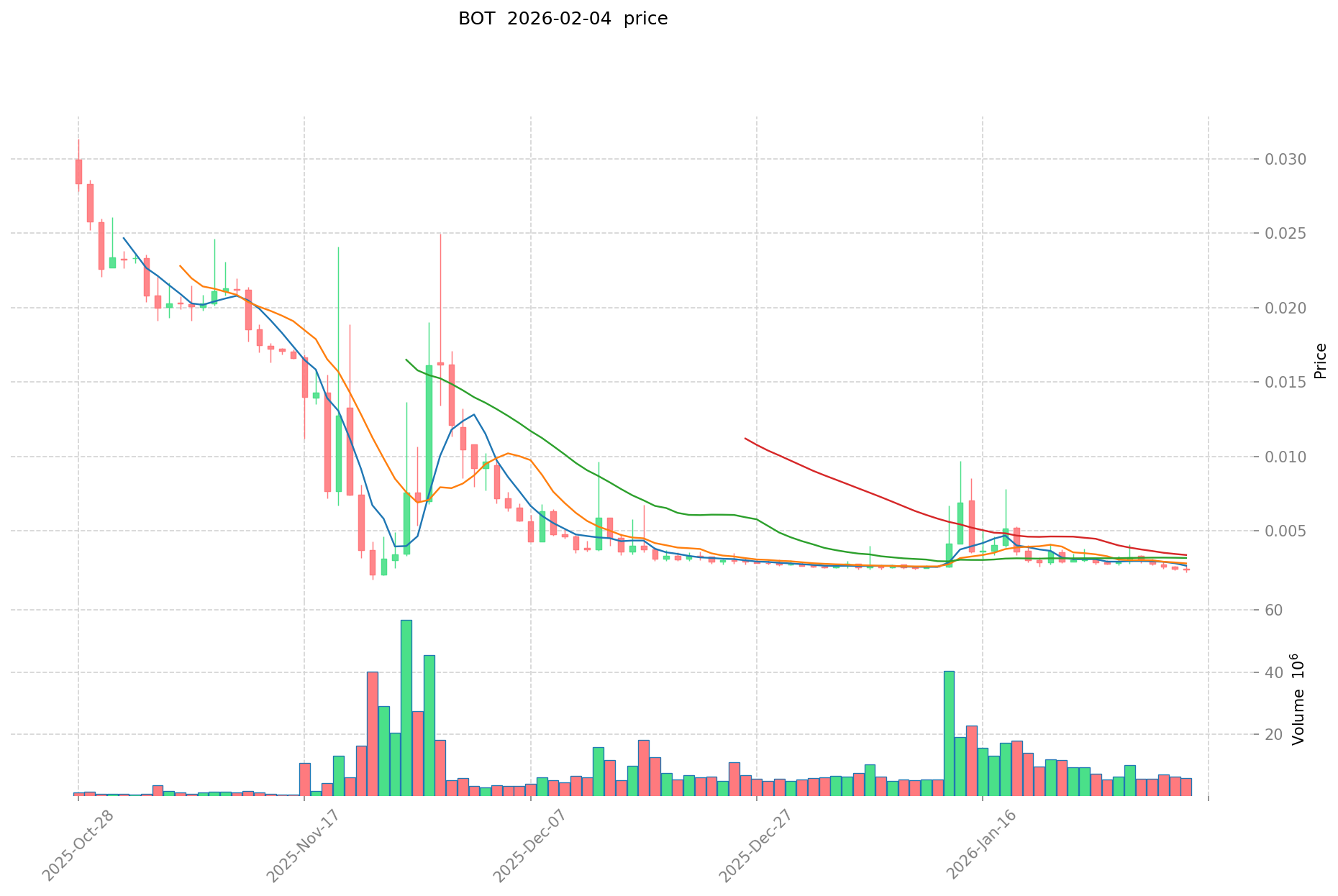
Recent price performance shows notable volatility, with movements of 1.83% over 1 hour, -11.14% over 24 hours, -20.01% over 7 days, and -13.53% over 30 days. The token's market dominance stands at 0.000083%, with a market cap to fully diluted valuation ratio of 31.9%. This article examines BOT's investment characteristics, historical price movements, future outlook considerations, and associated risks to provide analytical context for those evaluating "Is Hyperbot (BOT) a good investment?"
I. Hyperbot (BOT) Price History Review and Investment Value Status
- 2025: Launch and Initial Trading → BOT token commenced trading in January 2025, with initial market activity establishing baseline liquidity patterns
- 2025 September: Price Peak Period → BOT reached a notable price level of 0.18925 USD during market expansion phase
- 2025 November: Market Correction Phase → Price experienced downward adjustment to 0.001714 USD amid broader market volatility
Current BOT Investment Market Status (February 2026)
- BOT Current Price: 0.002257 USD
- Market Sentiment (Fear & Greed Index): Data reflects cautious positioning with recent 24-hour decline of 11.14%
- 24-Hour Trading Volume: 14,555.56 USD
- Circulating Supply: 319,000,010 BOT tokens (31.9% of maximum supply)
- Market Capitalization: Approximately 719,983 USD
- Holder Count: 7,870 addresses
Click to view real-time BOT market price
II. Core Factors Influencing Whether BOT is a Good Investment (Is Hyperbot(BOT) a Good Investment)
Supply Mechanism and Scarcity (BOT investment scarcity)
- Supply mechanism influences price and investment value
- BOT has a maximum supply of 1,000,000,000 tokens with a current circulating supply of 319,000,010 tokens, representing approximately 31.9% of the total supply
- The fixed maximum supply introduces a degree of scarcity that may support long-term investment considerations
- Investment significance: scarcity characteristics can be a factor supporting long-term investment evaluation
Institutional Investment and Mainstream Adoption (Institutional investment in BOT)
- Current holder count stands at 7,870 addresses, indicating a growing user base
- BOT is listed on 5 exchanges, including Gate.com, providing accessibility for investors
- The project integrates multi-chain and multi-DEX data with AI-driven trading execution, positioning itself within the growing copy-trading and on-chain analytics sector
- Adoption trends in AI-powered trading tools may influence investment potential
Macroeconomic Environment Impact on BOT Investment
- Broader cryptocurrency market conditions and monetary policy changes can affect investor appetite for digital assets
- Economic uncertainty may drive interest in decentralized trading solutions and AI-powered tools
- Regulatory developments in the cryptocurrency and DeFi sectors could impact investment attractiveness
Technology and Ecosystem Development (Technology & Ecosystem for BOT investment)
- Hyperbot integrates real-time on-chain contract data, social signal detection, and automated copy-trading systems
- The platform enables users to track smart money movements and whale behavior across multiple chains
- AI-driven analysis tools aim to provide speed and precision in executing on-chain trading opportunities
- Development of DeFi applications and trading infrastructure may provide long-term value support
- The project operates on BSC (BEP20 standard), benefiting from established blockchain infrastructure
III. BOT Future Investment Forecast and Price Outlook (Is Hyperbot(BOT) worth investing in 2026-2031)
Short-term Investment Outlook (2026, short-term BOT investment outlook)
Based on available price prediction data, the short-term outlook for Hyperbot (BOT) in 2026 suggests the following ranges:
- Conservative forecast: $0.0018296 - $0.002287
- Neutral forecast: Around $0.002287
- Optimistic forecast: Up to $0.00244709
The token shows a projected price change of approximately 1% for 2026, indicating relatively stable movement in the near term. Current market data shows BOT trading at $0.002257 as of February 4, 2026, with a 24-hour decline of 11.14% and a 7-day decline of 20.01%, suggesting recent downward pressure that may influence short-term performance.
Mid-term Investment Outlook (2027-2028, mid-term Hyperbot(BOT) investment forecast)
-
Market stage expectations: The mid-term period is anticipated to show moderate volatility with potential recovery patterns. The token may experience consolidation phases as the platform expands its AI-driven trading capabilities across multiple chains and DEXs.
-
Investment return forecasts:
- 2027: $0.00168060195 - $0.00338487435, with a projected price change of approximately 4%
- 2028: $0.00158177782125 - $0.00347991120675, with a potential increase reaching 27%
-
Key catalysts: Platform adoption rates, expansion of the AI-powered trading terminal ecosystem, integration with additional blockchain networks, and overall market sentiment toward AI-driven DeFi solutions.
Long-term Investment Outlook (Is BOT a good long-term investment?)
The long-term investment analysis for Hyperbot spans from 2029 to 2031, with projections showing potential growth trajectories:
- Base scenario: $0.002948647398815 - $0.004097471060692 (assuming steady platform development and moderate market conditions)
- Optimistic scenario: $0.003605774533409 - $0.005203788247079 (assuming accelerated adoption of AI trading tools and favorable market environment)
- Risk scenario: Below $0.002948647398815 (in cases of prolonged market downturns or reduced platform adoption)
View BOT long-term investment and price predictions: Price Forecast
2026-02-04 to 2031 Long-term Outlook
- Base scenario: $0.002948647398815 - $0.004097471060692 (corresponding to steady progress and gradual mainstream application enhancement)
- Optimistic scenario: $0.003605774533409 - $0.005203788247079 (corresponding to large-scale adoption and favorable market environment)
- Transformational scenario: Above $0.005203788247079 (in case of breakthrough developments in the ecosystem and mainstream proliferation)
- 2031-12-31 Forecast High: $0.005203788247079 (based on optimistic development assumptions)
Disclaimer: These projections are based on historical data analysis and current market trends. Cryptocurrency markets are highly volatile and subject to numerous unpredictable factors. Past performance does not guarantee future results. The forecasts provided should not be considered as financial advice, and investors should conduct their own research and risk assessment before making any investment decisions. Market conditions, regulatory changes, technological developments, and competitive dynamics may significantly impact actual outcomes.
| Year |
Predicted High Price |
Predicted Average Price |
Predicted Low Price |
Price Change |
| 2026 |
0.00244709 |
0.002287 |
0.0018296 |
1 |
| 2027 |
0.00338487435 |
0.002367045 |
0.00168060195 |
4 |
| 2028 |
0.00347991120675 |
0.002875959675 |
0.00158177782125 |
27 |
| 2029 |
0.004480888971633 |
0.003177935440875 |
0.002987259314422 |
40 |
| 2030 |
0.00436552991513 |
0.003829412206254 |
0.002948647398815 |
69 |
| 2031 |
0.005203788247079 |
0.004097471060692 |
0.003605774533409 |
81 |
IV. Hyperbot Investment Strategy and Risk Management (How to invest in Hyperbot)
Investment Methodology (Hyperbot investment strategy)
Long-term Holding (HODL Hyperbot)
For conservative investors seeking exposure to AI-driven trading infrastructure, a long-term holding approach may be considered. This strategy involves:
- Establishing positions during periods of market stability
- Monitoring technological developments and platform adoption metrics
- Reviewing portfolio allocations periodically based on project milestones
Active Trading Strategy
Traders employing technical analysis may consider:
- Monitoring price movements within the observed range between $0.002111 and $0.002651 (24-hour period as of February 4, 2026)
- Utilizing on-chain data and trading volume patterns ($14,555.56 in 24-hour volume)
- Implementing stop-loss mechanisms to manage downside exposure
Risk Management (Risk management for Hyperbot investment)
Asset Allocation Guidelines
- Conservative Investors: Limit exposure to 1-3% of total crypto portfolio given the token's early stage and market volatility
- Aggressive Investors: May allocate 5-10% while maintaining diversification across multiple asset classes
- Professional Investors: Consider strategic positioning based on comprehensive due diligence and risk assessment frameworks
Risk Hedging Approaches
- Portfolio Diversification: Combine BOT holdings with established cryptocurrencies and traditional assets
- Position Sizing: Implement graduated entry strategies rather than lump-sum investments
- Monitoring Mechanisms: Track holder count (7,870 holders as of latest data) and exchange listings (5 exchanges) as liquidity indicators
Secure Storage Solutions
- Hot Wallets: Suitable for active trading amounts only, with regular security audits
- Cold Storage: Hardware wallets recommended for long-term holdings (Ledger, Trezor, or similar devices)
- Multi-signature Wallets: Consider for institutional-grade security requirements
- Contract Verification: Always verify the official BSC contract address (0x59537849f2a119ec698c7aa6c6daadc40c398a25) before transactions
V. Hyperbot Investment Risks and Challenges (Risks of investing in Hyperbot)
Market Risks
- High Volatility: BOT experienced an 11.14% decline in 24 hours and a 20.01% decrease over 7 days as of February 4, 2026
- Price Fluctuations: The token has shown movement between historical levels, with trading activity concentrated on limited exchanges
- Liquidity Considerations: With a circulating market cap of approximately $719,983, liquidity may be limited during periods of high market stress
- Market Capitalization: The relatively modest market cap ranking (#2752) suggests exposure to higher price volatility compared to established cryptocurrencies
Regulatory Risks
- Jurisdictional Uncertainty: AI-driven trading platforms may face evolving regulatory frameworks across different jurisdictions
- Compliance Requirements: Future regulations regarding automated trading systems and AI applications in financial markets remain unclear
- Cross-border Operations: Multi-chain integration (as indicated by the platform's design) may encounter varying regulatory treatments
Technical Risks
- Smart Contract Vulnerabilities: As a BEP20 token on BSC, BOT relies on the security of its contract implementation
- Platform Dependencies: The project's functionality depends on multiple DEX integrations and blockchain networks
- Development Execution: Successful implementation of AI-driven features and trading algorithms requires ongoing technical development
- Network Security: Exposure to potential vulnerabilities in the underlying BSC infrastructure and connected platforms
VI. Conclusion: Is Hyperbot a Good Investment?
Investment Value Assessment
Hyperbot represents an emerging project in the AI-driven trading infrastructure space. The platform's focus on aggregating on-chain data and enabling intelligent copy trading addresses genuine market needs. However, several factors warrant careful consideration:
- The token has experienced notable price volatility, with a 20.01% decline over 7 days
- With 31.9% of maximum supply in circulation (319 million of 1 billion tokens), future supply dynamics merit attention
- The project's market position (#2752 ranking) indicates an early-stage status with corresponding risks
Investor Recommendations
✅ Beginner Investors:
- Consider dollar-cost averaging rather than large initial positions
- Prioritize secure storage using reputable hardware wallets
- Allocate only funds you can afford to lose entirely
- Research the platform's functionality and development progress before investing
✅ Experienced Investors:
- Employ technical analysis for potential entry and exit points
- Monitor on-chain metrics including holder distribution and transaction patterns
- Maintain portfolio diversification across multiple crypto assets and sectors
- Set predefined risk parameters and adhere to them consistently
✅ Institutional Investors:
- Conduct comprehensive due diligence on the project's technology and team
- Assess liquidity constraints given the current exchange availability (5 exchanges)
- Evaluate strategic allocation as part of a broader AI or DeFi infrastructure thesis
- Implement institutional-grade custody and risk management protocols
⚠️ Important Notice: Cryptocurrency investments involve substantial risk, including the potential loss of principal. Market conditions can change rapidly, and past performance does not indicate future results. This analysis is provided for informational purposes only and does not constitute financial advice, investment recommendation, or an offer to buy or sell securities. Readers should conduct independent research and consult qualified financial advisors before making investment decisions.
VII. FAQ
Q1: What is the current price and market capitalization of Hyperbot (BOT)?
As of February 4, 2026, Hyperbot (BOT) is trading at approximately $0.002257 with a market capitalization of around $719,983. The token has experienced significant volatility, with a 24-hour decline of 11.14% and a 7-day decrease of 20.01%. The circulating supply stands at 319,000,010 tokens, representing 31.9% of the maximum supply of 1 billion tokens. BOT ranks #2752 in market capitalization and maintains a 24-hour trading volume of $14,555.56 across 5 exchanges. The token's holder count has reached 7,870 addresses, indicating growing but still limited adoption in the market.
Q2: Is Hyperbot (BOT) a good long-term investment?
The long-term investment potential depends on multiple factors and risk tolerance levels. Projections suggest BOT could range from $0.002948 to $0.005204 by 2031 under various scenarios, representing potential returns of 81% in optimistic conditions. However, the token faces significant challenges: high volatility (20.01% weekly decline), limited liquidity with a modest market cap, early-stage development status, and concentration risk with only 5 exchange listings. Conservative investors might consider allocating 1-3% of their crypto portfolio, while aggressive investors could position 5-10%. The project operates in the emerging AI-driven trading infrastructure space, which presents both opportunities and uncertainties. Investors should conduct thorough due diligence and only invest funds they can afford to lose entirely.
Q3: What are the main risks associated with investing in Hyperbot (BOT)?
BOT investment carries substantial risks across multiple dimensions. Market risks include extreme volatility (11.14% daily decline observed), limited liquidity due to low market capitalization ($719,983), and concentration on only 5 exchanges. Technical risks involve smart contract vulnerabilities on the BSC network, platform dependencies on multiple DEX integrations, and execution risks related to AI-driven features. Regulatory risks stem from uncertain frameworks governing AI-powered trading platforms and cross-border operations across multiple blockchain networks. Additionally, with only 31.9% of tokens currently circulating, future supply releases could impact price dynamics. The project's early-stage status (#2752 ranking) amplifies these risks compared to established cryptocurrencies.
Q4: How should investors manage risks when investing in Hyperbot (BOT)?
Effective risk management requires a multi-layered approach tailored to investor profiles. For asset allocation, conservative investors should limit exposure to 1-3% of their total crypto portfolio, while aggressive investors might allocate 5-10% with proper diversification. Implement graduated entry strategies rather than lump-sum investments to mitigate timing risks. Use hardware wallets (Ledger, Trezor) for long-term holdings and verify the official BSC contract address (0x59537849f2a119ec698c7aa6c6daadc40c398a25) before transactions. Monitor key metrics including holder count, exchange listings, and trading volume as liquidity indicators. Set predefined stop-loss levels based on technical analysis and adhere to them consistently. Portfolio diversification across established cryptocurrencies and traditional assets helps mitigate concentration risk.
Q5: What factors could drive Hyperbot (BOT) price growth in the future?
Several catalysts could influence BOT's price trajectory. Technology development including successful implementation of AI-driven trading features, expansion of multi-chain integrations, and platform performance improvements could attract users. Adoption metrics such as increasing holder count (currently 7,870), growing trading volume, and additional exchange listings would enhance liquidity and accessibility. The broader DeFi and AI infrastructure sector's growth may provide tailwinds, particularly if copy-trading and on-chain analytics gain mainstream acceptance. Market conditions including favorable cryptocurrency sentiment and institutional interest in AI-powered trading tools could support valuations. However, these factors remain speculative, and price predictions ranging from $0.0018296 to $0.005204 by 2031 depend on numerous variables including competitive dynamics and regulatory developments.
Q6: What is Hyperbot's technology and how does it differentiate from competitors?
Hyperbot operates as an AI-powered on-chain contract trading terminal that integrates multi-chain and multi-DEX data execution capabilities. The platform combines real-time on-chain contract data with social signal detection and automated copy-trading systems, enabling users to track smart money movements and whale behavior across blockchain networks. Built on BSC (BEP20 standard), BOT aims to provide speed and precision in executing trading opportunities through AI-driven analysis tools. The differentiation lies in its focus on aggregating disparate data sources and automating trading execution based on identified patterns. However, the project operates in a competitive space with numerous trading infrastructure providers, and its success depends on delivering superior performance, reliability, and user experience compared to established alternatives.
Q7: How does Hyperbot's tokenomics structure affect investment value?
BOT's tokenomics features a maximum supply of 1 billion tokens with a current circulating supply of 319 million (31.9%), creating a supply structure that could impact long-term price dynamics. The fixed maximum supply introduces scarcity characteristics that may support value appreciation if demand increases. However, the substantial portion of uncirculated tokens (68.1%) represents potential future supply that could create selling pressure depending on release schedules and distribution mechanisms. The current market cap to fully diluted valuation ratio of 31.9% indicates significant dilution risk if all tokens enter circulation without proportional demand growth. The supply mechanism's impact on investment value depends on transparency regarding token release schedules, team holdings, and distribution plans, which investors should thoroughly investigate before committing capital.
Q8: What investment strategy is most suitable for Hyperbot (BOT)?
The appropriate strategy depends on investor profiles and objectives. For long-term holders (HODL strategy), establishing positions during market stability periods and monitoring technological developments and adoption metrics provides conservative exposure to AI-driven trading infrastructure. This approach suits investors allocating 1-3% of portfolios with multi-year time horizons. Active trading strategies involve technical analysis of price movements within observed ranges ($0.002111 to $0.002651 in recent 24-hour periods), utilizing on-chain data and volume patterns ($14,555.56 daily volume), and implementing stop-loss mechanisms for downside protection. This suits experienced traders comfortable with volatility and willing to monitor positions actively. Institutional approaches require comprehensive due diligence, strategic positioning within broader AI or DeFi infrastructure theses, and institutional-grade custody solutions. Regardless of strategy, dollar-cost averaging mitigates timing risks better than lump-sum investments given BOT's volatility profile.
* The information is not intended to be and does not constitute financial advice or any other recommendation of any sort offered or endorsed by Gate.