IRISnet (IRIS) is a BPoS cross-chain service hub designed to bridge digital and traditional economies through blockchain interoperability. As of February 2026, IRIS trades at $0.0005772 with a market cap of $942,510, representing a 75.91% annual decline from its peak. This comprehensive analysis examines IRIS's investment potential by evaluating its price history, technical architecture, supply mechanics, and market outlook through 2031. The article addresses key investment considerations including long-term growth scenarios ranging from $0.000539 to $0.001098, alongside substantial risks including market volatility, limited liquidity ($13,970 daily volume on Gate), and regulatory uncertainty. Investors receive tailored strategies for different risk profiles—from conservative dollar-cost averaging to active trading—plus detailed risk management guidance and FAQ addressing suitability for various investor types in the specialized blockchain infrastructure sector.
Introduction: IRISnet (IRIS) Investment Status and Market Outlook
IRIS is a cryptocurrency asset in the digital economy sector. Launched in 2019, it has been developing its cross-chain service infrastructure. As of February 2026, IRIS has a market capitalization of approximately $942,509.78, with a circulating supply of around 1,632,899,833.09 tokens, and the current price stands at approximately $0.0005772. Named after the Greek goddess of the rainbow, IRISnet positions itself as a self-evolving BPoS cross-chain service hub developed in collaboration between Bianjie AI and Tendermint team. The project aims to serve as a bridge linking digital and real economies by supporting seamless integration across public chains, consortium chains, and traditional business systems. As investors evaluate "Is IRISnet (IRIS) a good investment?", this article provides a comprehensive analysis of IRIS's investment characteristics, historical performance, future price outlook, and associated risks for reference purposes.
I. IRIS Price History Review and Current Investment Value
- 2021: Significant price volatility observed → IRIS reached notable price levels during this period, reflecting market-wide cryptocurrency movements
- Historical peak period: Price approached upper ranges in early phases → Market enthusiasm drove valuation increases
- Recent period (2025-2026): Substantial price correction occurred → From higher valuation levels to current trading range, reflecting broader market adjustments
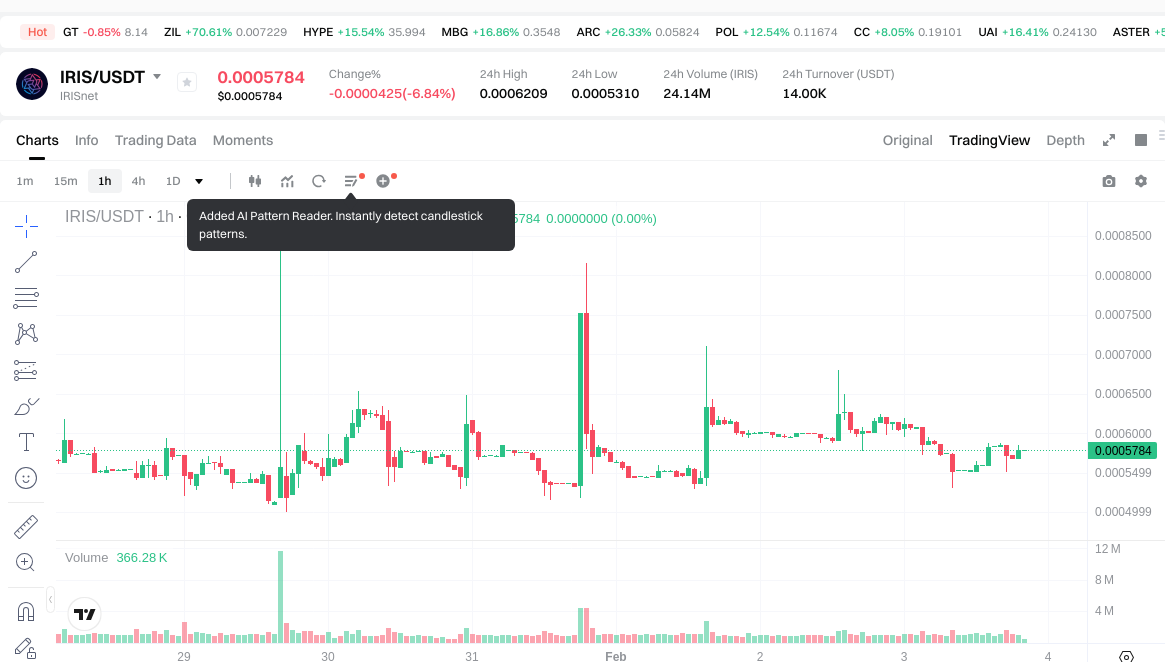
Current IRIS Investment Market Status (February 2026)
- IRIS current price: $0.0005772
- Market sentiment (Fear & Greed Index): Data indicates cautious market positioning
- 24-hour trading volume: $13,970.27
- Market capitalization: $942,509.78
- Circulating supply: 1,632,899,833 IRIS (81.89% of total supply)
- Price changes: +1.73% (1H), -6.64% (24H), +2.13% (7D), -23.04% (30D), -75.91% (1Y)
Click to view real-time IRIS market price
Investment Value Assessment Context
IRISnet positions itself as a cross-chain service hub aimed at bridging digital and real-world economies. The project, developed in collaboration between Bianjie AI and the Tendermint team, supports seamless integration across public chains, consortium chains, and traditional business systems. Current market performance reflects broader cryptocurrency sector trends, with price levels substantially below previous peaks. Investment considerations should account for the project's technical positioning in blockchain infrastructure, cross-chain interoperability focus, and current market liquidity levels. The relatively low trading volume and market capitalization suggest limited institutional participation at present levels.
II. Core Factors Affecting Whether IRIS is a Good Investment
Supply Mechanism and Scarcity (IRIS investment scarcity)
- IRISnet operates with a circulating supply of 1,632,899,833 IRIS tokens and a total supply of 1,993,957,077 tokens, representing approximately 81.89% of the total supply currently in circulation. The maximum supply is indicated as infinite (∞), suggesting an uncapped supply model that may influence long-term scarcity dynamics.
- The unlimited maximum supply structure presents different considerations compared to fixed-supply crypto assets, as ongoing token emission could potentially affect price dynamics over extended periods. The current market capitalization to fully diluted valuation ratio stands at 81.89%, reflecting the proportion of tokens already circulating in the market.
- Investment consideration: The supply mechanism represents a fundamental aspect when evaluating the asset's long-term characteristics, as unlimited supply models may exhibit different behavior patterns compared to capped-supply alternatives.
Institutional Investment and Mainstream Adoption (Institutional investment in IRIS)
- IRISnet maintains trading availability on one exchange platform as of February 2026, with a 24-hour trading volume of $13,970.27.
- The project positions itself as a cross-chain service hub developed through collaboration between Bianjie Intelligence and Tendermint teams, targeting seamless integration between public chains, consortium chains, and traditional business systems to enable cross-chain service invocation.
- The network aims to serve as infrastructure connecting digital and traditional economies, supporting complex distributed business applications through its BPoS (Bonded Proof of Stake) consensus mechanism.
Macroeconomic Environment Impact on IRIS Investment
- The broader cryptocurrency market conditions and regulatory developments in various jurisdictions continue to influence investor sentiment toward blockchain infrastructure projects.
- Price volatility remains a characteristic feature, with IRIS experiencing fluctuations across different timeframes: +1.73% (1H), -6.64% (24H), +2.13% (7D), -23.04% (30D), and -75.91% (1Y) as of February 3, 2026.
- Market uncertainty and changing economic conditions may affect capital allocation decisions across different asset classes, including blockchain-based projects.
Technology and Ecosystem Development (Technology & Ecosystem for IRIS investment)
- IRISnet's technical architecture focuses on cross-chain interoperability, enabling data and computational resources to communicate across heterogeneous networks.
- The platform supports service-oriented architecture, allowing for cross-chain service invocation between different blockchain networks and traditional systems.
- The project's positioning as a BPoS cross-chain service hub reflects its technical approach to addressing interoperability challenges in distributed ledger ecosystems.
III. IRIS Future Investment Forecast and Price Outlook (Is IRISnet(IRIS) worth investing in 2026-2031)
Short-term Investment Forecast (2026, short-term IRIS investment outlook)
- Conservative forecast: $0.000509 - $0.000578
- Neutral forecast: $0.000578 - $0.000688
- Optimistic forecast: $0.000688 - $0.000798
Mid-term Investment Outlook (2027-2029, mid-term IRISnet(IRIS) investment forecast)
- Market phase expectation: The token may experience modest growth phases interspersed with consolidation periods, reflecting ongoing ecosystem development and market adoption trends.
- Investment return forecast:
- 2027: $0.000385 - $0.000936
- 2028: $0.000707 - $0.000845
- 2029: $0.000439 - $0.000978
- Key catalysts: Expansion of cross-chain service capabilities, strategic partnerships within the distributed business application sector, and improvements in network governance mechanisms.
Long-term Investment Outlook (Is IRIS a good long-term investment?)
- Base scenario: $0.000539 - $0.001098 (assuming steady ecosystem growth and moderate network adoption)
- Optimistic scenario: $0.000813 - $0.001093 (assuming accelerated cross-chain integration and broader enterprise adoption)
- Risk scenario: $0.000385 - $0.000707 (assuming market headwinds or slower-than-expected adoption)
Click to view IRIS long-term investment and price forecast: Price Prediction
2026-02-03 - 2031 Long-term Outlook
- Base scenario: $0.000539 - $0.001098 (corresponding to steady progress and gradual mainstream application growth)
- Optimistic scenario: $0.000813 - $0.001093 (corresponding to large-scale adoption and favorable market conditions)
- Transformative scenario: Above $0.001098 (in case of breakthrough ecosystem developments and mainstream proliferation)
- 2031-12-31 forecast high: $0.001098 (based on optimistic development assumptions)
Disclaimer: The above forecasts are based on historical data and market analysis models and do not constitute investment advice. Cryptocurrency markets are highly volatile, and actual outcomes may differ materially from predictions.
| Year |
Predicted High Price |
Predicted Average Price |
Predicted Low Price |
Price Change |
| 2026 |
0.000798192 |
0.0005784 |
0.000508992 |
0 |
| 2027 |
0.00093608256 |
0.000688296 |
0.00038544576 |
19 |
| 2028 |
0.0008446768512 |
0.00081218928 |
0.0007066046736 |
40 |
| 2029 |
0.000977551017408 |
0.0008284330656 |
0.000439069524768 |
43 |
| 2030 |
0.001092620370219 |
0.000902992041504 |
0.000812692837353 |
56 |
| 2031 |
0.001097586826448 |
0.000997806205861 |
0.000538815351165 |
72 |
IV. IRIS Investment Strategy and Risk Management (How to invest in IRIS)
Investment Strategy (IRIS investment strategy)
Long-term Holding (HODL IRIS)
Long-term holding represents a conservative approach suitable for investors seeking to minimize trading frequency and transaction costs. This strategy involves acquiring IRIS tokens and maintaining positions through market cycles, based on confidence in the project's fundamental value proposition as a cross-chain service infrastructure.
Given IRIS's positioning as a bridge between digital and traditional economies, long-term investors may focus on the network's development milestones, ecosystem expansion, and adoption metrics rather than short-term price movements. However, investors should note that IRIS has experienced considerable price depreciation, with a 75.91% decline over the past year as of February 3, 2026.
Active Trading
Active trading strategies rely on technical analysis and swing trading techniques to capitalize on IRIS's price volatility. With a 24-hour price fluctuation ranging from $0.000531 to $0.0006209, traders may identify potential entry and exit points based on support and resistance levels.
Traders should monitor key technical indicators, volume patterns, and broader cryptocurrency market trends. The token's 24-hour trading volume of approximately $13,970 suggests relatively limited liquidity, which may impact execution of larger orders and increase slippage risks.
Risk Management (Risk management for IRIS investment)
Asset Allocation Ratios
Conservative Investors: May allocate 1-3% of their cryptocurrency portfolio to IRIS, prioritizing established assets with higher market capitalization and liquidity.
Moderate Investors: Could consider a 3-7% allocation, balancing exposure to infrastructure projects with more stable crypto assets.
Aggressive Investors: Might allocate 7-15% or more, accepting higher volatility in exchange for potential upside from specialized blockchain infrastructure projects.
These allocation suggestions assume IRIS represents a portion of a diversified cryptocurrency portfolio, which itself should constitute an appropriate percentage of overall investment assets based on individual risk tolerance.
Risk Hedging Solutions
Diversification across multiple asset classes can help mitigate IRIS-specific risks. Investors may consider combining IRIS holdings with:
- Established cryptocurrencies with higher market capitalization
- Tokens from different blockchain ecosystems and use cases
- Traditional financial instruments for overall portfolio balance
Given IRIS's correlation with broader cryptocurrency market movements, investors might also monitor Bitcoin and Ethereum trends as leading indicators for potential sector-wide volatility.
Secure Storage
Cold Wallets: For long-term holdings, cold storage solutions provide enhanced security by keeping private keys offline and isolated from internet-connected devices. Hardware wallets from established manufacturers offer robust protection against remote attacks.
Hot Wallets: For active traders requiring frequent access, hot wallets provide convenience but require additional security measures including two-factor authentication, strong passwords, and regular security audits.
Hardware Wallet Recommendations: Investors should research reputable hardware wallet providers that support IRIS tokens, ensuring compatibility before transferring assets. Regular firmware updates and proper backup procedures for recovery phrases are essential security practices.
V. IRIS Investment Risks and Challenges (Risks of investing in IRIS)
Market Risk
High Volatility: IRIS exhibits considerable price fluctuations, with a 6.64% decline in 24 hours and a 23.04% decrease over 30 days as of February 3, 2026. The token's price currently stands at $0.0005772, representing a significant decline from its all-time high of $0.299467 recorded on April 12, 2021.
The token's relatively low trading volume of approximately $13,970 over 24 hours and limited exchange availability (listed on 1 exchange) may contribute to price volatility and reduced liquidity. These factors can amplify price swings during periods of increased buying or selling pressure.
Market Capitalization Considerations: With a market capitalization of approximately $942,510 and a market dominance of 0.000041%, IRIS represents a smaller-cap cryptocurrency asset. Lower market capitalization tokens may experience heightened volatility and liquidity challenges compared to more established cryptocurrencies.
Regulatory Risk
Cryptocurrency regulatory frameworks vary significantly across jurisdictions and continue to evolve. Changes in regulatory approaches toward blockchain infrastructure projects, cross-chain services, or cryptocurrency assets generally could impact IRIS's operational environment and adoption prospects.
Investors should monitor regulatory developments in key markets and assess how potential policy changes might affect cross-chain service platforms. Different countries may adopt varying stances on blockchain interoperability solutions, creating an uncertain regulatory landscape for projects like IRISnet.
Technical Risk
Network Security: As a blockchain infrastructure project facilitating cross-chain services, IRISnet's security architecture plays a critical role in protecting user assets and maintaining network integrity. Potential vulnerabilities in smart contracts, consensus mechanisms, or cross-chain bridges could expose the network to security incidents.
Upgrade Implementation: The evolution of blockchain protocols often requires network upgrades and hard forks. Implementation challenges, community disagreements over upgrade directions, or technical issues during deployment could temporarily disrupt network operations or create uncertainty among stakeholders.
Interoperability Complexity: IRISnet's design supports integration across public blockchains, consortium chains, and traditional business systems. The technical complexity of maintaining secure and efficient cross-chain communications introduces potential points of failure that could affect service reliability.
VI. Conclusion: Is IRIS a Good Investment?
Investment Value Summary
IRIS presents a specialized investment opportunity within the blockchain infrastructure sector, focusing on cross-chain service capabilities and interoperability between diverse network types. The project's technical approach addresses challenges in connecting digital and traditional economic systems through its BPoS (Bonded Proof of Stake) framework.
However, the token's recent performance indicates significant challenges, with a 75.91% price decline over one year and substantial distance from its all-time high. The relatively low trading volume and limited exchange availability suggest constrained liquidity conditions. The market capitalization of approximately $942,510 and minimal market dominance reflect IRIS's position as a smaller-cap cryptocurrency asset.
Investors should carefully evaluate their risk tolerance and investment objectives when considering IRIS exposure, recognizing both the potential opportunities in cross-chain infrastructure and the substantial volatility and performance challenges evident in recent price trends.
Investor Recommendations
✅ Beginners: Consider dollar-cost averaging strategies combined with secure wallet storage. New investors should prioritize understanding the project's technology, use cases, and competitive landscape before committing capital. Given IRIS's volatility and limited liquidity, beginners might start with smaller position sizes to gain exposure while managing risk.
✅ Experienced Investors: May explore swing trading approaches leveraging technical analysis, while maintaining diversified portfolio allocation across multiple blockchain infrastructure projects. Experienced traders should account for liquidity constraints when planning position sizes and exit strategies.
✅ Institutional Investors: Strategic long-term allocation may focus on the broader cross-chain infrastructure thesis rather than IRIS specifically, potentially including multiple projects addressing interoperability challenges. Institutional participants should conduct comprehensive due diligence on technical architecture, development progress, and ecosystem partnerships.
⚠️ Important Notice: Cryptocurrency investments carry substantial risk, including potential total loss of capital. This analysis provides informational content only and does not constitute investment advice. Investors should conduct independent research, consider their financial situation and risk tolerance, and consult with qualified financial advisors before making investment decisions. Past performance does not indicate future results, and the cryptocurrency market remains highly unpredictable.
VII. FAQ
Q1: What is IRISnet (IRIS) and what makes it different from other blockchain projects?
IRISnet is a BPoS (Bonded Proof of Stake) cross-chain service hub developed in collaboration between Bianjie AI and the Tendermint team, designed to bridge digital and traditional economies through blockchain interoperability. Unlike many blockchain projects focused solely on cryptocurrency transactions, IRISnet positions itself as infrastructure enabling seamless integration across public blockchains, consortium chains, and traditional business systems. The project's service-oriented architecture allows for cross-chain service invocation, facilitating data and computational resource communication across heterogeneous networks. Named after the Greek goddess of the rainbow, IRISnet aims to serve as a connecting bridge in the distributed economy ecosystem.
Q2: Is IRIS a good investment for beginners in 2026?
For beginners, IRIS represents a high-risk, high-volatility investment opportunity that requires careful consideration. The token has experienced significant price depreciation, declining 75.91% over the past year and trading at $0.0005772 as of February 2026, substantially below its all-time high of $0.299467. With a relatively small market capitalization of approximately $942,510 and limited trading volume of $13,970 over 24 hours, IRIS presents liquidity challenges and amplified volatility. Beginners considering IRIS should start with small position sizes (1-3% of cryptocurrency portfolio), employ dollar-cost averaging strategies, and prioritize understanding the project's cross-chain technology and competitive landscape before committing capital. Secure storage in hardware wallets is essential for protecting any IRIS holdings.
Q3: What factors affect the price of IRIS tokens?
IRIS token price is influenced by multiple interconnected factors. Supply dynamics play a role, with 1.63 billion tokens currently circulating (81.89% of total supply) and an unlimited maximum supply that may affect long-term scarcity considerations. Market sentiment and broader cryptocurrency trends significantly impact IRIS, as evidenced by its correlation with general crypto market movements. Technical development progress, including improvements to cross-chain service capabilities and network upgrades, can influence investor confidence. Exchange availability and trading volume—currently limited to one exchange with modest daily volume—affect liquidity and price discovery. Regulatory developments regarding blockchain infrastructure and cross-chain services across different jurisdictions also contribute to price dynamics. Additionally, competitive pressures from other interoperability projects and adoption rates of IRISnet's cross-chain services by enterprises and developers impact long-term valuation prospects.
Q4: What is the price forecast for IRIS from 2026 to 2031?
Price forecasts for IRIS vary based on different scenarios and market conditions. For 2026, conservative estimates range from $0.000509 to $0.000578, neutral forecasts suggest $0.000578 to $0.000688, and optimistic scenarios project $0.000688 to $0.000798. Mid-term projections anticipate gradual growth with consolidation periods: 2027 ($0.000385 - $0.000936), 2028 ($0.000707 - $0.000845), and 2029 ($0.000439 - $0.000978). Long-term outlook through 2031 presents three scenarios: base case ($0.000539 - $0.001098), optimistic case ($0.000813 - $0.001093), and risk case ($0.000385 - $0.000707). These forecasts assume various factors including ecosystem development, cross-chain adoption rates, and market conditions. However, investors should recognize that cryptocurrency markets remain highly unpredictable, and actual outcomes may differ materially from these projections based on historical data and analysis models.
Q5: What are the main risks of investing in IRIS?
IRIS investment carries substantial risks across multiple dimensions. Market risk manifests through high volatility, with 24-hour fluctuations and a 75.91% annual decline, compounded by limited liquidity from low trading volume ($13,970 daily) and availability on only one exchange. The token's small market capitalization ($942,510) and minimal market dominance (0.000041%) amplify price sensitivity to buying and selling pressure. Regulatory risk stems from evolving and inconsistent cryptocurrency frameworks across jurisdictions, potentially affecting cross-chain service platforms differently in various markets. Technical risks include network security vulnerabilities in smart contracts, consensus mechanisms, or cross-chain bridges; potential complications during protocol upgrades or hard forks; and the inherent complexity of maintaining secure interoperability across diverse blockchain networks and traditional systems. The unlimited maximum supply model may also affect long-term scarcity dynamics compared to fixed-supply alternatives. Investors should carefully assess their risk tolerance and consider these factors alongside potential total loss of capital when evaluating IRIS exposure.
Q6: How should I store IRIS tokens securely?
Secure storage of IRIS tokens depends on investment timeframe and usage requirements. For long-term holders (HODLers), cold storage solutions provide optimal security by keeping private keys offline and isolated from internet-connected devices. Hardware wallets from reputable manufacturers offer robust protection against remote attacks, hacking attempts, and malware. Before transferring IRIS tokens, investors should verify hardware wallet compatibility and ensure devices are purchased directly from official sources. Regular firmware updates and proper backup procedures for recovery phrases are critical security practices. For active traders requiring frequent access, hot wallets provide convenience but necessitate additional security measures including two-factor authentication (2FA), strong unique passwords, and regular security audits. Regardless of storage method, investors should never share private keys or recovery phrases, implement strong password management, maintain up-to-date antivirus software, and be vigilant against phishing attempts targeting cryptocurrency holders.
Q7: What investment strategy is most suitable for IRIS?
The appropriate IRIS investment strategy depends on individual risk tolerance, investment timeframe, and market expertise. Long-term holding (HODL) suits conservative investors seeking to minimize trading frequency and transaction costs, focusing on IRISnet's fundamental value proposition as cross-chain infrastructure rather than short-term price movements. This approach requires patience through market cycles and confidence in the project's ecosystem development, though investors should acknowledge the token's 75.91% annual decline. Active trading strategies leverage IRIS's price volatility through technical analysis and swing trading, capitalizing on short-term fluctuations within the $0.000531 to $0.0006209 daily range. However, limited liquidity may increase slippage risks for larger orders. Asset allocation should reflect risk profile: conservative investors might allocate 1-3% of their cryptocurrency portfolio to IRIS, moderate investors 3-7%, and aggressive investors 7-15% or more. Diversification across multiple blockchain projects and asset classes helps mitigate IRIS-specific risks. Dollar-cost averaging can reduce timing risk for both strategies. All investors should monitor project development milestones, ecosystem partnerships, and broader cryptocurrency market trends when adjusting positions.
Q8: How does IRISnet's unlimited supply affect its investment potential?
IRISnet's unlimited maximum supply structure represents a fundamental characteristic that distinguishes it from fixed-supply cryptocurrencies like Bitcoin. With a current circulating supply of 1.63 billion tokens (81.89% of total supply) and no maximum cap, IRIS operates under a supply model where ongoing token emission continues indefinitely. This mechanism may influence long-term scarcity dynamics and price behavior differently compared to capped-supply alternatives. While fixed-supply assets theoretically benefit from increasing scarcity as demand grows, unlimited-supply models require continuous demand growth to maintain or increase value despite expanding token circulation. The supply mechanism affects long-term investment considerations, as dilution from new token emissions could potentially offset demand-driven price appreciation. However, the actual impact depends on token emission rates, network utility growth, token burn mechanisms (if implemented), and overall ecosystem adoption. Investors evaluating IRIS should consider how the unlimited supply model aligns with their investment thesis, particularly when comparing against fixed-supply infrastructure projects in the cross-chain interoperability sector.
* The information is not intended to be and does not constitute financial advice or any other recommendation of any sort offered or endorsed by Gate.