Is Ispolink (ISP) a good investment?: A Comprehensive Analysis of Market Performance, Risk Factors, and Future Prospects
Introduction: Ispolink (ISP) Investment Position and Market Outlook
ISP is a notable asset in the cryptocurrency space. Since its launch in May 2021, the project has positioned itself within the blockchain recruitment and talent connection sector. As of February 2026, Ispolink holds a market capitalization of approximately $1,016,621, with a circulating supply of around 9.46 billion tokens. The current trading price stands near $0.00010751. With its positioning as a platform connecting blockchain companies with technical talent through AI-powered solutions, ISP has become a subject of discussion among investors exploring "Is Ispolink (ISP) a good investment?" This article provides a comprehensive analysis of ISP's investment characteristics, historical price movements, future price considerations, and associated risks to serve as a reference for potential investors.
I. Ispolink (ISP) Price History Review and Current Investment Value
ISP Historical Price Trends and Investment Returns
- 2021: Ispolink token launched in May 2021 with an initial offering price of $0.001598 → Early investors experienced significant volatility as the project established its market presence
- 2021: In November 2021, ISP reached a notable peak of $0.01830029 → This represented substantial appreciation from the launch price, though market conditions subsequently shifted
- 2022-2024: Extended market adjustment period → Price declined from elevated levels to $0.00008478 in December 2025, reflecting broader cryptocurrency market trends and project development phases
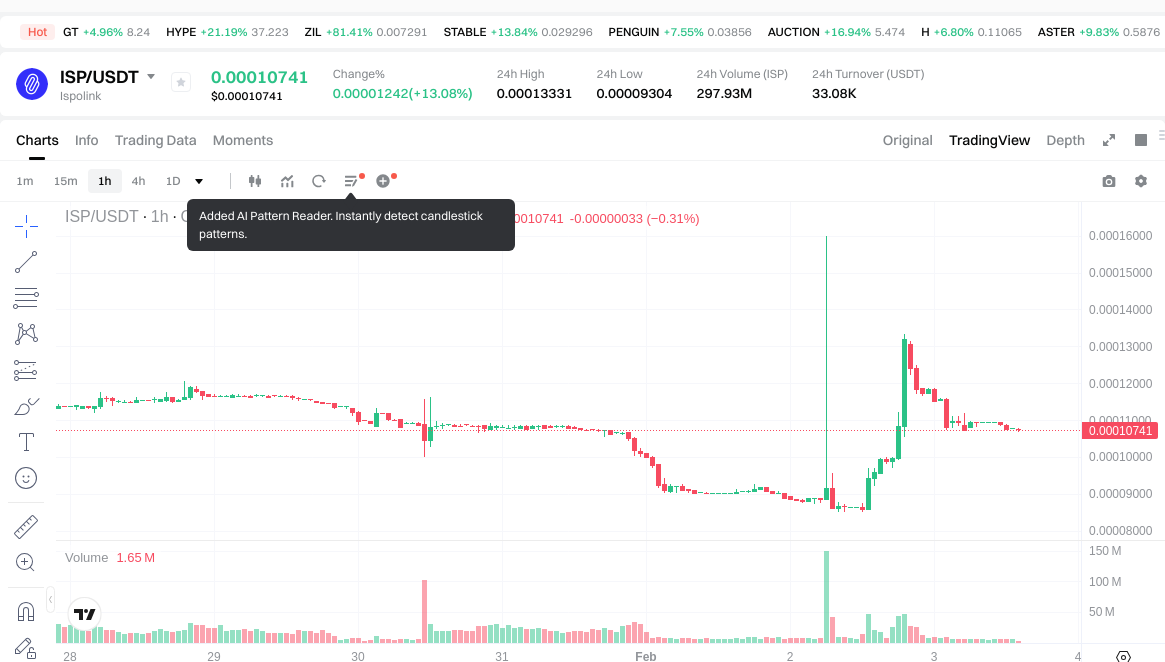
- 2026: As of February 2026, ISP trades at $0.00010751 → Recent 24-hour price movement shows an increase of 12.34%, suggesting potential short-term market interest
Current ISP Investment Market Status (February 2026)
- ISP current price: $0.00010751
- Market capitalization: Approximately $1.02 million with a circulating supply of 9.46 billion tokens
- 24-hour trading volume: $33,164.86
- Market share: 0.000038% of total cryptocurrency market
- Token holder count: 5,405 addresses
- Exchange availability: Listed on 1 exchange with Gate.com trading support
Click to view real-time ISP market price
Investment Considerations
Ispolink operates as a blockchain-based recruitment platform supported by Binance Smart Chain and Polygon Layer 2 infrastructure. The platform provides decentralized ecosystem services including recruitment package purchases, referral rewards, account verification incentives, token governance, and staking mechanisms. The token's utility is integrated with the platform's operational framework, connecting blockchain companies with technical talent through cryptocurrency-based transactions via MetaMask integration.
The current valuation reflects the project's position in the competitive blockchain recruitment sector, with a market cap to fully diluted valuation ratio of 94.56%. Trading activity remains modest compared to larger cryptocurrency projects, and the token demonstrates price sensitivity to both sector-specific developments and broader market conditions.
II. Core Factors Affecting Whether ISP is a Good Investment (Is Ispolink(ISP) a Good Investment)
Supply Mechanism and Scarcity (ISP investment scarcity)
- Ispolink has a maximum supply of 10,000,000,000 ISP tokens, with a circulating supply of approximately 9,456,066,397.76 ISP tokens as of February 3, 2026, representing around 94.56% of the total supply already in circulation.
- The relatively high circulation ratio suggests limited potential for significant scarcity-driven price appreciation in the near term, as the supply is approaching its maximum limit.
- Investment significance: The limited remaining supply may provide modest scarcity support, though the majority of tokens are already circulating in the market.
Institutional Investment and Mainstream Adoption (Institutional investment in ISP)
- As of February 3, 2026, Ispolink holds approximately 5,405 token holders, indicating a relatively modest holder base compared to larger cryptocurrency projects.
- The token is listed on at least one exchange, with a 24-hour trading volume of approximately $33,164.86, suggesting moderate liquidity and trading activity.
- The relatively low market capitalization of approximately $1,016,621.70 and limited exchange presence may indicate that ISP has not yet achieved significant institutional adoption or mainstream recognition.
Macroeconomic Environment's Impact on ISP Investment
- The cryptocurrency market in 2026 continues to be influenced by global monetary policies, interest rate decisions, and inflation trends, which affect investor appetite for digital assets.
- During periods of economic uncertainty or inflation concerns, some investors may seek alternative assets, though ISP's relatively small market capitalization and limited adoption may limit its effectiveness as a hedge.
- Geopolitical developments and regulatory changes in major markets could influence overall cryptocurrency market sentiment, potentially affecting smaller-cap tokens like ISP.
Technology and Ecosystem Development (Technology & Ecosystem for ISP investment)
- Ispolink operates as an interoperable ATS (Applicant Tracking System) platform that utilizes blockchain technology to connect blockchain companies with technical talent, supported by Binance Smart Chain and Polygon L2 infrastructure.
- Token utility includes purchasing recruitment packages, referral rewards, account verification rewards, governance participation, and token staking mechanisms, providing multiple use cases within its ecosystem.
- The platform integrates MetaMask for secure cryptocurrency transactions and aims to provide a decentralized ecosystem for recruitment services in the blockchain industry, though the adoption scale of these services remains limited based on available metrics.
III. ISP Future Investment Prediction and Price Outlook (Is Ispolink(ISP) worth investing in 2026-2031)
Short-term Investment Prediction (2026, short-term ISP investment outlook)
Based on available market data, ISP's short-term outlook for 2026 presents the following scenarios:
- Conservative prediction: $0.0000988 - $0.000107
- Neutral prediction: $0.000107 - $0.000112
- Optimistic prediction: $0.000112 - $0.000118
These projections reflect current market conditions and the token's recent trading patterns, with the 24-hour performance showing a positive movement of 12.34%.
Mid-term Investment Outlook (2027-2028, mid-term Ispolink(ISP) investment forecast)
- Market stage expectation: The platform may experience gradual development as it continues to connect blockchain companies with technical talent through its AI-powered ecosystem.
- Investment return prediction:
- 2027: $0.0000778 - $0.000125
- 2028: $0.000111 - $0.000163
- Key catalysts: Potential factors include the platform's token utility functions such as recruitment package purchases, referral rewards, and user verification mechanisms within the decentralized ecosystem.
Long-term Investment Outlook (Is ISP a good long-term investment?)
- Base scenario: $0.000106 - $0.000155 (assuming steady ecosystem development and sustained platform utility)
- Optimistic scenario: $0.000140 - $0.000230 (assuming enhanced adoption of the platform's services and favorable market conditions)
- Risk scenario: Below $0.0000778 (under challenging market conditions or reduced platform engagement)
View ISP long-term investment and price prediction: Price Prediction
2026-02-03 - 2031 Long-term Outlook
- Base scenario: $0.000107 - $0.000153 USD (corresponding to steady progress and gradual mainstream application growth)
- Optimistic scenario: $0.000141 - $0.000165 USD (corresponding to large-scale adoption and favorable market environment)
- Transformative scenario: Above $0.000230 USD (if the ecosystem achieves breakthrough developments and mainstream popularization)
- 2031-12-31 predicted high: $0.000230 USD (based on optimistic development assumptions)
Disclaimer: These projections are based on historical data and market analysis models. Cryptocurrency markets are highly volatile and subject to numerous unpredictable factors. Past performance does not guarantee future results. Investors should conduct thorough research and consider their risk tolerance before making investment decisions.
| Year | Predicted High Price | Predicted Average Price | Predicted Low Price | Price Change |
|---|---|---|---|---|
| 2026 | 0.000118151 | 0.00010741 | 0.0000988172 | 0 |
| 2027 | 0.000125186355 | 0.0001127805 | 0.000077818545 | 4 |
| 2028 | 0.000163007295675 | 0.0001189834275 | 0.000110654587575 | 10 |
| 2029 | 0.000164964573057 | 0.000140995361587 | 0.000131125686276 | 31 |
| 2030 | 0.000157569366342 | 0.000152979967322 | 0.000105556177452 | 42 |
| 2031 | 0.000229806506911 | 0.000155274666832 | 0.000105586773445 | 44 |
IV. ISP Investment Strategy and Risk Management (How to invest in Ispolink)
Investment Strategy (ISP investment strategy)
Long-term Holding (HODL ISP)
This approach suits conservative investors who believe in the long-term potential of blockchain-based recruitment platforms. Given ISP's position in connecting blockchain companies with technical talent, holding the token may benefit from the growth of the Web3 job market. However, investors should note the token's significant volatility, with a 1-year decline of 81.83%.
Active Trading
Traders may utilize technical analysis and swing trading strategies based on ISP's price movements. With 24-hour price changes showing fluctuations between 0.00009304 and 0.00013331, short-term opportunities exist for experienced traders. The token's relatively low liquidity (24-hour volume of approximately 33,164.86) requires careful position sizing.
Risk Management (Risk management for ISP investment)
Asset Allocation Ratio
- Conservative investors: Allocate no more than 1-3% of crypto portfolio to ISP
- Aggressive investors: May consider 5-10% allocation with strict stop-loss measures
- Professional investors: Can adjust based on risk tolerance and market analysis
Risk Hedging Solutions
Diversify holdings across multiple blockchain assets and consider allocating funds to more established cryptocurrencies. ISP's ranking at 2490 and market dominance of 0.000038% indicates it represents a higher-risk, smaller-cap investment.
Secure Storage
ISP exists on multiple chains (ETH and BSC). Users should:
- Utilize hardware wallets (Ledger, Trezor) for long-term storage
- Use hot wallets (MetaMask) only for active trading amounts
- Verify contract addresses before transactions (ETH: 0xc8807f0f5ba3fa45ffbdc66928d71c5289249014, BSC: 0xd2e7b964770fcf51df088a5f0bb2d33a3c60cccf)
V. ISP Investment Risks and Challenges (Risks of investing in Ispolink)
Market Risk
ISP demonstrates high volatility characteristics. The token experienced an 81.83% decline over the past year, with the current price significantly below its historical high. The 24-hour price change of 12.34% illustrates the potential for rapid price movements in both directions. The relatively low trading volume may increase susceptibility to price swings.
Regulatory Risk
As a recruitment platform token operating across multiple jurisdictions, ISP faces potential regulatory challenges. Different countries maintain varying policies regarding cryptocurrency utilities and employment platforms. Changes in labor laws, data privacy regulations, or cryptocurrency classifications could impact the platform's operations and token value.
Technical Risk
The platform's dependence on multiple blockchain networks (Binance Smart Chain, Polygon L2, and Ethereum) creates technical complexity. Network congestion, smart contract vulnerabilities, or interoperability issues could affect platform functionality. With 5,405 holders and limited exchange availability (trading on 1 exchange), liquidity risk remains a consideration.
VI. Conclusion: Is Ispolink a Good Investment?
Investment Value Summary
ISP represents a niche investment in the blockchain recruitment sector. While the platform addresses a specific need in connecting Web3 companies with technical talent, the token has experienced significant depreciation. The circulating supply represents 94.56% of maximum supply, limiting potential dilution concerns. However, the token's small market cap and limited trading venues present liquidity challenges.
Investor Recommendations
✅ Beginners: Consider dollar-cost averaging with minimal allocation (1-2% of portfolio). Store tokens in secure hardware wallets and understand the platform's utility before investing.
✅ Experienced Investors: May explore swing trading opportunities based on technical indicators. Maintain strict risk management protocols given the token's volatility and limited liquidity.
✅ Institutional Investors: Conduct thorough due diligence on the platform's business model, user adoption metrics, and competitive landscape before considering strategic allocation.
⚠️ Disclaimer: Cryptocurrency investments carry substantial risk. This analysis is for informational purposes only and does not constitute investment advice. Conduct independent research and consult financial professionals before making investment decisions.
VII. FAQ
Q1: What is Ispolink (ISP) and how does it function as a cryptocurrency investment?
Ispolink (ISP) is a blockchain-based recruitment platform token that connects Web3 companies with technical talent through AI-powered solutions. The token operates across multiple networks including Binance Smart Chain, Polygon L2, and Ethereum, serving as the utility currency for the platform's ecosystem. ISP holders can use the token for purchasing recruitment packages, earning referral rewards, participating in governance decisions, and staking mechanisms. With a current price of approximately $0.00010751 and a market capitalization of around $1.02 million, ISP ranks among smaller-cap cryptocurrency projects. The platform integrates MetaMask for secure transactions and aims to provide decentralized recruitment services specifically tailored to the blockchain industry.
Q2: Has ISP demonstrated historical price stability or significant volatility?
ISP has exhibited considerable volatility since its launch in May 2021. The token initially launched at $0.001598 and reached a peak of $0.01830029 in November 2021, representing substantial appreciation during the early phase. However, the subsequent period from 2022 to 2024 saw an extended market adjustment, with the price declining to $0.00008478 by December 2025—an 81.83% decrease over one year. As of February 2026, the token trades at $0.00010751, showing a 24-hour increase of 12.34%. This historical pattern reflects significant price swings influenced by both broader cryptocurrency market conditions and platform-specific developments, indicating high-risk characteristics typical of smaller-cap digital assets.
Q3: What is the token supply structure and its impact on investment scarcity?
Ispolink maintains a maximum supply of 10 billion ISP tokens, with approximately 9.46 billion tokens (94.56%) already in circulation as of February 2026. This high circulation ratio indicates that the majority of tokens have been released into the market, leaving limited remaining supply for future distribution. The near-complete circulation suggests minimal potential for scarcity-driven price appreciation through supply restrictions. Unlike cryptocurrencies with significant locked or unvested supplies that gradually enter circulation, ISP's current supply structure provides modest scarcity support. Investors should recognize that with 5,405 token holders and the majority of tokens already circulating, price movements will primarily depend on demand factors rather than supply-side constraints.
Q4: What are the primary risks associated with investing in ISP?
ISP investment carries several notable risks. Market risk is significant, evidenced by the 81.83% price decline over the past year and ongoing volatility with 24-hour fluctuations between $0.00009304 and $0.00013331. Liquidity risk exists due to limited trading venues (available on 1 exchange) and relatively low 24-hour volume of approximately $33,164.86, which may result in price slippage during larger transactions. Technical risk stems from the platform's multi-chain architecture spanning Binance Smart Chain, Polygon L2, and Ethereum, creating potential vulnerabilities related to smart contract security and interoperability. Regulatory risk involves potential changes in cryptocurrency classifications, labor laws, or data privacy regulations across jurisdictions where the platform operates. Additionally, the token's market dominance of 0.000038% and ranking at 2490 reflects its position as a highly speculative investment with limited mainstream adoption.
Q5: What investment allocation is appropriate for ISP based on risk tolerance?
Investment allocation for ISP should align with individual risk profiles and portfolio strategy. Conservative investors should limit ISP exposure to 1-3% of their cryptocurrency portfolio, treating it as a high-risk, speculative position within a diversified digital asset allocation. Aggressive investors with higher risk tolerance may consider 5-10% allocation, though this should be accompanied by strict stop-loss measures and active monitoring given the token's volatility. Professional investors can adjust allocations based on comprehensive risk analysis and market conditions. All investor types should avoid over-concentration in ISP and maintain core holdings in more established cryptocurrencies. Given the token's significant historical decline and limited liquidity, position sizing should account for potential scenarios where exiting positions may be challenging during periods of market stress.
Q6: How does ISP's technology and ecosystem compare to other blockchain recruitment platforms?
ISP operates as an interoperable Applicant Tracking System (ATS) leveraging blockchain technology across Binance Smart Chain and Polygon L2 infrastructure. The platform's ecosystem includes multiple utility functions: recruitment package purchases, referral reward systems, account verification incentives, governance participation, and token staking mechanisms. These features provide various use cases within the platform's operational framework. However, based on available metrics—including 5,405 token holders, limited exchange availability, and a market capitalization of approximately $1.02 million—the platform's adoption scale remains modest compared to broader recruitment or talent platforms. The integration of MetaMask for transactions provides security features, yet the platform faces competition from both traditional Web2 recruitment services and emerging Web3 talent platforms that may offer similar or enhanced capabilities.
Q7: What are realistic price expectations for ISP through 2031?
Price projections for ISP present multiple scenarios based on platform development and market conditions. For 2026, short-term predictions range from $0.0000988 (conservative) to $0.000118 (optimistic). Mid-term forecasts suggest 2027 prices between $0.0000778 and $0.000125, extending to $0.000111-$0.000163 by 2028. Long-term projections through 2031 present a base scenario of $0.000106-$0.000155, an optimistic scenario of $0.000140-$0.000230, and a risk scenario below $0.0000778. The 2031 predicted high reaches $0.000230 under optimistic development assumptions. However, these projections carry substantial uncertainty given cryptocurrency market volatility and the platform's current early-stage adoption. Historical performance shows an 81.83% decline over the past year, emphasizing that past trends do not guarantee future results. Investors should treat these predictions as potential scenarios rather than assured outcomes and maintain appropriate risk management regardless of timeframe.
Q8: Is ISP suitable for beginners, or is it better suited for experienced cryptocurrency investors?
ISP presents characteristics that make it more suitable for experienced cryptocurrency investors rather than beginners. The token's significant volatility (81.83% annual decline), limited liquidity (trading on only 1 exchange with approximately $33,164 daily volume), and small market capitalization create conditions requiring sophisticated risk management. Beginners who choose to invest should adopt dollar-cost averaging strategies with minimal allocation (1-2% of portfolio maximum), secure tokens in hardware wallets, and thoroughly understand the platform's utility before committing capital. Experienced investors may better navigate ISP's volatility through swing trading strategies and technical analysis, though strict risk protocols remain essential. The token's ranking at 2490 and limited mainstream adoption indicate it functions as a speculative investment requiring active monitoring and willingness to accept potential total loss. Both beginner and experienced investors should prioritize portfolio diversification and avoid over-concentration in such high-risk, smaller-cap digital assets.
Share
Content
Introduction: Ispolink (ISP) Investment Position and Market Outlook
I. Ispolink (ISP) Price History Review and Current Investment Value
II. Core Factors Affecting Whether ISP is a Good Investment (Is Ispolink(ISP) a Good Investment)
III. ISP Future Investment Prediction and Price Outlook (Is Ispolink(ISP) worth investing in 2026-2031)
IV. ISP Investment Strategy and Risk Management (How to invest in Ispolink)
V. ISP Investment Risks and Challenges (Risks of investing in Ispolink)
VI. Conclusion: Is Ispolink a Good Investment?
VII. FAQ
How to Buy Cryptocurrency


Trending Cryptocurrencies



Bitcoin Fear and Greed Index: Market Sentiment Analysis for 2025

Hedera Hashgraph (HBAR): Founders, Technology, and Price Outlook to 2030
Cardano (ADA) Price Prediction 2025 & 2030 – Is ADA Set to Soar?
2025 SUI coin: price, buying guide, and Staking rewards

Cardano (ADA): A History, Tech Overview, and Price Outlook
Jasmy Coin: A Japanese Crypto Tale of Ambition, Hype, and Hope

Comprehensive Guide to Cryptocurrency Trading Platform Registration Bonuses
Isamu Kaneko’s Connection to Bitcoin | The P2P Philosophy Legacy of the Winny Developer
Free Money for Registration in App: Crypto Bonus Guide

How to Create and Profitably Sell NFTs: The Complete Guide

Understanding GameFi: How to Profit from Play-to-Earn