Juice (JUC) is a specialized gas token operating on the AVAX C-Chain, designed to handle transaction fees within the Orange ecosystem since July 2021. As of February 2026, JUC trades at $0.0003863 with a market capitalization of $372,511 and 24-hour trading volume of $18,753.83, representing a micro-cap asset with significant volatility. The token features a maximum supply of 3 billion with 32.14% currently circulating, positioned to reduce gas fees and improve transaction processing efficiency. This analysis examines JUC's investment characteristics including historical price movements (94% decline from $0.0067677 peak), core utility mechanisms, associated risks such as low liquidity and regulatory uncertainty, and comprehensive investment strategies for different investor profiles. Key considerations include long-term holding approaches, active trading opportunities on Gate, and strict risk management protocols, with detailed price projections through 2031 and essential safeguards for crypto asset storage a
Introduction: Juice (JUC)'s Investment Position and Market Prospects
Juice (JUC) represents a specialized digital asset in the cryptocurrency space, designed specifically to handle transaction fees within the Orange ecosystem. Since its launch in July 2021, JUC has positioned itself as a gas token resulting from the migration of RFOX and VFOX tokens. As of February 6, 2026, Juice maintains a market capitalization of approximately $372,511, with a circulating supply of 964,305,050 tokens out of a maximum supply of 3,000,000,000. The current trading price stands at $0.0003863, reflecting recent market volatility with a 24-hour trading volume of $18,753.83.
JUC operates on the AVAX C-Chain infrastructure, focusing on reducing gas fees and improving transaction processing efficiency within its ecosystem. The token's core value proposition centers on making blockchain interactions more cost-effective and accessible for users. With approximately 32.14% of its total supply currently in circulation, the token demonstrates a measured release schedule. The project aims to address blockchain usability challenges through specialized fee handling mechanisms, contributing to faster transaction speeds and lower operational costs for ecosystem participants.
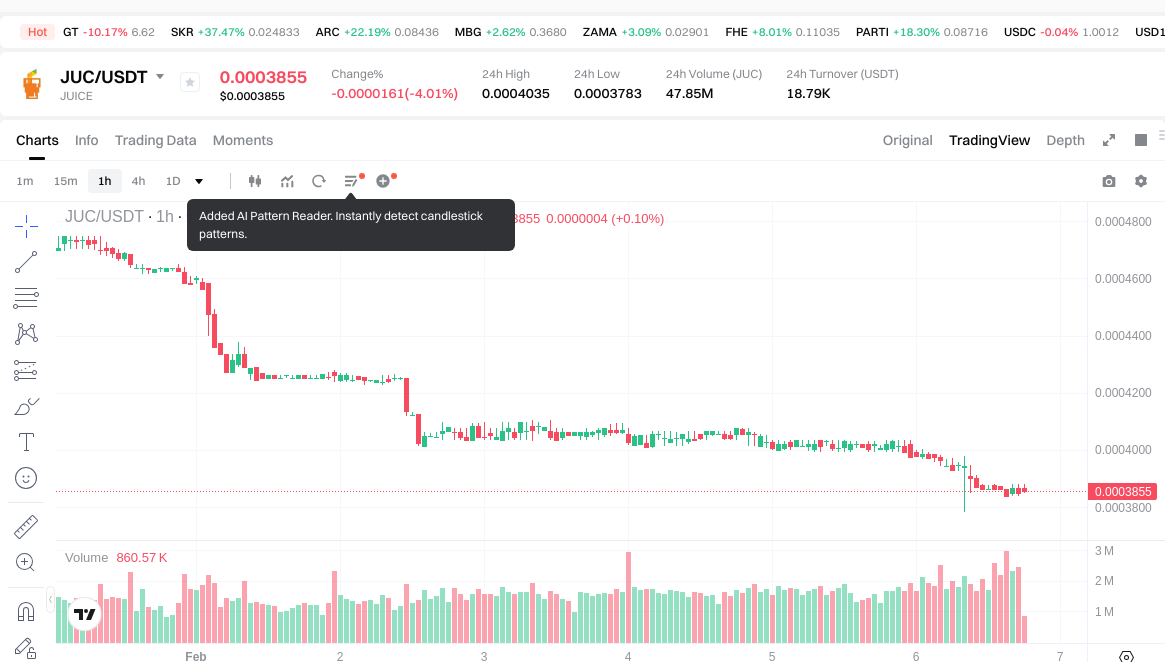
Market data shows JUC has experienced notable price fluctuations, with recent performance indicating a decline of 3.59% over 24 hours, 18.26% over 7 days, and 32.37% over 30 days. The token reached its price peak at $0.0067677 in July 2025 and recorded its lowest point at $0.0001503 in June 2025. Currently ranked 3262 in market capitalization among digital assets, JUC maintains a market dominance of 0.000048%. When investors consider "Is Juice (JUC) a good investment?", understanding these market dynamics becomes essential. This analysis examines JUC's investment characteristics, historical price movements, future projections, and associated risks to provide a comprehensive reference for potential investors.
I. Juice (JUC) Price History Review and Current Investment Value
- 2025: JUC recorded an all-time high price of $0.0067677 in July, followed by a significant correction
- 2025: The token experienced substantial volatility, with prices declining from the July peak to $0.0001503 by late June
- Recent period: JUC traded within a range, showing a 7-day decline of approximately 18.26% and a 30-day decline of around 32.37%
Current JUC Investment Market Status (February 2026)
- JUC current price: $0.0003863
- 24-hour trading volume: $18,753.83
- Market capitalization: $372,511.04
- Circulating supply: 964,305,050 JUC (approximately 32.14% of total supply)
Click to view real-time JUC market price
II. Core Factors Affecting Whether JUC is a Good Investment (Is Juice(JUC) a Good Investment)
Supply Mechanism and Scarcity (JUC investment scarcity)
- Total supply capped at 3,000,000,000 tokens with a maximum supply limit → influences price dynamics and investment considerations
- Current circulating supply represents approximately 32.14% of total supply (964,305,050 tokens in circulation) → indicates substantial portion remains locked or unvested
- Investment consideration: The controlled supply release mechanism may affect liquidity patterns and potential price movements over time
Technology & Ecosystem Development (Technology & Ecosystem for JUC investment)
- JUICE token designed specifically for handling transaction fees within the Orange ecosystem → serves as the gas token for network operations
- Token migration: JUICE resulted from the consolidation of RFOX and VFOX tokens → represents an evolution beyond traditional ERC20 functionality
- Transaction efficiency: Specialized focus on reducing overall gas fees and improving transaction processing speeds → aims to enhance ecosystem accessibility and user experience
- Ecosystem positioning: Functions as the primary gas token for the Orange Web3 ecosystem → provides utility-based value proposition tied to network usage
- Price performance shows varied trends across different timeframes: 1-hour (+0.1%), 24-hour (-3.59%), 7-day (-18.26%), 30-day (-32.37%), and 1-year (-3.18%)
- Historical price range between $0.0001503 and $0.0067677 demonstrates significant volatility characteristics
- Market capitalization of approximately $372,511 with relatively limited 24-hour trading volume of $18,753 → suggests lower liquidity levels
- Current market share stands at 0.000048% with ranking at #3262 → indicates early-stage market position
III. JUC Future Investment Prediction and Price Outlook (Is Juice(JUC) worth investing in 2026-2031)
Short-term Investment Prediction (2026, short-term JUC investment outlook)
- Conservative Forecast: $0.000343 - $0.000385
- Neutral Forecast: $0.000385 - $0.000397
- Optimistic Forecast: $0.000397 - $0.000420
Mid-term Investment Outlook (2027-2029, mid-term Juice(JUC) investment forecast)
- Market Stage Expectation: The token may experience gradual recovery following short-term pressure, with potential growth driven by ecosystem development and network optimization initiatives.
- Investment Return Prediction:
- 2027: $0.000231 - $0.000536
- 2028: $0.000413 - $0.000612
- 2029: $0.000484 - $0.000737
- Key Catalysts: Expansion of the Orange ecosystem, transaction fee optimization, and broader adoption as a gas token within the network.
Long-term Investment Outlook (Is Juice a good long-term investment?)
- Base Scenario: $0.000344 - $0.000637 (assuming steady ecosystem growth and sustained network utility)
- Optimistic Scenario: $0.000666 - $0.000746 (assuming accelerated adoption and favorable market conditions)
- Risk Scenario: Below $0.000344 (under adverse market conditions or limited ecosystem expansion)
Click to view JUC long-term investment and price prediction: Price Prediction
2026-2031 Long-term Outlook
- Base Scenario: $0.000344 - $0.000637 (corresponding to steady progress and gradual mainstream application)
- Optimistic Scenario: $0.000666 - $0.000746 (corresponding to large-scale adoption and favorable market environment)
- Transformative Scenario: Above $0.000746 (if ecosystem achieves breakthrough development and mainstream penetration)
- December 31, 2031 Predicted High: $0.000746 (based on optimistic development assumptions)
Disclaimer: This analysis is for informational purposes only and does not constitute investment advice. Cryptocurrency markets are highly volatile, and past performance does not guarantee future results. Investors should conduct their own research and consider their risk tolerance before making any investment decisions.
| Year |
Predicted High Price |
Predicted Average Price |
Predicted Low Price |
Price Change |
| 2026 |
0.000397065 |
0.0003855 |
0.000343095 |
0 |
| 2027 |
0.000536057025 |
0.0003912825 |
0.000230856675 |
1 |
| 2028 |
0.0006120440865 |
0.0004636697625 |
0.000412666088625 |
20 |
| 2029 |
0.000736863986565 |
0.0005378569245 |
0.00048407123205 |
39 |
| 2030 |
0.00069472289653 |
0.000637360455532 |
0.000344174645987 |
64 |
| 2031 |
0.000745966677155 |
0.000666041676031 |
0.000392964588858 |
72 |
IV. Juice Investment Strategy and Risk Management (How to invest in Juice)
Investment Methodology (Juice investment strategy)
Long-term Holding (HODL Juice)
For conservative investors seeking exposure to the Orange ecosystem's gas token, a long-term holding strategy may be considered. This approach involves:
- Accumulating JUC tokens during periods of lower valuation
- Holding through market volatility cycles
- Focusing on the ecosystem's long-term development rather than short-term price movements
This strategy suits investors who believe in the Orange ecosystem's potential growth and are willing to weather price fluctuations over extended periods.
Active Trading
For more experienced traders, active trading strategies based on technical analysis and swing trading may be employed:
- Technical Analysis: Monitoring price patterns, support and resistance levels, and volume trends
- Swing Trading: Capitalizing on short to medium-term price movements
- Entry and Exit Points: Using technical indicators to identify optimal trading opportunities
Given JUC's 24-hour trading volume of approximately $18,753 and recent price volatility (down 3.59% in 24 hours, down 18.26% over 7 days), active traders should exercise caution regarding liquidity and slippage.
Risk Management (Risk management for Juice investment)
Asset Allocation Ratios
- Conservative Investors: Allocate no more than 1-3% of total crypto portfolio to JUC, prioritizing established assets
- Aggressive Investors: May allocate 5-10% to JUC, accepting higher volatility for potential returns
- Professional Investors: Consider portfolio weight based on comprehensive due diligence, typically not exceeding 5% in micro-cap tokens
Risk Hedging Solutions
- Multi-Asset Portfolio: Diversify across different crypto categories (large-cap, mid-cap, stablecoins) to reduce concentration risk
- Hedging Tools: Consider using stablecoins or established cryptocurrencies to balance portfolio volatility
- Position Sizing: Scale positions according to risk tolerance and market conditions
Secure Storage
- Cold Wallets: For long-term holdings, transfer JUC to cold storage solutions to minimize security risks
- Hot Wallets: Keep only trading amounts in exchange or hot wallets for liquidity needs
- Hardware Wallets: Utilize reputable hardware wallets compatible with AVAX C-Chain for enhanced security
- Backup Procedures: Maintain secure backups of private keys and recovery phrases in multiple secure locations
V. Juice Investment Risks and Challenges (Risks of investing in Juice)
Market Risk
- High Volatility: JUC has experienced significant price swings, with a 7-day decline of 18.26% and a 30-day decline of 32.37% as of February 6, 2026
- Low Liquidity: With a daily trading volume of approximately $18,753, the token may face liquidity constraints that can amplify price movements
- Price Discovery: As a relatively new token (launched July 2024), price stability has not been established
- Market Capitalization: With a circulating market cap of approximately $372,511, JUC is considered a micro-cap asset with inherent volatility risks
Regulatory Risk
- Jurisdictional Uncertainty: Different countries maintain varying regulatory frameworks for crypto assets, which may impact JUC's accessibility and trading
- Gas Token Classification: The regulatory treatment of ecosystem-specific gas tokens remains evolving across jurisdictions
- Compliance Requirements: Potential future regulations may impose additional compliance burdens on the Orange ecosystem
- Exchange Listings: Regulatory changes could affect JUC's availability on exchanges, currently listed on 1 exchange
Technical Risk
- Network Security: As a gas token on the AVAX C-Chain, JUC's security depends partly on the underlying blockchain infrastructure
- Smart Contract Vulnerabilities: Potential risks associated with the token contract at address 0xD5D053D5B769383e860d1520Da7a908E00919F36
- Ecosystem Dependency: JUC's functionality is tied to the Orange ecosystem's success and technical stability
- Migration Risks: As JUC resulted from the migration of RFOX and VFOX tokens, historical technical transitions may present unknown risks
VI. Conclusion: Is Juice a Good Investment?
Investment Value Summary
Juice (JUC) represents a specialized gas token within the Orange ecosystem, designed to facilitate transaction fees with improved efficiency. The token's investment profile presents both opportunities and challenges:
Potential Considerations:
- Purpose-driven utility as an ecosystem gas token
- Lower transaction costs compared to standard blockchain operations
- Circulating supply of 964 million tokens out of 3 billion total supply (32.14% circulation)
Risk Factors:
- Significant recent price declines (18.26% over 7 days, 32.37% over 30 days)
- Limited liquidity with modest daily trading volume
- Micro-cap status with market dominance of 0.000048%
- Concentrated exchange presence (1 exchange)
Investor Recommendations
✅ Beginner Investors:
- Consider dollar-cost averaging (DCA) if interested in the Orange ecosystem
- Invest only amounts you can afford to lose entirely
- Utilize secure wallet storage with proper backup procedures
- Start with educational research before committing capital
✅ Experienced Investors:
- Employ swing trading strategies during volatility periods
- Maintain strict position sizing (recommended maximum 5% of crypto portfolio)
- Diversify across multiple assets to mitigate concentration risk
- Monitor ecosystem developments and trading volume trends
✅ Institutional Investors:
- Conduct comprehensive due diligence on Orange ecosystem fundamentals
- Assess liquidity requirements against available trading volume
- Consider strategic allocation only as part of diversified micro-cap exposure
- Implement robust risk management frameworks
⚠️ Important Notice: Cryptocurrency investments carry substantial risk, including potential total loss of capital. JUC's micro-cap status, limited liquidity, and recent price performance indicate elevated risk levels. This content is provided for informational purposes only and does not constitute financial advice, investment recommendation, or solicitation to buy or sell any asset. Investors should conduct independent research and consult with qualified financial advisors before making investment decisions.
VII. FAQ
Q1: What is Juice (JUC) and what is its primary function?
Juice (JUC) is a specialized gas token designed to handle transaction fees within the Orange Web3 ecosystem, operating on the AVAX C-Chain. JUC resulted from the migration of RFOX and VFOX tokens in July 2024, evolving beyond traditional ERC20 functionality. The token's primary purpose is to reduce overall gas fees and improve transaction processing speeds for users within the Orange ecosystem. With a maximum supply of 3 billion tokens and approximately 32.14% currently in circulation (964,305,050 tokens), JUC serves as the ecosystem's fee optimization mechanism, making blockchain interactions more cost-effective and accessible for network participants.
Q2: What are the main risks associated with investing in JUC?
JUC carries significant investment risks due to its micro-cap status and market characteristics. The token has demonstrated high volatility with recent declines of 18.26% over 7 days and 32.37% over 30 days. Key risk factors include extremely limited liquidity with only $18,753 in 24-hour trading volume, which can amplify price swings and create slippage challenges. Additional concerns include concentration risk with listing on only one exchange, dependency on the Orange ecosystem's success, regulatory uncertainty regarding gas token classification across jurisdictions, and smart contract vulnerabilities. The market capitalization of approximately $372,511 positions JUC as a speculative micro-cap asset with potential for substantial price fluctuations.
Q3: How does JUC's current price compare to its historical performance?
As of February 6, 2026, JUC trades at $0.0003863, significantly below its all-time high of $0.0067677 reached in July 2025, representing approximately a 94% decline from peak levels. The token has experienced considerable volatility, having recorded its lowest point at $0.0001503 in June 2025. Recent performance shows mixed short-term indicators: +0.1% over 1 hour, -3.59% over 24 hours, -18.26% over 7 days, -32.37% over 30 days, and -3.18% over 1 year. This price action reflects the broader challenges facing micro-cap tokens and highlights the substantial risk-reward profile investors must consider when evaluating JUC's investment potential.
Q4: What is the price prediction for JUC through 2031?
Price forecasts for JUC suggest modest potential growth under various scenarios. For 2026, conservative estimates range from $0.000343 to $0.000385, with optimistic projections reaching $0.000420. Mid-term predictions (2027-2029) anticipate gradual recovery, with 2027 ranging between $0.000231 and $0.000536, 2028 between $0.000413 and $0.000612, and 2029 between $0.000484 and $0.000737. Long-term projections through 2031 suggest a base scenario of $0.000344 to $0.000637, with optimistic scenarios reaching $0.000666 to $0.000746. These forecasts assume steady ecosystem growth, increased adoption, and favorable market conditions. However, investors should note that cryptocurrency price predictions carry high uncertainty, and actual performance may vary significantly from these estimates.
Q5: What investment strategies are suitable for JUC?
Investment strategies for JUC should align with individual risk tolerance and experience levels. Conservative investors may consider long-term holding (HODL) strategies, accumulating tokens during lower valuation periods while focusing on the Orange ecosystem's development rather than short-term price movements. Recommended allocation for conservative investors is 1-3% of total crypto portfolio. Experienced traders might employ active trading approaches using technical analysis and swing trading strategies, though they should exercise caution regarding liquidity constraints. Position sizing should not exceed 5-10% even for aggressive investors. Regardless of strategy, secure storage practices are essential, including cold wallet solutions for long-term holdings and maintaining only necessary trading amounts in hot wallets or exchanges.
Q6: How does JUC's supply mechanism affect its investment potential?
JUC features a controlled supply mechanism with a maximum supply cap of 3 billion tokens, of which approximately 32.14% (964,305,050 tokens) currently circulates. This means roughly 68% of the total supply remains locked or unvested, which presents both opportunities and considerations for investors. The controlled release schedule may help prevent excessive supply inflation but also introduces uncertainty regarding future token unlocks and their potential impact on price. The measured circulation rate suggests a long-term distribution approach, which could influence liquidity patterns and price dynamics as additional tokens enter circulation. Investors should monitor vesting schedules and unlock events, as these supply-side factors can significantly affect market behavior and investment returns.
Q7: Is JUC suitable for beginner cryptocurrency investors?
JUC presents substantial challenges for beginner investors due to its high-risk profile as a micro-cap gas token. The combination of extreme price volatility, limited liquidity ($18,753 daily trading volume), single exchange listing, and ecosystem-specific functionality makes it a complex investment requiring careful consideration. Beginners interested in JUC should start with extensive educational research about gas tokens, the Orange ecosystem, and AVAX C-Chain technology. If choosing to invest, implement dollar-cost averaging (DCA) strategies, invest only amounts affordable to lose entirely, and prioritize secure wallet storage with proper backup procedures. Beginners should consider allocating no more than 1-3% of their crypto portfolio to JUC, maintaining a diversified portfolio with established cryptocurrencies as core holdings. Consultation with qualified financial advisors is strongly recommended before investing.
Q8: What factors could drive JUC's price performance in the coming years?
Several key catalysts may influence JUC's future price trajectory. Positive drivers include expansion of the Orange ecosystem user base, successful implementation of transaction fee optimizations, increased adoption as the primary gas token within the network, broader exchange listings improving liquidity, and favorable developments in the AVAX C-Chain infrastructure. Technical enhancements that demonstrate measurable reductions in gas costs compared to alternatives could strengthen JUC's value proposition. However, negative factors such as competitive gas token solutions, regulatory challenges affecting utility tokens, limited ecosystem growth, continued low liquidity conditions, or technical vulnerabilities could pressure prices. The token's performance will ultimately depend on the Orange ecosystem's ability to attract users and demonstrate sustainable utility, making ecosystem metrics critical indicators for potential investors to monitor.
* The information is not intended to be and does not constitute financial advice or any other recommendation of any sort offered or endorsed by Gate.