This comprehensive guide evaluates LandShare (LANDSHARE) as an investment opportunity in real estate tokenization, examining its tokenomics, market positioning, and risk factors as of February 2026. The analysis covers LANDSHARE's current price of $0.24 with a $1.46M market cap, price history trends, and detailed forecasts through 2031 ranging from $0.233-$0.818 depending on adoption scenarios. Key sections explore core investment factors including supply mechanisms, institutional adoption, macroeconomic impacts, and upcoming V2 ecosystem upgrades featuring Real Assets Vault and RWA Launchpad. The guide provides practical investment strategies for different investor profiles, complete risk management frameworks, and addresses security considerations for BEP20 token storage. While LANDSHARE offers fractional real estate exposure with monthly rental income distributions on Gate and other exchanges, investors must carefully consider substantial volatility, liquidity constraints, and regulatory uncertainties befo
Introduction: LandShare (LANDSHARE) Investment Position and Market Outlook
LANDSHARE represents an innovative asset in the cryptocurrency sector, launched in August 2021, focusing on tokenizing real-world real estate properties on the Binance Smart Chain. As of February 2026, LANDSHARE maintains a market capitalization of approximately $1.46 million, with a circulating supply of around 6.15 million tokens, and the current price stands at approximately $0.24. With its positioning as a bridge between traditional real estate investment and decentralized finance, LANDSHARE has gradually become a focal point when investors discuss "Is LandShare (LANDSHARE) a good investment?" This article will comprehensively analyze LANDSHARE's investment value, historical trends, future price predictions, and investment risks to provide reference for investors.
The project converts physical properties into asset-backed tokens tradeable on blockchain infrastructure, enabling investors to participate in real estate markets with lower entry barriers. The platform incorporates DeFi functionalities including yield mechanisms and NFT elements. With 6,308 token holders and presence on 3 exchanges, LANDSHARE occupies a niche position within the real-world asset tokenization sector. Recent market data shows price fluctuations, with a 24-hour trading volume of $14,016 and movements reflecting broader market sentiment in both cryptocurrency and real estate sectors.
I. LandShare (LANDSHARE) Price History Review and Current Investment Value
- 2021: Historical price peak recorded in November → Early investors experienced significant returns during initial market enthusiasm
- 2026: Price adjustment phase → LANDSHARE experienced fluctuations, trading around $0.24 range
- Market cycle dynamics: Price movements reflected broader real estate tokenization sector trends and DeFi market conditions
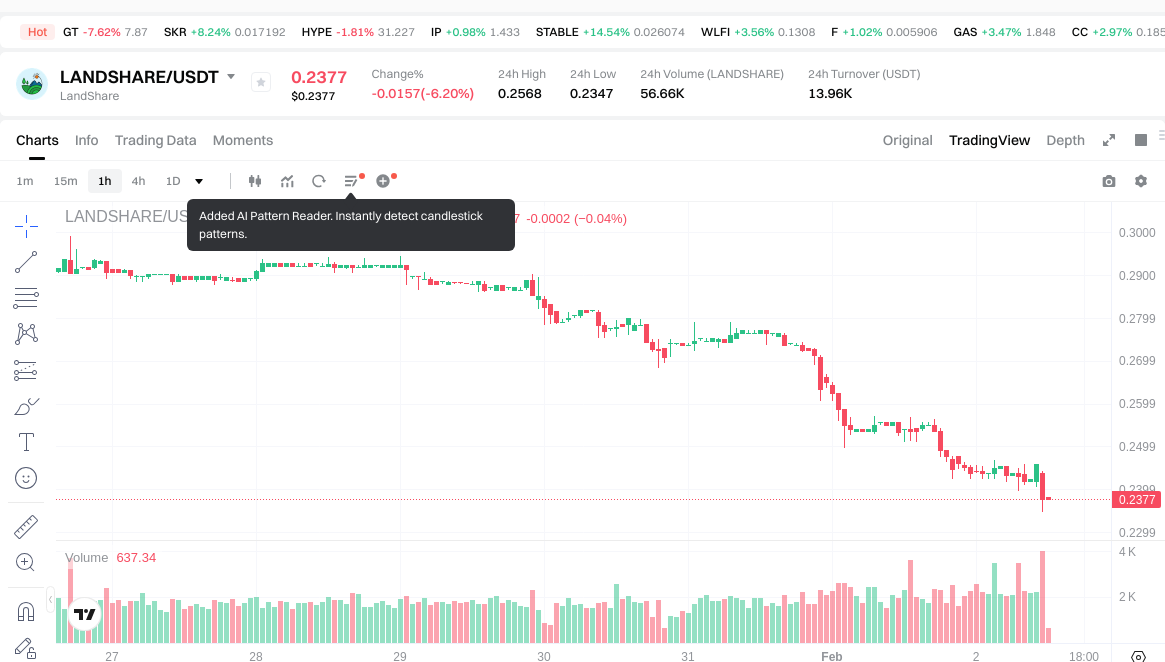
Current LANDSHARE Investment Market Status (February 2026)
- LANDSHARE current price: $0.2382
- 24-hour trading volume: $14,016.23
- Circulating supply: 6,147,108.41 tokens (61.47% of total supply)
- Market capitalization: $1,464,241.22
Click to view real-time LANDSHARE market price
II. Core Factors Influencing Whether LANDSHARE Is a Good Investment
Supply Mechanism and Scarcity (LANDSHARE Investment Scarcity)
- Supply structure: LANDSHARE has a maximum supply of 10,000,000 tokens, with approximately 6,147,108 tokens currently in circulation, representing a circulation ratio of 61.47%
- The limited supply design may provide scarcity characteristics that could influence long-term value dynamics
- Investment consideration: The defined maximum supply cap establishes a framework for potential scarcity-driven value considerations
Institutional Investment and Mainstream Adoption (Institutional Investment in LANDSHARE)
- Current holder base: The token has approximately 6,308 holders as of February 2, 2026
- Trading availability: LANDSHARE is listed on 3 exchanges, with Gate.com among the platforms supporting trading
- Market positioning: The project focuses on transforming real-world real estate into asset-backed, tradeable tokens on Binance Smart Chain
Macroeconomic Environment's Impact on LANDSHARE Investment
- Asset-backed model: LANDSHARE's connection to real estate may provide exposure to real-world asset performance
- Yield generation: The project offers rental income distribution features, which may be influenced by broader real estate market conditions
- Market volatility: Recent price movements show a 5.99% decline over 24 hours and an 18.75% decline over 7 days, reflecting market sensitivity
Technology and Ecosystem Development (Technology & Ecosystem for LANDSHARE Investment)
- V2 upgrade roadmap: Landshare announced a comprehensive ecosystem upgrade planned for Q1-Q2 2026, focusing on enhanced accessibility and liquidity for real estate on-chain
- Real Assets Vault (RAV): Introduction of USDT deposit functionality to earn real estate-backed interest, built on Real Yield principles rather than token emission models
- RWA Launchpad: Expansion plans to incorporate assets from other issuers, effectively positioning LSRWA as a multi-asset real estate index
- DeFi integration: Features include yield auto-compounding, liquidity pool incentives (LAND-BNB and LSRWA-USDT pools), and a planned loan protocol
- Direct access mechanisms: Users can mint LSRWA at Net Asset Value (NAV) with structured monthly redemption pools for enhanced liquidity
III. LANDSHARE Future Investment Forecast and Price Outlook (Is LandShare(LANDSHARE) worth investing in 2026-2031)
Short-term Investment Forecast (2026, short-term LANDSHARE investment outlook)
- Conservative forecast: $0.195 - $0.238
- Neutral forecast: $0.238 - $0.266
- Optimistic forecast: $0.266 - $0.295
Mid-term Investment Outlook (2027-2029, mid-term LandShare(LANDSHARE) investment forecast)
- Market stage expectation: Gradual growth phase with potential ecosystem expansion in real estate tokenization and DeFi integration
- Investment return forecast:
- 2027: $0.186 - $0.389
- 2028: $0.229 - $0.413
- 2029: $0.244 - $0.525
- Key catalysts: Real estate tokenization adoption trends, DeFi ecosystem development, market liquidity improvements, and broader crypto market sentiment
Long-term Investment Outlook (Is LANDSHARE a good long-term investment?)
- Baseline scenario: $0.233 - $0.448 (assuming steady ecosystem development and moderate adoption of real estate tokenization)
- Optimistic scenario: $0.481 - $0.818 (assuming accelerated mainstream adoption and favorable regulatory environment for tokenized real estate)
- Risk scenario: Below $0.195 (in case of significant market downturns or regulatory challenges)
Click to view LANDSHARE long-term investment and price forecast: Price Prediction
2026-02-02 - 2031 Long-term Outlook
- Base scenario: $0.238 - $0.553 USD (corresponding to steady progress and gradual mainstream application improvement)
- Optimistic scenario: $0.447 - $0.818 USD (corresponding to large-scale adoption and favorable market environment)
- Transformative scenario: Above $0.818 USD (in case of breakthrough ecosystem progress and mainstream popularization)
- 2031-12-31 forecast high: $0.818 USD (based on optimistic development assumptions)
Disclaimer: Price forecasts are based on historical data analysis and market trend projections. Cryptocurrency markets are highly volatile and unpredictable. These forecasts should not be considered as financial advice. Investors should conduct thorough research and consider their risk tolerance before making investment decisions.
| Year |
Predicted High Price |
Predicted Average Price |
Predicted Low Price |
Price Change |
| 2026 |
0.294748 |
0.2377 |
0.194914 |
0 |
| 2027 |
0.38868704 |
0.266224 |
0.1863568 |
11 |
| 2028 |
0.4125939552 |
0.32745552 |
0.229218864 |
37 |
| 2029 |
0.525435127392 |
0.3700247376 |
0.244216326816 |
55 |
| 2030 |
0.65816300076912 |
0.447729932496 |
0.23281956489792 |
87 |
| 2031 |
0.818360770616188 |
0.55294646663256 |
0.481063425970327 |
132 |
IV. LANDSHARE Investment Strategy and Risk Management (How to invest in Landshare)
Investment Methodology (LANDSHARE investment strategy)
Long-term Holding (HODL LANDSHARE)
For conservative investors seeking exposure to tokenized real estate assets, a long-term holding strategy may be appropriate. This approach involves acquiring LANDSHARE tokens and maintaining positions through market cycles, allowing potential benefit from:
- Property appreciation reflected in token value
- Monthly rental income distributions sent directly to wallets
- DeFi feature integration including yield auto-compounding mechanisms
Given the project's focus on asset-backed tokens representing real-world properties on Binance Smart Chain, long-term holders may consider the underlying real estate fundamentals alongside token price movements.
Active Trading
Active traders may employ technical analysis and swing trading strategies when engaging with LANDSHARE. Key considerations include:
- Volatility Profile: Recent data shows price fluctuations of -2.26% (1H), -5.99% (24H), and -18.75% (7D), indicating significant short-term volatility
- Liquidity Assessment: With 24-hour trading volume of approximately $14,016.23, traders should evaluate order book depth before executing larger positions
- Technical Indicators: Monitor support and resistance levels, with recent 24H range between $0.2347 and $0.2568
Risk Management (Risk management for LANDSHARE investment)
Asset Allocation Ratios
Conservative Investors: 1-3% of crypto portfolio allocation
- Prioritize capital preservation
- Focus on income-generating features (rental distributions)
- Longer holding periods to reduce trading frequency
Aggressive Investors: 5-10% of crypto portfolio allocation
- Accept higher volatility for potential appreciation
- Active participation in DeFi features
- Regular rebalancing based on market conditions
Professional Investors: Strategic allocation based on comprehensive due diligence
- Integration with broader real estate tokenization thesis
- Evaluation of smart contract audits and regulatory compliance
- Portfolio hedging through correlated and uncorrelated assets
Risk Hedging Solutions
- Multi-Asset Portfolio: Combine LANDSHARE with established cryptocurrencies (BTC, ETH) and stablecoins to reduce concentration risk
- Diversification Across Sectors: Balance real estate tokenization exposure with other crypto sectors (DeFi, infrastructure, gaming)
- Stablecoin Reserves: Maintain liquid stablecoin positions (10-30% of crypto allocation) for opportunistic buying during price declines
- Position Sizing: Limit individual token exposure to prevent disproportionate impact from adverse price movements
Secure Storage
Cold Wallet Solutions:
- Hardware wallets compatible with BEP20 tokens (Ledger Nano S/X, Trezor Model T)
- Paper wallets for long-term storage with proper offline generation protocols
- Multi-signature wallets for institutional holdings
Hot Wallet Management:
- Use reputable BEP20-compatible wallets (MetaMask, Trust Wallet) for active trading
- Enable two-factor authentication and regular security audits
- Limit hot wallet holdings to trading amounts only
Best Practices:
- Verify contract address (0xA73164DB271931CF952cBaEfF9E8F5817b42fA5C) before transactions
- Regular backup of recovery phrases in secure, distributed locations
- Periodic security reviews and wallet software updates
V. LANDSHARE Investment Risks and Challenges (Risks of investing in Landshare)
Market Risks
High Volatility
LANDSHARE exhibits substantial price volatility across multiple timeframes:
- 7-day decline of -18.75% demonstrates significant short-term fluctuations
- 30-day movement of -15.5% indicates medium-term price instability
- Annual performance of -76.64% reflects considerable downside exposure
The token's relatively modest market capitalization of approximately $1.46 million may contribute to increased price sensitivity to trading activity.
Liquidity Constraints
With 24-hour trading volume of $14,016.23 across 3 exchanges, investors may encounter:
- Wider bid-ask spreads during execution
- Potential slippage on larger orders
- Difficulty exiting positions rapidly without price impact
Price Manipulation Potential
Smaller market cap tokens with limited liquidity may be more susceptible to coordinated trading activities or large holder influence on price discovery.
Regulatory Risks
Jurisdictional Uncertainty
Tokenized real estate operates at the intersection of cryptocurrency regulation and traditional real estate law, creating complex compliance landscapes:
- Different countries maintain varying regulatory frameworks for security tokens
- Property ownership tokenization may face scrutiny under securities regulations
- Cross-border rental income distribution may encounter tax reporting requirements
Evolving Policy Environment
Regulatory approaches to real estate tokenization remain in development:
- Potential classification changes affecting token legal status
- Compliance requirements that may impact operational models
- Geographic restrictions on token accessibility or property locations
KYC/AML Considerations
Real estate tokenization platforms may require enhanced identity verification processes compared to standard cryptocurrency transactions, affecting accessibility and user experience.
Technical Risks
Smart Contract Vulnerabilities
As a BEP20 token on Binance Smart Chain, LANDSHARE relies on smart contract integrity:
- Potential coding errors or logic flaws in tokenization mechanisms
- Vulnerabilities in rental distribution automation
- Risks associated with DeFi feature integration (yield compounding, NFT systems)
Network Dependencies
The project's functionality depends on Binance Smart Chain infrastructure:
- Network congestion affecting transaction processing
- BSC validator set centralization concerns
- Potential network upgrades requiring protocol adjustments
Platform-Specific Risks
Tokenized real estate models introduce unique technical considerations:
- Property valuation oracle reliability
- Rental income calculation and distribution mechanisms
- Legal-technical integration for property ownership representation
Upgrade and Development Risks
Mentioned upcoming features (loan protocol) present implementation uncertainties:
- Development delays affecting roadmap execution
- Integration challenges with existing systems
- Market reception of new functionality
VI. Conclusion: Is Landshare a Good Investment?
Investment Value Summary
LANDSHARE represents an innovative approach to real estate tokenization, offering fractional property investment opportunities with a minimum entry point of $50. The project combines asset-backed tokens with DeFi functionality, including rental income distributions and yield optimization features.
However, several factors warrant careful consideration:
Potential Advantages:
- Low barrier to entry for real estate exposure
- Monthly rental income mechanism providing potential yield
- Integration of DeFi features for enhanced returns
- Asset-backed model providing tangible underlying value
Significant Challenges:
- Substantial price declines across multiple timeframes (-76.64% annually)
- Limited liquidity with modest trading volumes
- Relatively small market capitalization increasing volatility risk
- Regulatory uncertainty surrounding real estate tokenization
- Technical complexities in bridging physical assets and blockchain systems
Short-term price movements have demonstrated considerable volatility, while long-term performance reflects significant challenges. The circulating supply represents 61.47% of maximum supply, with approximately 6,308 holders.
Investor Recommendations
✅ Beginners:
- Start with minimal allocation (1-2% of crypto portfolio)
- Utilize dollar-cost averaging to reduce timing risk
- Store tokens in hardware wallets compatible with BEP20 standard
- Thoroughly research real estate tokenization mechanics before investing
- Understand rental income distribution processes and tax implications
✅ Experienced Investors:
- Consider swing trading opportunities given volatility patterns
- Evaluate position sizing relative to liquidity constraints
- Diversify across multiple real estate tokenization projects
- Monitor regulatory developments affecting tokenized securities
- Assess smart contract audits and technical documentation
✅ Institutional Investors:
- Conduct comprehensive due diligence on legal structure and property holdings
- Evaluate regulatory compliance across relevant jurisdictions
- Consider strategic allocation within broader real estate tokenization thesis
- Assess operational team capabilities and track record
- Implement robust custody solutions for token holdings
⚠️ Important Notice: Cryptocurrency investments carry substantial risk, including potential loss of principal. This analysis is provided for informational purposes only and does not constitute investment advice. Investors should conduct independent research, assess their risk tolerance, and consult qualified financial advisors before making investment decisions. Past performance does not guarantee future results.
VII. FAQ
Q1: What is LandShare (LANDSHARE) and how does it differ from traditional real estate investment?
LandShare is a cryptocurrency project launched in August 2021 that tokenizes real-world real estate properties on the Binance Smart Chain, enabling investors to purchase fractional ownership with a minimum entry of $50. Unlike traditional real estate investment, LANDSHARE eliminates high capital requirements, geographical barriers, and lengthy transaction processes by converting physical properties into asset-backed tokens tradeable 24/7 on blockchain infrastructure. The platform integrates DeFi functionalities including monthly rental income distributions sent directly to token holders' wallets, yield auto-compounding mechanisms, and liquidity pool incentives, providing investors with both property appreciation potential and passive income opportunities that traditional real estate typically cannot offer with such accessibility and liquidity.
Q2: What are the primary risks associated with investing in LANDSHARE?
The primary risks include substantial market volatility (with annual decline of -76.64% and 7-day decline of -18.75%), limited liquidity constraints with only $14,016.23 in 24-hour trading volume across 3 exchanges, and regulatory uncertainty surrounding real estate tokenization across different jurisdictions. The relatively small market capitalization of approximately $1.46 million increases susceptibility to price manipulation and heightened volatility from large trades. Additionally, smart contract vulnerabilities, dependency on Binance Smart Chain infrastructure, technical complexities in bridging physical assets with blockchain systems, and evolving regulatory frameworks for security tokens present significant challenges. Investors should also consider jurisdictional variations in property tokenization laws and potential tax reporting requirements for cross-border rental income distributions.
Q3: How does LANDSHARE generate returns for token holders?
LANDSHARE generates returns through two primary mechanisms: property appreciation reflected in token value and monthly rental income distributions. When the underlying real estate properties generate rental income, these earnings are distributed directly to LANDSHARE token holders' wallets on a monthly basis, providing passive income without additional action required. The platform also offers DeFi integration features including yield auto-compounding mechanisms that automatically reinvest earnings, liquidity pool incentives for LAND-BNB and LSRWA-USDT pairs, and the Real Assets Vault (RAV) which allows USDT deposits to earn real estate-backed interest. These multiple yield sources combine property appreciation potential with ongoing income generation, though returns are subject to property performance, occupancy rates, and broader real estate market conditions.
Q4: What is the recommended investment allocation for LANDSHARE?
Investment allocation should be determined by individual risk tolerance and investment experience. Conservative investors should limit LANDSHARE to 1-3% of their cryptocurrency portfolio, prioritizing capital preservation and focusing on income-generating features with longer holding periods. Aggressive investors comfortable with higher volatility may allocate 5-10% of their crypto portfolio, actively participating in DeFi features and regularly rebalancing based on market conditions. Professional investors should conduct comprehensive due diligence and determine strategic allocation based on their broader real estate tokenization thesis, integration with overall portfolio strategy, and evaluation of smart contract audits and regulatory compliance. Regardless of allocation, investors should maintain stablecoin reserves (10-30% of crypto allocation) for opportunistic buying opportunities and implement multi-asset portfolio diversification to reduce concentration risk.
Q5: What are the long-term price predictions for LANDSHARE through 2031?
Based on historical data analysis and market trend projections, LANDSHARE's long-term forecast presents multiple scenarios. The baseline scenario anticipates prices between $0.233-$0.448 by 2031, assuming steady ecosystem development and moderate adoption of real estate tokenization. The optimistic scenario projects $0.481-$0.818, contingent on accelerated mainstream adoption and favorable regulatory environment. Specific annual predictions include 2027 ($0.186-$0.389), 2028 ($0.229-$0.413), 2029 ($0.244-$0.525), and 2031 ($0.481-$0.818 optimistic high). However, investors must recognize that these forecasts are based on assumptions about ecosystem development, regulatory clarity, and market conditions that may not materialize. A risk scenario exists where prices could fall below $0.195 in cases of significant market downturns or regulatory challenges. These projections should not be considered financial advice, as cryptocurrency markets are highly volatile and unpredictable.
Q6: How should investors securely store LANDSHARE tokens?
LANDSHARE tokens, being BEP20-compatible on Binance Smart Chain, require appropriate storage solutions based on investment approach and holding period. For long-term holdings, cold wallet solutions are recommended including hardware wallets such as Ledger Nano S/X or Trezor Model T that support BEP20 tokens, with multi-signature wallets advised for institutional holdings. Active traders may use hot wallets like MetaMask or Trust Wallet with mandatory two-factor authentication enabled, limiting hot wallet holdings to trading amounts only. Best practices include verifying the contract address (0xA73164DB271931CF952cBaEfF9E8F5817b42fA5C) before any transactions, maintaining recovery phrase backups in secure and distributed locations, conducting periodic security reviews, and keeping wallet software updated. Investors should never share private keys or recovery phrases and should be vigilant against phishing attempts targeting crypto wallet users.
Q7: What upcoming developments could impact LANDSHARE's investment value?
Several planned developments announced for Q1-Q2 2026 could significantly influence LANDSHARE's investment trajectory. The comprehensive V2 ecosystem upgrade focuses on enhanced accessibility and liquidity for real estate on-chain, including the Real Assets Vault (RAV) introduction with USDT deposit functionality earning real estate-backed interest built on Real Yield principles. The RWA Launchpad expansion plans to incorporate assets from other issuers, effectively positioning LSRWA as a multi-asset real estate index, potentially increasing diversification and attracting broader investor interest. Additional developments include direct LSRWA minting at Net Asset Value (NAV), structured monthly redemption pools for enhanced liquidity, and a planned loan protocol enabling leveraged positions. However, implementation success depends on development execution, market reception, regulatory compliance, and broader adoption of real estate tokenization, with delays or challenges potentially affecting investment value negatively.
Q8: Is LANDSHARE suitable for beginner cryptocurrency investors?
LANDSHARE presents unique opportunities but carries substantial risks that beginners must carefully consider. The project's low entry barrier ($50 minimum) and tangible real estate backing may appeal to newcomers, offering exposure to property investment without traditional real estate's capital requirements. However, significant challenges include extreme price volatility (-76.64% annual decline), limited liquidity constraints, complex regulatory environment surrounding real estate tokenization, and technical complexities requiring understanding of both DeFi mechanisms and real estate fundamentals. Beginners considering LANDSHARE should start with minimal allocation (1-2% of crypto portfolio), utilize dollar-cost averaging to reduce timing risk, thoroughly research tokenization mechanics and rental income distribution processes before investing, understand tax implications across jurisdictions, and store tokens in hardware wallets compatible with BEP20 standard. Given these complexities, beginners should prioritize education, consider starting with more established cryptocurrencies, and only invest capital they can afford to lose entirely.
* The information is not intended to be and does not constitute financial advice or any other recommendation of any sort offered or endorsed by Gate.