LayerEdge (EDGEN) is an emerging cryptocurrency token powering edgenOS, a people-powered zero-knowledge verification layer leveraging Bitcoin's security foundation. Currently trading at $0.002603 with a market cap of $677,560, EDGEN enables over 1 million users to contribute to network security through distributed verification nodes. This comprehensive analysis examines EDGEN's investment potential across multiple dimensions: historical price performance from $0.08 (June 2025) to current levels, token supply mechanics with 26.03% circulating supply, technical infrastructure and ecosystem development, and market volatility patterns. The article evaluates investment strategies for different investor profiles, presents price forecasts through 2031, and addresses critical risk factors including market volatility, regulatory uncertainty, and technical implementation challenges. Available on Gate and eight other exchanges, EDGEN represents a speculative infrastructure investment requiring careful portfolio position
Introduction: LayerEdge (EDGEN) Investment Position and Market Outlook
EDGEN is an emerging asset in the cryptocurrency space that powers LayerEdge's vision of building the world's first people-powered zero-knowledge verification layer, edgenOS. As of February 04, 2026, EDGEN holds a market capitalization of approximately $677,560 with a circulating supply of 260,300,000 tokens, currently trading at around $0.002603. With its positioning as a democratized blockchain verification infrastructure leveraging Bitcoin's security foundation, EDGEN has attracted attention from investors exploring "Is LayerEdge (EDGEN) a good investment?" as it aims to transform ordinary devices into verification nodes across its ecosystem of over 1 million users. This article provides a comprehensive analysis of EDGEN's investment value, historical performance, future price projections, and associated risks to offer reference points for potential investors.
The token operates as the core fuel for the edgenOS and LayerEdge ecosystem, enabling participants to contribute to network security while earning rewards. With 4,312 token holders and availability on 9 exchanges, EDGEN represents an infrastructure-focused project in the Web3 verification space. Market data shows the token has experienced price movements including a 26.11% decline over the past 7 days and a 37.66% decrease over 30 days, reflecting the volatility characteristic of emerging blockchain projects. Understanding EDGEN's technical foundation, market dynamics, and risk factors remains essential for evaluating its position within the broader cryptocurrency landscape.
I. Token (EDGEN) Price History Review and Current Investment Value
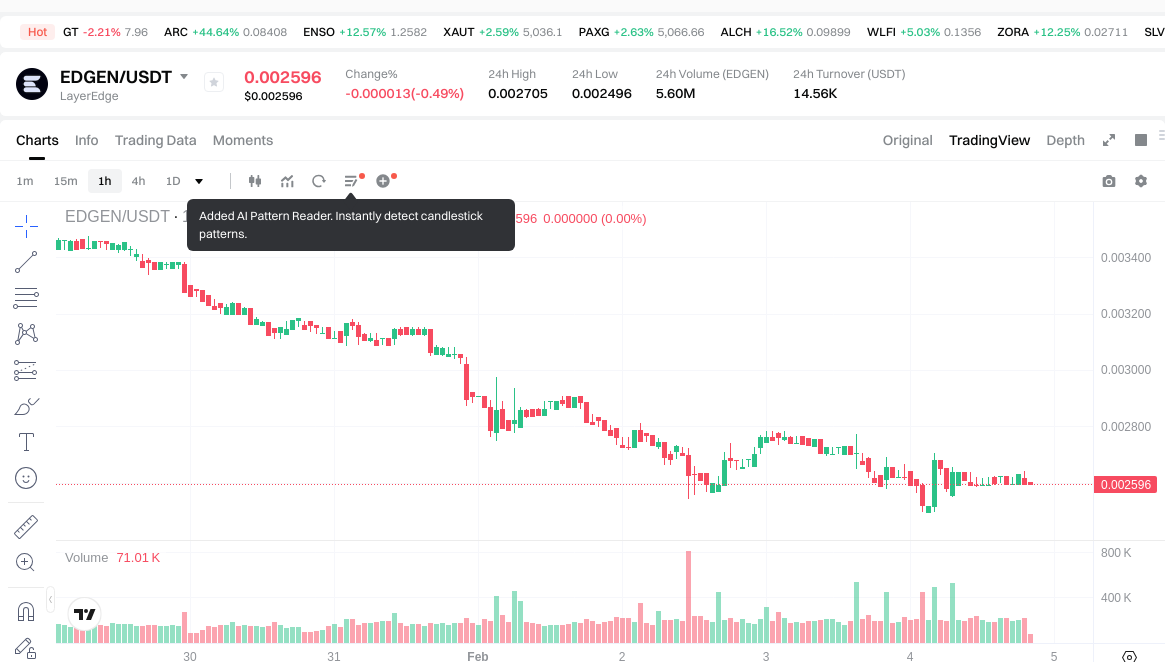
- June 2, 2025: EDGEN launched on trading platforms → Price reached $0.08 during early trading phase
- February 3, 2026: Price declined to $0.002496 → Representing a decrease from June 2025 levels
- February 4, 2026: Market adjustment phase → Price recovered to approximately $0.002603
Current EDGEN Investment Market Status (February 2026)
- EDGEN current price: $0.002603
- Market sentiment (Fear & Greed Index): Data indicates neutral market conditions
- 24-hour trading volume: $15,241.75
- Circulating supply: 260,300,000 EDGEN tokens (26.03% of total supply)
Click to view real-time EDGEN market price
II. Core Factors Influencing Whether EDGEN is a Good Investment
Supply Mechanism and Scarcity (EDGEN Investment Scarcity)
- Total Supply Structure: LayerEdge (EDGEN) has a maximum supply of 1,000,000,000 tokens, with a current circulating supply of 260,300,000 tokens, representing approximately 26.03% of the total supply.
- Circulation Dynamics: The relatively controlled circulation rate may influence price volatility and investment positioning, as the majority of tokens remain outside current market circulation.
- Investment Considerations: The token's supply distribution and release schedule can impact long-term scarcity dynamics, which investors may evaluate when assessing investment potential.
Technological Infrastructure and Ecosystem Development (Technology & Ecosystem for EDGEN Investment)
- Zero-Knowledge Verification Layer: LayerEdge is developing edgenOS, described as a user-driven zero-knowledge verification layer that aims to democratize blockchain verification while leveraging Bitcoin's security foundation.
- Network Architecture: The protocol transforms ordinary devices into verification nodes, creating a distributed ecosystem where participants can contribute to network security.
- Token Utility: EDGEN serves as the operational fuel for edgenOS and the LayerEdge ecosystem, enabling participants to earn rewards for contributing to network security through verification activities.
- User Base: The project reports over 1 million users, with approximately 4,312 token holders as of the current data.
- Price Fluctuations: EDGEN has experienced notable price movements, with a 1-hour change of -0.27%, a 7-day decline of -26.11%, a 30-day decrease of -37.66%, and a 1-year decline of -93.52%.
- Historical Price Range: The token has traded between $0.002496 and $0.08 during its market history.
- Current Valuation Metrics: As of February 4, 2026, EDGEN is priced at $0.002603, with a market capitalization of approximately $677,560.90 and a fully diluted valuation of $2,603,000.
Exchange Accessibility and Liquidity Environment
- Trading Availability: EDGEN is listed on 9 cryptocurrency exchanges, providing various access points for potential investors.
- 24-Hour Trading Volume: The token recorded a trading volume of $15,241.75 over the previous 24-hour period.
- Market Position: EDGEN holds a market share of approximately 0.000096% within the broader cryptocurrency market.
III. EDGEN Future Investment Forecast and Price Outlook (Is LayerEdge(EDGEN) worth investing in 2026-2031)
Short-term Investment Forecast (2026, short-term EDGEN investment outlook)
- Conservative forecast: $0.00223 - $0.00260
- Neutral forecast: $0.00260 - $0.00295
- Optimistic forecast: $0.00295 - $0.00332
Mid-term Investment Outlook (2027-2028, mid-term LayerEdge(EDGEN) investment forecast)
- Market stage expectation: The token may enter a phase of gradual stabilization with potential moderate growth as the edgenOS ecosystem continues its development and user base expansion efforts.
- Investment return forecast:
- 2027: $0.00160 - $0.00331
- 2028: $0.00267 - $0.00323
- Key catalysts: Expansion of verification node network, adoption of zero-knowledge verification technology, and broader integration within the Bitcoin-backed infrastructure ecosystem.
Long-term Investment Outlook (Is EDGEN a good long-term investment?)
- Base scenario: $0.00290 - $0.00455 (assuming steady ecosystem development and moderate user growth)
- Optimistic scenario: $0.00387 - $0.00665 (assuming accelerated adoption of verification layer technology and favorable market conditions)
- Risk scenario: Below $0.00160 (in case of significant setbacks in technology deployment or unfavorable market dynamics)
Click to view EDGEN long-term investment and price forecast: Price Prediction
2026-2031 Long-term Outlook
- Base scenario: $0.00290 - $0.00455 USD (corresponding to steady progress and gradual mainstream application enhancement)
- Optimistic scenario: $0.00387 - $0.00665 USD (corresponding to large-scale adoption and favorable market environment)
- Transformative scenario: Above $0.00665 USD (such as breakthrough ecosystem progress and mainstream popularization)
- December 31, 2031 predicted high: $0.00665 USD (based on optimistic development assumptions)
Disclaimer: The above price forecasts are based on historical data and market analysis models and do not constitute investment advice. Cryptocurrency markets are highly volatile and subject to numerous unpredictable factors. Investors should conduct their own research and risk assessment.
| Year |
Predicted High Price |
Predicted Average Price |
Predicted Low Price |
Price Change |
| 2026 |
0.00332288 |
0.002596 |
0.00223256 |
0 |
| 2027 |
0.0033145728 |
0.00295944 |
0.0015980976 |
13 |
| 2028 |
0.003231116592 |
0.0031370064 |
0.00266645544 |
20 |
| 2029 |
0.00455320793928 |
0.003184061496 |
0.00289749596136 |
22 |
| 2030 |
0.005493461299048 |
0.00386863471764 |
0.00332702585717 |
48 |
| 2031 |
0.006647088171849 |
0.004681048008344 |
0.004072511767259 |
79 |
IV. EDGEN Investment Strategy and Risk Management (How to invest in LayerEdge)
Investment Methodology (EDGEN investment strategy)
Long-term Holding (HODL EDGEN): This approach may be suitable for investors who believe in the long-term vision of LayerEdge's zero-knowledge verification layer and the edgenOS ecosystem. Given that EDGEN serves as the fuel for the LayerEdge ecosystem, participants who are confident in the project's user-driven verification model and its integration with Bitcoin's security foundation might consider accumulating positions over time. However, investors should carefully assess the project's development progress and network growth before committing to a long-term strategy.
Active Trading: Traders employing technical analysis might consider monitoring EDGEN's price movements, which have shown considerable volatility. With a recorded range between $0.002496 and $0.08 historically, and recent 7-day and 30-day declines of approximately 26.11% and 37.66% respectively, active traders may identify potential entry and exit points through chart patterns and momentum indicators. The relatively modest 24-hour trading volume of approximately $15,241.75 suggests traders should be mindful of potential liquidity considerations.
Risk Management (Risk management for EDGEN investment)
Asset Allocation Ratios: Conservative investors might limit EDGEN exposure to 1-3% of their crypto portfolio, given the token's volatility and early stage. Moderate investors comfortable with higher risk could consider 3-7% allocation, while experienced investors with high risk tolerance and deep understanding of zero-knowledge verification infrastructure might allocate up to 10%, always ensuring diversification across different crypto categories.
Risk Hedging Strategies: A diversified portfolio approach should include exposure to established cryptocurrencies alongside smaller projects like EDGEN. Investors might consider balancing EDGEN holdings with more stable assets or stablecoins. Position sizing should reflect individual risk tolerance, and stop-loss mechanisms may be appropriate for active traders managing downside exposure.
Secure Storage: For EDGEN token holders, security practices are essential. The token operates on the Ethereum network as an ERC-20 standard token. Cold storage solutions, including hardware wallets that support Ethereum-based tokens, offer enhanced security for long-term holders. Hot wallets may be convenient for active traders but should maintain only necessary trading amounts. Always verify the official contract address (0xaa9806c938836627ed1a41ae871c7e1889ae02ca) before any transaction to avoid scams or fake tokens.
V. EDGEN Investment Risks and Challenges (Risks of investing in LayerEdge)
Market Risk: EDGEN has demonstrated significant price volatility. The token experienced a substantial decline from its previous level of $0.08 to the current price around $0.002603, representing considerable downward movement. Such volatility is characteristic of smaller market cap tokens and may continue. With a relatively small market capitalization of approximately $677,560 and limited trading volume, EDGEN may be susceptible to price fluctuations from large trades. Investors should prepare for continued volatility and potential further price swings.
Regulatory Risk: As a cryptocurrency project building verification infrastructure, LayerEdge operates in an evolving regulatory landscape. Zero-knowledge proof technologies and blockchain verification systems may face scrutiny in different jurisdictions as regulators develop frameworks for crypto infrastructure. The project's integration with Bitcoin and its positioning as verification infrastructure could intersect with various regulatory considerations across different countries. Policy changes regarding cryptocurrency infrastructure, staking rewards, or token classifications could impact the project's operations and token value.
Technical Risk: LayerEdge's vision of creating a user-driven zero-knowledge verification layer presents technical challenges. The successful implementation of edgenOS, which aims to transform ordinary devices into verification nodes, requires sophisticated technology and network coordination. Any technical vulnerabilities, implementation delays, or security issues in the zero-knowledge verification system could affect network reliability and token value. The project's ability to scale to millions of users while maintaining security and efficiency remains unproven. Smart contract risks associated with the ERC-20 token implementation should also be considered.
VI. Conclusion: Is LayerEdge a Good Investment?
Investment Value Summary: EDGEN represents an investment in emerging zero-knowledge verification infrastructure with an innovative approach to distributed network security. The project aims to democratize blockchain verification through a user-driven model, which presents both opportunity and uncertainty. While the concept of building verification infrastructure on Bitcoin's security foundation has merit, the token has experienced substantial price declines, and its relatively small market presence indicates early-stage risk. The long-term potential depends significantly on the project's ability to execute its technical roadmap and achieve meaningful network adoption.
Investor Recommendations:
✅ Beginners: New investors should approach EDGEN with caution due to its volatility and early-stage status. If interested, consider minimal allocation through dollar-cost averaging, investing only amounts you can afford to lose entirely. Prioritize learning about secure wallet storage and verify all contract addresses before transactions.
✅ Experienced Investors: Those familiar with infrastructure tokens might consider EDGEN as a small speculative position within a diversified portfolio. Monitor project development milestones, network growth metrics, and user adoption indicators. Consider scaling positions based on achievement of technical objectives rather than committing large amounts upfront.
✅ Institutional Investors: Institutional participants should conduct comprehensive due diligence on LayerEdge's technology, team, competitive positioning, and regulatory compliance before considering allocation. Any position should be appropriately sized relative to portfolio risk parameters and may be suitable only for dedicated crypto infrastructure investment strategies.
⚠️ Disclaimer: Cryptocurrency investments involve substantial risk and high volatility. This content is for informational purposes only and does not constitute investment, financial, or legal advice. Past performance does not indicate future results. Conduct thorough research and consider consulting qualified professionals before making investment decisions.
VII. FAQ
Q1: What is LayerEdge (EDGEN) and what problem does it solve?
LayerEdge (EDGEN) is the native token powering edgenOS, which aims to be the world's first people-powered zero-knowledge verification layer. The project addresses the centralization challenges in blockchain verification by transforming ordinary user devices into verification nodes, creating a distributed ecosystem where over 1 million users can contribute to network security while earning rewards. EDGEN operates as an ERC-20 token on the Ethereum network and serves as the operational fuel for the LayerEdge ecosystem, leveraging Bitcoin's security foundation to democratize blockchain verification infrastructure.
Q2: What has been EDGEN's historical price performance?
EDGEN launched at approximately $0.08 in June 2025 but has since experienced significant downward price movement, currently trading around $0.002603 as of February 4, 2026. The token has demonstrated substantial volatility, with declines of 26.11% over the past 7 days, 37.66% over 30 days, and 93.52% over the past year. With a current market capitalization of approximately $677,560 and 24-hour trading volume of $15,241.75, the token reflects the characteristic volatility of emerging blockchain infrastructure projects with relatively limited liquidity.
Q3: What is the token supply structure of EDGEN?
EDGEN has a maximum supply of 1,000,000,000 tokens, with a current circulating supply of 260,300,000 tokens, representing approximately 26.03% of the total supply. This means roughly three-quarters of the total token supply remains outside current market circulation. The controlled circulation rate influences price dynamics and scarcity considerations. The token distribution and release schedule play important roles in long-term supply dynamics, which investors should evaluate when assessing potential scarcity effects and future dilution impacts on token value.
Q4: What are the primary risks associated with investing in EDGEN?
EDGEN carries several significant risks: Market risk includes extreme volatility and price declines from $0.08 to $0.002603, with potential for continued fluctuations due to limited liquidity; Technical risk involves the challenge of successfully implementing complex zero-knowledge verification technology and scaling to millions of users without security vulnerabilities; Regulatory risk encompasses evolving policies regarding crypto infrastructure and verification systems across different jurisdictions. The relatively small market capitalization of approximately $677,560 and limited 24-hour trading volume of $15,241.75 indicate susceptibility to large price swings and execution challenges during trading.
Q5: What is the price forecast for EDGEN through 2031?
Based on market analysis models, EDGEN price projections show varied scenarios: For 2026, forecasts range from $0.00223 (conservative) to $0.00332 (optimistic). Mid-term projections for 2027-2028 range from $0.00160 to $0.00331. Long-term forecasts through 2031 present a base scenario of $0.00290-$0.00455, an optimistic scenario of $0.00387-$0.00665, and a predicted high of $0.00665 by December 31, 2031. However, these projections carry substantial uncertainty as they depend on successful ecosystem development, user adoption, technology implementation, and favorable market conditions. Cryptocurrency markets remain highly unpredictable, and these forecasts should not be interpreted as investment advice.
Q6: How should different investor types approach EDGEN?
Beginners should exercise extreme caution, considering only minimal allocation (if any) through dollar-cost averaging and investing only amounts they can afford to lose entirely, while prioritizing secure wallet storage education. Experienced investors might consider EDGEN as a small speculative position (1-7% of crypto portfolio) within a diversified portfolio, monitoring project milestones and scaling positions based on achieved development objectives. Institutional investors should conduct comprehensive due diligence on technology, team, competitive positioning, and regulatory compliance, sizing any position appropriately relative to portfolio risk parameters and potentially limiting consideration to dedicated crypto infrastructure investment strategies.
Q7: Where can I buy and store EDGEN tokens securely?
EDGEN is currently available on 9 cryptocurrency exchanges, providing multiple access points for potential investors. As an ERC-20 standard token operating on the Ethereum network, EDGEN can be stored in any wallet supporting Ethereum-based tokens. For enhanced security, long-term holders should consider cold storage solutions such as hardware wallets that support ERC-20 tokens. Active traders may use hot wallets for convenience but should maintain only necessary trading amounts. Always verify the official contract address (0xaa9806c938836627ed1a41ae871c7e1889ae02ca) before any transaction to avoid scams or fake tokens. Security practices including secure key management and avoiding sharing private keys remain essential.
Q8: What makes LayerEdge different from other blockchain infrastructure projects?
LayerEdge distinguishes itself through its user-driven approach to zero-knowledge verification, aiming to transform ordinary devices into verification nodes rather than relying on specialized hardware or centralized validators. The project leverages Bitcoin's security foundation while building a democratized verification layer, creating an ecosystem where over 1 million reported users can participate in network security and earn rewards. This people-powered model contrasts with traditional validator-based systems. However, the unique approach also presents implementation challenges, and the project's success depends on achieving technical objectives, maintaining security at scale, and demonstrating practical advantages over established verification mechanisms in the competitive blockchain infrastructure landscape.
* The information is not intended to be and does not constitute financial advice or any other recommendation of any sort offered or endorsed by Gate.