This comprehensive analysis evaluates LightLink (LL), an Ethereum Layer 2 blockchain solution offering gasless transactions, as a potential investment opportunity for 2024-2030. The article examines LL's price trajectory—declining from $0.3 at April 2024 launch to approximately $0.004293 by February 2026—alongside fundamental factors including enterprise adoption potential, fixed token supply mechanisms, and proprietary Layer 2 technology. Price forecasts range from conservative ($0.00356-$0.00604 in 2026) to optimistic scenarios ($0.01137+ by 2030), contingent on ecosystem expansion and mainstream adoption. The guide addresses investment strategies for different risk profiles, from dollar-cost averaging for beginners to swing trading for experienced investors, while highlighting critical risks: extreme volatility, regulatory uncertainty, technical vulnerabilities, and limited exchange liquidity. Investors should view LL as a speculative, high-risk allocation within diversified Layer 2 portfolios on Gate exch
Introduction: LightLink (LL) Investment Position and Market Outlook
LightLink (LL) is a notable asset in the cryptocurrency sector. Positioned as an Ethereum Layer 2 blockchain solution, LightLink provides instant, gasless transactions for dApps and enterprise users. As of February 2026, LL holds a market capitalization of approximately $1.79 million, with a circulating supply of around 417.88 million tokens. The current price stands at approximately $0.004293. With its focus on enabling seamless blockchain experiences through proprietary Layer 2 technology, LightLink has become a point of discussion among investors exploring "Is LightLink (LL) a good investment?" This article comprehensively analyzes LL's investment value, historical performance trends, future price projections, and associated investment risks to provide reference points for potential investors.
I. LightLink (LL) Price History Review and Current Investment Value
- 2024: LL launched on exchanges in April → Price started at $0.3, marking initial market entry
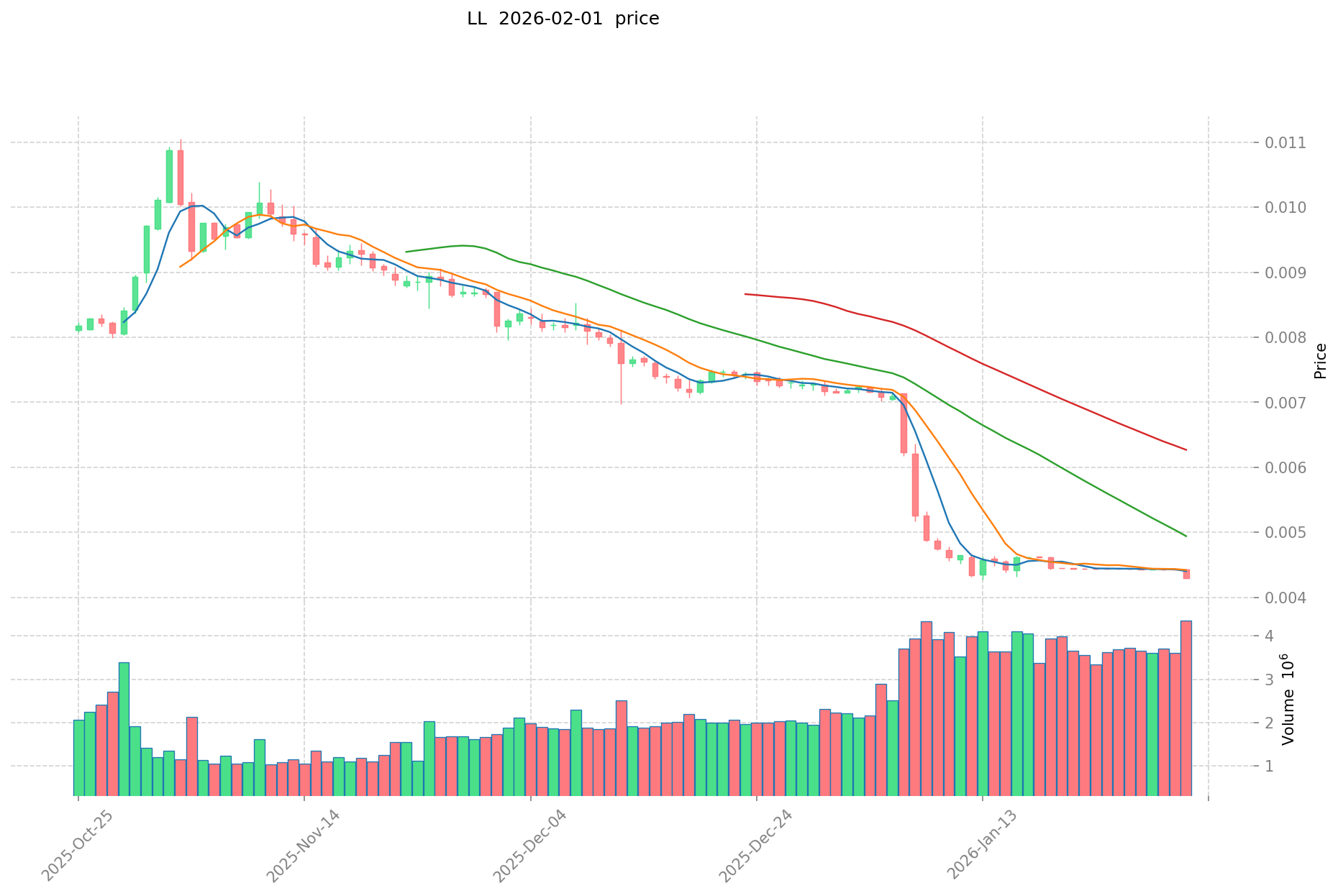
- 2024-2026: Market volatility period → Price declined from $0.3 to current levels around $0.004293
- 2026: Current trading cycle → LL trading near $0.004265, reflecting significant price adjustment from launch levels
Current LL Investment Market Status (February 2026)
- LL current price: $0.004293
- Market sentiment (Fear & Greed Index): Not available in provided data
- 24-hour trading volume: $21,191.00
- Market capitalization: $1,793,970.75
- Circulating supply: 417,882,774.68 LL (41.79% of total supply)
- Fully diluted valuation: $4,293,000.00
Click to view real-time LL market price
II. Core Factors Influencing Whether LL is a Good Investment (Is LightLink(LL) a Good Investment)
Supply Mechanism and Scarcity (LL investment scarcity)
- Total supply capped at 1,000,000,000 LL tokens with a maximum supply limit → influences price dynamics and investment valuation
- Current circulating supply represents approximately 41.79% of total supply, with 417,882,774 tokens in circulation as of February 1, 2026
- Investment significance: the fixed supply cap and gradual token release schedule may contribute to potential scarcity characteristics over time
Institutional Investment and Mainstream Adoption (Institutional investment in LL)
- Current holder count stands at 4,937 addresses, reflecting early-stage adoption levels
- LightLink has been developing blockchain solutions for major enterprises in the APAC region since 2017, establishing enterprise partnerships
- The platform's focus on connecting dApps with enterprise users positions it within the business adoption narrative
Macroeconomic Environment's Impact on LL Investment
- Monetary policy shifts and interest rate changes may affect risk appetite for Layer 2 blockchain investments
- Broader cryptocurrency market conditions influence LightLink's investment attractiveness as part of the Ethereum ecosystem
- Regulatory developments in blockchain technology across different jurisdictions could impact long-term investment considerations
Technology and Ecosystem Development (Technology & Ecosystem for LL investment)
- Layer 2 blockchain architecture: LightLink operates as an Ethereum Layer 2 solution offering instant, gasless transactions → technical differentiation in the scaling solutions market
- Proprietary stack development: the platform utilizes custom-built infrastructure aimed at improving interoperability between dApps and enterprise systems
- Enterprise integration focus: LightLink's strategy emphasizes bridging decentralized applications with traditional business users, potentially expanding use cases beyond typical DeFi applications
III. LL Future Investment Forecast and Price Outlook (Is LightLink(LL) worth investing in 2026-2030)
Short-term Investment Forecast (2026, short-term LL investment outlook)
- Conservative forecast: $0.00356 - $0.00463
- Neutral forecast: $0.00414 - $0.00604
- Optimistic forecast: $0.00508 - $0.00604
Mid-term Investment Outlook (2027-2028, mid-term LightLink(LL) investment forecast)
- Market stage expectation: LL may experience gradual recovery with potential ecosystem expansion and enterprise adoption growth. Technical developments and Layer 2 scalability improvements could influence market sentiment during this period.
- Investment return forecast:
- 2027: $0.00371 - $0.00758
- 2028: $0.00374 - $0.00760
- Key catalysts: Enterprise partnership expansion, Layer 2 technology adoption, broader dApp integration, and market recovery momentum.
Long-term Investment Outlook (Is LightLink a good long-term investment?)
- Base scenario: $0.00457 - $0.01065 (assuming steady ecosystem development and moderate market conditions)
- Optimistic scenario: $0.00641 - $0.01137 (assuming accelerated adoption, favorable market environment, and significant technological breakthroughs)
- Risk scenario: $0.00356 - $0.00457 (under challenging market conditions or slower-than-expected adoption)
Click to view LL long-term investment and price forecast: Price Prediction
2026-2030 Long-term Outlook
- Base scenario: $0.00457 - $0.01065 (corresponding to steady progress and gradual mainstream application improvement)
- Optimistic scenario: $0.00641 - $0.01137 (corresponding to large-scale adoption and favorable market environment)
- Transformative scenario: Above $0.01137 (if ecosystem achieves breakthrough progress and mainstream adoption)
- 2030-12-31 predicted high: $0.01065 (based on optimistic development assumptions)
Disclaimer: These forecasts are based on historical data analysis and predictive models. Cryptocurrency markets are highly volatile and subject to numerous unpredictable factors. Past performance does not guarantee future results. Investors should conduct thorough research and consider their risk tolerance before making investment decisions.
| Year |
Predicted High Price |
Predicted Average Price |
Predicted Low Price |
Price Change |
| 2026 |
0.00604002 |
0.004137 |
0.00355782 |
-3 |
| 2027 |
0.0075818799 |
0.00508851 |
0.0037146123 |
18 |
| 2028 |
0.00760223394 |
0.00633519495 |
0.0037377650205 |
47 |
| 2029 |
0.0075262116006 |
0.006968714445 |
0.0064112172894 |
62 |
| 2030 |
0.010653770643516 |
0.0072474630228 |
0.004565901704364 |
68 |
| 2031 |
0.01136728337811 |
0.008950616833158 |
0.007339505803189 |
108 |
IV. LightLink Investment Strategy and Risk Management (How to invest in Layer 2 blockchain)
Investment Methodology (LightLink investment strategy)
-
Long-term Holding (HODL LL): Suitable for conservative investors
Long-term holding strategy involves accumulating LL tokens during price corrections and maintaining positions through market cycles. This approach may benefit investors who believe in the fundamental value proposition of gasless transactions and enterprise adoption potential.
-
Active Trading: Relies on technical analysis and swing trading
Active traders may leverage LL's price movements, which have shown notable volatility with a 24-hour range between $0.004265 and $0.004424. Short-term trading strategies require monitoring of volume patterns, with current 24-hour trading volume at approximately $21,191.
Risk Management (Risk management for LL investment)
-
Asset Allocation Ratio: Conservative / Aggressive / Professional investors
Conservative investors might consider allocating 1-3% of their crypto portfolio to LL, while aggressive investors could increase exposure to 5-10%. Professional investors with higher risk tolerance may adjust allocations based on market conditions and enterprise partnership developments.
-
Risk Hedging Solutions: Multi-asset portfolio + hedging instruments
Diversification across established Layer 1 networks and other Layer 2 solutions can help mitigate LL-specific risks. Investors may consider pairing LL holdings with stablecoins or established cryptocurrencies to balance portfolio volatility.
-
Secure Storage: Hot/cold wallets + hardware wallet recommendations
As an ERC20 token deployed on Ethereum (contract address: 0x0921799cb1d702148131024d18fcde022129dc73), LL can be stored in Ethereum-compatible wallets. Hardware wallets such as Ledger or Trezor offer enhanced security for long-term holdings, while software wallets may suit traders requiring frequent access.
V. LightLink Investment Risks and Challenges (Risks of investing in Layer 2 blockchain)
-
Market Risk: High volatility and price manipulation concerns
LL has experienced substantial price fluctuations, with a 30-day decline of 40.52% and a 1-year decrease of 84.6%. The token's relatively low market capitalization of approximately $1.79 million and limited exchange availability (listed on 2 exchanges) may contribute to heightened volatility and lower liquidity compared to established assets.
-
Regulatory Risk: Policy uncertainty across different jurisdictions
Layer 2 blockchain solutions face evolving regulatory frameworks globally. Changes in cryptocurrency regulations, particularly regarding enterprise blockchain applications and cross-border transactions, could impact LightLink's business model and token utility.
-
Technical Risk: Network security vulnerabilities and upgrade failures
As a Layer 2 solution built on proprietary technology stack, LightLink faces technical implementation risks. Potential security vulnerabilities, smart contract bugs, or challenges in maintaining compatibility with Ethereum's evolving infrastructure could affect network reliability and user confidence.
VI. Conclusion: Is Layer 2 blockchain a Good Investment?
-
Investment Value Summary: LightLink presents a long-term investment thesis centered on gasless transactions and enterprise adoption, though the token has experienced considerable short-term price volatility.
-
Investor Recommendations:
✅ Beginners: Dollar-cost averaging + secure wallet storage
New investors should consider gradual accumulation strategies to mitigate timing risk, combined with proper security practices using hardware or reputable software wallets compatible with ERC20 tokens.
✅ Experienced Investors: Swing trading + portfolio diversification
Seasoned traders may capitalize on LL's price movements while maintaining diversified holdings across multiple blockchain layers and crypto asset categories to manage concentration risk.
✅ Institutional Investors: Strategic long-term allocation
Institutional participants might evaluate LL as part of a broader Layer 2 ecosystem exposure, considering factors such as enterprise partnership developments and technological differentiation within the scaling solutions landscape.
⚠️ Disclaimer: Cryptocurrency investment carries substantial risk. This content is for informational purposes only and does not constitute investment advice.
VII. FAQ
Q1: What is LightLink (LL) and how does it differ from other Layer 2 solutions?
LightLink is an Ethereum Layer 2 blockchain that offers instant, gasless transactions for decentralized applications and enterprise users. Unlike many Layer 2 solutions that focus primarily on DeFi applications, LightLink has been developing blockchain solutions for major enterprises in the APAC region since 2017, positioning itself as a bridge between dApps and traditional business users. The platform utilizes a proprietary technology stack aimed at improving interoperability, with its primary differentiation being the gasless transaction model that removes friction for end users.
Q2: Why has LL's price declined significantly from its launch price?
The token launched in April 2024 at approximately $0.3 and has declined to around $0.004293 as of February 2026, representing a substantial correction. This price movement reflects several factors: initial market overvaluation during launch, broader cryptocurrency market volatility, and the early-stage nature of the project. The 30-day decline of 40.52% and 1-year decrease of 84.6% indicate challenging market conditions and the adjustment period typical for newly launched tokens. Additionally, with only 2 exchange listings and a relatively small market capitalization of $1.79 million, liquidity constraints may amplify price movements.
Q3: What are the key risks associated with investing in LightLink?
The primary risks include high price volatility due to low market capitalization and limited exchange availability, regulatory uncertainty affecting Layer 2 solutions and enterprise blockchain applications, and technical implementation risks inherent in proprietary blockchain infrastructure. The circulating supply represents only 41.79% of the total supply, meaning future token releases could create selling pressure. Additionally, with 4,937 holders, the adoption base remains relatively small, and the project faces significant competition from established Layer 2 solutions such as Arbitrum, Optimism, and Polygon.
Q4: How should investors approach position sizing for LL?
Conservative investors should consider allocating 1-3% of their cryptocurrency portfolio to LL, reflecting the high-risk nature of the asset. Aggressive investors with higher risk tolerance might increase exposure to 5-10%, though this should be balanced against the token's volatility and liquidity constraints. Professional investors may adjust allocations dynamically based on enterprise partnership developments and market conditions. Regardless of risk profile, investors should avoid concentration risk and maintain diversification across established Layer 1 networks and other blockchain assets.
Q5: What factors could drive LL's price recovery in the future?
Potential catalysts for price appreciation include expansion of enterprise partnerships leveraging the gasless transaction model, increased dApp integration with the platform, broader Layer 2 adoption trends benefiting the entire sector, and technological improvements to the proprietary infrastructure. The base case forecast suggests gradual recovery to $0.00457-$0.01065 by 2030, assuming steady ecosystem development. However, this outlook depends heavily on LightLink's ability to differentiate its offering, expand its user base beyond current 4,937 holders, and secure additional exchange listings to improve liquidity.
Q6: What storage options are recommended for LL tokens?
As an ERC20 token deployed on Ethereum (contract address: 0x0921799cb1d702148131024d18fcde022129dc73), LL can be stored in any Ethereum-compatible wallet. For long-term holdings, hardware wallets such as Ledger or Trezor offer enhanced security against online threats. Software wallets like MetaMask or Trust Wallet provide convenient access for traders requiring frequent transactions. Investors should avoid keeping significant amounts on exchanges due to custodial risks, particularly given LL's limited exchange availability. Proper backup of recovery phrases and multi-signature setups are recommended for larger holdings.
Q7: How does the circulating supply impact LL's investment potential?
Currently, 417.88 million tokens are in circulation, representing 41.79% of the 1 billion total supply cap. This means approximately 582 million tokens remain to be released, which could create downward price pressure as they enter circulation. However, the fixed maximum supply of 1 billion tokens provides a scarcity element compared to assets with unlimited supply. The gradual token release schedule may allow the market to absorb new supply if accompanied by growing demand from enterprise adoption and dApp integration. Investors should monitor the token unlock schedule and vesting periods to anticipate potential supply-side pressure.
Q8: What is a realistic investment timeline for LL?
Short-term investors (2026) face significant uncertainty with conservative forecasts ranging from $0.00356-$0.00604, reflecting ongoing market volatility. Mid-term investors (2027-2028) may benefit from potential ecosystem expansion, with forecasts suggesting gradual recovery to $0.00371-$0.00760 range as enterprise partnerships mature. Long-term investors (2030 and beyond) should view LL as a speculative allocation within a broader Layer 2 thesis, with base case projections reaching $0.00457-$0.01065. The transformative scenario above $0.01137 requires breakthrough adoption and favorable market conditions. Given the high-risk profile, investors should maintain realistic expectations and avoid allocation beyond their risk tolerance.
* The information is not intended to be and does not constitute financial advice or any other recommendation of any sort offered or endorsed by Gate.