Lucky Block (LBLOCK) is an Ethereum-based NFT competition platform offering prize rewards for NFT holders, currently trading at $0.000009343 with a market cap of $934,300. This comprehensive analysis examines LBLOCK's investment potential across multiple dimensions: price history shows significant volatility with 35.69% yearly decline, while the fixed 100 billion token supply eliminates inflationary pressure. The article evaluates core investment factors including institutional adoption, macroeconomic impacts, and ecosystem development, then provides price forecasts ranging from conservative to transformative scenarios through 2031. A detailed investment framework addresses position sizing strategies for different investor profiles—conservative (1-3% allocation), aggressive (5-10%), and professional (10-15%)—alongside risk management approaches covering market volatility, regulatory uncertainty, and technical vulnerabilities. The analysis concludes that LBLOCK suits high-risk investors seeking exposure to eme
Introduction: Lucky Block (LBLOCK) Investment Position and Market Outlook
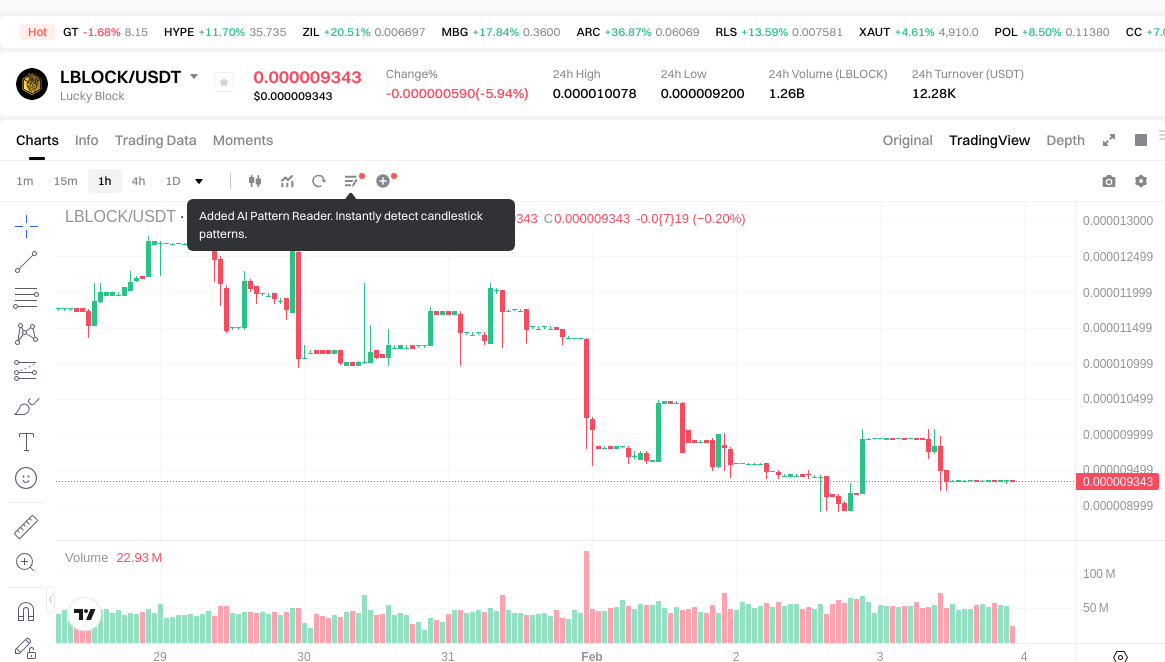
Lucky Block (LBLOCK) operates as an NFT competitions platform in the cryptocurrency sector, where participants can win prizes and receive rewards through NFT ownership. As of February 3, 2026, LBLOCK maintains a market capitalization of approximately $934,300, with a circulating supply of 100 billion tokens and a current trading price around $0.000009343. The token holds a market ranking of 2556, with a 24-hour trading volume of approximately $12,309. Positioning itself as an NFT-based reward platform, LBLOCK has attracted 3,675 holders and gradually become a subject of discussion when investors evaluate "Is Lucky Block (LBLOCK) a good investment?" This article provides a comprehensive analysis of LBLOCK's investment value, historical price movements, future price predictions, and associated investment risks to serve as a reference for potential investors.
I. LBLOCK Price History Review and Current Investment Value
- 2022: LBLOCK experienced price volatility during its early trading phase → Token price showed significant fluctuation patterns
- 2025: Market conditions led to price adjustments → LBLOCK price moved within a range showing decreased valuation from earlier periods
Current LBLOCK Investment Market Status (February 2026)
- LBLOCK current price: $0.000009343
- 24-hour trading volume: $12,309.63
- Circulating supply: 100,000,000,000 LBLOCK
- Market capitalization: $934,300
- Price changes: +0.2% (1H), -5.94% (24H), -20.46% (7D), -38.29% (30D), -35.69% (1Y)
- Token holders: 3,675
Click to view real-time LBLOCK market price
II. Core Factors Influencing Whether LBLOCK is a Good Investment (Is Lucky Block(LBLOCK) a Good Investment)
Supply Mechanism and Scarcity (LBLOCK investment scarcity)
- Fixed Maximum Supply: Lucky Block has a maximum supply of 100 billion LBLOCK tokens, with 100% currently in circulation
- Supply dynamics: The fully circulating supply (100 billion tokens) means there is no future inflationary pressure from additional token releases
- Investment significance: The complete circulation and capped supply structure provides a clear supply framework for investors to evaluate
Institutional Investment and Mainstream Adoption (Institutional investment in LBLOCK)
- Holder base: As of 2026-02-03, Lucky Block has 3,675 token holders
- Platform positioning: Lucky Block operates as an NFT competitions platform where participants can win prizes and receive rewards for holding Lucky Block NFTs
- Market presence: LBLOCK is currently listed on at least one cryptocurrency exchange with trading activity
Macroeconomic Environment's Impact on LBLOCK Investment
- Market volatility: LBLOCK has shown significant price fluctuations, with declines of 5.94% in 24 hours, 20.46% over 7 days, 38.29% over 30 days, and 35.69% over 1 year
- Historical price range: The token has experienced considerable volatility, with prices ranging between $0.000000067315 and $0.00974554 since inception
- Current market conditions: As of 2026-02-03, LBLOCK trades at $0.000009343 with a market capitalization of $934,300, representing 0.000033% market share
Technology and Ecosystem Development (Technology & Ecosystem for LBLOCK investment)
- Platform functionality: Lucky Block operates as a market-leading NFT competitions platform, allowing players to participate in competitions and earn rewards through NFT ownership
- Technical infrastructure: LBLOCK is deployed on the Ethereum blockchain at contract address 0x2b867efD2dE4Ad2B583Ca0CB3dF9C4040Ef4D329
- Application focus: The platform concentrates on NFT-based competition mechanics, creating a specific use case within the digital asset ecosystem
III. LBLOCK Future Investment Forecast and Price Outlook (Is Lucky Block(LBLOCK) worth investing in 2026-2031)
Short-term Investment Forecast (2026, short-term LBLOCK investment outlook)
- Conservative forecast: $0.0000072 - $0.0000094
- Neutral forecast: $0.0000094 - $0.0000110
- Optimistic forecast: $0.0000110 - $0.0000130
Mid-term Investment Outlook (2027-2028, mid-term Lucky Block(LBLOCK) investment forecast)
-
Market stage expectation: Based on available data, LBLOCK may experience gradual growth driven by platform expansion and potential increases in NFT competition participation. The token appears to be in an early-stage development phase with focus on user acquisition.
-
Investment return forecast:
- 2027: $0.0000085 - $0.0000126 (approximately 19% potential increase from 2026 baseline)
- 2028: $0.0000103 - $0.0000131 (approximately 27% potential increase from 2026 baseline)
-
Key catalysts: Platform expansion initiatives, strategic partnership development, increased global user engagement in NFT-based competitions, and broader adoption of the Lucky Block NFT ecosystem.
Long-term Investment Outlook (Is LBLOCK a good long-term investment?)
- Base scenario: $0.0000080 - $0.0000130 (assuming steady platform development and moderate user growth through 2030)
- Optimistic scenario: $0.0000130 - $0.0000183 (assuming successful platform expansion, enhanced strategic partnerships, and increased transparency in NFT competitions attracting larger audiences)
- Risk scenario: $0.0000072 - $0.0000090 (under conditions of limited adoption growth, increased market competition, or unfavorable crypto market conditions)
Click to view LBLOCK long-term investment and price forecast: Price Prediction
2026-2031 Long-term Outlook
- Base scenario: $0.0000080 - $0.0000129 USD (corresponding to steady progress and gradual mainstream application advancement)
- Optimistic scenario: $0.0000130 - $0.0000183 USD (corresponding to large-scale adoption and favorable market environment)
- Transformative scenario: Above $0.0000210 USD (if ecosystem achieves breakthrough developments and mainstream popularization)
- 2031-12-31 forecast high: $0.0000211 USD (based on optimistic development assumptions)
Disclaimer: These forecasts are based on historical data analysis and market trend projections. Cryptocurrency investments carry substantial risk, and past performance does not guarantee future results. Price predictions should not be considered as investment advice. Investors should conduct thorough research and consider their risk tolerance before making investment decisions.
| Year |
Predicted High Price |
Predicted Average Price |
Predicted Low Price |
Price Change |
| 2026 |
0.00001298677 |
0.000009343 |
0.00000719411 |
0 |
| 2027 |
0.00001261632005 |
0.000011164885 |
0.0000084853126 |
19 |
| 2028 |
0.000013079662777 |
0.000011890602525 |
0.000010344824196 |
27 |
| 2029 |
0.000013359091936 |
0.000012485132651 |
0.000008989295508 |
33 |
| 2030 |
0.000018349399457 |
0.000012922112294 |
0.000008011709622 |
38 |
| 2031 |
0.000021108270432 |
0.000015635755875 |
0.000008286950614 |
67 |
Investment Methodology (Lucky Block investment strategy)
-
Long-term Holding (HODL LBLOCK): Suitable for conservative investors
Long-term holding strategies may appeal to investors who believe in the potential growth of NFT-based competition platforms. This approach requires patience and tolerance for price fluctuations, as LBLOCK has experienced notable volatility with a historical high of $0.00974554 and a historical low of $0.000000067315.
-
Active Trading: Relies on technical analysis and swing trading
Active traders may leverage technical indicators and market momentum to capitalize on short-term price movements. Given LBLOCK's 24-hour trading volume of approximately $12,309.63 and recent price fluctuations (ranging from $0.0000092 to $0.000010078 in 24 hours), swing trading opportunities may present themselves, though liquidity considerations should be evaluated.
Risk Management (Risk management for LBLOCK investment)
-
Asset Allocation Ratios: Conservative / Aggressive / Professional investors
- Conservative investors: Consider allocating a minimal percentage (1-3%) of the crypto portfolio to LBLOCK
- Aggressive investors: May allocate a moderate percentage (5-10%) while maintaining awareness of volatility risks
- Professional investors: Could consider higher allocations (10-15%) with active monitoring and hedging strategies
-
Risk Hedging Solutions: Multi-asset portfolio + hedging instruments
Diversification across different cryptocurrency categories and traditional assets may help mitigate concentration risk. Investors might consider pairing LBLOCK positions with more established cryptocurrencies or stablecoins to balance portfolio volatility.
-
Secure Storage: Hot/cold wallets + hardware wallet recommendations
LBLOCK tokens are deployed on the Ethereum network (contract address: 0x2b867efD2dE4Ad2B583Ca0CB3dF9C4040Ef4D329). Investors should consider:
- Hardware wallets (such as Ledger or Trezor) for long-term holdings
- Reputable software wallets with multi-signature capabilities for moderate holdings
- Limited amounts in exchange wallets for active trading purposes only
-
Market Risks: High volatility, potential price manipulation
LBLOCK has demonstrated substantial price volatility, with a 7-day decline of approximately 20.46% and a 30-day decline of approximately 38.29% as of the current reference period. The relatively modest market capitalization of around $934,300 and limited exchange availability (1 exchange) may contribute to price volatility and potential susceptibility to large order impacts.
-
Regulatory Risks: Policy uncertainty across different jurisdictions
NFT and gaming-related tokens face evolving regulatory landscapes globally. Different countries maintain varying stances on digital assets, NFTs, and online gaming platforms, which could affect Lucky Block's operational model and token utility.
-
Technical Risks: Network security vulnerabilities, upgrade failures
As an Ethereum-based token, LBLOCK's security depends partially on the Ethereum network's integrity. Additionally, platform-specific risks related to the NFT competition mechanism, smart contract vulnerabilities, and potential technical issues in the competition infrastructure should be considered.
-
Investment Value Summary: Lucky Block operates in the emerging NFT competition platform sector, which presents both opportunities and uncertainties. The platform's unique model of rewarding NFT holders through competitions offers differentiation, though the token has experienced considerable price declines over recent periods.
-
Investor Recommendations:
✅ Beginners: Dollar-cost averaging + secure wallet storage
- Consider small, regular purchases to mitigate timing risk
- Prioritize security by transferring tokens to self-custody wallets
- Allocate only funds you can afford to lose entirely
✅ Experienced Investors: Swing trading + portfolio diversification
- Monitor technical indicators and trading volume patterns
- Maintain balanced exposure across multiple crypto categories
- Set clear stop-loss levels to manage downside risk
✅ Institutional Investors: Strategic long-term allocation considerations
- Conduct thorough due diligence on platform fundamentals and competition mechanisms
- Evaluate market positioning within the broader NFT and gaming sectors
- Consider position sizing relative to overall crypto allocation strategy
⚠️ Disclaimer: Cryptocurrency investments carry substantial risk, including potential complete loss of capital. This content is for informational purposes only and does not constitute investment advice. Investors should conduct independent research and consult with financial professionals before making investment decisions.
VII. FAQ
Q1: Is Lucky Block (LBLOCK) a good investment for beginners in 2026?
LBLOCK may be suitable for beginners only as a high-risk, speculative allocation representing no more than 1-3% of their crypto portfolio. The token has experienced significant volatility with a 38.29% decline over 30 days and 35.69% decline over one year as of February 2026. With a modest market cap of $934,300 and limited liquidity ($12,309 in 24-hour trading volume), beginners should employ dollar-cost averaging strategies and prioritize secure wallet storage. Given the token's historical price range from $0.000000067315 to $0.00974554, new investors must be prepared for substantial price fluctuations and should only invest funds they can afford to lose completely.
Q2: What factors determine LBLOCK's long-term investment potential through 2031?
LBLOCK's long-term investment value depends primarily on platform adoption rates, NFT competition participation growth, and ecosystem expansion. With 3,675 current holders and a fully circulated supply of 100 billion tokens, the scarcity model is transparent but requires user base expansion to drive demand. Price forecasts suggest a range from $0.0000080 to $0.0000183 by 2031 under base and optimistic scenarios, representing potential growth of 67% from current levels under favorable conditions. Key catalysts include strategic partnership development, increased global engagement in NFT-based competitions, and successful platform expansion initiatives. However, investors should note that these projections are speculative and subject to market conditions, regulatory developments, and competitive dynamics within the NFT platform sector.
Q3: How does LBLOCK's supply mechanism affect its investment value?
LBLOCK has a fixed maximum supply of 100 billion tokens with 100% already in circulation, eliminating future inflationary pressure from new token releases. This complete circulation provides clarity for supply-side analysis and means price movements will be driven primarily by demand factors rather than supply expansion. Unlike cryptocurrencies with ongoing emission schedules, LBLOCK's fully circulated structure prevents dilution of existing holdings. However, the large absolute supply number (100 billion tokens) means significant demand increases would be necessary to drive substantial per-token price appreciation. The current market capitalization of $934,300 represents approximately 0.000033% market share, indicating substantial room for growth if platform adoption accelerates, though equally highlighting early-stage risks.
Q4: What are the primary risks associated with investing in Lucky Block?
LBLOCK investment carries several significant risks: (1) Market Risk - substantial price volatility evidenced by recent declines of 20.46% over 7 days and 38.29% over 30 days, combined with limited liquidity that may amplify price swings; (2) Platform Risk - dependence on sustained growth of NFT competition participation and user engagement with no guarantee of mainstream adoption; (3) Regulatory Risk - uncertain policy landscapes across jurisdictions regarding NFT-based gaming and competition platforms; (4) Technical Risk - reliance on Ethereum network security and potential smart contract vulnerabilities in competition mechanisms; (5) Competitive Risk - emergence of alternative NFT competition platforms or shifting user preferences. The token's listing on only one exchange and modest holder base of 3,675 also present liquidity and concentration risks that investors must carefully consider.
Q5: How should investors approach LBLOCK position sizing and portfolio allocation?
Position sizing for LBLOCK should reflect individual risk tolerance and investment experience levels. Conservative investors should limit LBLOCK to 1-3% of their crypto portfolio, treating it as a speculative allocation with high risk-reward potential. Aggressive investors might consider 5-10% allocation while maintaining active monitoring and strict stop-loss disciplines given recent volatility patterns. Professional investors could allocate 10-15% with hedging strategies and regular rebalancing protocols. All investors should implement diversification across multiple cryptocurrency categories and consider pairing LBLOCK positions with more established cryptocurrencies or stablecoins to balance portfolio volatility. Given LBLOCK's Ethereum-based infrastructure (contract address: 0x2b867efD2dE4Ad2B583Ca0CB3dF9C4040Ef4D329), investors should prioritize security through hardware wallets for long-term holdings and limit exchange wallet exposure to active trading amounts only.
Q6: What distinguishes Lucky Block from other NFT platform investments?
Lucky Block differentiates itself through its NFT-based competition and reward mechanism, where participants can win prizes and receive rewards for holding Lucky Block NFTs rather than solely focusing on NFT trading or collections. This utility-driven model creates ongoing engagement incentives beyond speculative trading. However, the platform operates in a competitive landscape with numerous NFT and gaming projects vying for user attention. Its current market positioning with a ranking of 2556 and market cap under $1 million indicates early-stage status compared to established NFT platforms. The platform's success depends on its ability to attract and retain active participants in NFT competitions, develop strategic partnerships, and expand its user base from the current 3,675 holders. Investors should evaluate LBLOCK's competitive advantages against similar platforms in terms of prize structures, competition transparency, user experience, and ecosystem development roadmap when assessing long-term investment potential.
* The information is not intended to be and does not constitute financial advice or any other recommendation of any sort offered or endorsed by Gate.