This comprehensive guide analyzes whether Muse (MUSE) represents a viable investment opportunity within the NFT infrastructure sector. The article examines MUSE's historical price performance—including a dramatic 97.18% decline over the past year—current market position with a $240,253 market capitalization, and its role as the governance token for the NFT20 decentralized exchange protocol. The analysis evaluates critical investment factors including tokenomics with 82.76% circulating supply, limited liquidity from a single exchange listing, and smart contract vulnerabilities alongside fee-sharing mechanisms. Price projections through 2030 range from conservative scenarios at $0.28-$0.42 to optimistic outlooks reaching $0.46 USD. The guide provides tailored investment strategies for beginners, experienced traders, and institutional investors, emphasizing strict risk management given MUSE's extreme volatility and micro-cap status. Detailed risk assessment covers market manipulation potential, regulatory uncert
Introduction: Muse (MUSE) Investment Position and Market Outlook
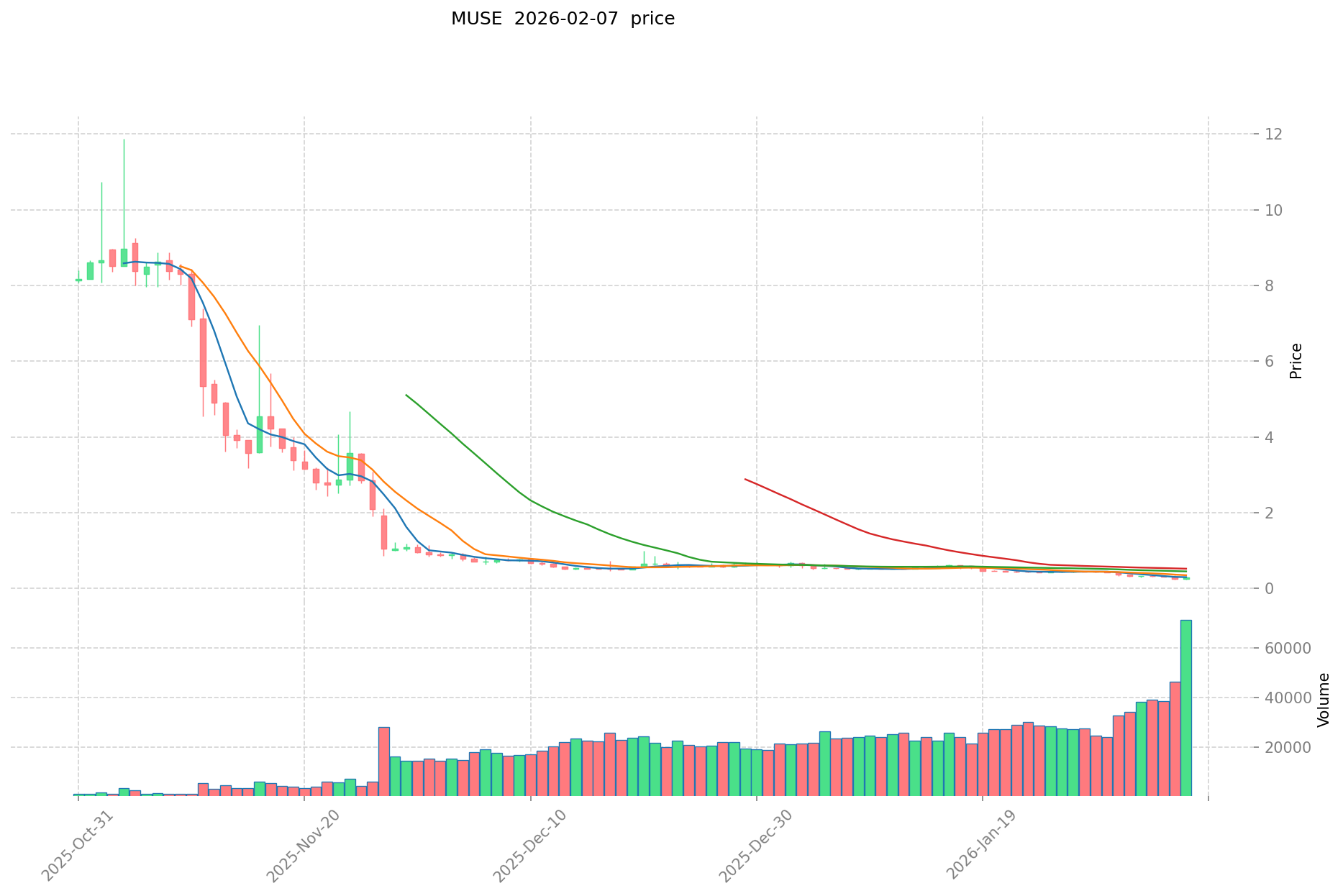
Muse is a notable asset in the cryptocurrency sector, having been launched in 2021 and establishing its presence within the NFT tokenization and decentralized exchange governance space. As of February 8, 2026, MUSE maintains a market capitalization of approximately $240,253, with a circulating supply of around 827,602 tokens and a current price near $0.2903. Positioned as a governance token for the NFT20 decentralized exchange protocol, MUSE has become a subject of interest among investors exploring "Is Muse (MUSE) a good investment?" This article provides a comprehensive analysis of MUSE's investment characteristics, historical price movements, future price outlook, and associated risks, offering reference points for investors considering this asset.
I. MUSE Price History Review and Investment Value Status
- 2021: March 14th recorded peak price of $124.14 → Early investors achieved substantial returns
- 2021: January 22nd reached minimum price of $0.124326 → Demonstrated extreme volatility in price movements
- 2025: Price declined to approximately $0.29 → Market experienced significant correction from previous peaks
Current MUSE Investment Market Status (February 2026)
- MUSE current price: $0.2903
- 24-hour trading volume: $20,761.49
- Circulating supply: 827,602.74 MUSE
- Market capitalization: $240,253.08
Click to view real-time MUSE market price
II. Core Factors Affecting Whether MUSE is a Good Investment
Supply Mechanism and Scarcity (MUSE investment scarcity)
- Maximum supply capped at 1,000,000 MUSE tokens, with current circulating supply of approximately 827,603 tokens (82.76% of max supply) → influences price dynamics and investment considerations
- Total supply stands at 829,194 tokens, indicating minimal unreleased tokens remaining in the emission schedule
- Investment consideration: The high circulation ratio suggests limited additional supply pressure, though scarcity alone does not guarantee value appreciation
Institutional Investment and Mainstream Adoption (Institutional investment in MUSE)
- Current holder count stands at 3,943 addresses, reflecting a relatively concentrated user base
- Trading availability limited to 1 exchange, which may constrain liquidity and institutional access compared to more widely distributed assets
- Market capitalization of approximately $240,253 represents a micro-cap position, which typically correlates with higher volatility and lower institutional participation
Macroeconomic Environment's Impact on MUSE Investment
- As a small-cap NFT governance token, MUSE's performance is influenced by broader cryptocurrency market sentiment and risk appetite
- Market conditions in early 2026 show declining trends, with MUSE experiencing a 7-day decline of 21.03% and a 30-day decline of 42.88%
- The token's correlation with NFT market cycles may amplify sensitivity to changes in digital collectibles sector performance
Technology and Ecosystem Development (Technology & Ecosystem for MUSE investment)
- NFT20 Protocol: Functions as a permissionless peer-to-peer protocol for tokenizing NFTs and enabling their trading on decentralized exchanges such as UniSwap and SushiSwap
- Governance Functionality: MUSE serves as the governance token for the NFT20 DEX, allowing holders to participate in platform voting and receive a portion of trading fees
- Fee Distribution Mechanism: Token holders can burn MUSE to acquire fees generated by the DEX, creating a value capture mechanism tied to platform activity
- Smart contract deployment on Ethereum mainnet (contract address: 0xb6ca7399b4f9ca56fc27cbff44f4d2e4eef1fc81) provides transparency and composability within the broader DeFi ecosystem
III. MUSE Future Investment Prediction and Price Outlook (Is Muse(MUSE) worth investing in 2026-2030)
Short-term Investment Prediction (2026, short-term MUSE investment outlook)
- Conservative Prediction: $0.25 - $0.29
- Neutral Prediction: $0.29 - $0.30
- Optimistic Prediction: $0.30 - $0.32
Mid-term Investment Outlook (2027-2029, mid-term Muse(MUSE) investment forecast)
- Market Stage Expectation: MUSE may experience moderate growth as the NFT ecosystem continues to evolve, though price volatility remains a characteristic of the broader crypto market.
- Investment Return Prediction:
- 2027: $0.29 - $0.36
- 2028: $0.30 - $0.46
- 2029: $0.25 - $0.44
- Key Catalysts: NFT market development, governance participation trends, and decentralized exchange integration progress may influence price movements.
Long-term Investment Outlook (Is MUSE a good long-term investment?)
- Base Scenario: $0.28 - $0.42 (assuming steady ecosystem development and sustained NFT market interest)
- Optimistic Scenario: $0.37 - $0.46 (assuming expanded NFT adoption and favorable market conditions)
- Risk Scenario: $0.25 - $0.29 (in case of prolonged market downturns or reduced NFT activity)
View MUSE long-term investment and price prediction: Price Prediction
2026-02-08 - 2030 Long-term Outlook
- Base Scenario: $0.28 - $0.42 USD (corresponding to steady progress and gradual mainstream application expansion)
- Optimistic Scenario: $0.37 - $0.46 USD (corresponding to large-scale adoption and favorable market environment)
- Transformative Scenario: Above $0.50 USD (in case of breakthrough ecosystem developments and mainstream penetration)
- 2030-12-31 Predicted High: $0.43 USD (based on optimistic development assumptions)
Disclaimer: The above predictions are based on current market data and historical trends. Cryptocurrency investments involve substantial risk, and actual price movements may differ significantly from projections. This information does not constitute investment advice, and investors should conduct their own research and risk assessment before making any investment decisions.
| Year |
Predicted High Price |
Predicted Average Price |
Predicted Low Price |
Price Change |
| 2026 |
0.31933 |
0.2903 |
0.252561 |
0 |
| 2027 |
0.3596817 |
0.304815 |
0.2926224 |
5 |
| 2028 |
0.4618252065 |
0.33224835 |
0.3023459985 |
14 |
| 2029 |
0.436740456075 |
0.39703677825 |
0.25410353808 |
36 |
| 2030 |
0.433564161849 |
0.4168886171625 |
0.279315373498875 |
43 |
| 2031 |
0.437983181190922 |
0.42522638950575 |
0.369946958870002 |
46 |
IV. Muse Investment Strategy and Risk Management (How to invest in Muse)
Investment Strategy (Muse investment strategy)
Long-term Holding (HODL Muse)
For conservative investors seeking stable exposure to the NFT market infrastructure, long-term holding of MUSE may offer participation in the governance and fee-sharing mechanisms of the NFT20 decentralized exchange protocol. This approach requires tolerance for high volatility, as indicated by the token's -97.18% performance over the past year. Investors considering this strategy should evaluate the protocol's utility in NFT tokenization and its role in decentralized trading ecosystems.
Active Trading
Active trading strategies for MUSE require careful technical analysis given its significant price fluctuations. With 24-hour price movements ranging between $0.2803 and $0.3000, and recent performance showing -0.54% in 24 hours and -21.029% over 7 days, traders must implement disciplined entry and exit points. The token's trading volume of $20,761.49 suggests relatively limited liquidity, which may impact execution for larger position sizes.
Risk Management (Risk management for Muse investment)
Asset Allocation Ratios
- Conservative Investors: Maximum 1-2% portfolio allocation given MUSE's high volatility and small market capitalization of approximately $240,253
- Aggressive Investors: May consider 3-5% allocation with strict stop-loss mechanisms
- Professional Investors: Should conduct thorough due diligence on NFT20 protocol adoption and competitive positioning before determining allocation
Risk Hedging Solutions
- Implement multi-asset portfolio diversification across different cryptocurrency sectors
- Consider hedging strategies using stablecoins or traditional assets
- Monitor correlation with broader NFT market trends and Ethereum network performance
- Set predetermined exit thresholds based on technical and fundamental analysis
Secure Storage
- Cold Wallets: Hardware wallets supporting ERC-20 tokens for long-term holdings
- Hot Wallets: Use reputable software wallets with multi-signature features for active trading positions
- Hardware Wallet Recommendations: Consider industry-standard devices that support Ethereum-based tokens
- Security Practices: Enable two-factor authentication, maintain backup recovery phrases in secure offline locations, and regularly update wallet software
V. Muse Investment Risks and Challenges (Risks of investing in Muse)
Market Risks
- High Volatility: MUSE demonstrates extreme price fluctuations, with a 97.18% decline over one year and historical price range from $0.124326 to $124.14
- Limited Liquidity: Daily trading volume of approximately $20,761 may result in significant slippage for larger transactions
- Market Manipulation Potential: Lower market capitalization assets may be more susceptible to concentrated trading activities
- Market Share: MUSE represents only 0.0000096% of the total cryptocurrency market, indicating minimal market presence
Regulatory Risks
- Evolving regulatory frameworks for NFT-related protocols across different jurisdictions may impact platform operations
- Uncertainty regarding classification of governance tokens and their associated rights
- Potential regulatory scrutiny of decentralized exchange mechanisms and NFT tokenization processes
- Cross-border regulatory compliance requirements may affect protocol accessibility
Technical Risks
- Smart Contract Vulnerabilities: As an Ethereum-based protocol, MUSE depends on smart contract security and is subject to potential code exploits
- Network Dependencies: Performance tied to Ethereum network congestion and gas fee fluctuations
- Protocol Competition: NFT20 faces competition from other NFT trading platforms and marketplaces
- Governance Implementation: Effectiveness of token-based governance in driving protocol development and adoption
- Integration Risks: Dependencies on third-party platforms like Uniswap and Sushiswap for liquidity provision
VI. Conclusion: Is Muse a Good Investment?
Investment Value Summary
MUSE presents a specialized investment opportunity within the NFT infrastructure sector, offering governance rights and fee-sharing mechanisms for the NFT20 protocol. However, the token has experienced substantial price depreciation, declining 97.18% over the past year. The circulating supply represents 82.76% of maximum supply, with 3,943 holders. While the protocol aims to facilitate NFT tokenization and decentralized trading, market adoption remains limited as reflected in the modest trading volume and market capitalization.
Investor Recommendations
✅ Beginners: Exercise extreme caution with MUSE allocation. If considering exposure, implement dollar-cost averaging with minimal position sizes (under 1% of portfolio) and prioritize secure wallet storage using hardware devices supporting ERC-20 tokens.
✅ Experienced Investors: May explore tactical trading opportunities based on technical analysis and NFT market sentiment. Maintain strict risk controls including stop-loss orders and position sizing discipline. Monitor protocol development updates and competitive dynamics within the NFT trading sector.
✅ Institutional Investors: Conduct comprehensive due diligence on NFT20 protocol adoption metrics, governance participation rates, and fee generation before considering any strategic allocation. Evaluate the protocol's competitive positioning relative to established NFT marketplaces.
⚠️ Disclaimer: Cryptocurrency investments involve substantial risk of loss. MUSE has demonstrated extreme volatility and significant price depreciation. This analysis is for informational purposes only and does not constitute investment advice. Investors should conduct independent research and consult financial professionals before making investment decisions.
VII. FAQ
Q1: Is Muse (MUSE) a good investment for beginners in 2026?
No, MUSE is generally not suitable for beginners due to its extreme volatility and high risk profile. The token has declined 97.18% over the past year, demonstrating significant price instability. With a small market capitalization of approximately $240,253 and limited trading volume of $20,761.49 daily, MUSE presents liquidity challenges and potential execution risks. Beginners considering any exposure should limit allocation to under 1% of their portfolio, implement dollar-cost averaging strategies, and prioritize secure storage using hardware wallets that support ERC-20 tokens. The specialized nature of NFT governance tokens requires substantial research and understanding before investment.
Q2: What is the primary use case of the MUSE token?
MUSE serves as the governance token for the NFT20 decentralized exchange protocol, enabling holders to participate in platform voting and receive a portion of trading fees. The token provides holders with governance rights to influence protocol decisions and the ability to burn MUSE to acquire fees generated by the DEX. NFT20 functions as a permissionless peer-to-peer protocol for tokenizing NFTs and enabling their trading on decentralized exchanges such as UniSwap and SushiSwap. This dual utility combines governance participation with value capture through fee distribution, though the effectiveness depends on protocol adoption and trading volume.
Q3: What are the main risks associated with investing in MUSE?
MUSE presents multiple significant risks: extreme price volatility with historical fluctuations from $0.124326 to $124.14; limited liquidity with only one exchange listing and modest daily trading volume; smart contract vulnerabilities inherent to Ethereum-based protocols; regulatory uncertainty regarding NFT tokenization and governance tokens; intense competition from other NFT trading platforms; and dependencies on third-party platforms like Uniswap and SushiSwap. The token's 97.18% decline over one year and minimal market presence (0.0000096% of total crypto market) demonstrate substantial downside risk. Investors should implement strict risk controls including position sizing limits, stop-loss mechanisms, and portfolio diversification.
Q4: What is the predicted price outlook for MUSE through 2030?
Based on current market data and historical trends, MUSE price projections show: 2026 ranging from $0.25-$0.32; 2027 between $0.29-$0.36; 2028 from $0.30-$0.46; 2029 spanning $0.25-$0.44; and 2030 reaching $0.28-$0.43 in the base scenario. The optimistic scenario for 2030 suggests potential prices up to $0.46, while the risk scenario indicates possible decline to $0.25-$0.29. These predictions assume varying degrees of NFT market development, protocol adoption, and broader cryptocurrency market conditions. However, actual price movements may differ significantly from projections due to the token's high volatility and dependence on multiple external factors including NFT sector performance and competitive dynamics.
Q5: How does MUSE's supply mechanism affect its investment value?
MUSE has a maximum supply capped at 1,000,000 tokens, with current circulating supply of approximately 827,603 tokens (82.76% of max supply) and total supply of 829,194 tokens. This high circulation ratio indicates limited additional supply pressure, as minimal unreleased tokens remain in the emission schedule. While scarcity can support value in assets with strong demand, MUSE's supply constraints alone do not guarantee price appreciation. The token's investment value depends more significantly on protocol adoption, trading volume on NFT20, governance participation rates, and overall NFT market dynamics rather than purely on supply mechanics. Investors should evaluate utility and demand factors alongside supply characteristics.
Q6: What storage options are recommended for MUSE holders?
For secure MUSE storage, long-term holders should utilize cold wallet solutions, specifically hardware wallets that support ERC-20 tokens, such as industry-standard devices compatible with Ethereum-based assets. Active traders may use hot wallets with reputable software platforms featuring multi-signature capabilities for enhanced security. Essential security practices include enabling two-factor authentication, maintaining backup recovery phrases in secure offline locations, regularly updating wallet software, and verifying contract addresses before transactions (MUSE contract: 0xb6ca7399b4f9ca56fc27cbff44f4d2e4eef1fc81). Given MUSE's limited exchange availability and the importance of self-custody in the cryptocurrency space, proper wallet security is critical for protecting investments.
Q7: How does MUSE compare to other NFT-related investment opportunities?
MUSE occupies a niche position in the NFT infrastructure sector, focusing specifically on NFT tokenization and decentralized exchange governance rather than direct NFT trading or creation. Compared to broader NFT platforms or established marketplaces, MUSE has significantly lower market capitalization ($240,253), limited exchange listings (1 platform), and modest holder count (3,943 addresses). While mainstream NFT platforms may offer greater liquidity and institutional participation, MUSE provides specialized exposure to NFT trading infrastructure through its governance and fee-sharing mechanisms. Investors comparing NFT investment options should consider that MUSE represents a higher-risk, lower-liquidity alternative to more established NFT ecosystem plays, with potential returns dependent on NFT20 protocol adoption rather than individual NFT asset performance.
Q8: What key metrics should investors monitor when evaluating MUSE?
Investors should track several critical metrics: trading volume trends to assess liquidity and market interest; holder count growth indicating protocol adoption; governance participation rates demonstrating active community engagement; fee generation and distribution from the NFT20 DEX reflecting platform utility; correlation with broader NFT market performance; integration progress with decentralized exchanges like Uniswap and SushiSwap; and competitive positioning relative to other NFT trading protocols. Additionally, monitoring Ethereum network conditions (gas fees, congestion) is important given MUSE's ERC-20 token structure. Technical indicators including support/resistance levels, volume patterns, and relative strength can inform short-term trading decisions, while fundamental metrics related to protocol development and NFT sector trends are crucial for long-term investment assessment.
* The information is not intended to be and does not constitute financial advice or any other recommendation of any sort offered or endorsed by Gate.