This comprehensive analysis examines ParallelAI (PAI), a decentralized AI computing infrastructure token launched in September 2024, to help investors evaluate its investment viability. The article reviews PAI's dramatic price journey from $0.193 launch price to a $1.518 peak in December 2024, followed by a 99.16% decline to current $0.0128 levels, revealing significant market volatility and risk exposure. It analyzes core investment factors including fixed tokenomics, limited liquidity ($36,090 daily volume across 3 exchanges), and modest adoption with 10,724 holders and $1.28 million market cap ranking #2350 globally. The analysis provides differentiated investment strategies for conservative, moderate, and aggressive investors, alongside price forecasts ranging from $0.0108-$0.0180 (2026) to $0.0174-$0.0348 (2031). Critical risk assessment covers market volatility, liquidity constraints, regulatory uncertainty, smart contract vulnerabilities, and unproven platform adoption. The article concludes PAI repres
Introduction: ParallelAI (PAI) Investment Position and Market Outlook
PAI is a digital asset in the cryptocurrency sector, launched in September 2024, focusing on decentralized AI computational infrastructure. As of February 03, 2026, ParallelAI has a market capitalization of approximately $1.28 million, with a circulating supply of 100 million tokens, and the current price is around $0.0128. Positioned as a platform addressing GPU bottlenecks through parallel processing solutions, PAI has gradually become a subject of discussion among investors exploring "Is ParallelAI (PAI) a good investment?" This article comprehensively analyzes PAI's investment value, historical trends, future price projections, and investment risks to provide reference for investors.
ParallelAI distinguishes itself through its decentralized approach, integrating AI and blockchain ecosystems to optimize GPU utilization for developers globally. The project operates on the Ethereum blockchain as an ERC-20 token, with its platform designed to make computational resources more accessible and cost-effective. Currently trading on 3 exchanges with over 10,700 holders, PAI has experienced notable price volatility since its initial offering at $0.193, reflecting the dynamic nature of early-stage blockchain infrastructure projects in the AI computational space.
I. PAI Price History Review and Current Investment Value
-
2024: PAI launched in September 2024 with an initial price of $0.193, representing the project's market entry phase. Early investors who participated at the listing price faced substantial volatility in subsequent months.
-
December 2024: PAI reached a peak price of $1.518 on December 12, 2024, marking a significant milestone within its first few months of trading. This represented approximately 687% growth from the listing price, indicating strong initial market interest in the project's parallel processing solutions for AI development.
-
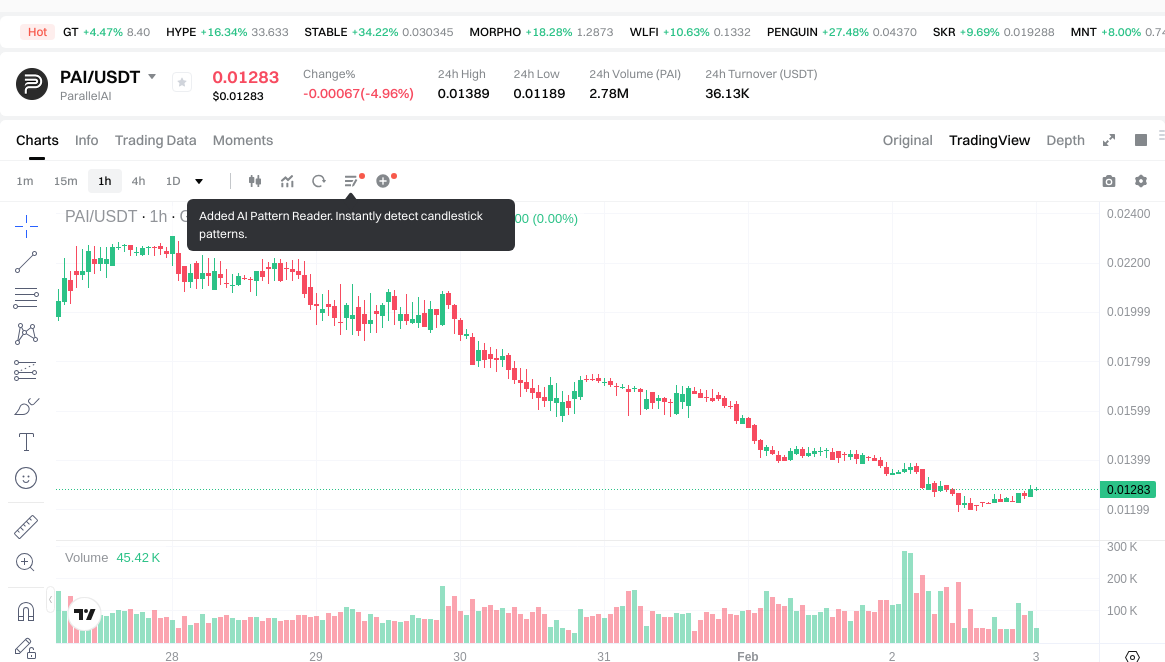
Early 2026: The cryptocurrency experienced a notable correction phase, with PAI declining to $0.01189 on February 2, 2026. This substantial price adjustment reflected broader market dynamics and the project's transition from initial hype to fundamental value assessment.
Current PAI Investment Market Status (February 2026)
- Current Price: $0.0128 (as of February 3, 2026)
- 24-Hour Trading Volume: $36,090.43
- Market Capitalization: $1,280,000
- Circulating Supply: 100,000,000 PAI (100% of max supply)
- 24-Hour Price Change: -4.73%
- 7-Day Price Change: -35.28%
- 30-Day Price Change: -59.95%
- 1-Year Price Change: -94.62%
Click to view real-time PAI market price
The current investment landscape for PAI reflects a challenging period following its initial market enthusiasm. The token trades significantly below its December 2024 peak, with the fully diluted market capitalization matching the current market cap at $1.28 million, indicating all tokens are in circulation. Trading activity remains modest with approximately $36,000 in daily volume across 3 exchanges. The project maintains 10,724 holders according to available data, suggesting a dedicated but limited community base during this market phase.
II. Core Factors Affecting Whether PAI Is a Good Investment
Supply Mechanism and Scarcity (PAI Investment Scarcity)
- Fixed Supply Structure → Influences Price and Investment Value
ParallelAI (PAI) operates with a fixed total supply of 100,000,000 tokens, with 100% of tokens already in circulation. This complete circulation means there is no future dilution from additional token releases, which can provide supply-side clarity for investors. The maximum supply cap is set at 100,000,000 tokens, establishing a definitive scarcity ceiling.
- Historical Price Performance → Price Volatility Patterns
PAI has experienced significant price fluctuations since its launch in September 2024. The token reached a notable price level of $1.518 on December 12, 2024, but has since declined substantially to $0.01189 on February 2, 2026. As of February 3, 2026, PAI trades at $0.0128, representing a decline of 4.73% over 24 hours, 35.28% over 7 days, 59.95% over 30 days, and 94.62% over one year. The current price is 99.16% below the level seen in December 2024.
- Investment Significance → Scarcity as Long-term Support Factor
The fixed supply mechanism and complete circulation provide a transparent tokenomics structure. However, scarcity alone does not guarantee value appreciation, as demonstrated by PAI's significant price decline despite its fixed supply. Market demand, project development progress, and broader market conditions play equally important roles in determining investment outcomes.
Institutional Investment and Mainstream Adoption (Institutional Investment in PAI)
- Token Holder Base → Current Adoption Metrics
As of the latest data, PAI has approximately 10,724 token holders. The token is available on 3 exchanges and maintains a relatively modest 24-hour trading volume of $36,090.43. These metrics suggest a developing but still relatively limited user base compared to more established cryptocurrency projects.
- Market Capitalization and Position → Market Standing
PAI holds a market capitalization of $1,280,000, ranking it at position #2350 in the cryptocurrency market. The project maintains a market dominance of 0.000046%, indicating a minor presence in the overall cryptocurrency ecosystem. The market cap to fully diluted valuation ratio stands at 100%, reflecting the complete circulation of all tokens.
Macroeconomic Environment's Impact on PAI Investment
- Broader Cryptocurrency Market Correlation → Market Dynamics
PAI's performance should be considered within the context of broader cryptocurrency market trends. The token's significant price declines across multiple timeframes suggest sensitivity to market conditions and investor sentiment. The 94.62% year-over-year decline indicates substantial downward pressure that extends beyond short-term volatility.
Technology and Ecosystem Development (Technology & Ecosystem for PAI Investment)
- Core Technology Focus → GPU Optimization and Parallel Processing
ParallelAI positions itself as addressing GPU bottlenecks in AI development through innovative parallel processing solutions. The project's mission centers on making computation faster and reducing GPU costs for developers, aiming to enable scalable and efficient AI applications. This technological focus targets the intersection of artificial intelligence and blockchain ecosystems.
- Decentralized Approach → Infrastructure Model
The project employs a decentralized approach that seeks to integrate AI and blockchain ecosystems to unlock global computational resources. The $PAI token serves as the native asset powering this platform, designed to provide a transparent and cost-effective framework for optimizing GPU utilization. The platform aims to make AI innovation more accessible, efficient, and democratized.
- Token Standard and Infrastructure → Technical Implementation
PAI operates as an ERC-20 token on the Ethereum blockchain. The token's contract address on Ethereum is 0x13e4b8cffe704d3de6f19e52b201d92c21ec18bd. This implementation leverages Ethereum's established infrastructure and security framework. The project maintains official documentation through its whitepaper hosted on GitBook and communicates through its website (parallelai.tech) and social media channels including Twitter/X.
III. PAI Future Investment Forecast and Price Outlook (Is ParallelAI(PAI) worth investing in 2026-2031)
Short-term Investment Forecast (2026, short-term PAI investment outlook)
- Conservative forecast: $0.0108 - $0.0128
- Neutral forecast: $0.0128 - $0.0143
- Optimistic forecast: $0.0143 - $0.0180
Mid-term Investment Outlook (2027-2029, mid-term ParallelAI(PAI) investment forecast)
- Market stage expectation: PAI is anticipated to enter a gradual recovery and development phase, with market performance potentially influenced by the broader adoption of decentralized AI computing solutions and GPU resource optimization initiatives.
- Investment return forecast:
- 2027: $0.0102 - $0.0186
- 2028: $0.0157 - $0.0223
- 2029: $0.0183 - $0.0236
- Key catalysts: Progress in parallel processing technology development, expansion of the decentralized AI and blockchain ecosystem integration, and improvements in platform transparency and cost-effectiveness for global developers.
Long-term Investment Outlook (Is PAI a good long-term investment?)
- Base scenario: $0.0174 - $0.0348 (assuming steady ecosystem development and moderate market adoption)
- Optimistic scenario: $0.0259 - $0.0348 (assuming accelerated platform adoption and favorable market conditions for AI-blockchain convergence)
- Risk scenario: Below $0.0174 (under conditions of delayed development milestones or adverse regulatory environment)
Click to view PAI long-term investment and price forecast: Price Prediction
2026-02-03 to 2031 Long-term Outlook
- Base scenario: $0.0174 - $0.0259 USD (corresponding to steady progress and gradual mainstream application enhancement)
- Optimistic scenario: $0.0259 - $0.0348 USD (corresponding to large-scale adoption and favorable market environment)
- Transformative scenario: Above $0.0348 USD (if the ecosystem achieves breakthrough progress and mainstream popularization)
- 2031-12-31 forecast high: $0.0348 USD (based on optimistic development assumptions)
Disclaimer: The above forecasts are based on historical data and predictive models and do not constitute investment advice. Cryptocurrency markets are highly volatile and subject to various risks. Investors should conduct independent research and assess their risk tolerance before making investment decisions.
| Year |
Predicted High Price |
Predicted Average Price |
Predicted Low Price |
Price Change |
| 2026 |
0.017962 |
0.01283 |
0.0107772 |
0 |
| 2027 |
0.01862916 |
0.015396 |
0.01016136 |
20 |
| 2028 |
0.0222864798 |
0.01701258 |
0.0156515736 |
32 |
| 2029 |
0.02357943588 |
0.0196495299 |
0.018274062807 |
53 |
| 2030 |
0.030260276046 |
0.02161448289 |
0.0192368897721 |
68 |
| 2031 |
0.03475608848712 |
0.025937379468 |
0.01737804424356 |
102 |
IV. PAI Investment Strategy and Risk Management (How to invest in ParallelAI)
Investment Strategy (PAI investment strategy)
Long-term Holding (HODL PAI)
For conservative investors seeking exposure to the decentralized AI computing sector, a long-term holding strategy may be considered. This approach involves acquiring PAI tokens and maintaining positions through market cycles, betting on the project's vision of democratizing GPU resources for AI development. Given PAI's focus on solving GPU bottlenecks through parallel processing solutions, long-term holders would be positioning themselves on the potential growth of decentralized computational infrastructure.
Active Trading
Active traders may approach PAI through technical analysis and swing trading strategies. With 24-hour trading volume of $36,090.43 and demonstrated price volatility (24-hour range: $0.01189-$0.01389), there exists opportunities for short-term position trading. Technical traders should monitor key support and resistance levels, volume patterns, and broader market sentiment toward AI-related crypto assets.
Risk Management (Risk management for PAI investment)
Asset Allocation Guidelines
- Conservative Investors: Limit PAI exposure to 1-3% of total crypto portfolio, given the token's volatility and relatively low market capitalization of $1.28 million
- Moderate Investors: May allocate 3-7% to PAI as part of a diversified AI/blockchain infrastructure basket
- Aggressive Investors: Could consider up to 10-15% allocation, understanding the heightened risk profile
Risk Hedging Approaches
- Portfolio Diversification: Combine PAI with established cryptocurrencies and other AI-related tokens to reduce concentration risk
- Position Sizing: Use dollar-cost averaging to mitigate timing risk, particularly given PAI's significant drawdowns from peak levels
- Stop-Loss Protocols: Implement trailing stops or predetermined exit points to protect capital during adverse price movements
Secure Storage Solutions
- Hot Wallets: For active trading positions, use reputable exchanges with strong security track records
- Cold Storage: For long-term holdings, transfer PAI tokens to hardware wallets such as Ledger or Trezor that support ERC-20 tokens
- Multi-Signature Wallets: Advanced users may consider multi-sig solutions for additional security layers
- Custody Considerations: Given PAI's deployment on Ethereum (contract address: 0x13e4b8cffe704d3de6f19e52b201d92c21ec18bd), ensure wallet compatibility with ERC-20 standard tokens
V. PAI Investment Risks and Challenges (Risks of investing in ParallelAI)
Market Risks
High Volatility
PAI has demonstrated substantial price fluctuations. The token experienced a 35.28% decline over 7 days and a 59.95% decrease over 30 days as of February 3, 2026. With a current price of $0.0128 and a previous level of $1.518 recorded on December 12, 2024, investors face significant downside exposure. The low market capitalization of $1.28 million contributes to susceptibility to rapid price movements.
Liquidity Concerns
With 24-hour trading volume of approximately $36,090 and listing on 3 exchanges, PAI faces limited liquidity compared to major cryptocurrencies. This thin trading environment can result in wider bid-ask spreads and difficulty executing larger orders without price impact.
Market Manipulation Potential
Small-cap tokens with limited liquidity and 10,724 holders may be more vulnerable to coordinated buying or selling pressure that can artificially influence price discovery.
Regulatory Risks
Jurisdictional Uncertainty
The regulatory landscape for cryptocurrency projects integrating AI and blockchain technologies remains evolving across different jurisdictions. Changes in securities classification, token utility definitions, or cross-border transaction rules could impact PAI's operational framework and token economics.
Compliance Requirements
As regulatory frameworks mature, ParallelAI may face additional compliance obligations regarding token distribution, platform operations, or data handling that could affect project development timelines and resource allocation.
Technical Risks
Smart Contract Vulnerabilities
As an ERC-20 token deployed on Ethereum, PAI inherits both the security advantages and potential vulnerabilities of smart contract systems. Bugs in contract code or unforeseen interactions with other protocols could expose token holders to risks.
Network Dependencies
PAI's functionality depends on Ethereum network performance. Network congestion, high gas fees, or technical issues on the base layer could affect token transferability and platform operations.
The success of PAI is tied to ParallelAI's ability to deliver on its technical roadmap of solving GPU bottlenecks through parallel processing solutions. Delays in development, technical obstacles in implementation, or failure to achieve adoption among AI developers could negatively impact token value.
VI. Conclusion: Is ParallelAI a Good Investment?
Investment Value Summary
ParallelAI (PAI) presents a speculative opportunity in the intersection of decentralized infrastructure and AI computing. The project addresses a genuine market need—GPU resource optimization for AI development—through a decentralized approach. However, the token's performance metrics reveal significant challenges: substantial price declines across multiple timeframes, limited market capitalization, and constrained liquidity. While the long-term vision of democratizing computational resources holds conceptual appeal, the current market conditions and risk profile suggest caution.
Investor Recommendations
✅ For Beginners
- Employ dollar-cost averaging strategy with minimal position sizes
- Prioritize secure storage using hardware wallets compatible with ERC-20 tokens
- Invest only amounts you can afford to lose entirely
- Thoroughly research the project's technical documentation and development progress
✅ For Experienced Investors
- Consider swing trading opportunities during high volatility periods
- Integrate PAI as a small component within a diversified AI/infrastructure token portfolio
- Monitor on-chain metrics, development milestones, and partnership announcements
- Set clear entry/exit criteria based on technical and fundamental analysis
✅ For Institutional Investors
- Conduct comprehensive due diligence on team credentials, technical architecture, and competitive positioning
- Assess PAI within broader thematic allocations to decentralized AI infrastructure
- Consider position sizing that reflects the high-risk, early-stage nature of the project
- Implement robust risk management frameworks including regular portfolio rebalancing
⚠️ Important Notice: Cryptocurrency investments carry substantial risk. PAI's price volatility, limited liquidity, and early-stage development status amplify these risks. This analysis is for informational purposes only and does not constitute financial advice. Prospective investors should conduct independent research and consult qualified financial advisors before making investment decisions.
VII. FAQ
Q1: What is the current market position of ParallelAI (PAI)?
As of February 3, 2026, ParallelAI (PAI) is a small-cap cryptocurrency with a market capitalization of approximately $1.28 million, ranking #2350 in the overall cryptocurrency market. The token trades at $0.0128 with a 24-hour trading volume of $36,090.43 across 3 exchanges. PAI has experienced significant price volatility since its launch in September 2024, declining from its peak of $1.518 in December 2024 to current levels—a decrease of approximately 99.16%. With 10,724 token holders and 100% of its 100 million token supply already in circulation, PAI represents an early-stage project in the decentralized AI computing infrastructure space with limited market presence and liquidity.
Q2: What are the primary risks associated with investing in PAI?
PAI investment carries substantial risks across multiple dimensions. Market risks include extreme volatility (35.28% decline over 7 days, 59.95% over 30 days), limited liquidity with only $36,000 daily trading volume, and potential for price manipulation due to its small market cap. Technical risks involve smart contract vulnerabilities inherent in ERC-20 tokens and dependency on Ethereum network performance. Regulatory uncertainty surrounding AI-blockchain integration projects poses additional concerns. The project's ability to deliver on its technical roadmap of GPU optimization through parallel processing remains unproven, with development execution risks potentially impacting token value. The token's 94.62% year-over-year decline demonstrates the severe downside exposure investors face.
Q3: How does PAI's tokenomics structure affect its investment potential?
PAI operates with a fixed maximum supply of 100 million tokens, with 100% already in circulation as of February 2026. This complete circulation eliminates future dilution risk from additional token releases, providing supply-side transparency. However, the fixed supply has not prevented significant price depreciation, as PAI has declined 99.16% from its December 2024 peak despite this scarcity mechanism. The market cap to fully diluted valuation ratio of 100% indicates no token unlock events ahead. While the deflationary supply structure theoretically supports long-term value, PAI's performance demonstrates that scarcity alone is insufficient without corresponding demand growth, technological adoption, and broader market support for the decentralized AI computing thesis.
Q4: What is the investment outlook for PAI between 2026 and 2031?
Short-term forecasts for 2026 range from conservative estimates of $0.0108-$0.0128 to optimistic projections of $0.0143-$0.0180. Mid-term predictions suggest gradual recovery potential, with 2027 estimates between $0.0102-$0.0186, 2028 projections of $0.0157-$0.0223, and 2029 forecasts of $0.0183-$0.0236. Long-term outlook for 2031 indicates a base scenario of $0.0174-$0.0259, with optimistic scenarios reaching $0.0259-$0.0348 if platform adoption accelerates. These forecasts assume various factors including successful technological development, ecosystem growth, and favorable market conditions for AI-blockchain convergence. However, given PAI's significant historical drawdowns and current risk profile, these projections carry substantial uncertainty and should not be interpreted as guaranteed outcomes.
Q5: What investment strategies are appropriate for different investor profiles considering PAI?
For conservative investors, PAI should represent only 1-3% of total crypto portfolio allocation, utilizing dollar-cost averaging to mitigate timing risk and prioritizing secure cold storage. Moderate investors may allocate 3-7% within a diversified AI/blockchain infrastructure basket, implementing trailing stops to protect capital. Aggressive investors could consider up to 10-15% allocation while maintaining robust risk management protocols. Active traders might exploit PAI's volatility through technical analysis and swing trading, monitoring the $0.01189-$0.01389 range observed in recent 24-hour periods. All investors should use hardware wallets compatible with ERC-20 tokens for secure storage and implement portfolio diversification to reduce concentration risk. Beginners should invest only amounts they can afford to lose entirely, while institutional investors require comprehensive due diligence on technical architecture and competitive positioning.
Q6: How does ParallelAI's technology differentiate it in the market?
ParallelAI positions itself as addressing GPU bottlenecks in AI development through decentralized parallel processing solutions. The platform aims to optimize GPU utilization by integrating AI and blockchain ecosystems, making computational resources more accessible and cost-effective for developers globally. As an ERC-20 token on Ethereum (contract address: 0x13e4b8cffe704d3de6f19e52b201d92c21ec18bd), PAI leverages established blockchain infrastructure. The project's mission centers on democratizing AI innovation by providing transparent, efficient frameworks for GPU resource allocation. However, despite this technological vision, the platform's actual adoption metrics remain limited, with modest trading volume and holder base suggesting the technology has yet to achieve significant market validation or demonstrate competitive advantages over alternative GPU optimization solutions in the rapidly evolving AI infrastructure landscape.
Q7: What factors could positively influence PAI's future price performance?
Several catalysts could potentially support PAI price appreciation: successful development milestones in parallel processing technology implementation, expanded partnerships with AI developers requiring decentralized computational infrastructure, increased platform adoption demonstrated through rising transaction volumes and active users, favorable regulatory clarity for AI-blockchain integration projects, broader cryptocurrency market recovery particularly in AI-related tokens, and successful differentiation from competing GPU optimization solutions. Additionally, transparent communication of development progress, strategic exchange listings to improve liquidity, and demonstrable cost savings for developers using the platform could enhance investor confidence. However, given PAI's current early-stage status and significant price depreciation from peak levels, these positive factors would need to materialize substantially to offset the considerable headwinds the project currently faces in gaining market traction and restoring investor sentiment.
Q8: Should beginners invest in ParallelAI (PAI)?
For beginners, PAI represents a high-risk, speculative investment that should only be considered with extreme caution and minimal capital allocation. The token's 94.62% year-over-year decline, limited liquidity, and early-stage development status create substantial downside risk unsuitable for inexperienced investors. If beginners choose to gain exposure despite these risks, they should invest only amounts they can afford to lose completely, use dollar-cost averaging to reduce timing risk, prioritize secure storage through hardware wallets, and dedicate significant time to understanding the project's technical documentation and competitive landscape. More prudent approaches for beginners include gaining experience with established cryptocurrencies before exploring small-cap projects, diversifying across multiple assets rather than concentrating in single tokens, and consulting qualified financial advisors. PAI should never constitute a core portfolio holding for novice investors.
* The information is not intended to be and does not constitute financial advice or any other recommendation of any sort offered or endorsed by Gate.