This comprehensive analysis examines Planck (PLANCK), an AI computing infrastructure token launched in January 2025, currently trading at $0.00389 with a market capitalization of $297,779 across 14 exchanges. The article evaluates PLANCK's investment potential through multiple dimensions: historical price performance (declining 98.5% from peak of $0.2348), market fundamentals including limited liquidity ($66,419 daily volume), supply mechanics (15.31% circulating), and ecosystem development status. The guide provides detailed price projections for 2026-2030, compares long-term holding versus active trading strategies, and outlines comprehensive risk management approaches including portfolio allocation guidelines. Critical risk factors including extreme volatility, regulatory uncertainty, technical vulnerabilities, and significant token dilution (84.69% supply unlocked) are thoroughly examined. This resource serves beginners, experienced traders, and institutional investors seeking informed decision-making on
Introduction: Planck (PLANCK)'s Investment Position and Market Prospects
Planck (PLANCK) represents a digital asset in the cryptocurrency sector focused on AI computing infrastructure. Since its launch in January 2025, the project has positioned itself within the AI computing solutions domain. As of February 2026, PLANCK trades at approximately $0.00389, with a circulating supply of 76.55 million tokens and a market capitalization of around $297,779. The token holds a market ranking of 3527 and maintains a circulating supply ratio of 15.31% relative to its maximum supply of 500 million tokens.
The project aims to develop an AI computing stack encompassing infrastructure, cloud services, foundational models, and AI-powered applications. With a 24-hour trading volume of $66,419 and availability across 14 exchanges, PLANCK has attracted 8,243 holders. The token has experienced notable price fluctuations, with recent performance showing a 1.01% change over 24 hours, a decline of 17.95% over 7 days, and a 72.5% decrease over 30 days. This article examines PLANCK's investment characteristics, historical price movements, future projections, and associated risks to provide analytical reference for investors considering exposure to this asset.
I. Planck (PLANCK) Price History Review and Current Investment Value
-
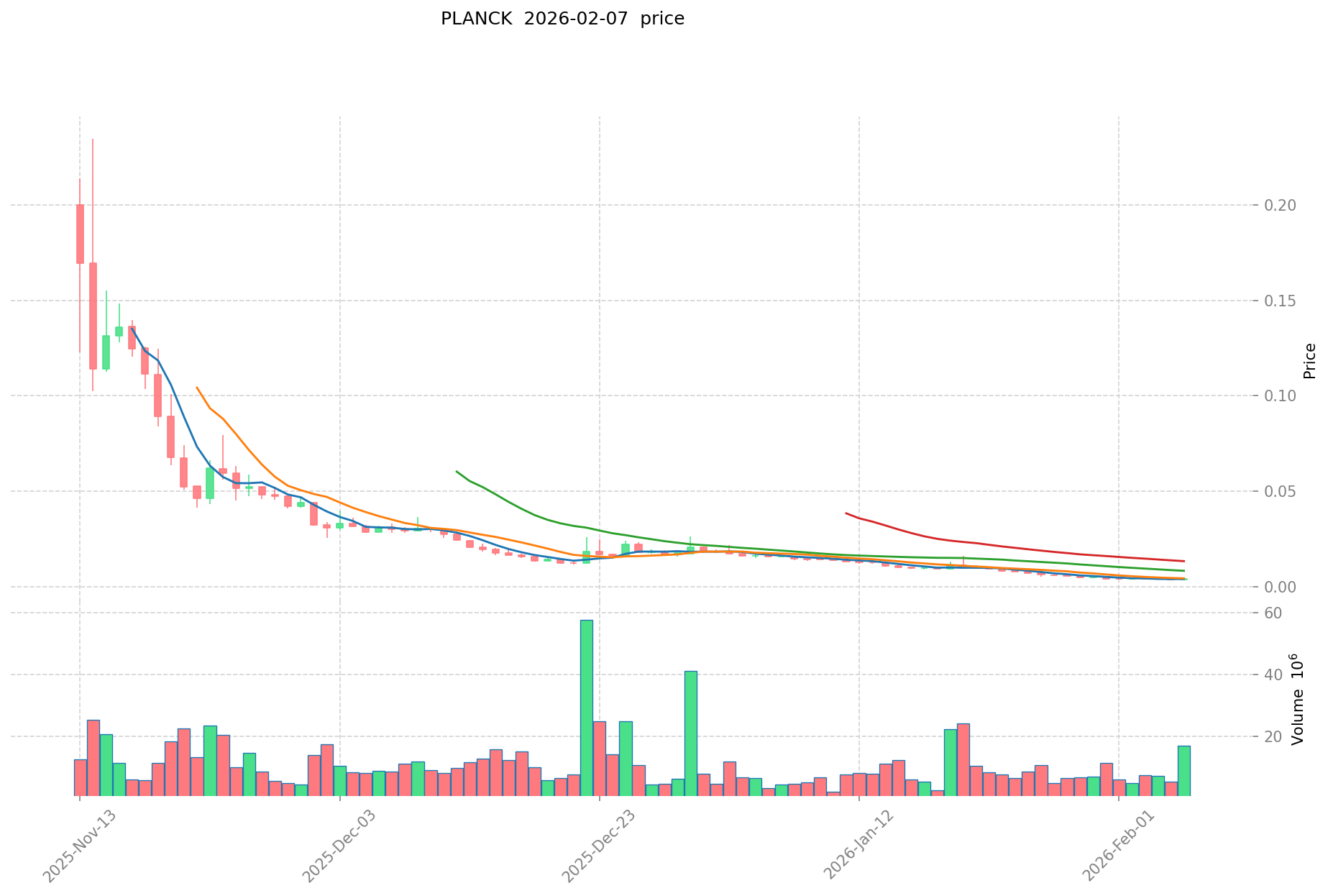
2025: PLANCK experienced significant price volatility following its November launch. The token reached a notable price level of $0.2348 in mid-November 2025, reflecting initial market interest in AI computing infrastructure projects. Following this period, the token entered a downward trend, with investor returns declining substantially throughout Q4 2025.
-
Late 2025 - Early 2026: PLANCK faced continued market pressure during the broader crypto market correction phase. The token's price declined from elevated levels to approximately $0.003521 by early February 2026, representing a challenging period for token holders.
Current PLANCK Investment Market Status (February 2026)
- PLANCK current price: $0.00389
- 24-hour trading volume: $66,419.42
- Market capitalization: $297,779.50
- Circulating supply: 76,550,000 PLANCK (15.31% of max supply)
- Fully diluted market cap: $1,945,000
- 24-hour price change: +1.01%
- 7-day price change: -17.95%
- 30-day price change: -72.5%
Click to view real-time PLANCK market price
II. Core Factors Affecting Whether PLANCK is a Good Investment
Supply Mechanism and Scarcity (PLANCK Investment Scarcity)
- Total Supply: PLANCK has a maximum supply of 500,000,000 tokens, with a current circulating supply of 76,550,000 tokens, representing approximately 15.31% of the total supply.
- Supply Distribution Impact: The relatively low circulating supply compared to total supply suggests a significant portion of tokens remains unvested or unlocked, which could influence future price dynamics as more tokens enter circulation.
- Scarcity Considerations: While PLANCK has a capped maximum supply, the current market capitalization of approximately $297,779.5 and fully diluted valuation of $1,945,000 indicate limited scarcity premium at present price levels.
- Investment Implications: The gradual release of the remaining 84.69% of tokens represents a potential dilutive factor that investors should consider when evaluating long-term holding strategies.
Institutional Investment and Mainstream Adoption (Institutional Investment in PLANCK)
- Exchange Presence: PLANCK is listed on 14 exchanges, indicating moderate accessibility for institutional and retail participants.
- Holder Distribution: The token has approximately 8,243 holders, suggesting a relatively small but growing user base.
- Market Position: With a market ranking of 3,527 and market share of 0.000079%, PLANCK remains a relatively small-cap project with limited institutional presence at this stage.
- Adoption Indicators: As an AI computing infrastructure project targeting consumers, startups, enterprises and researchers across the US, Asia and globally, mainstream adoption will depend on the successful deployment and utilization of its two AI development platforms.
Macroeconomic Environment Impact on PLANCK Investment
- Market Sensitivity: PLANCK's performance shows notable volatility, with a 30-day decline of 72.5% and a 1-year decline of 99.78%, suggesting high sensitivity to broader market conditions and investor sentiment.
- Risk Asset Correlation: As an emerging AI-focused crypto asset, PLANCK likely exhibits correlation with both cryptocurrency market cycles and AI sector sentiment, exposing investors to multiple risk factors.
- Market Positioning: The token's positioning in the AI computing infrastructure sector may attract interest during periods of heightened AI technology investment, though this remains dependent on project execution and competitive differentiation.
Technology and Ecosystem Development (Technology & Ecosystem for PLANCK Investment)
- AI Computing Stack: PLANCK is developing an integrated AI computing stack encompassing AI computing infrastructure, AI Cloud, foundational models, and AI-powered end applications.
- Platform Development: The project has developed two platforms designed to enable AI research and development across various industry domains, serving as the foundation for its ecosystem value proposition.
- Target Markets: PLANCK's technology aims to empower consumers, startups, enterprises and scientists across the US, Asia and globally to build AI applications or train AI models.
- Ecosystem Applications: The project's value proposition centers on facilitating AI application development and model training, though specific adoption metrics and use case traction are not detailed in available materials.
- Investment Considerations: The long-term investment value will depend on successful technology deployment, competitive differentiation in the AI infrastructure space, and demonstrated utility adoption across the target user segments.
III. PLANCK Future Investment Forecast and Price Outlook (Is Planck(PLANCK) worth investing in 2026-2030)
Short-term Investment Forecast (2026, short-term PLANCK investment outlook)
- Conservative forecast: $0.0032 - $0.0039
- Neutral forecast: $0.0039 - $0.0042
- Optimistic forecast: $0.0042 - $0.0097
Mid-term Investment Outlook (2027-2028, mid-term Planck(PLANCK) investment forecast)
- Market phase expectation: The token may experience gradual development as the AI computing infrastructure ecosystem evolves, with potential fluctuations influenced by broader market conditions and project adoption rates.
- Investment return forecast:
- 2027: $0.0032 - $0.0054
- 2028: $0.0027 - $0.0065
- Key catalysts: Platform development progress, AI industry growth trends, ecosystem expansion, and broader cryptocurrency market conditions.
Long-term Investment Outlook (Is PLANCK a good long-term investment?)
- Baseline scenario: $0.0034 - $0.0063 (assuming steady ecosystem development and moderate market conditions)
- Optimistic scenario: $0.0063 - $0.0096 (assuming accelerated adoption and favorable market environment)
- Risk scenario: Below $0.0027 (in case of adverse market conditions or delayed project development)
Click to view PLANCK long-term investment and price prediction: Price Prediction
2026-02-07 - 2030 Long-term Outlook
- Baseline scenario: $0.0034 - $0.0063 (corresponding to steady progress and gradual mainstream application improvement)
- Optimistic scenario: $0.0063 - $0.0096 (corresponding to large-scale adoption and favorable market environment)
- Transformative scenario: Above $0.0096 (such as breakthrough ecosystem progress and mainstream popularization)
- 2030-12-31 predicted high: $0.0074 (based on optimistic development assumptions)
Disclaimer: The above predictions are based on technical analysis and historical data patterns. Cryptocurrency markets are highly volatile and unpredictable. Past performance does not guarantee future results. This information should not be considered as investment advice. Investors should conduct their own research and consult with financial professionals before making any investment decisions.
| Year |
Predicted High Price |
Predicted Average Price |
Predicted Low Price |
Price Change |
| 2026 |
0.0042405 |
0.003855 |
0.0032382 |
0 |
| 2027 |
0.0053835075 |
0.00404775 |
0.003157245 |
4 |
| 2028 |
0.006507567675 |
0.00471562875 |
0.002735064675 |
21 |
| 2029 |
0.006902265801375 |
0.0056115982125 |
0.00448927857 |
44 |
| 2030 |
0.007383179768186 |
0.006256932006937 |
0.003378743283746 |
60 |
| 2031 |
0.009616278801462 |
0.006820055887561 |
0.006342651975432 |
75 |
IV. Planck Investment Strategy and Risk Management (How to invest in Planck)
Investment Methodology (Planck investment strategy)
Risk Management (Risk management for Planck investment)
-
Asset Allocation Ratio: Conservative / Aggressive / Professional investors
- Conservative investors: Given the significant price decline history and high volatility, conservative allocation might limit PLANCK exposure to a small percentage of the total portfolio (e.g., 1-3%).
- Aggressive investors: Those with higher risk tolerance and conviction in the AI computing sector might allocate a moderate portion (e.g., 5-10%), while maintaining awareness of downside risks.
- Professional investors: Institutional or experienced investors may conduct deeper due diligence on the project's technical capabilities, team background, and competitive positioning before determining appropriate allocation levels.
-
Risk Hedging Solutions: Multi-asset portfolio + hedging tools
- Diversification across different cryptocurrency categories and traditional assets can help mitigate concentration risk.
- Consider maintaining exposure to more established cryptocurrencies alongside speculative positions in emerging projects like PLANCK.
- Setting stop-loss orders and position size limits can help control downside risk in volatile market conditions.
-
Secure Storage: Hot and cold wallets + hardware wallet recommendations
- PLANCK tokens are deployed on the BSC (Binance Smart Chain) network with contract address 0x004d50b3fc784b580531d8e8615aa96cf7fbb919.
- For long-term holdings, hardware wallets compatible with BSC networks provide enhanced security against online threats.
- Hot wallets (software wallets) may be suitable for smaller amounts intended for active trading, while larger holdings should be stored in cold storage solutions.
- Always verify contract addresses through official sources before conducting transactions to avoid scam tokens.
V. Planck Investment Risks and Challenges (Risks of investing in Planck)
-
Market Risk: High volatility and price manipulation concerns
- PLANCK has demonstrated extreme volatility, with a historical high of $0.2348 (recorded on November 14, 2025) and a historical low of $0.003521 (recorded on February 6, 2026), representing a decline of approximately 98.5% from peak to trough.
- The current price of $0.00389 is relatively close to the all-time low, indicating sustained selling pressure.
- With a market capitalization of approximately $297,779.5 and relatively limited trading volume, the token may be susceptible to price manipulation or large order impacts.
- The circulating supply of 76,550,000 tokens represents only 15.31% of the maximum supply of 500,000,000, suggesting potential future dilution risks if additional tokens enter circulation.
-
Regulatory Risk: Policy uncertainty across different jurisdictions
- AI and cryptocurrency-related projects face evolving regulatory frameworks in various countries.
- Compliance requirements for AI computing infrastructure and token-based business models may vary significantly across the US, Asia, and other regions mentioned in the project description.
- Changes in cryptocurrency regulations, securities laws, or AI governance policies could materially impact the project's operations and token value.
-
Technical Risk: Network security vulnerabilities and upgrade failures
- As an AI computing infrastructure project, PLANCK's success depends on the technical execution of its platforms and services.
- Security vulnerabilities in smart contracts, platform infrastructure, or integrated AI systems could lead to financial losses or reputational damage.
- The project's reliance on BSC network infrastructure means that any issues affecting the underlying blockchain could impact PLANCK operations.
- Technical challenges in scaling AI computing services or integrating with enterprise systems could affect adoption and token utility.
VI. Conclusion: Is Planck a Good Investment?
-
Investment Value Summary: PLANCK presents a high-risk, high-volatility investment opportunity in the AI computing infrastructure sector. The token has experienced significant price declines over the past year, with current prices near historical lows. While the project's vision of building an AI computing stack serving consumers, startups, enterprises, and researchers has conceptual appeal, the token's price performance and limited market capitalization suggest substantial uncertainty regarding near-term value recovery.
-
Investor Recommendations:
✅ Beginners: If considering exposure to PLANCK, employ dollar-cost averaging strategies with very limited position sizes, and prioritize secure wallet storage on BSC-compatible solutions. However, given the extreme volatility and significant historical losses, beginners may be better served focusing on more established cryptocurrencies while gaining market experience.
✅ Experienced Investors: May consider tactical trading approaches based on technical analysis, taking advantage of short-term price swings while maintaining strict risk management protocols. Portfolio allocation should remain minimal given the elevated risk profile.
✅ Institutional Investors: Should conduct comprehensive due diligence on the project's technology roadmap, competitive positioning in the AI infrastructure market, team credentials, and partnership ecosystem before considering any strategic allocation. The current market dynamics suggest a need for caution.
⚠️ Disclaimer: Cryptocurrency investments carry substantial risks, including the potential loss of entire capital. This analysis is for informational purposes only and does not constitute investment advice. Investors should conduct independent research and consult with qualified financial advisors before making investment decisions. Past performance does not guarantee future results, and the extreme volatility observed in PLANCK's price history underscores the high-risk nature of this investment.
VII. FAQ
Q1: What makes Planck (PLANCK) different from other AI computing infrastructure projects?
PLANCK distinguishes itself by offering an integrated AI computing stack that encompasses infrastructure, cloud services, foundational models, and AI-powered applications. The project has developed two platforms designed to enable consumers, startups, enterprises, and researchers across the US, Asia, and globally to build AI applications or train AI models. However, with a market capitalization of approximately $297,779 and ranking at 3,527, PLANCK remains a relatively small player in the AI infrastructure space. The project's differentiation will ultimately depend on successful technology deployment, competitive advantages in service delivery, and demonstrated user adoption across its target segments.
Q2: Why has PLANCK's price declined so dramatically since its November 2025 launch?
PLANCK has experienced a decline of approximately 98.5% from its historical high of $0.2348 (November 14, 2025) to near its all-time low of $0.003521 (February 6, 2026), with the current price at $0.00389. This dramatic decline reflects multiple factors including broader cryptocurrency market corrections, limited early adoption traction, substantial selling pressure, and the challenges faced by newly launched tokens in establishing sustainable market demand. The 30-day decline of 72.5% and 1-year decline of 99.78% indicate persistent downward momentum. Additionally, with only 15.31% of the maximum supply currently in circulation, concerns about future token dilution may contribute to selling pressure.
Q3: Is PLANCK suitable for long-term investment in 2026 and beyond?
PLANCK presents a high-risk proposition for long-term investors. While price forecasts suggest potential recovery scenarios ranging from $0.0032-$0.0042 in 2026 to $0.0034-$0.0096 by 2030 under various assumptions, these projections carry substantial uncertainty. Long-term holding requires confidence in the project's ability to execute its AI computing infrastructure vision, achieve meaningful ecosystem adoption, and survive competitive pressures. Conservative investors should limit exposure to 1-3% of portfolio value, while even aggressive investors should maintain awareness of the significant downside risks evidenced by the token's historical performance. The investment thesis depends heavily on the project's ability to deliver tangible products and demonstrate real-world utility.
Q4: How liquid is PLANCK, and what are the implications for trading?
PLANCK currently maintains a 24-hour trading volume of approximately $66,419 across 14 exchanges, indicating relatively limited liquidity compared to mainstream cryptocurrencies. This liquidity profile presents several implications for traders: larger orders may experience significant slippage, bid-ask spreads may be wider during periods of low activity, and price volatility can be amplified by individual transactions. The token's market capitalization of $297,779 further suggests susceptibility to price manipulation or large order impacts. Active traders should exercise caution with position sizing, use limit orders to control execution prices, and be prepared for potentially challenging exit conditions during periods of market stress.
Q5: What are the primary risks investors should consider before buying PLANCK?
Investors face multiple significant risks with PLANCK: (1) Market Risk - extreme volatility with 98.5% decline from peak and current prices near all-time lows; (2) Liquidity Risk - limited trading volume and market depth may hinder position exit; (3) Dilution Risk - only 15.31% of maximum supply is circulating, with 84.69% of tokens potentially entering the market; (4) Execution Risk - the project must successfully deliver on its AI computing infrastructure vision in a competitive landscape; (5) Regulatory Risk - evolving policies affecting both AI and cryptocurrency sectors across multiple jurisdictions; and (6) Technical Risk - potential vulnerabilities in smart contracts, platform infrastructure, or AI systems. Given these factors, PLANCK represents a speculative investment suitable only for investors with high risk tolerance and capital they can afford to lose entirely.
Q6: How does PLANCK's token economics affect its investment potential?
PLANCK's token economics present a mixed picture for investors. The maximum supply is capped at 500 million tokens, providing theoretical scarcity, but the current circulating supply of 76.55 million (15.31%) means significant token unlocks may occur in the future. This creates potential dilutive pressure on price as additional supply enters the market. The fully diluted valuation of $1,945,000 compared to the current market cap of $297,779 suggests the market is pricing in substantial discount for future dilution. With 8,243 holders, the token has limited distribution, which may constrain network effects. The token's utility within the AI computing ecosystem will be critical to establishing sustainable demand that can absorb future supply increases and support long-term value appreciation.
Q7: What technical indicators should traders monitor when considering PLANCK positions?
Traders evaluating PLANCK should focus on several key technical metrics: (1) Volume Analysis - monitor 24-hour trading volume relative to the $66,419 baseline to identify periods of increased or decreased market activity; (2) Price Volatility - track daily price ranges, noting the recent 24-hour range of $0.00365-$0.004622 (approximately 26.7% range); (3) Support and Resistance Levels - the historical low of $0.003521 represents a critical support level, while the current price of $0.00389 may act as near-term resistance; (4) Moving Averages - given the persistent downtrend evidenced by -17.95% over 7 days and -72.5% over 30 days, traders should watch for potential trend reversals; and (5) Exchange Distribution - monitor which of the 14 listing exchanges show the most volume concentration to optimize execution quality.
Q8: What would constitute positive catalysts for PLANCK's price recovery?
Several developments could potentially support PLANCK price recovery: (1) Platform Milestones - successful launch or significant upgrades to the two AI development platforms, with demonstrated user adoption metrics; (2) Partnership Announcements - strategic collaborations with established enterprises, research institutions, or technology providers in the AI space; (3) Ecosystem Growth - measurable increases in the number of AI applications built on PLANCK infrastructure or models trained using its services; (4) Market Sentiment - broader cryptocurrency market recovery or increased investor interest in AI-focused blockchain projects; (5) Exchange Listings - addition to major exchanges with deeper liquidity; and (6) Token Utility Expansion - implementation of compelling use cases that create organic demand for PLANCK tokens beyond speculative trading. However, investors should note that even positive developments may not guarantee price appreciation given the token's challenged current position.
* The information is not intended to be and does not constitute financial advice or any other recommendation of any sort offered or endorsed by Gate.