This comprehensive analysis evaluates Powerloom (POWERLOOM) as an investment opportunity within the Web3 data infrastructure sector. The article examines POWERLOOM's core value proposition as a composable data network providing verified on-chain insights, currently trading at $0.0006942 with a market capitalization of $225,606.63 as of February 2026. It reviews the token's dramatic price history—launching at $0.23 in January 2025, peaking at $0.36, then declining 98.08% to current levels—while analyzing supply dynamics with 324,987,942 tokens circulating from a 1,000,000,000 total supply. The analysis presents price forecasts ranging from conservative ($0.000393-$0.000562 for 2026) to optimistic ($0.001520 by 2031), details investment strategies for different investor profiles, and identifies significant risks including market volatility, regulatory uncertainty, and technical vulnerabilities. Suitable for investors seeking to understand POWERLOOM's potential on Gate and other trading platforms.
Introduction: Powerloom (POWERLOOM) Investment Status and Market Outlook
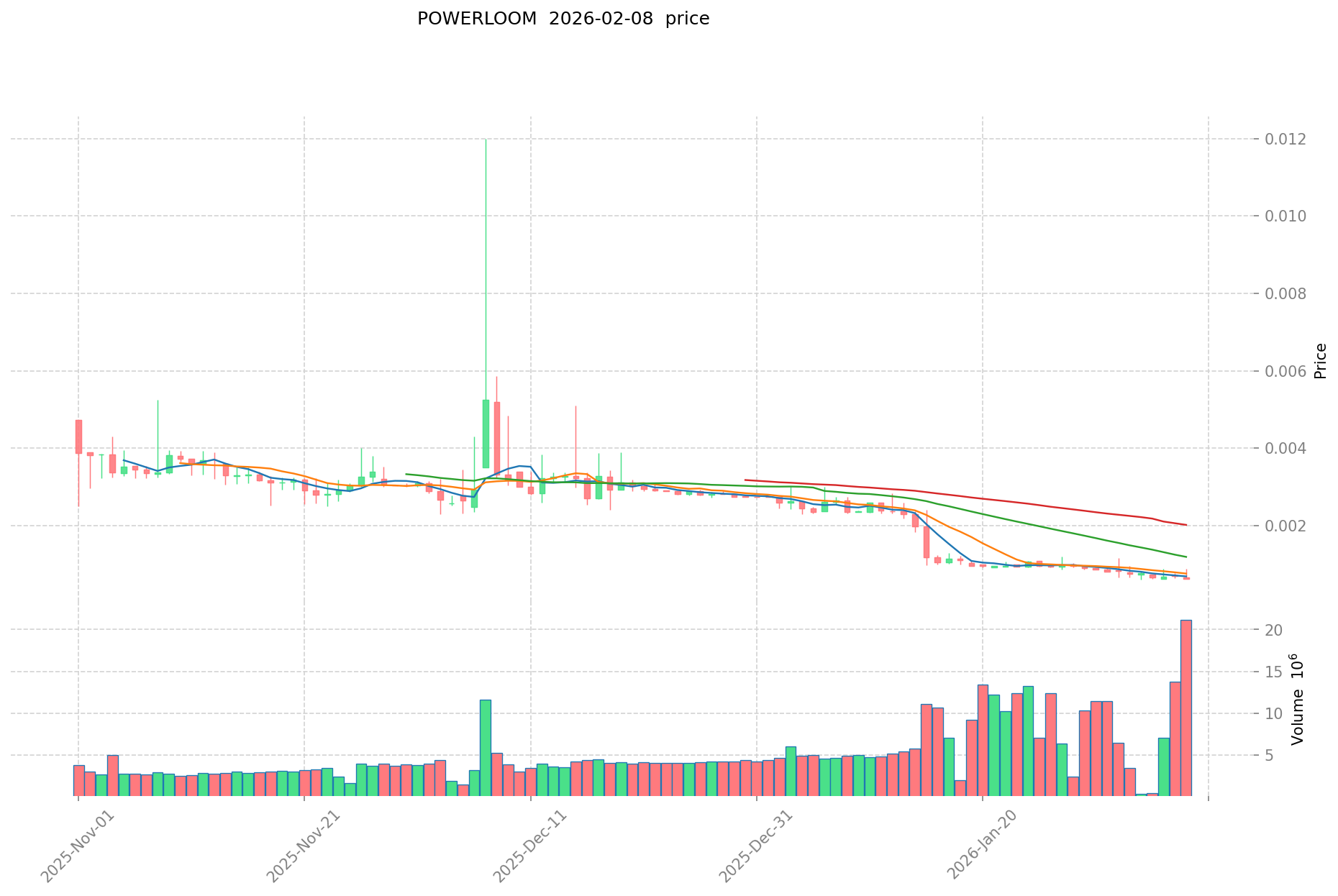
Powerloom (POWERLOOM) represents a composable data network within the cryptocurrency ecosystem, designed to provide hassle-free access to reliable and verifiable on-chain insights for Web3 consumers. As its native gas token, POWER fuels activities within this data infrastructure ecosystem. As of February 8, 2026, POWERLOOM holds a market ranking of 3,797 with a market capitalization of approximately $225,606.63 and a circulating supply of 324,987,942 tokens out of a maximum supply of 1,000,000,000 tokens. The current price stands at approximately $0.0006942, with a circulating ratio of 32.50%. Since its launch in January 2025 with a publish price of $0.23, the token has experienced notable price movements, reaching a recorded high of $0.36 in January 2025. With its positioning in the Web3 data infrastructure sector and implementation as an ERC-20 token on the Ethereum network, POWERLOOM has gradually attracted attention from investors examining "Is Powerloom (POWERLOOM) a good investment?" This article provides a comprehensive analysis of POWERLOOM's investment characteristics, historical performance trends, future price considerations, and associated investment risks to serve as a reference for investors.
I. POWERLOOM Price History Review and Investment Value Status
- 2025: Token launched in January with an initial price of $0.23, reaching an all-time high of $0.36 on January 10, 2025, representing a 56.5% increase from launch price.
- 2026: Market experienced significant volatility, with the price declining to $0.000601 on February 3, 2026, reflecting a 99.8% decrease from the January 2025 peak.
- Recent performance shows fluctuating returns across different timeframes, with a 1-hour change of +0.013% and a 24-hour decline of -3.73%.
Current POWERLOOM Investment Market Status (February 2026)
- Current POWERLOOM price: $0.0006942
- 24-hour trading volume: $12,853.30
- Circulating supply: 324,987,942 POWERLOOM (32.50% of total supply)
- Market capitalization: $225,606.63
- Fully diluted valuation: $694,200.00
- Number of holders: 502
Click to view real-time POWERLOOM market price
II. Core Factors Influencing Whether POWERLOOM is a Good Investment
Supply Mechanism and Scarcity (POWERLOOM Investment Scarcity)
- Token Supply Structure → Impacts price dynamics and investment valuation. Powerloom has a maximum supply of 1,000,000,000 POWER tokens, with approximately 324,987,942 tokens (32.5%) currently in circulation as of February 8, 2026.
- Circulating Supply Growth → The relatively low circulating supply ratio suggests potential for controlled token distribution, which may influence future price movements as more tokens enter circulation.
- Investment Significance → The defined maximum supply establishes a scarcity framework that could support long-term investment considerations, though market dynamics remain subject to multiple variables.
- Market Capitalization → As of February 8, 2026, Powerloom's market cap stands at approximately $225,606.63, with a fully diluted valuation of $694,200.00.
- Price Volatility Trends → The token has experienced notable price fluctuations, with the 24-hour price range between $0.0006225 and $0.0007898, reflecting a 24-hour decline of 3.73%. Over broader timeframes, the token has shown declines of 18.45% over 7 days, 70.7% over 30 days, and 98.08% over one year.
- Historical Price Levels → The token's all-time high was recorded at $0.36 on January 10, 2025, while its all-time low of $0.000601 occurred on February 3, 2026. The current price of $0.0006942 represents a position near historical lows.
Technology and Ecosystem Development (Technology & Ecosystem for POWERLOOM Investment)
- Core Value Proposition → Powerloom positions itself as a composable data network designed to provide accessible, reliable, and verifiable on-chain insights for Web3 consumers. The native POWER token serves as a gas token fueling activities within this ecosystem.
- Blockchain Infrastructure → The POWER token is deployed on the Ethereum blockchain as an ERC-20 token, with the contract address 0x429f0d8233e517f9acf6f0c8293bf35804063a83.
- Network Utility → The token's functionality as a gas token within the Powerloom ecosystem suggests utility tied to network activity and data verification processes, which may influence long-term value based on network adoption and usage patterns.
Market Accessibility and Trading Environment
- Exchange Availability → Powerloom is available for trading on 1 exchange as of February 8, 2026, with 24-hour trading volume of approximately $12,853.30.
- Token Holder Base → The project currently has approximately 502 token holders, indicating an early-stage distribution profile.
- Market Dominance → POWERLOOM represents a market dominance of 0.000027%, reflecting its position as an emerging asset within the broader cryptocurrency market.
- Initial Offering Price → The token was published on January 10, 2025, with a launch price of $0.23.
- Price Change from Launch → The current price of $0.0006942 represents a substantial decline from the initial offering price, indicating negative price performance since launch.
- Recovery Potential → While some price projections suggest potential recovery scenarios, the token's performance since launch reflects significant market headwinds and investor sentiment challenges.
III. POWERLOOM Future Investment Forecast and Price Outlook (Is Powerloom (POWERLOOM) Worth Investing in 2026-2031)
Short-term Investment Outlook (2026, Short-term POWERLOOM Investment Outlook)
- Conservative Forecast: $0.000393 - $0.000562
- Neutral Forecast: $0.000644 - $0.000747
- Optimistic Forecast: $0.000747 - $0.001009
Mid-term Investment Outlook (2027-2029, Mid-term Powerloom (POWERLOOM) Investment Forecast)
-
Market Phase Expectation: Based on reference materials, POWERLOOM may experience gradual recovery during the mid-term period. The project, as a composable data network providing reliable on-chain insights for Web3 consumers, could potentially benefit from broader adoption of decentralized data infrastructure.
-
Investment Return Forecast:
- 2027: $0.000515 - $0.001009
- 2028: $0.000562 - $0.000980
- 2029: $0.000650 - $0.001191
-
Key Catalysts: Network adoption growth, ecosystem development, partnerships with Web3 projects, market sentiment toward data infrastructure tokens, and overall cryptocurrency market conditions.
Long-term Investment Outlook (Is POWERLOOM a Good Long-term Investment?)
- Base Scenario: $0.000664 - $0.001117 (assuming steady ecosystem development and moderate market conditions through 2030)
- Optimistic Scenario: $0.001085 - $0.001520 (assuming accelerated adoption, favorable regulatory environment, and strong market momentum through 2031)
- Risk Scenario: Below $0.000393 (under adverse market conditions, limited adoption, or significant competitive pressure)
View POWERLOOM long-term investment and price forecast: Price Prediction
2026-2031 Long-term Outlook
- Base Scenario: $0.000664 - $0.001117 (corresponding to steady progress and gradual mainstream application growth)
- Optimistic Scenario: $0.001085 - $0.001520 (corresponding to large-scale adoption and favorable market environment)
- Transformative Scenario: Above $0.001520 (in case of breakthrough ecosystem developments and mainstream popularization)
- 2031-12-31 Forecast High: $0.001520 (based on optimistic development assumptions)
Disclaimer: Cryptocurrency investments carry substantial risk. The forecasts presented are based on historical data analysis and predictive models, which may not accurately reflect future market performance. Price predictions are subject to high volatility, regulatory changes, technological developments, and market sentiment shifts. Investors should conduct independent research and consider their risk tolerance before making investment decisions. Past performance does not guarantee future results.
| Year |
Predicted High Price |
Predicted Average Price |
Predicted Low Price |
Price Change |
| 2026 |
0.00074762 |
0.0006445 |
0.000393145 |
-7 |
| 2027 |
0.001009287 |
0.00069606 |
0.0005150844 |
0 |
| 2028 |
0.000980574525 |
0.0008526735 |
0.00056276451 |
22 |
| 2029 |
0.00119161121625 |
0.0009166240125 |
0.000650803048875 |
32 |
| 2030 |
0.001117364671237 |
0.001054117614375 |
0.000664094097056 |
51 |
| 2031 |
0.001520037599928 |
0.001085741142806 |
0.00072744656568 |
56 |
IV. Powerloom Investment Strategy and Risk Management (How to invest in Powerloom)
Investment Methodology (Powerloom investment strategy)
Long-term Holding (HODL Powerloom): This approach may be suitable for conservative investors who believe in the long-term potential of decentralized data networks. Given Powerloom's focus on providing verifiable on-chain insights for Web3 consumers, investors considering this strategy should evaluate the project's technological development and adoption trajectory over extended periods.
Active Trading: For traders employing technical analysis and swing trading strategies, Powerloom's price movements present certain opportunities. Recent data shows the token experienced a 0.013% increase over 1 hour, while facing a 3.73% decline over 24 hours and an 18.45% decrease over 7 days. The 30-day performance shows a 70.7% decline. These fluctuations may provide entry and exit points for active traders, though such volatility also increases trading risks.
Risk Management (Risk management for Powerloom investment)
Asset Allocation Ratios:
- Conservative investors: Consider limiting Powerloom exposure to a small percentage of overall portfolio (typically 1-3% of crypto allocation)
- Aggressive investors: May allocate a moderate portion (5-10% of crypto holdings) based on risk tolerance
- Professional investors: Should conduct thorough due diligence and adjust allocation based on comprehensive market analysis
Risk Hedging Solutions: Investors should consider diversifying across multiple blockchain projects and asset classes. Portfolio construction may include a mix of established cryptocurrencies, emerging tokens, and traditional assets to balance risk exposure.
Secure Storage:
- Cold Wallets: For long-term holdings, hardware wallets such as Ledger or Trezor offer enhanced security
- Hot Wallets: For active trading purposes, use reputable exchange wallets or software wallets with strong security features
- Security Practices: Enable two-factor authentication, maintain separate storage for different investment portions, and regularly update security protocols
V. Powerloom Investment Risks and Challenges (Risks of investing in Powerloom)
Market Risks: Powerloom has demonstrated significant price volatility. The token reached a peak of $0.36 on January 10, 2025, and subsequently declined to a low of $0.000601 on February 3, 2026. As of February 8, 2026, the token price stands at $0.0006942, representing a 98.08% decline from its peak over a one-year period. The 24-hour trading volume of approximately $12,853 suggests relatively limited liquidity, which may contribute to price instability.
Regulatory Risks: Cryptocurrency projects face varying regulatory frameworks across different jurisdictions. Changes in regulatory policies regarding data networks, blockchain infrastructure, or token classifications could impact Powerloom's operations and token value. Investors should monitor regulatory developments in their respective regions.
Technical Risks: As a data network project, Powerloom faces technological challenges including:
- Network security vulnerabilities that could compromise data integrity
- Potential technical failures during protocol upgrades or scaling efforts
- Competition from alternative data solutions in the Web3 ecosystem
- Smart contract risks associated with the ERC-20 token standard implementation
The circulating supply represents 32.5% of the total supply (324,987,942 out of 1,000,000,000 tokens), indicating potential future token releases that could affect supply dynamics.
VI. Conclusion: Is Powerloom a Good Investment?
Investment Value Summary: Powerloom operates in the emerging sector of blockchain data infrastructure, providing verifiable on-chain insights for Web3 applications. While the project addresses a potential need in the decentralized ecosystem, the token has experienced substantial price volatility and significant value decline since its launch. The market capitalization of approximately $225,607 and relatively low trading volume indicate an early-stage project with limited market presence.
Investor Recommendations:
✅ Beginners: Consider starting with established cryptocurrencies before exploring smaller market cap tokens like Powerloom. If interested, employ dollar-cost averaging strategies and store assets in secure hardware wallets.
✅ Experienced Investors: May explore swing trading opportunities based on technical indicators, while maintaining strict position sizing and risk management protocols. Consider Powerloom as part of a diversified portfolio of Web3 infrastructure projects.
✅ Institutional Investors: Should conduct comprehensive due diligence on the project's technology, team, partnerships, and market positioning before considering any strategic allocation.
⚠️ Disclaimer: Cryptocurrency investments carry substantial risk, including the potential loss of principal. This content is provided for informational purposes only and does not constitute investment advice. Investors should conduct their own research and consult with qualified financial advisors before making investment decisions.
VII. FAQ
Q1: What is Powerloom (POWERLOOM) and what makes it different from other crypto projects?
Powerloom is a composable data network designed to provide hassle-free access to reliable and verifiable on-chain insights for Web3 consumers. The POWER token serves as the native gas token fueling activities within this data infrastructure ecosystem. Unlike many cryptocurrencies focused on payments or DeFi, Powerloom specifically targets the Web3 data infrastructure sector, positioning itself as a solution for decentralized applications requiring verified blockchain data. The project is deployed as an ERC-20 token on the Ethereum network with the contract address 0x429f0d8233e517f9acf6f0c8293bf35804063a83, which allows for integration with the broader Ethereum ecosystem while maintaining its specialized focus on data verification and accessibility.
Q2: How has POWERLOOM performed since its launch, and what is its current market position?
POWERLOOM experienced significant volatility since its launch in January 2025. The token started with a publish price of $0.23 and reached an all-time high of $0.36 on January 10, 2025 (a 56.5% increase from launch). However, it subsequently declined to a low of $0.000601 on February 3, 2026. As of February 8, 2026, the token trades at approximately $0.0006942, representing a 98.08% decline from its peak. The project currently holds a market ranking of 3,797 with a market capitalization of approximately $225,607 and a 24-hour trading volume of $12,853. The circulating supply stands at 324,987,942 tokens (32.5% of the maximum supply of 1,000,000,000), with approximately 502 token holders, indicating an early-stage distribution profile.
Q3: What are the price forecasts for POWERLOOM in the short-term and long-term?
Short-term forecasts for 2026 range from a conservative estimate of $0.000393 - $0.000562 to an optimistic scenario of $0.000747 - $0.001009. Mid-term projections suggest gradual recovery potential: 2027 ($0.000515 - $0.001009), 2028 ($0.000562 - $0.000980), and 2029 ($0.000650 - $0.001191). Long-term forecasts for 2030-2031 present a base scenario of $0.000664 - $0.001117 and an optimistic scenario reaching $0.001085 - $0.001520 by late 2031. These projections assume various factors including ecosystem development, broader Web3 adoption, and favorable market conditions. However, investors should note that cryptocurrency price predictions carry substantial uncertainty due to market volatility, regulatory changes, and technological developments that may significantly impact actual outcomes.
Q4: What investment strategies are suitable for POWERLOOM?
Two primary approaches exist for POWERLOOM investment. The long-term holding (HODL) strategy may suit conservative investors who believe in the project's vision for decentralized data networks, though this requires careful evaluation of technological development and adoption metrics. Conservative investors might limit exposure to 1-3% of their crypto allocation, while aggressive investors may consider 5-10% based on risk tolerance. Active trading represents the second approach, leveraging the token's price volatility for short-term gains. Recent performance shows fluctuations including a 0.013% increase over 1 hour, but a 3.73% decline over 24 hours and larger declines over extended periods. Regardless of strategy, investors should implement proper risk management through diversified portfolio construction, secure storage using hardware wallets for long-term holdings or reputable exchange wallets for active trading, and strict position sizing protocols.
Q5: What are the main risks associated with investing in POWERLOOM?
POWERLOOM investment carries several significant risks. Market risk is substantial, evidenced by the 98.08% price decline from its peak of $0.36 to the current level near $0.0007, with limited liquidity (24-hour volume of approximately $12,853) potentially contributing to price instability. Regulatory risk exists as cryptocurrency projects face evolving frameworks across jurisdictions, and changes in policies regarding data networks or token classifications could impact operations. Technical risks include potential network security vulnerabilities, smart contract risks inherent to ERC-20 tokens, technical failures during protocol upgrades, and competition from alternative Web3 data solutions. Additionally, the current circulating supply represents only 32.5% of total supply, indicating potential future token releases that could affect supply dynamics and price pressure. The project's early-stage status with 502 holders and market cap of $225,607 suggests higher volatility compared to established cryptocurrencies.
Q6: How does POWERLOOM's tokenomics affect its investment potential?
POWERLOOM's tokenomics structure plays a crucial role in its investment characteristics. The maximum supply is capped at 1,000,000,000 POWER tokens, with approximately 324,987,942 tokens (32.5%) currently circulating as of February 8, 2026. This relatively low circulating supply ratio indicates controlled token distribution, though it also means that future token releases could impact price dynamics. The token serves as a gas token within the Powerloom ecosystem, meaning its utility is tied to network activity and data verification processes. The fully diluted valuation stands at $694,200, significantly higher than the current market cap of $225,607, reflecting the valuation implications of the remaining 67.5% of tokens yet to enter circulation. This supply structure establishes a scarcity framework that could support long-term value appreciation if network adoption increases, but it also presents dilution risk as more tokens are released into the market over time.
Q7: Is POWERLOOM suitable for different types of investors?
POWERLOOM suitability varies significantly across investor profiles. For beginners, the token presents considerable challenges due to its high volatility, limited liquidity, and early-stage status. Newcomers are generally advised to gain experience with established cryptocurrencies before exploring smaller market cap tokens like POWERLOOM. If interested, beginners should employ dollar-cost averaging strategies and use secure hardware wallets. Experienced investors may find opportunities in swing trading based on technical analysis, given the token's price movements, but should maintain strict position sizing (typically no more than 5-10% of crypto holdings) and comprehensive risk management protocols. Institutional investors should conduct extensive due diligence on the project's technology stack, team credentials, partnership ecosystem, and competitive positioning within the Web3 data infrastructure sector before considering strategic allocation. All investor types must recognize that the project's limited market presence, with 502 holders and ranking of 3,797, indicates higher risk compared to mainstream cryptocurrency investments.
Q8: What factors could drive POWERLOOM's future value appreciation?
Several catalysts could potentially influence POWERLOOM's future performance. Network adoption growth represents a primary driver, as increased usage of Powerloom's data verification services would directly impact demand for the POWER token as a gas token. Ecosystem development, including partnerships with Web3 projects requiring reliable on-chain data, could expand utility and user base. Broader market conditions within the cryptocurrency sector, particularly sentiment toward data infrastructure and Web3 technologies, may create favorable environments for appreciation. The project's positioning in the emerging decentralized data network sector could benefit from industry-wide trends toward verifiable blockchain insights. Technical developments such as protocol upgrades, scaling solutions, or enhanced security features may strengthen competitive positioning. However, these potential positive factors must be weighed against current market realities including the token's substantial decline from launch price, limited liquidity, and competitive landscape within the Web3 infrastructure space.
* The information is not intended to be and does not constitute financial advice or any other recommendation of any sort offered or endorsed by Gate.