Is pSTAKE Finance (PSTAKE) a good investment? A Comprehensive Analysis of Risks, Rewards, and Market Potential in 2024

Introduction: pSTAKE Finance (PSTAKE) Investment Position and Market Prospects
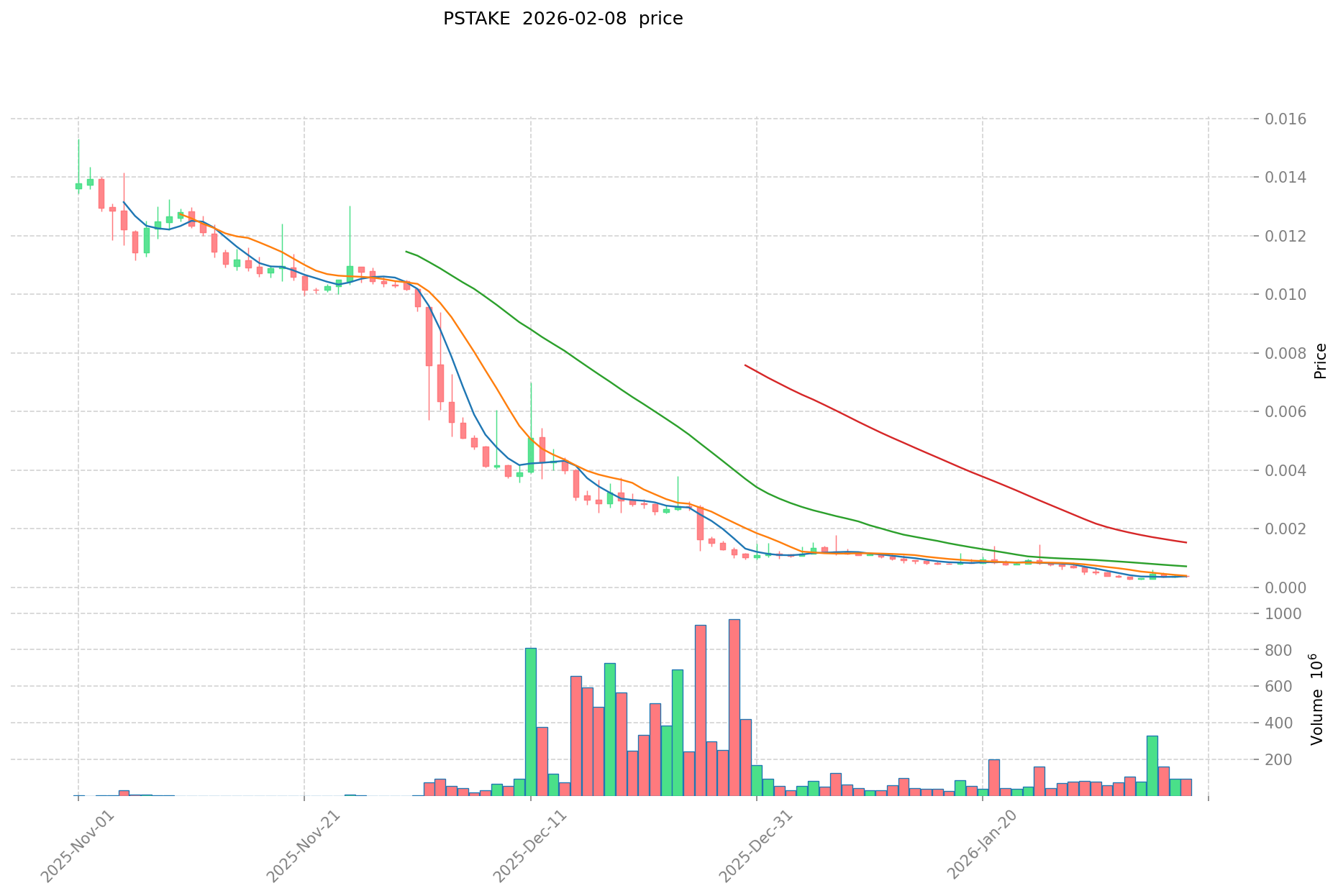
pSTAKE Finance (PSTAKE) represents a liquid staking protocol for Proof-of-Stake (PoS) assets within the cryptocurrency ecosystem. As of February 9, 2026, PSTAKE maintains a market capitalization of $182,000 with a circulating supply of 500,000,000 tokens and a current trading price of approximately $0.000364. The protocol enables PoS token holders to deposit their assets on the pSTAKE platform to mint 1:1 pegged ERC-20 wrapped tokens (pTOKENs), such as pATOM, allowing staking participants to maintain liquidity while earning rewards. By utilizing custom bridges, pSTAKE facilitates growth within the Cosmos ecosystem while enhancing liquidity and composability for Ethereum ecosystem assets. With a fully diluted market cap to current market cap ratio of 100%, PSTAKE has experienced notable price movements, including a 3.82% increase over one hour and a 4.12% gain over seven days, though facing a 67.12% decline over the past 30 days. Currently holding approximately 14,205 token holders and listed on 4 exchanges, PSTAKE continues to evolve within the liquid staking sector. This article provides a comprehensive analysis of PSTAKE's investment characteristics, historical performance patterns, future price dynamics, and associated risk factors to inform potential market participants.
I. PSTAKE Price History Review and Current Investment Value
PSTAKE Historical Price Trends and Investment Performance
- 2022: PSTAKE reached a price level of $1.21 on March 7, 2022 → Investors experienced significant returns during this period
- 2026: Market adjustment phase → PSTAKE price declined to $0.00027458 on February 3, 2026
- Recent period: Price demonstrated volatility → Trading at $0.000364 as of February 9, 2026, showing a recovery trend with a 7-day increase of 4.12%
Current PSTAKE Investment Market Status (February 2026)
- PSTAKE current price: $0.000364
- 24-hour trading volume: $25,531.09
- Market capitalization: $182,000
- Circulating supply: 500,000,000 PSTAKE (100% of total supply)
Click to view real-time PSTAKE market price
II. Core Factors Influencing Whether PSTAKE is a Good Investment (Is pSTAKE Finance(PSTAKE) a Good Investment)
Supply Mechanism and Scarcity (PSTAKE investment scarcity)
- Fixed supply cap: pSTAKE Finance has a maximum supply of 500 million tokens, with 100% currently in circulation (500 million circulating supply). This fixed cap mechanism may influence long-term price dynamics by limiting potential dilution.
- Historical price volatility: PSTAKE has experienced significant price fluctuations, with historical data showing a peak price of $1.21 in March 2022 and a lower bound of $0.00027458 in February 2026. As of February 9, 2026, the token trades at $0.000364.
- Investment considerations: The complete circulation of the total supply eliminates inflationary pressure from token unlocks, though the current fully diluted market capitalization of $182,000 suggests a relatively small market presence compared to established projects.
Institutional Investment and Mainstream Adoption (Institutional investment in PSTAKE)
- Exchange listings: pSTAKE Finance is currently listed on 4 exchanges, with Gate.com being one confirmed trading platform. The limited exchange presence may affect liquidity and accessibility for institutional participants.
- Holder distribution: The token has approximately 14,205 holders, indicating a relatively modest user base that may impact market depth and trading activity.
- Market capitalization positioning: With a market capitalization of $182,000 and a market dominance of 0.0000072%, pSTAKE represents a micro-cap cryptocurrency asset that may face challenges in attracting significant institutional capital.
Macroeconomic Environment Impact on PSTAKE Investment
- Recent price performance: As of February 2026, PSTAKE shows mixed short-term signals with a 1-hour gain of 3.82%, 24-hour increase of 2.39%, and 7-day growth of 4.12%. However, longer-term metrics reveal substantial declines of -67.12% over 30 days and -98.52% over one year.
- Market volatility: The 24-hour trading range between $0.0003026 and $0.000391 demonstrates considerable intraday volatility, which may reflect broader risk-off sentiment in cryptocurrency markets or project-specific concerns.
- Trading volume: Daily trading volume of $25,531.09 indicates relatively limited market activity, which could amplify price sensitivity to macroeconomic shifts or changes in investor sentiment.
Technology and Ecosystem Development (Technology & Ecosystem for PSTAKE investment)
- Core protocol function: pSTAKE Finance operates as a liquid staking protocol for Proof-of-Stake (PoS) assets, enabling users to stake tokens such as ATOM while maintaining liquidity through 1:1 pegged ERC-20 wrapped tokens (pTOKENs like pATOM).
- Cross-chain infrastructure: The protocol utilizes custom bridge technology to facilitate interoperability between the Cosmos ecosystem and Ethereum, potentially enhancing asset composability and liquidity across different blockchain networks.
- DeFi integration potential: By allowing staked assets to remain liquid, pSTAKE's mechanism theoretically enables participation in DeFi applications while earning staking rewards, though specific adoption metrics and ecosystem partnerships were not detailed in available materials.
III. PSTAKE Future Investment Prediction and Price Outlook (Is pSTAKE Finance(PSTAKE) worth investing in 2026-2031)
Short-term Investment Prediction (2026, short-term PSTAKE investment outlook)
- Conservative prediction: $0.000235 - $0.000345
- Neutral prediction: $0.000345 - $0.000470
- Optimistic prediction: $0.000470 - $0.000510
Mid-term Investment Outlook (2027-2029, mid-term pSTAKE Finance(PSTAKE) investment forecast)
- Market stage expectation: The token may experience gradual development with potential expansion in liquid staking adoption and ecosystem partnerships.
- Investment return prediction:
- 2027: $0.000395 - $0.000509
- 2028: $0.000307 - $0.000637
- 2029: $0.000482 - $0.000679
- Key catalysts: Protocol partnerships, decentralized governance implementation, and broader adoption of liquid staking mechanisms in the Cosmos and Ethereum ecosystems.
Long-term Investment Outlook (Is PSTAKE a good long-term investment?)
- Base scenario: $0.000540 - $0.000798 (assuming steady protocol development and moderate market adoption)
- Optimistic scenario: $0.000798 - $0.000917 (assuming enhanced ecosystem integration and favorable market conditions)
- Risk scenario: Below $0.000307 (considering potential market volatility and competitive pressures)
Click to view PSTAKE long-term investment and price prediction: Price Prediction
2026-02-09 - 2031 Long-term Outlook
- Base scenario: $0.000540 - $0.000798 (corresponding to steady progress and stable mainstream application growth)
- Optimistic scenario: $0.000798 - $0.000917 (corresponding to large-scale adoption and favorable market environment)
- Transformational scenario: Above $0.000917 (such as breakthrough progress in ecosystem and mainstream adoption)
- 2031-12-31 predicted high: $0.000917 (based on optimistic development assumptions)
Disclaimer: The above predictions are based on current market data and analytical models. Cryptocurrency markets are highly volatile and subject to various risk factors. These predictions should not be considered as financial advice or guarantees of future performance. Investors should conduct their own research and assess their risk tolerance before making any investment decisions.
| Year | Predicted High Price | Predicted Average Price | Predicted Low Price | Price Change |
|---|---|---|---|---|
| 2026 | 0.000469744 | 0.0003454 | 0.000234872 | -5 |
| 2027 | 0.000509465 | 0.000407572 | 0.00039534484 | 11 |
| 2028 | 0.000637340715 | 0.0004585185 | 0.000307207395 | 25 |
| 2029 | 0.0006794327133 | 0.0005479296075 | 0.0004821780546 | 50 |
| 2030 | 0.00079778550852 | 0.0006136811604 | 0.000540039421152 | 68 |
| 2031 | 0.000917453334798 | 0.00070573333446 | 0.000663389334392 | 93 |
IV. PSTAKE Investment Strategy and Risk Management (How to invest in liquid staking tokens)
Investment Methodology (PSTAKE investment strategy)
Long-term Holding (HODL PSTAKE)
Long-term holding may be suitable for investors who believe in the fundamental value proposition of liquid staking protocols. This approach focuses on:
- Protocol Adoption: Monitoring the growth of staked assets and total value locked (TVL) within the pSTAKE ecosystem
- Ecosystem Integration: Tracking partnerships and integrations with DeFi protocols that enhance utility for pTokens
- Market Position: Observing the protocol's competitive positioning within the liquid staking sector
Investors considering this approach should maintain realistic expectations about the token's price volatility, as PSTAKE has experienced substantial fluctuations, with a current price of $0.000364 representing a significant decline from its all-time high.
Active Trading
Active trading strategies for PSTAKE require careful analysis due to its relatively low liquidity:
- Technical Analysis: Chart patterns and volume indicators may have limited reliability given the 24-hour trading volume of approximately $25,531
- Volatility Utilization: Recent price movements show a 24-hour change of 2.39% and 7-day change of 4.12%, presenting potential opportunities for short-term traders
- Liquidity Considerations: Limited exchange availability (4 exchanges) may impact execution and slippage
Risk Management (Risk management for PSTAKE investment)
Asset Allocation Ratios
Given PSTAKE's market characteristics, suggested allocation frameworks include:
Conservative Investors
- Maximum allocation: 0.5-1% of crypto portfolio
- Focus on diversification across multiple asset classes
- Priority on established cryptocurrencies with higher liquidity
Aggressive Investors
- Potential allocation: 2-5% of crypto portfolio
- Acceptance of higher volatility in exchange for potential upside
- Active monitoring and position adjustment capability
Professional Investors
- Strategic allocation based on liquid staking thesis
- Hedging strategies utilizing related DeFi protocols
- Advanced risk modeling incorporating protocol-specific metrics
Risk Hedging Solutions
Multi-Asset Portfolio Construction
- Combine PSTAKE with established PoS tokens (e.g., ATOM, ETH)
- Include stablecoins for liquidity and stability
- Consider broader DeFi protocol tokens for sector exposure
Protective Instruments
- Maintain adequate stablecoin reserves for opportunistic rebalancing
- Consider dollar-cost averaging to mitigate timing risk
- Monitor correlation with underlying staked assets
Secure Storage Solutions
Given that PSTAKE operates as an ERC-20 token on Ethereum (contract address: 0xfB5c6815cA3AC72Ce9F5006869AE67f18bF77006):
Cold and Hot Wallet Distribution
- Hot wallets: 10-20% for active trading and liquidity provision
- Cold wallets: 80-90% for long-term holdings
Hardware Wallet Recommendations
- Ledger Nano X/S: Full ERC-20 support with Ethereum ecosystem compatibility
- Trezor Model T: Alternative hardware solution with comprehensive token support
- Security practices: Verify contract addresses, enable all security features, maintain secure backup procedures
V. PSTAKE Investment Risks and Challenges (Risks of investing in liquid staking tokens)
Market Risks
Volatility Characteristics
PSTAKE demonstrates substantial price volatility:
- 30-day price change: -67.12%
- 1-year price change: -98.52%
- Current price ($0.000364) represents a 99.97% decline from all-time high ($1.21)
This volatility profile indicates significant downside risk and potential for rapid capital loss. The token's limited liquidity (24-hour volume of $25,531) may amplify price swings during periods of market stress.
Market Manipulation Considerations
Lower market capitalization tokens face elevated risks:
- Total market cap: approximately $182,000
- Limited exchange presence (4 exchanges) may concentrate liquidity
- Potential for disproportionate price impact from large transactions
Regulatory Risks
Jurisdictional Uncertainty
Liquid staking protocols operate in an evolving regulatory landscape:
- Securities Classification: Ongoing debates regarding whether staking tokens constitute securities in various jurisdictions
- Cross-Border Operations: pSTAKE's bridge functionality between Cosmos and Ethereum ecosystems may face scrutiny in different regulatory environments
- Compliance Evolution: Potential future requirements for KYC/AML procedures that could impact protocol accessibility
Geographic Policy Variations
Investors should be aware that:
- Regulatory frameworks differ substantially across regions
- Policy changes may impact token accessibility or trading availability
- Compliance requirements may evolve, affecting protocol operations
Technical Risks
Network Security Vulnerabilities
As a protocol interfacing with multiple blockchain networks:
- Smart Contract Risk: Vulnerabilities in protocol smart contracts could lead to fund loss
- Bridge Security: Custom bridge infrastructure connecting Cosmos and Ethereum represents additional attack surfaces
- Oracle Dependencies: Reliance on price feeds and external data sources introduces potential failure points
Protocol Upgrade Challenges
Technical development carries inherent risks:
- Implementation of protocol updates may encounter unexpected issues
- Network coordination across multiple blockchain ecosystems adds complexity
- Backward compatibility considerations during upgrades
Operational Risks
- Liquidity Constraints: Limited pToken liquidity may impact user ability to unlock staked positions
- Validator Performance: Underlying validator selection and performance affects staking rewards
- Composability Dependencies: Integration with DeFi protocols introduces interdependencies that may affect functionality
VI. Conclusion: Is Liquid Staking Token Investment Appropriate?
Investment Value Summary
PSTAKE represents a liquid staking protocol attempting to address liquidity constraints in Proof-of-Stake ecosystems. The fundamental value proposition of allowing users to maintain liquidity while earning staking rewards addresses a genuine market need. However, the token has experienced substantial price depreciation, with current metrics showing:
- Price decline of 98.52% over one year
- Recent 30-day decline of 67.12%
- Limited market capitalization of approximately $182,000
- Modest trading volume of $25,531 over 24 hours
The protocol's technical infrastructure, including custom bridges connecting Cosmos and Ethereum ecosystems, demonstrates innovation in cross-chain functionality. However, investors should recognize that strong technology does not necessarily translate to token price appreciation.
Investor Recommendations
✅ New Investors
Approach Considerations:
- Begin with educational research on liquid staking mechanisms before capital allocation
- If participating, consider dollar-cost averaging with very small position sizes
- Prioritize secure storage using hardware wallets that support ERC-20 tokens
- Maintain realistic expectations about volatility and potential for loss
Recommended Actions:
- Allocate no more than 0.5-1% of overall crypto portfolio
- Utilize reputable exchanges with adequate liquidity
- Verify all contract addresses before transactions (0xfB5c6815cA3AC72Ce9F5006869AE67f18bF77006)
✅ Experienced Investors
Strategic Considerations:
- Evaluate PSTAKE within broader liquid staking sector trends
- Consider position sizing relative to protocol TVL and adoption metrics
- Implement active monitoring of key performance indicators
- Maintain flexibility to adjust positions based on market conditions
Tactical Approaches:
- Employ disciplined entry and exit strategies
- Consider portfolio hedging through diversification across multiple liquid staking protocols
- Monitor correlation with underlying PoS assets (particularly ATOM)
✅ Institutional Investors
Due Diligence Requirements:
- Conduct comprehensive smart contract audits and security assessments
- Evaluate protocol governance structures and development roadmaps
- Assess liquidity depth across available trading venues
- Consider regulatory implications across relevant jurisdictions
Allocation Framework:
- Position PSTAKE within broader DeFi and staking infrastructure thesis
- Implement institutional-grade custody solutions
- Establish clear risk parameters and position limits
- Maintain ongoing monitoring of protocol metrics and competitive landscape
⚠️ Important Disclosure
Cryptocurrency investments carry substantial risk, including potential total loss of capital. PSTAKE's historical price performance demonstrates significant downside volatility. Market conditions can change rapidly, and past performance does not indicate future results. This analysis is provided for informational purposes only and does not constitute investment advice, financial advice, trading advice, or recommendations of any kind. Investors should conduct independent research, consider their individual financial circumstances, and consult with qualified financial advisors before making investment decisions. The regulatory landscape for cryptocurrency and DeFi protocols continues to evolve, and future policy changes may materially impact token value and accessibility.
VII. FAQ
Q1: What is pSTAKE Finance and how does liquid staking work?
pSTAKE Finance is a liquid staking protocol that allows Proof-of-Stake (PoS) token holders to stake their assets while maintaining liquidity. When users deposit PoS tokens (such as ATOM) on the pSTAKE platform, they receive 1:1 pegged ERC-20 wrapped tokens called pTOKENs (like pATOM). These pTOKENs can be used in DeFi applications while the original assets continue earning staking rewards. The protocol utilizes custom bridges to connect the Cosmos ecosystem with Ethereum, enabling cross-chain functionality and composability. This mechanism addresses a fundamental challenge in traditional staking where assets become locked and illiquid during the staking period.
Q2: Why has PSTAKE experienced such significant price decline from its all-time high?
PSTAKE has declined approximately 99.97% from its all-time high of $1.21 (March 2022) to its current price of $0.000364 (February 2026). This dramatic decline reflects multiple factors: broader cryptocurrency market corrections, reduced investor appetite for micro-cap DeFi tokens, limited exchange availability (only 4 exchanges), and relatively low trading volume ($25,531 daily). The token's small market capitalization of $182,000 makes it particularly susceptible to volatility. Additionally, the liquid staking sector has become increasingly competitive, and the protocol's modest holder base (approximately 14,205 holders) suggests limited mainstream adoption compared to larger competitors in the space.
Q3: What are the primary risks associated with investing in PSTAKE?
Investing in PSTAKE carries several significant risks. Market risks include extreme price volatility (67.12% decline over 30 days, 98.52% decline over one year), low liquidity that can amplify price swings, and potential for market manipulation given the small market cap. Technical risks involve smart contract vulnerabilities, bridge security concerns connecting Cosmos and Ethereum ecosystems, and potential operational issues with validator performance or pToken liquidity. Regulatory risks include uncertainty around securities classification for staking tokens and evolving compliance requirements across different jurisdictions. The limited exchange presence and trading volume also pose practical challenges for position entry and exit.
Q4: What allocation percentage should investors consider for PSTAKE?
Allocation recommendations vary significantly based on investor profile and risk tolerance. Conservative investors should limit PSTAKE exposure to 0.5-1% of their overall cryptocurrency portfolio, prioritizing diversification across established assets with higher liquidity. Aggressive investors with higher risk tolerance might allocate 2-5% of their crypto portfolio, accepting substantial volatility for potential upside. Professional investors can consider strategic allocations based on their liquid staking thesis, implementing advanced hedging strategies and protocol-specific risk modeling. Regardless of investor type, PSTAKE should represent only a small portion of total holdings given its micro-cap status, limited liquidity, and significant historical price decline.
Q5: How should PSTAKE tokens be stored securely?
As an ERC-20 token on Ethereum (contract address: 0xfB5c6815cA3AC72Ce9F5006869AE67f18bF77006), PSTAKE requires proper storage solutions. Hardware wallets like Ledger Nano X/S or Trezor Model T provide optimal security with full ERC-20 support. Investors should implement a distribution strategy: maintain 80-90% of holdings in cold storage (hardware wallets) for long-term positions, and keep 10-20% in hot wallets for active trading and liquidity provision. Essential security practices include always verifying the contract address before transactions, enabling all available security features on wallets, maintaining secure backup procedures for recovery phrases, and using reputable exchanges with adequate security infrastructure for trading activities.
Q6: What factors could drive PSTAKE price appreciation in the future?
Potential positive catalysts for PSTAKE include increased adoption of liquid staking mechanisms across PoS ecosystems, strategic partnerships with major DeFi protocols that enhance pTOKEN utility, successful implementation of decentralized governance structures, and expansion of exchange listings to improve liquidity. Technical improvements to the protocol's bridge infrastructure and security measures could also attract more users. Broader market trends favoring DeFi innovation and institutional interest in staking infrastructure might benefit the token. However, investors should maintain realistic expectations given the token's current low market cap, limited trading volume, and substantial historical decline. Price predictions suggest modest potential appreciation in base scenarios ($0.000540-$0.000798 by 2031), though significant uncertainty remains.
Q7: How does PSTAKE compare to other liquid staking protocols in the market?
While specific comparative metrics are limited in available materials, PSTAKE's positioning can be assessed through several dimensions. With a market capitalization of only $182,000 and trading volume of $25,531 daily, PSTAKE represents a micro-cap project significantly smaller than established liquid staking competitors. The protocol's focus on Cosmos ecosystem assets (particularly ATOM) through cross-chain bridges to Ethereum provides a distinct niche, though this specialization may limit broader market appeal. PSTAKE's complete token circulation (500 million tokens, 100% in circulation) eliminates inflation concerns from future unlocks, unlike some competitors with vesting schedules. However, the limited exchange presence (4 exchanges) and modest holder base (approximately 14,205) suggest PSTAKE faces challenges in achieving adoption levels comparable to larger liquid staking protocols with stronger network effects and institutional backing.
Q8: What monitoring metrics should investors track for PSTAKE?
Investors should establish comprehensive monitoring of several key performance indicators. Protocol-level metrics include total value locked (TVL) in pSTAKE, growth in pTOKEN minting and circulation, validator performance and staking yields, and adoption of pTOKENs across DeFi applications. Market metrics encompass trading volume trends across available exchanges, holder count growth, liquidity depth at various price levels, and correlation with underlying PoS assets (particularly ATOM). Technical development indicators include smart contract upgrades, security audit findings, bridge transaction volumes between Cosmos and Ethereum, and governance activity if decentralized governance is implemented. Competitive landscape assessment should track rival liquid staking protocols, market share dynamics, and innovation in the broader staking infrastructure sector.
Share
Content
Introduction: pSTAKE Finance (PSTAKE) Investment Position and Market Prospects
I. PSTAKE Price History Review and Current Investment Value
II. Core Factors Influencing Whether PSTAKE is a Good Investment (Is pSTAKE Finance(PSTAKE) a Good Investment)
III. PSTAKE Future Investment Prediction and Price Outlook (Is pSTAKE Finance(PSTAKE) worth investing in 2026-2031)
IV. PSTAKE Investment Strategy and Risk Management (How to invest in liquid staking tokens)
V. PSTAKE Investment Risks and Challenges (Risks of investing in liquid staking tokens)
VI. Conclusion: Is Liquid Staking Token Investment Appropriate?
VII. FAQ
How to Buy Cryptocurrency


Trending Cryptocurrencies



Best Staking Protocols in 2025: Comparing Lido, Rocket Pool, and Beyond
What is the liquidity staking? Beginner's guide to unlocking liquidity by staking crypto assets.

ETH Staking in 2025: On-Chain Options and Best Platforms

Maximizing decentralized finance returns through liquidity staking: a strategy to earn yields while maintaining liquidity
How to Stake BTC and Earn NXPC Tokens on Gate Launchpool in 2025

2025 Liquid Staking: A Web3 Investor's Guide

Top Cold Wallets for Cryptocurrency: Rankings

Funding Rate Analysis: Bitcoin Price Prediction and Investment Strategies

Is Ethereum becoming irrelevant?

What is PSTAKE: A Comprehensive Guide to Persistence's Liquid Staking Token

What is MAK: A Comprehensive Guide to Understanding Microkernel Architecture and Its Applications