Quantstamp (QSP) is a blockchain security audit protocol providing smart contract vulnerability detection on Ethereum, currently trading at $0.001025 with a market cap of $731,290 and ranking #2747. The token demonstrates mixed investment characteristics: established partnerships with Ethereum 2.0, Binance, MakerDAO, and Chainlink provide operational credibility, while a circulating supply of 713.8 million tokens (73.1% of maximum) supports the scarcity model. However, QSP faces significant challenges including high volatility (-15.12% weekly), limited trading volume ($13,056 daily), and regulatory uncertainty surrounding security tokens. Investment strategies range from conservative dollar-cost averaging (1-3% allocation) to active trading approaches, with 2026-2031 price scenarios ranging from $0.000759684 to $0.002594146586128 depending on blockchain security adoption rates. Risk management through portfolio diversification, secure cold wallet storage, and thorough due diligence remains essential for evalu
Introduction: Quantstamp (QSP)'s Investment Position and Market Prospects
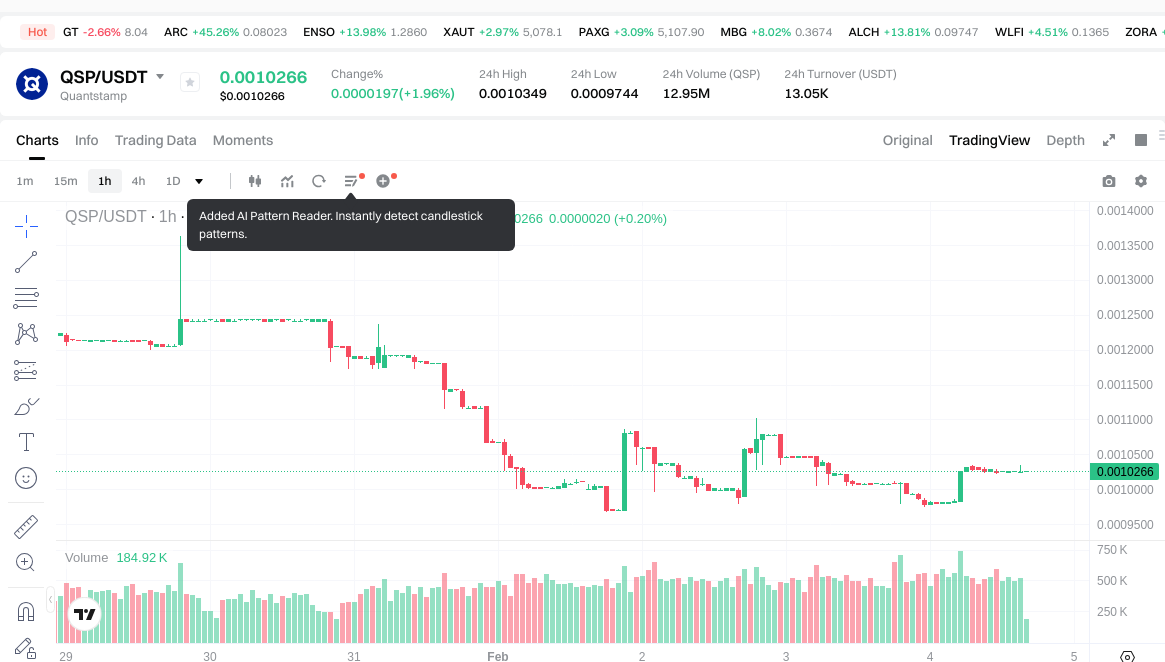
QSP is a notable asset in the cryptocurrency sector, having been launched in 2017 and establishing itself within the blockchain security audit domain. As of February 2026, Quantstamp maintains a market capitalization of approximately $731,290, with a circulating supply of around 713,801,947 tokens, and the current price hovering near $0.0010245. Positioned as a scalable security audit protocol for Ethereum smart contracts, QSP has gradually become a focal point for investors discussing "Is Quantstamp (QSP) a good investment?" This article provides a comprehensive analysis of QSP's investment value, historical trends, future price projections, and associated risks to offer reference points for investors.
Quantstamp operates as a leader in blockchain security, providing specialized security audit services. The protocol aims to address smart contract vulnerabilities through a distributed network of participants, with QSP tokens serving as the medium for payment and service improvement within the ecosystem. Notable clients include entities associated with Ethereum 2.0, Binance, MakerDAO, Chainlink, and eToro. As of February 4, 2026, QSP ranks #2747 in market capitalization with a 24-hour trading volume of $13,056.60, representing a market dominance of 0.000036%. The token demonstrates a circulating supply ratio of approximately 73.1% against its maximum supply of 976,442,388 tokens.
Recent price performance shows QSP experienced a 1.96% increase over 24 hours, while facing declines of 15.12% over the past week, 4.6% over 30 days, and 11% over the past year. The token's historical price range spans from an all-time high of $0.866421 recorded on January 8, 2018, to an all-time low of $0.003370653149 observed on August 16, 2025. With the token currently holding 33,315 addresses and available for trading on exchanges, this analysis examines the technical foundations, market dynamics, and risk factors relevant to evaluating QSP's potential as an investment option.
I. Quantstamp (QSP) Price History and Current Investment Value
- 2018: QSP reached a peak price of $0.866421 → early investors experienced significant returns during this period
- 2020-2021: Cryptocurrency market bull cycle → QSP demonstrated notable price fluctuations alongside broader market movements
- 2025: Market adjustment phase → price declined from higher levels to approximately $0.001025
Current QSP Investment Market Status (February 2026)
- QSP current price: $0.001025
- 24-hour trading volume: $13,056.60
- Market capitalization: $731,290.09
- Circulating supply: 713,801,947 QSP
Click to view real-time QSP market price
II. Core Factors Affecting Whether QSP is a Good Investment (Is Quantstamp(QSP) a Good Investment)
Supply Mechanism and Scarcity (QSP investment scarcity)
- Fixed supply model → influences price and investment value
- Quantstamp has a maximum supply of 976,442,388 QSP tokens, with approximately 713,801,947 tokens currently in circulation, representing a circulating ratio of 73.10%
- Investment significance: the limited supply structure may provide potential support for long-term value considerations
Institutional Investment and Mainstream Adoption (Institutional investment in QSP)
- Enterprise client base: Quantstamp has provided blockchain security audit services for notable projects including Ethereum 2.0, Binance, MakerDAO, Chainlink, and eToro
- Industry positioning: as a blockchain security audit protocol provider, Quantstamp's adoption by major crypto and enterprise companies demonstrates its role in the ecosystem
- Market influence: the World Economic Forum has also chosen Quantstamp to protect blockchain applications
Macroeconomic Environment's Impact on QSP Investment
- Smart contract growth: the expansion of smart contract implementation across blockchain networks may influence demand for security audit services
- Cybersecurity considerations: increasing awareness of smart contract vulnerabilities and security requirements may affect the value proposition of audit protocols
- Market volatility: QSP has experienced notable price fluctuations, with 24-hour price changes of 1.96%, 7-day changes of -15.12%, and 1-year changes of -11%
Technology and Ecosystem Development (Technology & Ecosystem for QSP investment)
- Protocol foundation: Quantstamp operates as a scalable security audit protocol designed to identify vulnerabilities in Ethereum smart contracts
- Service model: the protocol creates a distributed participant network to provide cost-effective audit systems for smart contracts on the Ethereum network
- Token utility: QSP serves as an ERC-20 token used for payment, receiving compensation, and service improvements within the Quantstamp protocol ecosystem
III. QSP Future Investment Forecast and Price Outlook (Is Quantstamp(QSP) worth investing in 2026-2031)
Short-term Investment Forecast (2026, short-term QSP investment outlook)
- Conservative forecast: $0.000759684 - $0.0010266
- Neutral forecast: $0.0010266 - $0.001211388
- Optimistic forecast: $0.001211388 - $0.001396176
Mid-term Investment Outlook (2027-2029, mid-term Quantstamp(QSP) investment forecast)
- Market phase expectation: The token may experience gradual growth as the blockchain security sector continues to develop, with potential fluctuations based on broader market conditions and adoption of security audit services.
- Investment return forecast:
- 2027: $0.00106602144 - $0.00178074036
- 2028: $0.001421260971 - $0.0021842537028
- 2029: $0.001159300133082 - $0.002079379603782
- Key catalysts: Growth in smart contract deployments, increased demand for security auditing services, partnerships with major blockchain projects, and overall market sentiment toward blockchain security solutions.
Long-term Investment Outlook (Is QSP a good long-term investment?)
- Base scenario: $0.001156263870828 - $0.002126349660761 (assuming steady development of blockchain security services and moderate market growth)
- Optimistic scenario: $0.002126349660761 - $0.002594146586128 (assuming expanded adoption of security auditing protocols and favorable regulatory environment)
- Risk scenario: Below $0.001156263870828 (under conditions of declining demand for security services or unfavorable market dynamics)
View QSP long-term investment and price forecast: Price Prediction
2026-2031 Long-term Outlook
- Base scenario: $0.001156263870828 - $0.001959769272591 (corresponding to stable progress and steady growth in mainstream applications)
- Optimistic scenario: $0.001959769272591 - $0.002594146586128 (corresponding to large-scale adoption and favorable market conditions)
- Transformative scenario: Above $0.002594146586128 (if ecosystem achieves breakthrough developments and mainstream proliferation)
- 2031-12-31 forecast high: $0.002594146586128 (based on optimistic development assumptions)
Disclaimer: The forecast is for reference only and does not constitute investment advice. Cryptocurrency markets are highly volatile, and actual performance may differ significantly from predictions.
| Year |
Predicted High Price |
Predicted Average Price |
Predicted Low Price |
Price Change |
| 2026 |
0.001396176 |
0.0010266 |
0.000759684 |
0 |
| 2027 |
0.00178074036 |
0.001211388 |
0.00106602144 |
18 |
| 2028 |
0.0021842537028 |
0.00149606418 |
0.001421260971 |
45 |
| 2029 |
0.002079379603782 |
0.0018401589414 |
0.001159300133082 |
79 |
| 2030 |
0.002292930048931 |
0.001959769272591 |
0.001156263870828 |
90 |
| 2031 |
0.002594146586128 |
0.002126349660761 |
0.001743606721824 |
107 |
IV. Quantstamp (QSP) Investment Strategy and Risk Management (How to invest in QSP)
Investment Methodology (QSP investment strategy)
Investors can approach QSP through various strategies aligned with their risk tolerance and investment objectives:
-
Long-term Holding (HODL QSP): This approach suits conservative investors who believe in the long-term value proposition of blockchain security solutions. Given Quantstamp's established position in smart contract auditing, investors may choose to accumulate QSP tokens and hold through market cycles, anticipating that growing demand for blockchain security services could support token value over time.
-
Active Trading: Traders employing technical analysis and swing trading strategies may capitalize on QSP's price fluctuations. With a 24-hour trading volume of approximately $13,056 and recent price movements showing -0.2% (1H), +1.96% (24H), and -15.12% (7D), active traders can identify potential entry and exit points based on short-term price patterns and momentum indicators.
Risk Management (Risk management for QSP investment)
Effective risk management is essential when investing in QSP:
V. Quantstamp (QSP) Investment Risks and Challenges (Risks of investing in QSP)
-
Market Risk: QSP exhibits considerable volatility, with a 7-day price decline of -15.12% and 30-day movement of -4.6%. The token's 24-hour price range between $0.0009744 and $0.0010349 demonstrates intraday volatility. With a relatively low trading volume of approximately $13,056, the token may be susceptible to price manipulation or liquidity issues during periods of high volatility.
-
Regulatory Risk: As blockchain security services evolve, regulatory frameworks governing security tokens and utility tokens remain uncertain across different jurisdictions. Changes in securities laws, compliance requirements for blockchain auditing services, or restrictions on token usage could impact QSP's utility and value proposition. Investors should monitor regulatory developments in their respective countries and major crypto markets.
-
Technical Risk: While Quantstamp focuses on identifying vulnerabilities in smart contracts, the protocol itself relies on Ethereum network infrastructure. Potential risks include:
- Network security vulnerabilities affecting the Ethereum blockchain
- Smart contract risks in the QSP token contract or associated protocol implementations
- Challenges in protocol upgrades or transitions that could affect token functionality
- Competition from emerging blockchain security platforms offering alternative solutions
VI. Conclusion: Is QSP a Good Investment?
-
Investment Value Summary: Quantstamp (QSP) operates in the growing blockchain security sector, providing smart contract auditing services for Ethereum-based applications. With a circulating supply of approximately 713.8 million tokens (73.1% of max supply) and partnerships with notable projects, QSP has established a presence in the security audit space. However, the token has experienced price volatility, with a -11% movement over one year and a current price of $0.0010245, significantly below its historical peak. The relatively low market capitalization and trading volume suggest limited liquidity compared to major cryptocurrencies.
-
Investor Recommendations:
✅ Beginners: Consider dollar-cost averaging (DCA) with minimal allocation, prioritize secure wallet storage, and thoroughly research blockchain security fundamentals before investing in QSP.
✅ Experienced Investors: May employ swing trading strategies based on technical analysis while maintaining a diversified portfolio that includes established cryptocurrencies alongside smaller-cap tokens like QSP.
✅ Institutional Investors: Should conduct comprehensive due diligence on Quantstamp's business model, competitive positioning, and token economics before considering strategic allocation.
⚠️ Disclaimer: Cryptocurrency investments carry substantial risk due to price volatility, regulatory uncertainty, and market dynamics. This content is provided for informational purposes only and does not constitute investment advice. Investors should conduct their own research and consult with financial advisors before making investment decisions.
VII. FAQ
Q1: Is Quantstamp (QSP) a good investment in 2026?
Whether QSP represents a suitable investment depends on individual risk tolerance and investment objectives. QSP operates in the blockchain security sector with established partnerships including Ethereum 2.0, Binance, and MakerDAO, suggesting operational legitimacy. However, the token currently trades at $0.001025 with a market cap of $731,290 and ranks #2747, indicating limited liquidity and market presence. Recent performance shows mixed signals: +1.96% (24H) but -15.12% (7D) and -11% (1Y). Conservative investors should consider minimal allocation (1-3%), while acknowledging that QSP's value proposition relies on continued demand for smart contract security audits and broader blockchain adoption.
Q2: What are the main risks of investing in QSP tokens?
QSP carries several significant risks that investors should evaluate carefully. Market risk is substantial, evidenced by high volatility with a 15.12% weekly decline and relatively low trading volume of approximately $13,056, which may result in liquidity challenges and price manipulation susceptibility. Regulatory risk exists as blockchain security token frameworks remain uncertain across jurisdictions, potentially affecting utility and compliance requirements. Technical risks include dependency on Ethereum network infrastructure, potential smart contract vulnerabilities, and competitive pressure from emerging security platforms. The token's distance from its all-time high of $0.866421 (January 2018) to current levels represents a 99.88% decline, highlighting historical downside risk.
Q3: How does QSP's supply mechanism affect its investment potential?
QSP operates with a fixed supply model featuring a maximum supply of 976,442,388 tokens, with approximately 713,801,947 tokens currently circulating (73.10% circulation ratio). This fixed supply structure theoretically provides scarcity characteristics that could support long-term value, as no additional tokens will be created beyond the maximum cap. However, with nearly three-quarters of total supply already in circulation, the scarcity premium is limited compared to tokens with lower circulation ratios. The remaining 26.90% of tokens (approximately 262.6 million QSP) may enter circulation through various mechanisms, potentially creating selling pressure. Unlike deflationary tokens with burning mechanisms, QSP's supply remains static, meaning value appreciation depends primarily on demand growth rather than supply contraction.
Q4: What are the price predictions for QSP through 2031?
Price forecasts for QSP through 2031 vary across different scenarios, though all projections should be viewed with caution given cryptocurrency market volatility. For 2026, conservative estimates range from $0.000759684 to $0.001396176, representing potential movements of -26% to +36% from current levels. Mid-term projections for 2027-2029 suggest gradual appreciation under favorable conditions: 2027 ($0.00106602144 - $0.00178074036), 2028 ($0.001421260971 - $0.0021842537028), and 2029 ($0.001159300133082 - $0.002079379603782). Long-term 2031 forecasts project a high of $0.002594146586128 in optimistic scenarios, representing approximately 153% growth from current prices, contingent on expanded blockchain security adoption and favorable market conditions. Base scenarios suggest more modest appreciation to $0.001959769272591.
Q5: What investment strategies work best for QSP tokens?
Investment strategies for QSP should align with individual risk profiles and market expertise. Long-term holding (HODL) suits conservative investors who believe in blockchain security's growth potential, requiring allocation of 1-3% of crypto portfolios and secure cold wallet storage given QSP's position as an established but smaller-cap token. Active trading strategies may capitalize on QSP's price volatility, utilizing technical analysis to identify entry and exit points based on recent patterns showing intraday fluctuations between $0.0009744 and $0.0010349. Dollar-cost averaging (DCA) provides risk mitigation by spreading purchases across time intervals, reducing exposure to timing risk. Experienced traders might employ swing trading during periods of increased volatility, though low trading volume ($13,056 daily) requires careful consideration of liquidity constraints and wider bid-ask spreads.
Q6: How does Quantstamp's business model support QSP token value?
Quantstamp's business model centers on providing scalable security audit services for Ethereum smart contracts through a distributed network of participants, with QSP tokens serving as the protocol's economic medium. Tokens function as payment for audit services, compensation for security researchers and validators, and mechanisms for protocol improvements, creating utility-driven demand. The protocol's client roster including Ethereum 2.0, Binance, MakerDAO, Chainlink, eToro, and recognition by the World Economic Forum demonstrates operational adoption in the blockchain security sector. However, token value correlation with business success depends on whether increased audit demand translates to token utilization and whether competitive pressures from alternative security platforms affect market share. The token's current price of $0.001025 and limited market cap suggest the business model's value has not yet significantly impacted token pricing.
Q7: What wallet options are recommended for storing QSP tokens securely?
QSP storage requires wallet solutions compatible with ERC-20 tokens, as QSP operates on the Ethereum network (contract address: 0x99ea4dB9EE77ACD40B119BD1dC4E33e1C070b80d). For long-term holdings, hardware wallets such as Ledger or Trezor provide optimal security through offline private key storage, protecting against online threats and exchange vulnerabilities. Software wallets like MetaMask or Trust Wallet offer convenience for moderate holdings and periodic transactions, though they maintain online connectivity that introduces additional risk vectors. Exchange wallets should be limited to trading amounts only, given centralization risks and potential exchange security breaches. Multi-signature wallets provide enhanced security for larger holdings through distributed key management. Investors should implement backup procedures for recovery phrases, utilize strong passwords, and enable two-factor authentication where available.
Q8: How does QSP compare to other blockchain security investment options?
QSP occupies a specific niche within blockchain security as a protocol-focused audit solution, distinguishing it from broader cybersecurity cryptocurrencies or infrastructure tokens. Compared to larger security-focused projects, QSP's market cap of $731,290 and #2747 ranking indicate significantly smaller scale and liquidity, potentially offering higher risk-reward ratios but also greater volatility and liquidity challenges. Unlike security tokens from established cybersecurity firms entering blockchain or general-purpose smart contract platforms with built-in security features, QSP specializes exclusively in audit services for Ethereum-based contracts. This specialization provides focused value proposition but creates dependency on Ethereum ecosystem growth and competition from emerging Layer 1 blockchains with native security mechanisms. Investors comparing security tokens should evaluate market capitalization, trading liquidity, partnership quality, competitive positioning, and utility mechanisms across options.
* The information is not intended to be and does not constitute financial advice or any other recommendation of any sort offered or endorsed by Gate.