Ready to Fight (RTF) is a blockchain-based SocialFi platform targeting the professional fighting industry, trading at $0.01387 with a $1.11 million market cap as of February 2026. This comprehensive analysis evaluates RTF's investment potential across multiple dimensions: historical price movements from April 2024 launch through current levels, tokenomics with unlimited maximum supply and 80 million circulating tokens, and realistic price forecasts ranging from conservative to optimistic scenarios through 2031. The article addresses core investment considerations including market volatility, regulatory uncertainty, technical infrastructure risks, and project-specific execution challenges within the fighting community. Suitable strategies span from dollar-cost averaging for beginners to active trading for experienced investors, with emphasis on disciplined risk management and secure wallet storage. RTF represents a speculative niche cryptocurrency requiring careful due diligence and position sizing appropriate
Introduction: Ready to Fight (RTF)'s Investment Position and Market Outlook
Ready to Fight (RTF) represents a platform combining blockchain technology with SocialFi principles to serve the professional fighting industry. Since its launch in April 2024, RTF has positioned itself within the intersection of sports and decentralized technology. As of February 3, 2026, RTF holds a market capitalization of approximately $1.11 million, with a circulating supply of 80 million tokens and a current price around $0.01387. The platform aims to create an ecosystem connecting fighters, coaches, fans, promoters, and other stakeholders through automated and transparent business processes. With its focus on providing resources for training, career development, and personal branding within the fighting community, RTF has attracted attention from observers tracking niche blockchain applications. This article examines RTF's market positioning, historical price movements, potential future trajectories, and associated investment considerations to provide analytical reference for those evaluating this asset.
I. Ready to Fight (RTF) Price History Review and Investment Value Status
- 2024: RTF launched in April 2024 with an initial offering price of $0.1 → Early participants experienced significant price appreciation as the token reached $0.356 within the same month
- 2024-2025: Market correction phase → RTF price declined from April 2024 peak levels to $0.00861 by November 2025, reflecting broader market volatility and project development cycles
- 2026 (current): Price recovery period → As of February 3, 2026, RTF trades at $0.01387, showing partial recovery from previous lows with mixed short-term and long-term performance indicators
Current RTF Investment Market Status (February 2026)
- RTF current price: $0.01387
- Market capitalization: $1,109,600 with a fully diluted valuation of $5,548,000
- 24-hour trading volume: $13,083.63
- Circulating supply: 80,000,000 RTF (20% of total supply)
- Price performance: +0.055% (1H), -0.28% (24H), -10.19% (7D), -24.47% (30D), -37.76% (1Y)
- Token holders: 4,464 addresses
- Exchange listings: Available on 3 exchanges including Gate.com
Click to view real-time RTF market price
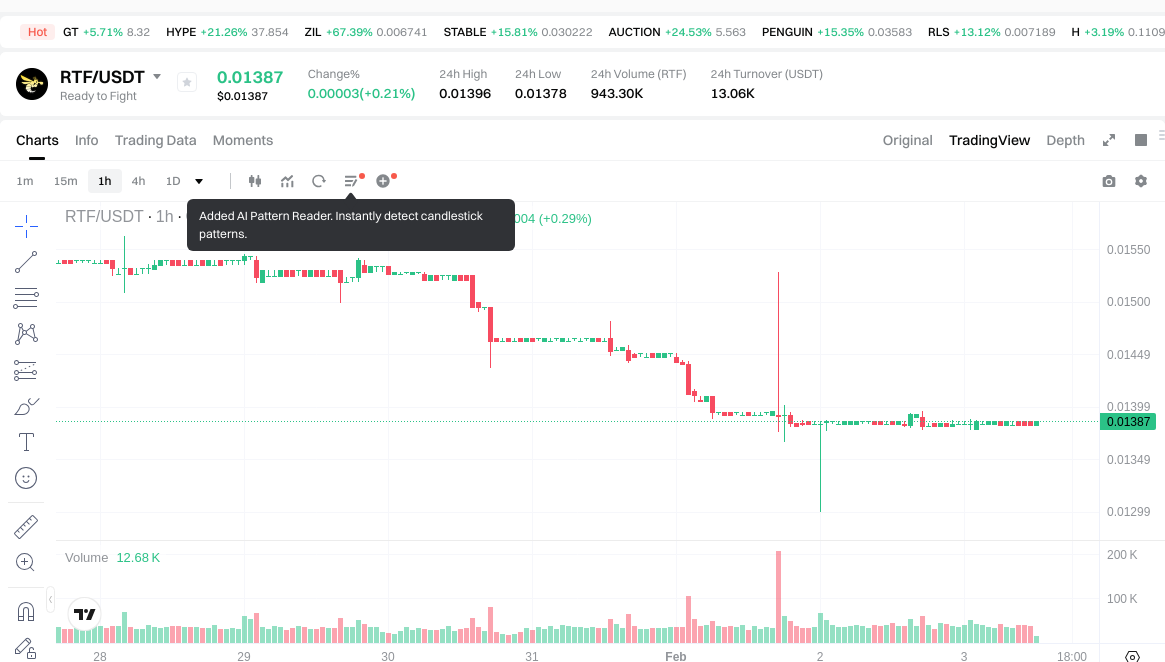
II. Core Factors Affecting Whether RTF is a Good Investment
Supply Mechanism and Scarcity (RTF Investment Scarcity)
- Maximum supply is unlimited (∞), while current circulating supply is 80,000,000 tokens (20% of total supply of 400,000,000) → potentially affects price dynamics and investment considerations
- Historical price ranges: RTF has traded between $0.00861 and $0.356 since launch in April 2024 → reflects significant volatility patterns
- Investment perspective: The unlimited maximum supply model differs from traditional scarcity-based tokenomics, which may influence long-term value considerations
Institutional Investment and Mainstream Adoption (Institutional Investment in RTF)
- Current holder base: Approximately 4,464 token holders as of February 2026
- Trading availability: RTF is listed on 3 exchanges, indicating limited but growing market accessibility
- Industry positioning: The platform targets professional fighting industry stakeholders including fighters, coaches, fans, and promoters through blockchain-based SocialFi integration
Macroeconomic Environment Impact on RTF Investment
- Market capitalization: Current market cap stands at approximately $1.11 million with a dominance of 0.00020% in the crypto market
- Performance metrics: RTF has shown price declines across multiple timeframes: -0.28% (24H), -10.19% (7D), -24.47% (30D), and -37.76% (1Y)
- Market positioning: As a niche sector token focused on professional fighting, RTF may respond differently to broader macroeconomic conditions compared to mainstream cryptocurrencies
Technology and Ecosystem Development (Technology & Ecosystem for RTF Investment)
- Core platform features: RTF utilizes blockchain technology to automate business processes in professional fighting, including partner matching, logistics management, and transparency mechanisms
- Ecosystem pillars: The platform provides gateway services for fighters and teams, an integrated social ecosystem for industry participants, and automated interoperable business processes
- Token standard: RTF operates as an ERC-20 token on Binance Smart Chain (BSC), providing compatibility with existing DeFi infrastructure
III. RTF Future Investment Prediction and Price Outlook (Is Ready to Fight(RTF) worth investing in 2026-2031)
Short-term Investment Prediction (2026, short-term RTF investment outlook)
- Conservative forecast: $0.0085 - $0.0120
- Neutral forecast: $0.0120 - $0.0144
- Optimistic forecast: $0.0144 - $0.0170
Mid-term Investment Outlook (2027-2028, mid-term Ready to Fight(RTF) investment forecast)
- Market phase expectation: The platform may undergo ecosystem consolidation and user base expansion as it continues to develop its SocialFi infrastructure within the professional fighting industry.
- Investment return prediction:
- 2027: $0.0110 - $0.0209
- 2028: $0.0170 - $0.0182
- Key catalysts: Platform adoption rate among fighters and stakeholders, strategic partnerships within the fighting community, broader Web3 and blockchain sector developments, and regulatory environment changes.
Long-term Investment Outlook (Is RTF a good long-term investment?)
- Base scenario: $0.0112 - $0.0221 (assuming steady platform development and moderate ecosystem growth)
- Optimistic scenario: $0.0197 - $0.0221 (assuming accelerated adoption, favorable market conditions, and successful technology upgrades)
- Risk scenario: $0.0085 - $0.0150 (under challenging market volatility or regulatory headwinds)
Click to view RTF long-term investment and price prediction: Price Prediction
2026-02-03 - 2031 Long-term Outlook
- Base scenario: $0.0112 - $0.0197 (corresponding to steady progress and gradual mainstream application enhancement)
- Optimistic scenario: $0.0197 - $0.0221 (corresponding to large-scale adoption and favorable market environment)
- Transformative scenario: Above $0.0221 (if ecosystem achieves breakthrough progress and mainstream popularization)
- 2031-12-31 predicted high: $0.0221 (based on optimistic development assumptions)
Disclaimer: The above predictions are based on available data and market analysis models. Cryptocurrency investments carry significant risks, and past performance does not guarantee future results. Investors should conduct independent research and consider their risk tolerance before making investment decisions.
| Year |
Predicted High Price |
Predicted Average Price |
Predicted Low Price |
Price Change |
| 2026 |
0.0144248 |
0.01387 |
0.0084607 |
0 |
| 2027 |
0.020938152 |
0.0141474 |
0.011034972 |
2 |
| 2028 |
0.01824448704 |
0.017542776 |
0.01701649272 |
26 |
| 2029 |
0.021472357824 |
0.01789363152 |
0.0150306504768 |
29 |
| 2030 |
0.02086397435232 |
0.019682994672 |
0.01692737541792 |
41 |
| 2031 |
0.022098098118254 |
0.02027348451216 |
0.011150416481688 |
46 |
IV. RTF Investment Strategy and Risk Management (How to invest in Ready to Fight)
Investment Methodology (RTF investment strategy)
-
Long-term holding (HODL RTF): Suitable for conservative investors who believe in the long-term vision of transforming the professional fighting industry through blockchain and SocialFi principles. This approach focuses on accumulating RTF tokens and holding through market cycles, anticipating that the platform's ecosystem development and adoption within the fighting community may contribute to value appreciation over extended periods.
-
Active trading: Relies on technical analysis and swing trading strategies. Traders may monitor price movements, trading volumes, and market sentiment to identify entry and exit points. Given RTF's observed price fluctuations, active traders should employ disciplined risk management, including stop-loss orders and position sizing based on volatility patterns.
Risk Management (Risk management for RTF investment)
V. RTF Investment Risks and Challenges (Risks of investing in Ready to Fight)
-
Market risks: RTF exhibits substantial price volatility, with observed fluctuations including notable percentage changes over various timeframes. The relatively modest trading volume may contribute to price sensitivity to larger orders. Market capitalization positioning suggests exposure to broader market movements affecting smaller-cap digital assets. Liquidity considerations should be evaluated before establishing positions, particularly for larger investment amounts.
-
Regulatory risks: Cryptocurrency projects operating across jurisdictions face evolving regulatory frameworks. Policy developments in different countries regarding digital assets, blockchain-based platforms, and tokenized ecosystems may affect project operations and token utility. Investors should monitor regulatory announcements in relevant jurisdictions and understand that regulatory clarity remains developing in many regions.
-
Technical risks: Blockchain projects involve technical complexity including smart contract security, network stability, and protocol upgrades. Potential vulnerabilities in smart contract code, dependencies on underlying blockchain infrastructure, and execution of planned technical roadmap elements represent considerations for investors. Platform development progress and ecosystem adoption within the fighting industry community may affect long-term project viability.
-
Project-specific risks: RTF's focus on the professional fighting industry represents both opportunity and concentration risk. Project success depends on adoption by fighters, coaches, fans, and other ecosystem participants. Competition from other blockchain-based sports and entertainment platforms, execution of the stated vision across three foundational pillars, and ability to build meaningful network effects within the fighting community all represent factors affecting potential outcomes.
VI. Conclusion: Is Ready to Fight a Good Investment?
-
Investment value summary: RTF represents a niche-focused blockchain project targeting the professional fighting industry with stated goals of creating unified, transparent ecosystem infrastructure. Long-term investment considerations depend on project execution, ecosystem development, and adoption within the fighting community. Short-term price movements reflect typical characteristics of emerging cryptocurrency projects with developing liquidity profiles.
-
Investor recommendations:
-
✅ Beginners: Consider dollar-cost averaging (DCA) strategies if interested in exposure, limiting position sizes appropriate to risk tolerance. Prioritize secure wallet storage and thorough research into project fundamentals before committing capital. Start with small allocations while developing understanding of both RTF specifically and cryptocurrency markets generally.
-
✅ Experienced investors: May employ swing trading approaches based on technical analysis while maintaining disciplined risk management protocols. Portfolio allocation should reflect comprehensive assessment of project stage, market positioning, and personal risk parameters. Monitor project developments, community engagement metrics, and competitive landscape.
-
✅ Institutional investors: Strategic allocation decisions should incorporate thorough due diligence on project team, technology infrastructure, market opportunity assessment, and regulatory considerations. Position sizing should align with institutional risk frameworks and investment mandates regarding emerging digital assets.
⚠️ Disclaimer: Cryptocurrency investments involve substantial risks including potential loss of invested capital. Market volatility, regulatory uncertainty, technical challenges, and project-specific execution risks all affect potential outcomes. This content provides informational analysis only and does not constitute investment advice, financial guidance, or recommendations to buy, sell, or hold any digital assets. Investors should conduct independent research, consult qualified financial advisors, and make decisions appropriate to their individual circumstances and risk tolerance.
VII. FAQ
Q1: What is Ready to Fight (RTF) and what makes it different from other cryptocurrency projects?
Ready to Fight (RTF) is a blockchain-based SocialFi platform specifically designed for the professional fighting industry. Unlike general-purpose cryptocurrencies, RTF focuses exclusively on connecting fighters, coaches, fans, promoters, and other stakeholders through automated and transparent business processes. The platform operates on Binance Smart Chain (BSC) as an ERC-20 token and provides three core pillars: gateway services for fighters and teams, an integrated social ecosystem for industry participants, and automated interoperable business processes. This niche specialization differentiates RTF from broader blockchain projects by targeting a specific industry vertical with tailored solutions for professional fighting community needs.
Q2: What has been RTF's price performance since its launch?
RTF launched in April 2024 at an initial offering price of $0.1 and experienced significant appreciation to $0.356 within the same month. However, the token subsequently entered a correction phase, declining to $0.00861 by November 2025. As of February 3, 2026, RTF trades at approximately $0.01387, representing a partial recovery from previous lows. Performance metrics show -0.28% (24H), -10.19% (7D), -24.47% (30D), and -37.76% (1Y), indicating substantial volatility patterns characteristic of emerging cryptocurrency projects. The token has traded between $0.00861 and $0.356 since launch, reflecting the typical price discovery process for new blockchain assets.
Q3: What are the key investment risks associated with RTF?
RTF investment involves multiple risk dimensions. Market risks include substantial price volatility, modest trading volumes that may affect liquidity, and a relatively small market capitalization of approximately $1.11 million. Regulatory risks stem from evolving cryptocurrency frameworks across different jurisdictions that may affect project operations. Technical risks encompass smart contract security, blockchain infrastructure dependencies, and execution of the development roadmap. Project-specific risks include concentrated focus on the professional fighting industry, dependence on ecosystem adoption by fighters and stakeholders, competition from other blockchain-based sports platforms, and the challenge of building meaningful network effects within the fighting community. Investors should carefully evaluate these factors against their risk tolerance.
Q4: What is RTF's tokenomics structure and how might it affect investment value?
RTF has a total supply of 400,000,000 tokens with a maximum supply listed as unlimited (∞), though current circulating supply stands at 80,000,000 tokens (20% of total). This represents a non-traditional tokenomics model compared to scarcity-based cryptocurrencies with fixed maximum supplies. The unlimited maximum supply designation potentially affects long-term value dynamics and investment considerations. As of February 2026, RTF maintains approximately 4,464 token holders and is listed on 3 exchanges including Gate.com. The fully diluted valuation stands at $5,548,000, suggesting significant potential token circulation ahead. Investors should understand how this supply mechanism differs from fixed-supply assets and consider implications for long-term value propositions.
Q5: What are the realistic price predictions for RTF through 2031?
Based on analysis models, RTF price projections vary across timeframes and scenarios. For 2026, short-term forecasts range from $0.0085-$0.0120 (conservative) to $0.0144-$0.0170 (optimistic). Mid-term outlook for 2027-2028 suggests $0.0110-$0.0209 (2027) and $0.0170-$0.0182 (2028). Long-term scenarios through 2031 include a base case of $0.0112-$0.0221, an optimistic scenario of $0.0197-$0.0221, and a risk scenario of $0.0085-$0.0150. The predicted high for 2031 is $0.0221 under optimistic development assumptions. These projections depend on platform adoption, ecosystem development, market conditions, regulatory environment, and successful execution of the project roadmap. Investors should note that cryptocurrency predictions involve significant uncertainty and past performance does not guarantee future results.
Q6: How should different investor types approach RTF investment?
Investment approaches should align with experience levels and risk tolerance. Beginners should consider dollar-cost averaging (DCA) strategies with small position sizes (1-3% of portfolio), prioritize secure wallet storage, and thoroughly research project fundamentals before investing. Experienced investors may employ swing trading strategies based on technical analysis while maintaining disciplined risk management, potentially allocating 3-7% of portfolios with active monitoring of project developments and market conditions. Institutional investors should conduct comprehensive due diligence on project team, technology infrastructure, market opportunity, and regulatory considerations, with position sizing aligned to institutional risk frameworks. All investor types should understand that RTF represents a speculative asset with substantial volatility and should only invest capital they can afford to lose.
Q7: What factors could influence RTF's future adoption and value?
Several key factors may impact RTF's trajectory. Platform adoption rate among fighters, coaches, and other stakeholders directly affects ecosystem viability and network effects. Strategic partnerships within the fighting community could accelerate user growth and utility expansion. Broader Web3 and blockchain sector developments may create favorable conditions for niche-focused projects like RTF. Technical execution of the development roadmap, including successful implementation of the three foundational pillars (gateway services, social ecosystem, and automated business processes), represents a critical success factor. Regulatory clarity in relevant jurisdictions could reduce uncertainty and enable broader participation. Competition from other blockchain-based sports and entertainment platforms may affect market positioning. Investors should monitor these catalysts while maintaining realistic expectations about project stage and execution challenges.
Q8: Where can investors trade RTF and how should they secure their holdings?
RTF is currently available on 3 exchanges, including Gate.com, with a 24-hour trading volume of approximately $13,083.63. For secure storage, long-term holders should consider cold wallet solutions such as hardware wallets (Ledger or Trezor devices) that provide offline protection from online security threats. Active traders may use reputable exchange wallets or software wallets with strong security features, but should limit stored amounts to trading needs only. Best practices include enabling two-factor authentication on all accounts, maintaining backup recovery phrases in secure offline locations, regularly verifying wallet addresses before transactions, and never sharing private keys or seed phrases. The relatively modest liquidity suggests investors should be mindful of position sizing and potential slippage when executing larger orders.
* The information is not intended to be and does not constitute financial advice or any other recommendation of any sort offered or endorsed by Gate.