This comprehensive analysis evaluates whether Refund (RFD) is a viable investment by examining its market position as a meme token launched in May 2023. The article reviews RFD's price history showing a 96.66% decline from initial offering, current market fundamentals including $1.36 million capitalization and limited exchange availability on Gate, and price forecasts through 2031. Core sections address supply mechanisms, investment risks including extreme volatility and regulatory uncertainty, and management strategies for different investor profiles. RFD presents substantial speculation risk with limited liquidity ($11,290 daily volume) and 6,999 holders. The analysis concludes with tailored recommendations for beginners, experienced traders, and institutional investors, emphasizing conservative allocation percentages and rigorous risk management protocols for this high-volatility micro-cap asset.
Introduction: Refund (RFD) Investment Position and Market Prospects
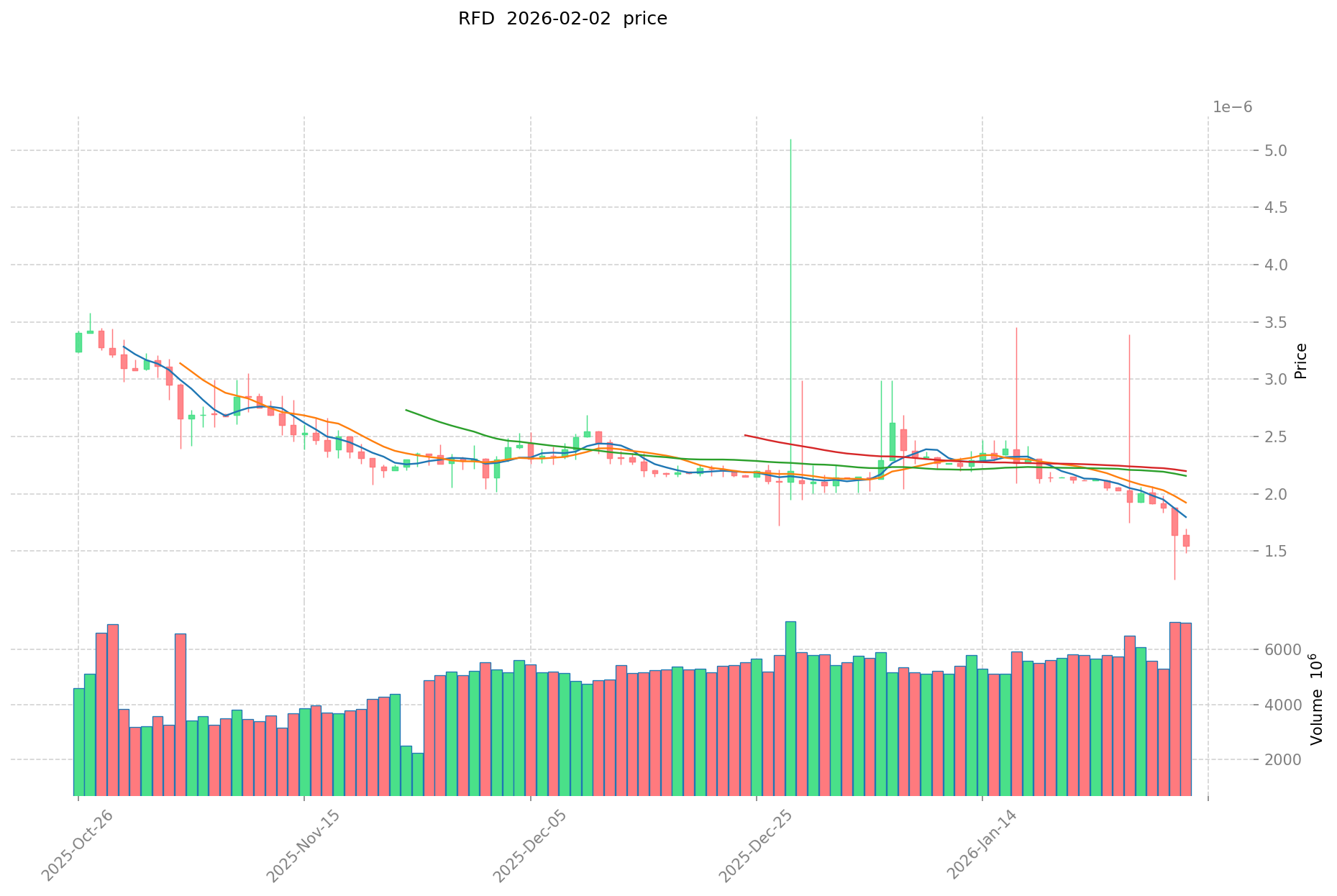
RFD is a notable asset in the cryptocurrency field, having been launched in May 2023 as a meme token. As of February 2026, RFD holds a market capitalization of approximately $1,336,000, with a circulating supply of 1,000,000,000,000 tokens, and the current price hovers around $0.000001336. Positioned as a community-driven meme token, RFD has gradually become a subject of discussion among investors exploring "Is Refund (RFD) a good investment?" This article will comprehensively analyze RFD's investment characteristics, historical price movements, future price projections, and associated investment risks to provide reference for potential investors.
I. Refund (RFD) Price History Review and Investment Value Status
- 2023: Launch on May 22, 2023, with initial trading price of $0.00004 → Early participants experienced significant portfolio fluctuations as price movements began.
- 2023-2024: Market volatility period → Price declined from $0.0001436 to lower ranges, reflecting broader market sentiment shifts.
- 2024-2025: Continued price adjustments → Trading range narrowed between $0.000001336 and $0.000001697, showing consolidation patterns.
Current RFD Investment Market Status (February 2026)
- RFD current price: $0.000001336
- Market sentiment (Fear & Greed Index): Data not available in reference materials
- 24-hour trading volume: $11,290.60
- Institutional investor holdings: Data not available in reference materials
Click to view real-time RFD market price
II. Core Factors Affecting Whether RFD is a Good Investment
Supply Mechanism and Scarcity (RFD investment scarcity)
- Maximum supply capped at 1,000,000,000,000 tokens with 100% currently in circulation → impacts price dynamics and investment consideration
- Historical patterns: RFD experienced price movements from a low of $0.0000005 in November 2024 to a historical reference point of $0.0001436 in May 2023
- Investment significance: The fixed total supply and full circulation create a defined supply framework for potential investors to evaluate
Institutional Investment and Mainstream Adoption (Institutional investment in RFD)
- Current holder base stands at approximately 6,999 addresses
- Trading availability limited to 1 exchange as of February 2026
- Market share represents 0.000049% of the broader crypto market
Macroeconomic Environment's Impact on RFD Investment
- Broader macroeconomic conditions, including monetary policy and interest rate changes, can influence investor sentiment toward crypto assets
- Market volatility and economic uncertainty may affect speculative tokens differently than established assets
- Global economic factors contribute to overall crypto market dynamics
Technology and Ecosystem Development (Technology & Ecosystem for RFD investment)
- RFD operates as a meme token with contract address deployed on the Ethereum network
- The project maintains basic online presence through official website and social media channels
- As a meme token, the investment profile differs from utility-focused or infrastructure projects in the crypto space
III. RFD Future Investment Forecast and Price Outlook (Is Refund(RFD) worth investing in 2026-2031)
Short-term Investment Forecast (2026, short-term RFD investment outlook)
- Conservative Forecast: $0.00000093264 - $0.000001392
- Neutral Forecast: $0.000001392 - $0.00000207408
- Optimistic Forecast: $0.00000207408 and above
Mid-term Investment Outlook (2027-2029, mid-term Refund(RFD) investment forecast)
- Market Phase Expectation: RFD may experience gradual recovery phases during the mid-term period, with price movements influenced by broader market sentiment and meme token dynamics.
- Investment Return Forecast:
- 2027: $0.000001213128 - $0.000002079648
- 2028: $0.00000183009024 - $0.00000238293
- 2029: $0.00000115810398 - $0.00000233765433
- Key Catalysts: Community engagement, social media trends, and overall cryptocurrency market conditions
Long-term Investment Outlook (Is RFD a good long-term investment?)
- Base Scenario: $0.000002106676925 - $0.000002734197711 (assuming stable market conditions and sustained community support)
- Optimistic Scenario: $0.000002487671688 - $0.000003681754098 (assuming increased adoption and favorable market environment)
- Risk Scenario: Below $0.000001 (under extreme adverse market conditions or diminished community interest)
View RFD long-term investment and price forecast: Price Prediction
2026-02-02 to 2031 Long-term Outlook
- Base Scenario: $0.000001392 - $0.000002241145665 (corresponding to steady progress and gradual mainstream application growth)
- Optimistic Scenario: $0.000002487671688 - $0.000003681754098 (corresponding to large-scale adoption and favorable market environment)
- Transformative Scenario: Above $0.000003681754098 (if breakthrough ecosystem developments and mainstream popularization occur)
- 2031-12-31 Forecast High: $0.000003681754098 (based on optimistic development assumptions)
Disclaimer: The forecasts and scenarios presented are based on available data and historical trends. Cryptocurrency investments carry substantial risk, and past performance does not guarantee future results. Market conditions, regulatory changes, and unforeseen events may significantly impact actual outcomes.
| Year |
Predicted High Price |
Predicted Average Price |
Predicted Low Price |
Price Change |
| 2026 |
0.00000207408 |
0.000001392 |
0.00000093264 |
-3 |
| 2027 |
0.000002079648 |
0.00000173304 |
0.000001213128 |
19 |
| 2028 |
0.00000238293 |
0.000001906344 |
0.00000183009024 |
31 |
| 2029 |
0.00000233765433 |
0.000002144637 |
0.00000115810398 |
48 |
| 2030 |
0.000002734197711 |
0.000002241145665 |
0.000002106676925 |
54 |
| 2031 |
0.000003681754098 |
0.000002487671688 |
0.000002064767501 |
71 |
IV. Refund (RFD) Investment Strategy and Risk Management (How to invest in meme tokens)
Investment Methodology (Refund investment strategy)
-
Long-term Holding (HODL RFD): Given RFD's meme token nature and significant price volatility (down 65.93% over one year), long-term holding may be more suitable for risk-tolerant investors who believe in the token's community-driven potential. However, the token's substantial decline from its all-time high of $0.0001436 in May 2023 to current levels around $0.000001336 suggests careful consideration is warranted.
-
Active Trading: For traders utilizing technical analysis and swing trading strategies, RFD's volatility presents opportunities. Recent short-term movements show declines of 8.49% (1H), 18.63% (24H), and 35.02% (7D), indicating substantial intraday price swings. The 24-hour trading range between $0.000001336 and $0.000001697 demonstrates potential for active trading approaches.
Risk Management (Risk management for Refund investment)
-
Asset Allocation Ratios:
- Conservative investors: Allocate no more than 1-2% of crypto portfolio to meme tokens like RFD
- Aggressive investors: May consider 5-10% allocation with strict stop-loss parameters
- Professional investors: Employ dynamic allocation based on market sentiment and momentum indicators
-
Risk Hedging Solutions: Implement multi-asset portfolio diversification combining established cryptocurrencies with meme tokens. Consider setting predetermined exit points given RFD's 96.66% decline from its initial offering price of $0.00004.
-
Secure Storage: Utilize cold wallet solutions for long-term holdings and hot wallets only for active trading amounts. Hardware wallets from reputable manufacturers are recommended for storing RFD tokens held on the Ethereum network.
V. Refund (RFD) Investment Risks and Challenges (Risks of investing in meme tokens)
-
Market Risk: RFD exhibits extreme volatility, with a historical high of $0.0001436 and historical low of $0.0000005. The token's 24-hour trading volume of approximately $11,290 indicates relatively limited liquidity, which may amplify price swings and create challenges for executing large trades without significant slippage.
-
Regulatory Risk: As a meme token, RFD operates in an evolving regulatory landscape. Different jurisdictions continue to develop frameworks for digital assets, creating uncertainty around classification, taxation, and trading restrictions. The token's availability on limited exchanges (currently listed on one exchange) may reflect regulatory considerations or market acceptance challenges.
-
Technical Risk: RFD is deployed as an ERC-20 token on the Ethereum network. While this provides access to established infrastructure, investors face potential risks including smart contract vulnerabilities, network congestion affecting transaction costs, and dependency on Ethereum's ongoing development and security.
VI. Conclusion: Is meme token a Good Investment?
-
Investment Value Summary: Refund (RFD) demonstrates characteristics typical of meme tokens, including substantial price volatility and community-driven dynamics. The token's performance since launch shows significant decline, with current pricing representing over 99% below its all-time high. While approximately 6,999 holders maintain positions, the limited exchange availability and trading volume suggest moderate market participation.
-
Investor Recommendations:
✅ Beginners: Consider dollar-cost averaging with minimal allocation (1-3% of crypto portfolio maximum) and prioritize secure wallet storage on hardware devices. Understand that meme tokens carry heightened speculation risk.
✅ Experienced Investors: May employ swing trading strategies during volatility spikes, but maintain strict position sizing and risk management protocols. Monitor trading volume and holder count as indicators of market interest.
✅ Institutional Investors: Meme tokens like RFD typically fall outside traditional institutional allocation frameworks due to volatility profiles and limited fundamental value propositions. Any consideration should be within experimental or venture-style portfolios with appropriate risk parameters.
⚠️ Disclaimer: Cryptocurrency investment carries substantial risk. This analysis is for informational purposes only and does not constitute investment advice. Conduct thorough due diligence and consider consulting financial advisors before making investment decisions.
VII. FAQ
Q1: What makes Refund (RFD) different from other meme tokens in terms of investment characteristics?
RFD distinguishes itself primarily through its extreme price volatility and limited market presence, with availability on only one exchange and a relatively small holder base of approximately 6,999 addresses as of February 2026. Unlike more established meme tokens with broader exchange listings and larger communities, RFD represents a highly speculative micro-cap asset with a market capitalization of approximately $1,336,000. The token has experienced a decline of over 99% from its all-time high of $0.0001436 in May 2023 to its current price around $0.000001336, reflecting both market-wide meme token corrections and project-specific challenges. This concentration of risk factors creates a distinct investment profile that differs significantly from larger meme token projects with more robust liquidity and community engagement.
Q2: How should investors interpret RFD's dramatic price decline since launch?
The 96.66% decline from RFD's initial offering price of $0.00004 to current levels indicates substantial value erosion that investors should carefully consider. This performance reflects typical patterns observed in many meme token launches, where initial speculation-driven price surges are followed by prolonged corrections as market enthusiasm wanes. The decline does not necessarily indicate fundamental project failure, as meme tokens operate primarily on community sentiment rather than traditional value metrics. However, it does demonstrate the extreme risk profile associated with early-stage meme token investments. Investors should recognize that recovery to previous price levels would require exponential percentage gains (over 10,000% from current levels to reach the all-time high), making historical price comparisons particularly important for realistic expectation setting.
Q3: What allocation percentage is appropriate for including RFD in a cryptocurrency portfolio?
Conservative investors should limit RFD exposure to 1-2% of their total cryptocurrency portfolio allocation, treating it as a highly speculative position within the broader crypto asset class. Aggressive investors with higher risk tolerance may consider allocations up to 5-10%, but must implement strict stop-loss parameters and position sizing disciplines. Professional investors typically approach meme tokens like RFD as experimental or venture-style positions separate from core portfolio holdings. The key principle is ensuring that a total loss of the RFD position would not materially impact overall portfolio performance or financial goals. Given RFD's limited liquidity with only $11,290 in 24-hour trading volume, even these modest allocation percentages may represent significant portions of available market liquidity, requiring careful execution strategies to avoid price impact when entering or exiting positions.
Q4: What are the primary catalysts that could drive RFD price movements in 2026-2027?
RFD's price trajectory will likely depend on several interconnected factors rather than single catalysts. Community engagement remains the primary driver for meme tokens, with social media trends, viral marketing campaigns, and coordinated community initiatives potentially creating short-term price momentum. Broader cryptocurrency market conditions, particularly the performance of major assets like Bitcoin and Ethereum, tend to influence sentiment toward speculative tokens like RFD through correlation effects. Additional exchange listings would significantly expand accessibility and potentially increase trading volume, though the token's current single-exchange status suggests challenges in meeting listing requirements for larger platforms. Ethereum network developments, including scaling solutions and fee structures, may impact transaction costs and user accessibility. Finally, general meme token market cycles, influenced by social media platforms and influencer activity, create sector-wide momentum that individual tokens can benefit from regardless of project-specific developments.
Q5: How does RFD's fixed supply of 1 trillion tokens impact its investment thesis?
The maximum supply cap of 1,000,000,000,000 tokens with 100% currently in circulation creates a defined supply framework that eliminates inflation concerns from new token emissions. This complete circulation means all tokens are already in the market, removing the dilution risk present in projects with vesting schedules or ongoing token releases. However, the extremely large token count combined with the low price point (around $0.000001336) creates psychological pricing dynamics where small absolute price changes represent large percentage movements. For example, a move from $0.000001336 to $0.000002 represents approximately 50% gains but only $0.00000064 in absolute terms. This structure means meaningful returns require substantial percentage gains rather than achieving specific price targets. The fixed supply also means scarcity must be created through holder accumulation and reduced selling pressure rather than supply reductions, placing significant emphasis on community cohesion and long-term holder conviction.
Q6: What technical and security considerations should RFD investors understand?
RFD operates as an ERC-20 token on the Ethereum network, inheriting both advantages and limitations of this infrastructure. Investors benefit from Ethereum's established security model, widespread wallet support, and proven smart contract framework. However, this also means exposure to Ethereum network congestion, which can result in elevated transaction fees during periods of high activity, potentially making small RFD transactions economically inefficient. Storage security requires proper private key management, with hardware wallets recommended for significant holdings to protect against online threats. Investors should verify the contract address through official project channels before transactions to avoid scam tokens with similar names. The token's smart contract should be understood as immutable code; unlike traditional investments, there is no recourse mechanism for incorrect transactions or lost private keys. Additionally, Ethereum's ongoing development, including potential protocol changes or network upgrades, may indirectly affect RFD's functionality or transaction costs, requiring investors to stay informed about broader Ethereum ecosystem developments.
Q7: What indicators suggest whether RFD maintains viable community support?
Several metrics provide insight into RFD's community health and sustainability. The holder count of approximately 6,999 addresses represents the distribution breadth, though this number alone doesn't indicate holder conviction or wallet concentration. Monitoring changes in this figure over time reveals whether the community is expanding or contracting. Trading volume relative to market capitalization offers liquidity insights; RFD's 24-hour volume of $11,290 against a $1.36 million market cap represents roughly 0.8% daily turnover, indicating relatively low trading activity. Social media engagement metrics, including follower counts, interaction rates, and content frequency across official channels, signal community vitality. On-chain metrics such as transaction frequency, unique active addresses, and token transfer patterns reveal actual usage versus speculative holding. Comparison of these indicators to historical baselines helps identify trends, with sustained declines potentially signaling community erosion while stabilization or growth suggests ongoing interest. Investors should independently verify these metrics through blockchain explorers and analytics platforms rather than relying solely on project-reported figures.
Q8: How should investors approach exit strategy planning for RFD positions?
Given RFD's limited liquidity and high volatility, structured exit planning becomes particularly important. Investors should establish predetermined price targets or percentage gain thresholds before entering positions, removing emotional decision-making during price movements. For positions intended as long-term speculative holds, consider scaling out in tranches rather than single exit transactions—for example, selling 25% at 2x return, another 25% at 5x, maintaining flexibility for further upside while securing partial gains. Stop-loss parameters should account for RFD's volatility patterns; setting stops too tight (within 20-30% of entry) may result in premature exits during normal price fluctuations. Time-based reviews, such as quarterly reassessments regardless of price performance, provide structured evaluation points. Given the single exchange listing, monitor that platform's operational status and withdrawal capabilities, maintaining awareness of potential technical issues that could affect exit execution. For larger positions relative to daily volume, plan gradual liquidation over multiple days to minimize price impact. Finally, understand tax implications of timing, particularly regarding short-term versus long-term capital gains classifications in applicable jurisdictions, which may influence optimal exit timing strategies.
* The information is not intended to be and does not constitute financial advice or any other recommendation of any sort offered or endorsed by Gate.