Is Router Protocol (ROUTE) a good investment?: A Comprehensive Analysis of Features, Market Performance, and Future Prospects


Introduction: Router Protocol (ROUTE) Investment Position and Market Outlook
ROUTE is a notable asset in the cryptocurrency sector, representing Router Protocol, a chain abstraction protocol launched in July 2024. As of February 4, 2026, ROUTE maintains a market capitalization of approximately $890,070, with a circulating supply of around 648.74 million tokens, and a current price hovering near $0.001372. With its positioning as a cross-chain infrastructure solution enabling seamless transfers and messaging across blockchain networks, ROUTE has gradually become a focal point when investors discuss "Is Router Protocol (ROUTE) a good investment?" This article provides a comprehensive analysis of ROUTE's investment characteristics, historical price movements, future price outlook, and associated investment risks to serve as a reference for investors.
Router Protocol operates as a chain abstraction layer that empowers developers to build intent-based products facilitating cross-chain communication in a decentralized environment. The protocol also develops technology allowing Proof-of-Stake chains to leverage Ethereum's security infrastructure. Currently ranked at #2604 by market capitalization with a dominance of 0.000049%, ROUTE is listed on 4 exchanges and holds approximately 3,633 holders. The token's 24-hour trading volume stands at $28,072, indicating active but modest market participation in the current environment.
I. Router Protocol (ROUTE) Price History Review and Current Investment Value
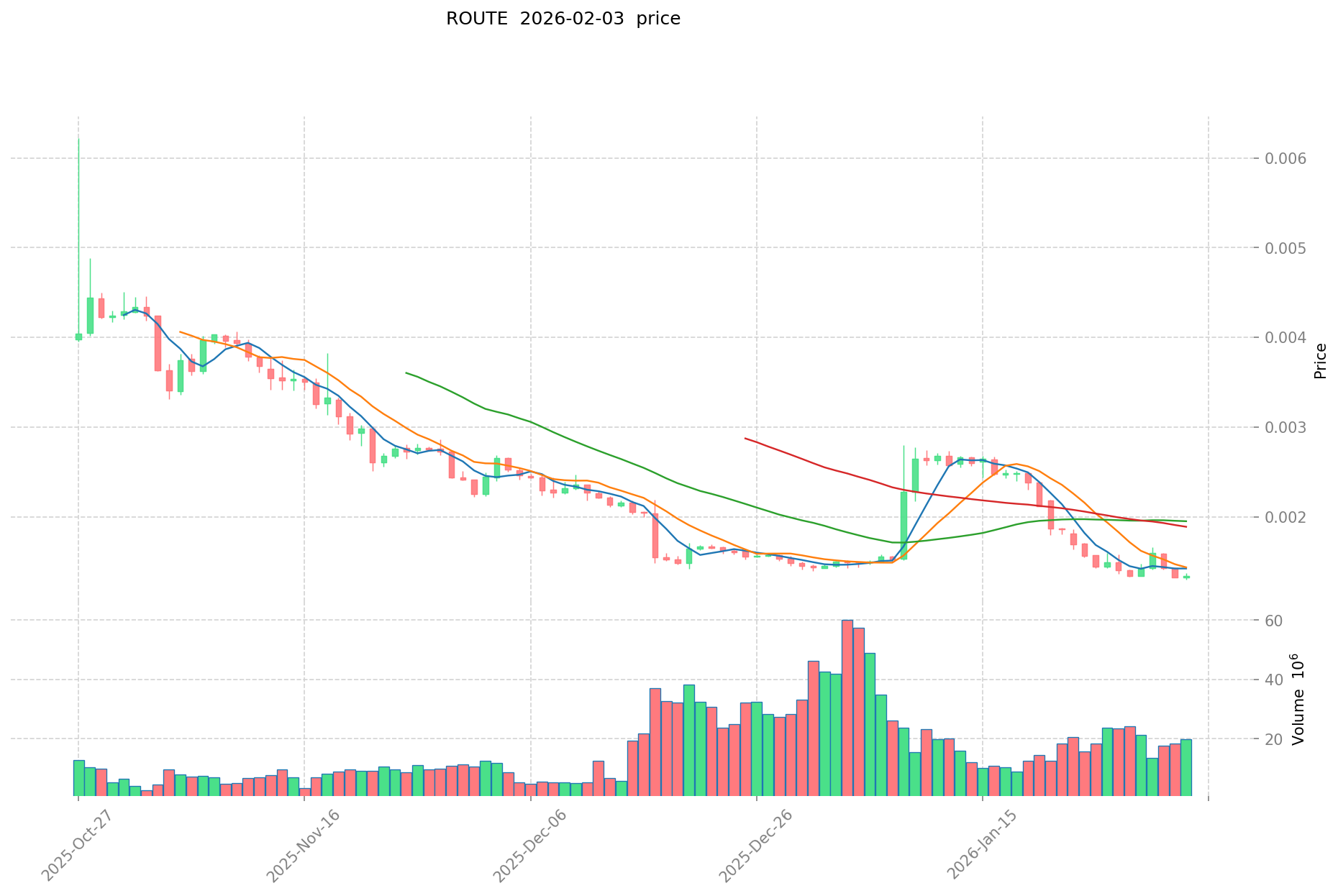
ROUTE Historical Price Trends and Investment Returns (Router Protocol (ROUTE) Investment Performance)
- 2021: Initial public offering → Early investors reported substantial returns, with the token price experiencing significant growth
- 2022: Crypto market downturn → ROUTE price declined alongside broader market trends
- 2023: Gradual recovery → Price movements showed increased stability
Current ROUTE Investment Market Status (February 2026)
- Current ROUTE price: $0.001372
- Market Sentiment (Fear & Greed Index): Data not available in reference materials
- 24-hour trading volume: $28,072.44
- Institutional investor holdings: Data not available in reference materials
Click to view real-time ROUTE market price
II. Core Factors Influencing Whether ROUTE is a Good Investment
Supply Mechanism and Scarcity (ROUTE investment scarcity)
- Maximum supply of 982,072,351.30 ROUTE with a circulating supply of 648,739,153.30 (66.06% of total supply) → creates a defined supply framework that may influence price dynamics
- Historical price movements show ROUTE reached $0.08108 in November 2024, while the current price stands at $0.001372 as of February 2026 → reflecting significant volatility in market valuation
- Investment consideration: The fixed maximum supply mechanism provides a quantifiable scarcity model, though circulating supply represents approximately two-thirds of total tokens
Institutional Investment and Mainstream Adoption (Institutional investment in ROUTE)
- Holder count: 3,633 addresses currently hold ROUTE tokens
- Trading availability: ROUTE is listed on 4 exchanges with Gate.com as one of the trading platforms
- Market capitalization stands at $890,070.12 with a fully diluted valuation of $1,347,403.27, representing a market cap to FDV ratio of 66.06%
Macroeconomic Environment's Impact on ROUTE Investment
- ROUTE's 24-hour trading volume of $28,072.44 and market dominance of 0.000049% reflects limited market penetration relative to broader crypto markets
- The token's price performance shows a 1-year decline of 94.62%, indicating sensitivity to broader market conditions and investor sentiment shifts
- Current market ranking at 2,604 suggests positioning within the mid-to-lower tier of cryptocurrency projects by market capitalization
Technology and Ecosystem Development (Technology & Ecosystem for ROUTE investment)
- Chain abstraction protocol: Router Protocol enables developers to build intent-based products for cross-chain transfers and messaging in a decentralized environment
- Ethereum security integration: The protocol builds technology allowing Proof-of-Stake chains to borrow security from Ethereum's network
- Token standard: ROUTE operates on Mainnet and ERC20, with contract address 0x60f67e1015b3f069dd4358a78c38f83fe3a667a9 on Ethereum
- Cross-chain infrastructure: The protocol's focus on seamless cross-chain communication and permissionless operations positions it within the blockchain interoperability sector
III. ROUTE Future Investment Forecast and Price Outlook (Is Router Protocol(ROUTE) worth investing in 2026-2031)
Short-term Investment Forecast (2026, short-term ROUTE investment outlook)
- Conservative forecast: $0.00097 - $0.00137
- Neutral forecast: $0.00137 - $0.00161
- Optimistic forecast: $0.00161 - $0.00186
Mid-term Investment Outlook (2027-2028, mid-term Router Protocol(ROUTE) investment forecast)
-
Market stage expectation: Router Protocol may experience gradual recovery as cross-chain infrastructure continues to develop. The token demonstrated notable volatility in its historical trajectory, reaching peaks near $0.081 before entering a correction phase. Mid-term performance will likely correlate with broader adoption of chain abstraction technology and DeFi cross-chain messaging solutions.
-
Investment return forecast:
- 2027: $0.00155 - $0.00232
- 2028: $0.00140 - $0.00285
-
Key catalysts: Cross-chain infrastructure adoption, ecosystem partnerships expansion, Router Chain technical developments, and broader DeFi market recovery.
Long-term Investment Outlook (Is ROUTE a good long-term investment?)
- Base scenario: $0.00137 - $0.00330 (assuming steady ecosystem development and moderate market conditions)
- Optimistic scenario: $0.00240 - $0.00377 (assuming accelerated chain abstraction adoption and favorable market environment)
- Risk scenario: Below $0.0013 (under adverse market conditions or limited ecosystem traction)
Click to view ROUTE long-term investment and price forecast: Price Prediction
2026-2031 Long-term Outlook
- Base scenario: $0.00137 - $0.00285 USD (corresponding to steady progress and gradual mainstream application enhancement)
- Optimistic scenario: $0.00241 - $0.00377 USD (corresponding to large-scale adoption and favorable market environment)
- Transformational scenario: Above $0.00377 USD (if ecosystem achieves breakthrough developments and mainstream popularization)
- 2031-12-31 forecast high: $0.00365 USD (based on optimistic development assumptions)
Disclaimer: The forecasts presented are based on historical data analysis and current market trends. Cryptocurrency investments involve substantial risk, and past performance does not guarantee future results. These projections should not be considered as investment advice. Investors should conduct independent research and consult financial professionals before making investment decisions.
| Year | Predicted High Price | Predicted Average Price | Predicted Low Price | Price Change |
|---|---|---|---|---|
| 2026 | 0.00185912 | 0.001367 | 0.00097057 | 0 |
| 2027 | 0.0023228064 | 0.00161306 | 0.0015485376 | 17 |
| 2028 | 0.00285350314 | 0.0019679332 | 0.001397232572 | 43 |
| 2029 | 0.0033026838929 | 0.00241071817 | 0.0013741093569 | 75 |
| 2030 | 0.003770845361514 | 0.00285670103145 | 0.002371061856103 | 108 |
| 2031 | 0.00364515051613 | 0.003313773196482 | 0.003181222268622 | 141 |
IV. Router Protocol (ROUTE) Investment Strategy and Risk Management (How to invest in Router Protocol)
Investment Methodology (ROUTE investment strategy)
Long-term Holding (HODL ROUTE): Suitable for conservative investors
Long-term holding involves purchasing ROUTE tokens and maintaining positions over extended periods, typically years. This approach requires less active management and may be appropriate for investors who believe in Router Protocol's fundamental value proposition as a chain abstraction protocol. Conservative investors should consider the project's focus on cross-chain infrastructure and its position in the decentralized messaging ecosystem.
Active Trading: Relying on technical analysis and swing operations
Active trading strategies involve monitoring ROUTE's price movements and executing trades based on technical indicators and market patterns. Given ROUTE's 24-hour price volatility of 1.99% and trading volume of approximately $28,072, traders should be aware of liquidity considerations. Technical analysis tools such as support/resistance levels, moving averages, and volume indicators may inform entry and exit points. The token's recent price range between $0.00132 (24h low) and $0.001417 (24h high) demonstrates intraday volatility that active traders might utilize.
Risk Management (Risk management for ROUTE investment)
Asset Allocation Ratio: Conservative / Aggressive / Professional investors
- Conservative investors: May allocate 1-3% of their cryptocurrency portfolio to ROUTE, limiting exposure to smaller-cap altcoins
- Aggressive investors: Could consider 5-10% allocation while maintaining awareness of concentration risk
- Professional investors: May implement dynamic allocation strategies based on market conditions and portfolio rebalancing protocols
Risk Hedging Solutions: Multi-asset portfolio + hedging instruments
Investors can implement several risk mitigation strategies:
- Diversification across multiple blockchain infrastructure projects to reduce single-asset exposure
- Correlation analysis with major cryptocurrencies to understand portfolio dependencies
- Position sizing based on volatility metrics and personal risk tolerance
- Regular portfolio rebalancing to maintain target allocation percentages
Secure Storage: Hot/cold wallets + hardware wallet recommendations
ROUTE tokens operate on Ethereum (ERC20 standard) based on the contract address 0x60f67e1015b3f069dd4358a78c38f83fe3a667a9. Storage options include:
- Cold storage: Hardware wallets such as Ledger or Trezor for long-term holdings
- Hot wallets: Software wallets for active trading, with multi-signature options for enhanced security
- Exchange custody: Suitable for active traders but carries counterparty risk
Investors should implement proper private key management, backup procedures, and consider multi-signature solutions for larger holdings.
V. Router Protocol (ROUTE) Investment Risks and Challenges (Risks of investing in Router Protocol)
Market Risk: High volatility and price manipulation
ROUTE demonstrates substantial price volatility, with 1-year returns showing a decline of 94.62% from previous levels. The current price of $0.001372 represents significant distance from the November 2024 high of $0.08108. With a relatively modest 24-hour trading volume of approximately $28,072 and listing on 4 exchanges, the token may experience:
- Limited liquidity conditions that can amplify price swings
- Wider bid-ask spreads during periods of market stress
- Potential susceptibility to large order impacts given the current market capitalization of approximately $890,070
The token's market dominance of 0.000049% indicates a micro-cap status within the broader cryptocurrency ecosystem, which typically correlates with higher volatility profiles.
Regulatory Risk: Policy uncertainty across different jurisdictions
As a cross-chain infrastructure protocol, Router Protocol operates in a regulatory environment characterized by:
- Evolving frameworks for decentralized protocols across multiple jurisdictions
- Potential classification uncertainties regarding token utility versus security designation
- Cross-border compliance requirements given the protocol's multi-chain nature
- Ongoing regulatory developments affecting decentralized finance infrastructure
Investors should monitor regulatory announcements in key markets and assess how policy changes might impact cross-chain protocol operations.
Technical Risk: Network security vulnerabilities and upgrade failures
Router Protocol's focus on cross-chain messaging and security borrowing from Ethereum introduces specific technical considerations:
- Smart contract risk associated with cross-chain bridge functionality
- Dependency on multiple blockchain networks for protocol operations
- Potential vulnerabilities in chain abstraction mechanisms
- Protocol upgrade risks that could affect token economics or functionality
The circulating supply of 648,739,153 tokens represents 66.06% of the maximum supply of 982,072,351, indicating ongoing token distribution dynamics that investors should monitor.
VI. Conclusion: Is Router Protocol a Good Investment?
Investment Value Summary
Router Protocol (ROUTE) operates in the chain abstraction and cross-chain infrastructure sector, addressing interoperability challenges in the blockchain ecosystem. The protocol's focus on intent-based products and security borrowing mechanisms positions it within the broader narrative of blockchain scalability and user experience enhancement.
However, the token's recent performance metrics present mixed signals. The 94.62% decline over the past year and current trading near recent lows ($0.0013 on February 2, 2026) indicate significant price pressure. The modest market capitalization of approximately $890,070 and limited exchange listings reflect early-stage market adoption.
Investor Recommendations
✅ Beginners: Consider dollar-cost averaging with small position sizes + secure wallet storage
- Implement regular, fixed-amount purchases to average entry prices
- Prioritize security through hardware wallet usage for ERC20 token storage
- Limit exposure to a small percentage of overall portfolio
- Focus on understanding the underlying technology before increasing position size
✅ Experienced Investors: Swing trading + portfolio allocation strategies
- Monitor technical indicators and volume patterns for tactical entries
- Consider Router Protocol within a broader blockchain infrastructure allocation
- Implement stop-loss mechanisms to manage downside risk
- Evaluate correlation with major cross-chain protocols for portfolio optimization
✅ Institutional Investors: Strategic long-term allocation considerations
- Assess Router Protocol's competitive positioning within chain abstraction solutions
- Evaluate team execution capability and partnership developments
- Consider position sizing relative to infrastructure allocation thesis
- Implement comprehensive due diligence on technical architecture and security models
⚠️ Disclaimer: Cryptocurrency investment carries substantial risk. This analysis is provided for informational purposes only and does not constitute investment advice. Past performance does not guarantee future results. Investors should conduct independent research and consider their risk tolerance before making investment decisions.
VII. FAQ
Q1: What is Router Protocol (ROUTE) and what makes it different from other blockchain projects?
Router Protocol (ROUTE) is a chain abstraction protocol that enables seamless cross-chain communication and asset transfers across multiple blockchain networks. Launched in July 2024, Router Protocol differentiates itself by focusing on intent-based products that allow developers to build decentralized applications with native cross-chain functionality. The protocol also develops technology that permits Proof-of-Stake chains to borrow security infrastructure from Ethereum's network, creating a unique security model. Unlike traditional bridge solutions, Router Protocol operates as a comprehensive chain abstraction layer that simplifies the developer experience while maintaining decentralization and permissionless operations.
Q2: How has ROUTE's price performed historically and what is its current market position?
ROUTE has experienced significant price volatility since its launch. The token reached a notable high of approximately $0.08108 in November 2024, but has since declined substantially to its current price of around $0.001372 as of February 2026, representing a 94.62% decline over a one-year period. Currently ranked at #2604 by market capitalization with approximately $890,070 in market cap, ROUTE maintains a modest market presence with 3,633 token holders and listings on 4 exchanges. The 24-hour trading volume stands at approximately $28,072, indicating limited liquidity compared to larger cryptocurrency projects. This performance reflects both broader market conditions and the early-stage adoption phase of chain abstraction technology.
Q3: What are the main risks associated with investing in Router Protocol (ROUTE)?
Investing in ROUTE carries several significant risks. Market risk is substantial due to high volatility and limited liquidity, as evidenced by the token's micro-cap status with market dominance of 0.000049% and modest trading volumes. Technical risks include potential smart contract vulnerabilities in cross-chain bridge functionality, dependencies on multiple blockchain networks, and possible security issues in chain abstraction mechanisms. Regulatory uncertainty poses challenges as cross-chain protocols navigate evolving compliance frameworks across multiple jurisdictions. Additionally, with 66.06% of total supply currently in circulation, ongoing token distribution dynamics may impact price stability. The token's recent 94.62% decline demonstrates the magnitude of downside risk potential in adverse market conditions.
Q4: What is the long-term price outlook for ROUTE through 2031?
Price forecasts for ROUTE through 2031 vary significantly based on adoption scenarios and market conditions. Conservative base-case projections suggest a range of $0.00137 to $0.00285 by 2031, assuming steady ecosystem development and moderate market conditions. Optimistic scenarios project prices between $0.00241 and $0.00377, contingent on accelerated chain abstraction adoption and favorable market environments. Specifically, the 2031 year-end forecast high reaches approximately $0.00365 under optimistic development assumptions. However, investors should note these projections carry substantial uncertainty, particularly given the early stage of chain abstraction technology adoption. Risk scenarios consider prices potentially remaining below $0.0013 if the ecosystem fails to gain significant traction or adverse market conditions persist. These forecasts should be viewed as analytical frameworks rather than definitive predictions.
Q5: How should different types of investors approach ROUTE investment strategy?
Investment approaches should vary based on investor experience and risk tolerance. Beginners should consider dollar-cost averaging with small position sizes limited to 1-3% of their cryptocurrency portfolio, prioritizing secure storage through hardware wallets for the ERC20 token. Experienced investors might implement swing trading strategies combined with portfolio allocation approaches, monitoring technical indicators and volume patterns while maintaining 5-10% allocation limits. Active traders should be aware of ROUTE's intraday volatility, with recent ranges between $0.00132 and $0.001417 providing potential trading opportunities. Institutional investors should conduct comprehensive due diligence on Router Protocol's technical architecture, competitive positioning within chain abstraction solutions, and team execution capability before considering strategic long-term allocations. All investor types should implement proper risk management including diversification, position sizing based on volatility metrics, and regular portfolio rebalancing protocols.
Q6: What factors will most significantly influence ROUTE's future value?
Several key factors will likely drive ROUTE's future valuation. Technology adoption rates for chain abstraction protocols and cross-chain infrastructure will be critical, as Router Protocol's value proposition depends on developers building intent-based products using its platform. Ecosystem development including partnership expansion, integration with additional blockchain networks, and Router Chain technical advancements will signal project momentum. Broader DeFi market recovery and increased demand for cross-chain messaging solutions could provide tailwinds. The token's fixed maximum supply of 982,072,351 ROUTE creates a defined scarcity model, though the current circulation of 66.06% suggests ongoing distribution dynamics. Market liquidity improvements through additional exchange listings and increased holder participation could reduce volatility. Regulatory clarity regarding cross-chain protocols and token classification will also impact investor confidence and institutional adoption potential.
Q7: Is Router Protocol suitable as a long-term investment and what storage options are recommended?
Router Protocol's suitability as a long-term investment depends on individual risk tolerance and belief in chain abstraction technology adoption. The project addresses genuine blockchain interoperability challenges and operates in a sector with potential growth as multi-chain ecosystems expand. However, the early-stage nature of the protocol, reflected in its micro-cap status and limited market adoption, presents elevated risk. Long-term holders should be prepared for continued volatility and potential extended accumulation periods before significant value realization. For storage, ROUTE operates as an ERC20 token on Ethereum (contract address: 0x60f67e1015b3f069dd4358a78c38f83fe3a667a9), making it compatible with standard Ethereum wallets. Hardware wallets such as Ledger or Trezor are recommended for long-term cold storage, while software wallets with multi-signature capabilities can be used for active management. Investors should implement proper private key management, maintain secure backups, and avoid keeping significant holdings on exchanges to minimize counterparty risk.
Q8: How does Router Protocol's market performance compare to its technical fundamentals?
Router Protocol's current market performance appears disconnected from its technical ambitions and infrastructure positioning. While the protocol addresses important blockchain interoperability challenges through chain abstraction and security borrowing mechanisms, the token's 94.62% decline and micro-cap status suggest limited market recognition of these technical capabilities. The modest holder count of 3,633 addresses and trading availability on only 4 exchanges indicate early-stage market penetration despite the protocol's launch in July 2024. This disconnect may reflect broader challenges in crypto infrastructure valuations, where technical innovation doesn't immediately translate to token appreciation. The circulating supply representing 66.06% of maximum supply suggests controlled distribution, yet market interest remains limited. This divergence presents both risk and opportunity: fundamental believers might view current valuations as entry opportunities, while skeptics may question whether technical capabilities will translate to ecosystem adoption and token demand. Investors should monitor on-chain metrics, developer activity, and partnership announcements as indicators of whether market perception might eventually align with technical fundamentals.
Share
Content
Introduction: Router Protocol (ROUTE) Investment Position and Market Outlook
I. Router Protocol (ROUTE) Price History Review and Current Investment Value
II. Core Factors Influencing Whether ROUTE is a Good Investment
III. ROUTE Future Investment Forecast and Price Outlook (Is Router Protocol(ROUTE) worth investing in 2026-2031)
IV. Router Protocol (ROUTE) Investment Strategy and Risk Management (How to invest in Router Protocol)
V. Router Protocol (ROUTE) Investment Risks and Challenges (Risks of investing in Router Protocol)
VI. Conclusion: Is Router Protocol a Good Investment?
VII. FAQ
How to Buy Cryptocurrency


Trending Cryptocurrencies



2025 SUI coin: price, buying guide, and Staking rewards

How to Buy Crypto: A Step-by-Step Guide with Gate.com

HNT Price in 2025: Helium Network Token Value and Market Analysis
What is SwissCheese (SWCH) and How Does It Democratize Investment?

Cardano (ADA) Price Analysis and Outlook for 2025
How to Invest in Metaverse Crypto

Is Keep3rV1 (KP3R) a good investment?: A Comprehensive Analysis of the Decentralized Job Market Protocol and Its Investment Potential in 2024

Is Almanak (ALMANAK) a good investment?: A Comprehensive Analysis of the Token's Potential, Market Position, and Risk Factors for 2024
Is RWA Inc. (RWAINC) a good investment?: A Comprehensive Analysis of Financial Performance, Market Position, and Future Growth Potential
Is ETHS (ETHS) a good investment?: A Comprehensive Analysis of Performance, Risk Factors, and Future Prospects
What are the best practices for investing small amounts in Bitcoin?