This comprehensive analysis evaluates SaaSGo (SAAS) as an investment opportunity, examining the token's performance since its December 2024 launch through February 2026. The article reviews SAAS's dramatic price movements, ranging from an all-time high of $0.1182 to current levels around $0.0008172, while analyzing core investment factors including token supply mechanics, ecosystem development, and market positioning. It presents multiple price scenarios across different timeframes, investment strategies for varying investor profiles, and detailed risk assessments covering market volatility, regulatory challenges, and technical vulnerabilities. The analysis provides actionable guidance on portfolio allocation, secure storage solutions, and risk management practices, concluding with evidence-based recommendations for beginners, experienced investors, and institutional participants interested in this emerging DeFi marketplace platform token.
Introduction: SaaSGo (SAAS) Investment Positioning and Market Outlook
SAAS is a cryptocurrency asset in the decentralized finance sector. Launched in December 2024, the project focuses on code-free deployment of peer-to-peer DApp marketplaces. As of February 4, 2026, SAAS has a market capitalization of approximately $653,760, with a circulating supply of 800,000,000 tokens out of a maximum supply of 1,000,000,000. The current trading price stands at approximately $0.0008172. Positioned as a DeFi Dex Builder platform, SAAS has become a subject of analysis when investors examine "Is SaaSGo (SAAS) a good investment?" This article provides a comprehensive analysis of SAAS's investment characteristics, historical price movements, future price projections, and associated investment risks to serve as a reference for market participants.
I. Coin (SAAS) Price History Review and Investment Value Status
- December 2024: Project launch with initial listing → SAAS began trading at $0.05 on Gate.com
- December 20, 2024: Peak price milestone → SAAS reached $0.1182, representing approximately 136% gain from launch price
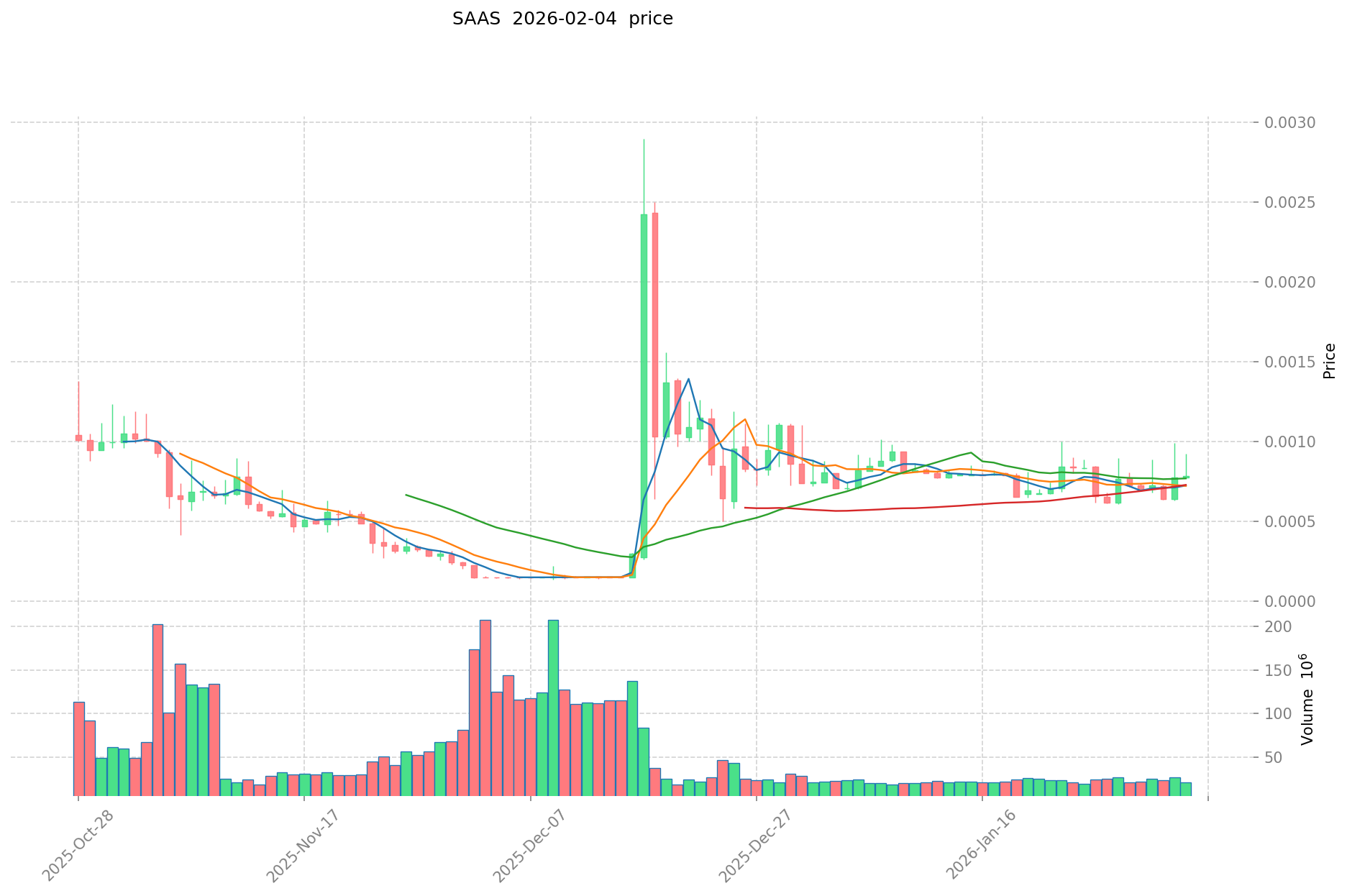
- 2025: Market correction phase → Price declined from $0.1182 to approximately $0.000817, reflecting significant volatility in the early trading period
Current SAAS Investment Market Status (February 2026)
- SAAS current price: $0.0008172
- 24-hour trading volume: $17,687.50
- Market capitalization: $653,760
- Circulating supply: 800,000,000 SAAS (80% of total supply)
Click to view real-time SAAS market price
II. Core Factors Influencing Whether SAAS is a Good Investment
Supply Mechanism and Scarcity (SAAS investment scarcity)
- Maximum supply is capped at 1,000,000,000 SAAS tokens, with 800,000,000 currently in circulation (80% of total supply) → This fixed supply structure may influence price dynamics and investment considerations
- Historical price pattern: SAAS has experienced substantial volatility, trading between $0.000134 and $0.1182 since its launch in December 2024
- Investment perspective: The token's circulating supply ratio of 80% suggests limited additional dilution risk from future token releases, which may be relevant for assessing medium-term supply dynamics
Institutional Investment and Mainstream Adoption (Institutional investment in SAAS)
- Market presence: SAAS is currently listed on one exchange with a market capitalization of approximately $653,760 as of February 4, 2026
- Holder base: The token has approximately 30 holders, indicating an early-stage adoption profile
- Platform accessibility: SAAS operates with contract addresses on both Ethereum (ETH) and Binance Smart Chain (BSC) networks, providing multi-chain accessibility for potential users
Macroeconomic Environment's Impact on SAAS Investment
- Market context: As of February 2026, the broader SaaS industry is experiencing shifts, with increased emphasis on return on investment and practical utility rather than speculative features
- Valuation considerations: Industry analysis suggests caution regarding elevated valuations in certain segments of the SaaS market, which may influence investor sentiment toward SaaS-related tokens
- Industry trends: The global SaaS investment landscape is projected to see continued evolution in 2026, with focus areas including AI integration and sustainable growth models
Technology and Ecosystem Development (Technology & Ecosystem for SAAS investment)
- Core functionality: SaaSGo enables code-free deployment of peer-to-peer Dapp marketplaces, allowing users to establish DeFi platforms with customizable farming and staking features
- Platform capabilities: The SaaSGo DeFi Dex Builder provides tools for users to configure transaction fees, stake-pool interest rates, referral rewards, and governance protocols according to their community needs
- Multi-chain infrastructure: Deployment on both Ethereum and BSC networks offers users flexibility in choosing blockchain environments based on their preferences for transaction costs and network characteristics
III. SAAS Future Investment Prediction and Price Outlook (Is SaaSGo(SAAS) worth investing in 2026-2030)
Short-term Investment Prediction (2026, short-term SAAS investment outlook)
- Conservative Forecast: $0.000566 - $0.000692
- Neutral Forecast: $0.000692 - $0.000845
- Optimistic Forecast: $0.000845 - $0.000997
Mid-term Investment Outlook (2027-2028, mid-term SaaSGo(SAAS) investment forecast)
- Market Stage Expectation: Potential consolidation phase with moderate volatility as the project seeks to establish fundamental value drivers and expand its DeFi marketplace ecosystem.
- Investment Return Prediction:
- 2027: $0.000884 - $0.000985
- 2028: $0.000657 - $0.001124
- Key Catalysts: Adoption rate of the no-code DeFi Dex Builder platform, community growth, strategic partnerships in the decentralized application space, and overall sentiment in the DeFi sector.
Long-term Investment Outlook (Is SAAS a good long-term investment?)
- Base Scenario: $0.000821 - $0.001319 (assuming gradual ecosystem development and steady adoption of the peer-to-peer Dapp marketplace model through 2029)
- Optimistic Scenario: $0.001136 - $0.001559 (assuming accelerated user base expansion, successful governance protocol implementations, and favorable market conditions through 2031)
- Risk Scenario: Below $0.000566 (under scenarios involving prolonged market downturn, limited user adoption, intensified competition, or regulatory challenges affecting DeFi platforms)
Click to view SAAS long-term investment and price prediction: Price Prediction
2026-02-04 - 2031 Long-term Outlook
- Base Scenario: $0.000821 - $0.001238 (corresponding to steady progress in mainstream application adoption and platform functionality enhancements)
- Optimistic Scenario: $0.001319 - $0.001559 (corresponding to large-scale adoption, favorable market environment, and successful expansion of the DeFi ecosystem)
- Transformative Scenario: Above $0.001559 (if the ecosystem achieves breakthrough developments, widespread mainstream adoption, and significant network effects)
- 2031-12-31 Predicted High: $0.001559 (based on optimistic development assumptions)
Disclaimer: Price predictions are inherently uncertain and should not be considered as investment advice. Cryptocurrency markets are highly volatile and subject to various risks including technological, regulatory, and market factors. Past performance does not guarantee future results. Investors should conduct thorough research and consider their risk tolerance before making investment decisions.
| Year |
Predicted High Price |
Predicted Average Price |
Predicted Low Price |
Price Change |
| 2026 |
0.000996746 |
0.0008447 |
0.000565949 |
3 |
| 2027 |
0.00098517361 |
0.000920723 |
0.00088389408 |
12 |
| 2028 |
0.0011244789999 |
0.000952948305 |
0.00065753433045 |
16 |
| 2029 |
0.001319166338611 |
0.00103871365245 |
0.000820583785435 |
27 |
| 2030 |
0.001237886995307 |
0.00117893999553 |
0.001049256596022 |
44 |
| 2031 |
0.00155885340909 |
0.001208413495419 |
0.001135908685693 |
47 |
IV. SAAS Investment Strategy and Risk Management (How to invest in SaaSGo)
Investment Strategy (SAAS investment strategy)
Long-term Holding (HODL SAAS)
Long-term holding may be suitable for investors who believe in the potential of no-code DeFi marketplace deployment. This strategy involves purchasing SAAS tokens and holding them through market fluctuations, focusing on the project's long-term development rather than short-term price movements.
Active Trading
Active trading relies on technical analysis and swing trading strategies. Given SAAS's price volatility, with recent performance showing -0.26% (1H), -3.28% (24H), and -2.51% (7D), traders may identify potential entry and exit points. The 24-hour high of $0.0008931 and low of $0.00077 indicate intraday trading opportunities.
Risk Management (Risk management for SAAS investment)
Asset Allocation Ratio
- Conservative investors: Consider limiting SAAS allocation to a small percentage of the overall crypto portfolio
- Aggressive investors: May allocate a moderate portion while maintaining diversification
- Professional investors: Should conduct thorough due diligence and implement position sizing based on risk tolerance
Risk Hedging Strategies
Multi-asset portfolio construction combined with risk management tools can help mitigate exposure. Diversification across different crypto categories and traditional assets may reduce concentration risk.
Secure Storage
SAAS tokens are deployed on both Ethereum (ETH) and Binance Smart Chain (BSC) networks. Storage options include:
- Hot wallets: For active trading and smaller amounts
- Cold wallets: For long-term holdings
- Hardware wallets: Recommended for enhanced security of larger holdings
V. SAAS Investment Risks and Challenges (Risks of investing in SaaSGo)
Market Risks
SAAS exhibits high volatility, with a significant decline of -98.55% over the past year. The price has fluctuated between an all-time high of $0.1182 (December 20, 2024) and an all-time low of $0.000134 (December 9, 2025). Current market capitalization stands at approximately $653,760, with a 24-hour trading volume of $17,687.50, indicating relatively limited liquidity.
Regulatory Risks
As a DeFi-focused project enabling marketplace creation, SAAS may face regulatory uncertainty across different jurisdictions. Policy developments regarding decentralized finance and token offerings could impact the project's operations and token value.
Technical Risks
Potential technical risks include:
- Smart contract vulnerabilities on deployed marketplaces
- Network security concerns on both Ethereum and BSC chains
- Platform upgrade challenges
- Competition from other no-code DeFi solutions
With approximately 30 holders and trading availability on 1 exchange, the project has limited market depth, which may amplify technical and operational risks.
VI. Conclusion: Is SaaSGo a Good Investment?
Investment Value Summary
SAAS presents a concept focused on democratizing DeFi marketplace creation through no-code deployment. However, the token has experienced substantial price decline (-98.55% over one year) and operates with limited market presence. The circulating supply represents 80% of maximum supply (800 million out of 1 billion tokens).
Investor Recommendations
✅ Beginners: Consider thorough research before investment; if interested, use dollar-cost averaging with amounts you can afford to lose, and prioritize secure wallet storage
✅ Experienced investors: May explore swing trading opportunities given price volatility, while maintaining strict position sizing and stop-loss strategies
✅ Institutional investors: Should conduct comprehensive due diligence on project fundamentals, team, and market positioning before considering strategic allocation
⚠️ Disclaimer: Cryptocurrency investment carries high risk. This content is for informational purposes only and does not constitute investment advice. Past performance does not guarantee future results. Conduct your own research and consult with financial professionals before making investment decisions.
VII. FAQ
Q1: What is SaaSGo (SAAS) and what makes it different from other DeFi tokens?
SaaSGo (SAAS) is a cryptocurrency token that powers a code-free DeFi Dex Builder platform, enabling users to deploy peer-to-peer DApp marketplaces without programming knowledge. Unlike traditional DeFi tokens that focus solely on trading or staking, SAAS provides tools for creating customizable farming and staking platforms with configurable transaction fees, stake-pool interest rates, referral rewards, and governance protocols. The project operates on both Ethereum (ETH) and Binance Smart Chain (BSC) networks, offering multi-chain accessibility. Launched in December 2024, SAAS aims to democratize DeFi platform creation by removing technical barriers to entry.
Q2: What has been SAAS's historical price performance since launch?
SAAS has experienced significant volatility since its December 2024 launch. The token initially traded at $0.05 on Gate.com and reached an all-time high of $0.1182 on December 20, 2024 (representing a 136% gain from launch price). However, the price subsequently declined substantially, hitting an all-time low of $0.000134 in December 2025. As of February 4, 2026, SAAS trades at approximately $0.0008172, reflecting a -98.55% decline over the past year. This performance indicates high volatility and substantial risk associated with the token.
Q3: Is SAAS a good long-term investment for 2026-2030?
The long-term investment outlook for SAAS depends on multiple factors and presents considerable uncertainty. Price predictions suggest a conservative range of $0.000566-$0.000692 for 2026, with optimistic long-term scenarios reaching $0.001559 by 2031 if the ecosystem achieves widespread adoption. However, investors should note the token's limited market presence (approximately 30 holders, $653,760 market capitalization, single exchange listing) and significant historical decline. Long-term investment suitability varies by investor profile: conservative investors may limit allocation to a small percentage of their crypto portfolio, while the token may only be appropriate for risk-tolerant investors who thoroughly understand the project's fundamentals and DeFi marketplace potential.
Q4: What are the main risks associated with investing in SAAS?
SAAS investment carries several significant risks. Market risks include extreme price volatility (-98.55% annual decline) and limited liquidity with only $17,687.50 in 24-hour trading volume. Regulatory risks stem from evolving DeFi regulations across jurisdictions that could impact marketplace deployment platforms. Technical risks encompass potential smart contract vulnerabilities, network security concerns on both Ethereum and BSC chains, and competition from alternative no-code DeFi solutions. The token's limited market depth (30 holders, 1 exchange) amplifies operational risks. The current circulating supply of 800 million tokens (80% of maximum supply) suggests limited future dilution risk, but the small holder base indicates concentrated ownership.
Q5: How can investors purchase and securely store SAAS tokens?
SAAS tokens are currently available for trading on Gate.com exchange. To purchase SAAS, investors need to create and verify an account on this platform, deposit funds (typically USDT or other trading pairs), and execute buy orders. For secure storage, SAAS tokens exist on both Ethereum and Binance Smart Chain networks, requiring compatible wallets. Storage options include: hot wallets (such as MetaMask or Trust Wallet) for active trading and smaller amounts; cold wallets for long-term holdings with offline security; and hardware wallets (like Ledger or Trezor) recommended for enhanced security of larger holdings. Investors should ensure they use the correct contract address corresponding to their chosen blockchain network when storing tokens.
Q6: What investment strategies are suitable for SAAS tokens?
Two primary strategies may be considered for SAAS investment. The long-term holding (HODL) approach suits investors who believe in the no-code DeFi marketplace concept and can tolerate significant volatility, focusing on potential ecosystem development over multiple years rather than short-term price movements. Alternatively, active trading strategies may capitalize on SAAS's substantial price volatility, with recent performance showing intraday fluctuations between $0.00077 and $0.0008931. Swing traders using technical analysis might identify entry and exit points based on price patterns. However, both strategies require careful risk management, including appropriate position sizing relative to overall portfolio, diversification across multiple assets, and strict stop-loss protocols given the token's -98.55% historical decline and limited liquidity.
Q7: What factors could influence SAAS's future price performance?
Several key factors may impact SAAS's future valuation. Adoption rate of the no-code DeFi Dex Builder platform remains critical—increased user base and marketplace deployments could drive demand for the token. Strategic partnerships within the decentralized application space and integration of AI or enhanced governance features may strengthen the ecosystem. Broader market conditions affecting the DeFi sector, including regulatory developments and macroeconomic trends in cryptocurrency markets, will likely influence sentiment toward SAAS. Technical developments such as successful platform upgrades, multi-chain expansion, and security enhancements could improve investor confidence. Additionally, the token's limited supply (1 billion maximum, 800 million circulating) and current holder concentration (30 holders) mean that changes in whale positions or exchange listings could significantly affect price dynamics.
Q8: Should beginners invest in SAAS tokens?
Beginners should approach SAAS investment with significant caution given the token's high-risk profile. The -98.55% annual price decline, limited market presence ($653,760 market cap, single exchange listing), and substantial volatility make SAAS unsuitable as a primary cryptocurrency holding for novice investors. If beginners choose to invest after thorough research, they should: only allocate amounts they can afford to lose completely; use dollar-cost averaging to mitigate timing risk; prioritize secure wallet storage over exchange custody; diversify across multiple established cryptocurrencies rather than concentrating in SAAS; and avoid using leverage or borrowed funds. Understanding DeFi concepts, blockchain technology, and the specific use case of no-code marketplace deployment is essential before considering investment. Beginners should also recognize that cryptocurrency investments carry no guarantee of returns and that past performance does not predict future results.
* The information is not intended to be and does not constitute financial advice or any other recommendation of any sort offered or endorsed by Gate.