Is Skate (SKATE) a good investment?: A Comprehensive Analysis of Risk, Potential Returns, and Market Outlook for 2024


Introduction: Skate (SKATE) Investment Position and Market Outlook
Skate (SKATE) is a multi-VM infrastructure project in the cryptocurrency sector that enables decentralized applications to operate seamlessly across multiple blockchains, including EVM and alternative virtual machines. As of February 5, 2026, SKATE has a market capitalization of approximately $628,200, with a circulating supply of 180,000,000 tokens, and a current trading price around $0.00349. The token is listed on 7 exchanges and holds approximately 5,885 holders. With its positioning as a cross-chain interoperability solution, particularly through its core product Skate AMM which enables multi-VM, single-liquidity-curve functionality across chains, SKATE has gradually become a subject of discussion among investors considering "Is Skate (SKATE) a good investment?" This article provides a comprehensive analysis of SKATE's investment value, historical trends, future price projections, and associated investment risks to serve as a reference for investors.
I. Skate (SKATE) Historical Price Review and Current Investment Value
SKATE Historical Price Movement and Investment Performance
-
June 9, 2025: SKATE reached a notable peak at $0.128, reflecting strong early market enthusiasm following the project's launch. Investors who entered during the initial deployment phase experienced substantial short-term gains.
-
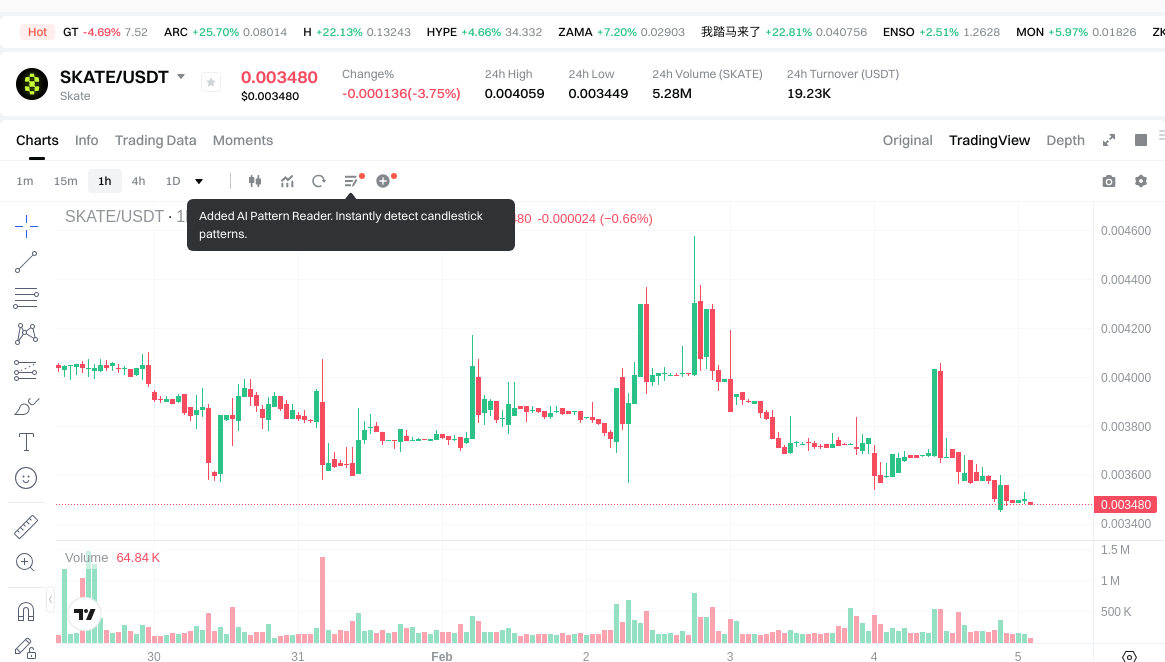
February 4, 2026: The token recorded its lowest trading level at $0.003449, representing a significant correction from earlier elevated levels. This downturn occurred amid broader market volatility and consolidation across multi-VM infrastructure projects.
-
February 5, 2026: Current trading activity shows SKATE at approximately $0.00349, with 24-hour price fluctuations ranging between $0.003449 and $0.004059. The token has experienced mixed directional movement across multiple timeframes: a minor decline of 0.06% over one hour, a 4.3% decrease over 24 hours, and more pronounced retracements of 13.88% weekly, 38.17% monthly, and 97.71% annually.
Current SKATE Investment Market Status (February 2026)
- SKATE Current Price: $0.00349
- 24-Hour Trading Volume: $19,200.84
- Circulating Market Cap: $628,200 (representing 18% of the fully diluted valuation of $3.49 million)
- Circulation: 180 million SKATE tokens out of a total supply of 1 billion tokens
- Exchange Availability: Listed on 7 trading platforms with Gate.com among active markets
- Holder Base: Approximately 5,885 addresses
- Market Share: 0.00013% of the overall cryptocurrency market
Click to view real-time SKATE market price
The current market positioning reflects Skate's early-stage status as a multi-VM infrastructure project operating across EVM and alternative virtual machine environments. Trading activity and holder distribution suggest developing adoption within specialized segments of the decentralized application ecosystem, particularly around its core Skate AMM product facilitating cross-chain liquidity operations.
II. Core Factors Affecting Whether SKATE is a Good Investment (Is Skate(SKATE) a Good Investment)
Supply Mechanism and Scarcity (SKATE investment scarcity)
- Maximum supply capped at 1,000,000,000 tokens → influences price and investment value
- Current circulating supply of 180,000,000 tokens represents 18% of total supply → indicates controlled release schedule
- Investment significance: limited supply structure may support long-term investment considerations
Institutional Investment and Mainstream Adoption (Institutional investment in SKATE)
- Current holder base includes 5,885 addresses → reflects early-stage adoption levels
- Token deployed on Ethereum and Arbitrum networks → provides accessibility across multiple platforms
- Multi-VM infrastructure design enables cross-chain compatibility → potential factor in broader ecosystem integration
Technology and Ecosystem Development (Technology & Ecosystem for SKATE investment)
- Multi-VM infrastructure: allows decentralized applications to operate across multiple blockchains including EVM and alternative VMs → enhances interoperability appeal
- Native cross-VM access: EVM applications can operate within SVM or MOVE environments → expands technical capabilities
- Skate AMM: core product enables multi-VM, single-liquidity-curve functionality across chains → provides differentiated technical offering in DeFi space
- Integration with DeFi applications through AMM infrastructure → supports ecosystem development potential
III. SKATE Future Investment Forecast and Price Outlook (Is Skate(SKATE) Worth Investing in 2026-2031)
Short-Term Investment Forecast (2026, Short-Term SKATE Investment Outlook)
- Conservative Forecast: $0.00195 - $0.00293
- Neutral Forecast: $0.00349 - $0.00390
- Optimistic Forecast: $0.00390 - $0.00450
Based on current market data, SKATE is trading at $0.00349 as of February 5, 2026. The short-term outlook reflects recent price volatility, with the token experiencing a 4.3% decline over 24 hours and a 13.88% decrease over the past week. Technical indicators suggest potential consolidation near current levels, though broader market sentiment and trading volume ($19,200.84 in 24h volume) indicate relatively limited liquidity. Short-term price movements may be influenced by overall crypto market conditions and the development progress of Skate's multi-VM infrastructure.
Mid-Term Investment Outlook (2027-2028, Mid-Term Skate(SKATE) Investment Forecast)
- Market Stage Expectation: Recovery and infrastructure adoption phase, contingent on successful implementation of cross-chain interoperability features and ecosystem expansion
- Investment Return Forecast:
- 2027: $0.00292 - $0.00410 (representing potential 5% growth from 2026 baseline)
- 2028: $0.00242 - $0.00546 (reflecting 11% projected increase with wider variance based on adoption metrics)
- Key Catalysts: Development of Skate AMM functionality across multiple blockchains, integration with EVM and alternative VM environments (SVM, MOVE), expansion of decentralized application partnerships, and improvements in multi-chain liquidity provisioning
The mid-term forecast accounts for Skate's positioning as a multi-VM infrastructure project. Market performance will likely correlate with successful deployment of cross-chain application capabilities and adoption by dApps requiring seamless multi-blockchain operations. However, the project faces competition from established cross-chain protocols and must demonstrate technical advantages to capture market share.
Long-Term Investment Outlook (Is SKATE a Good Long-Term Investment?)
- Base Scenario: $0.00366 - $0.00780 by 2030 (assuming steady progress in multi-VM infrastructure adoption and moderate market growth)
- Optimistic Scenario: $0.00660 - $0.00930 by 2031 (contingent on widespread adoption of Skate AMM, strategic partnerships with major blockchain ecosystems, and favorable regulatory environment for cross-chain technologies)
- Risk Scenario: $0.00195 - $0.00350 (in case of technical implementation challenges, intensified competition from established protocols, or unfavorable shifts in multi-chain infrastructure demand)
Explore detailed SKATE long-term investment analysis and price predictions: Price Prediction
2026-2031 Long-Term Outlook
- Base Scenario: $0.00366 - $0.00780 (corresponding to steady infrastructure development and gradual mainstream application growth)
- Optimistic Scenario: $0.00660 - $0.00930 (aligned with large-scale adoption and favorable market conditions supporting multi-VM interoperability solutions)
- Transformative Scenario: Above $0.010 (if Skate achieves breakthrough ecosystem development and mainstream protocol integration across major blockchains)
- December 31, 2031 Projected High: $0.00930 (based on optimistic development assumptions and sustained market interest in cross-chain infrastructure)
Disclaimer: Cryptocurrency investments carry substantial risks. Price predictions are speculative and based on available data, technical analysis, and project fundamentals as of February 5, 2026. Actual market performance may differ significantly due to technological developments, regulatory changes, competitive dynamics, market sentiment, and macroeconomic factors. The information provided does not constitute financial advice, and investors should conduct independent research and consider their risk tolerance before making investment decisions. Past performance and projections do not guarantee future results.
| Year | Predicted High Price | Predicted Average Price | Predicted Low Price | Price Change |
|---|---|---|---|---|
| 2026 | 0.00390656 | 0.003488 | 0.00195328 | 0 |
| 2027 | 0.0041039808 | 0.00369728 | 0.0029208512 | 5 |
| 2028 | 0.00546088256 | 0.0039006304 | 0.002418390848 | 11 |
| 2029 | 0.006084983424 | 0.00468075648 | 0.002808453888 | 34 |
| 2030 | 0.0078051614304 | 0.005382869952 | 0.00366035156736 | 54 |
| 2031 | 0.009297562124592 | 0.0065940156912 | 0.004022349571632 | 88 |
IV. Skate Investment Strategy and Risk Management (How to invest in Skate)
Investment Methodology (Skate investment strategy)
Long-term Holding (HODL Skate)
For conservative investors seeking steady growth, a long-term holding strategy may be considered. This approach involves purchasing SKATE tokens and maintaining positions through market cycles, focusing on the project's fundamental development rather than short-term price movements. Given Skate's positioning as multi-VM infrastructure enabling cross-chain interoperability, investors adopting this strategy would focus on the platform's technological progress and ecosystem expansion.
Active Trading
Active trading strategies rely on technical analysis and swing trading opportunities. Traders monitor price movements, volume patterns, and market sentiment indicators to identify entry and exit points. For SKATE, which has demonstrated notable volatility with a 24-hour change of -4.3% and 7-day change of -13.88%, technical traders may find opportunities in short-term price fluctuations. This approach requires continuous market monitoring and understanding of support and resistance levels.
Risk Management (Risk management for Skate investment)
Asset Allocation Ratios
- Conservative Investors: May allocate 1-3% of their cryptocurrency portfolio to SKATE, maintaining majority positions in established assets
- Aggressive Investors: Could consider 5-10% allocation, accepting higher risk for potential returns from emerging infrastructure projects
- Professional Investors: May employ dynamic allocation strategies based on market conditions, project milestones, and technical indicators
Risk Hedging Solutions
Investors can implement multi-asset portfolio strategies combining different cryptocurrency categories to reduce concentration risk. Diversification across infrastructure tokens, established cryptocurrencies, and stablecoins can help balance portfolio volatility. Given SKATE's relatively small market capitalization of approximately $628,200 and circulating supply of 180 million tokens (18% of total supply), position sizing becomes particularly important.
Secure Storage Solutions
Proper asset custody is essential for cryptocurrency investments:
- Hot Wallets: Convenient for active trading but carry online security risks. Suitable for smaller trading positions
- Cold Wallets: Offline storage solutions providing enhanced security for long-term holdings
- Hardware Wallets: Physical devices offering robust security features. Recommended options include established brands with proven security track records and multi-chain support
For SKATE tokens deployed on both Ethereum and Arbitrum networks (contract address: 0x61dbbbb552dc893ab3aad09f289f811e67cef285), investors should ensure their chosen wallet solution supports both networks.
V. Skate Investment Risks and Challenges (Risks of investing in Skate)
Market Risk
High Volatility: SKATE has experienced significant price fluctuations, with a 30-day decline of -38.17% and 1-year change of -97.71%. The token's 24-hour trading volume of approximately $19,200 relative to its market cap suggests relatively thin liquidity, which can amplify price movements.
Price Manipulation Concerns: Lower market cap tokens with limited trading volume may be more susceptible to price manipulation activities. The current circulating supply represents only 18% of maximum supply (180 million out of 1 billion tokens), and future token releases could impact price dynamics.
Regulatory Risk
Cryptocurrency regulations vary significantly across jurisdictions and continue to evolve. Multi-chain infrastructure projects like Skate may face regulatory considerations across multiple networks and geographical regions. Changes in regulatory frameworks regarding:
- Cross-chain protocols and interoperability solutions
- Decentralized application infrastructure
- Token classification and securities regulations
- Cross-border cryptocurrency transactions
Investors should monitor regulatory developments in their respective jurisdictions and assess potential impacts on project operations and token utility.
Technical Risk
Network Security Vulnerabilities: As a multi-VM infrastructure project enabling cross-chain operations, Skate's architecture involves complex technical components. Potential security vulnerabilities in smart contracts, bridge mechanisms, or cross-chain communication protocols could pose risks to the platform and token holders.
Upgrade Implementation: The project's ability to successfully implement technical upgrades and maintain compatibility across multiple virtual machine environments (EVM, SVM, MOVE) represents ongoing technical challenges. Development delays or implementation issues could affect project adoption and token value.
Competition and Technology Evolution: The multi-chain infrastructure sector continues to evolve rapidly, with numerous projects developing interoperability solutions. Skate faces competition from established cross-chain protocols and emerging technologies that could impact its market position.
VI. Conclusion: Is Skate a Good Investment?
Investment Value Summary
Skate represents an infrastructure project addressing cross-chain interoperability challenges in the blockchain ecosystem. The platform's multi-VM approach and focus on enabling applications across different virtual machine environments position it within the growing infrastructure sector. However, the token has experienced substantial price volatility, with notable declines across various timeframes. The project's relatively small market capitalization and early-stage development status should be carefully considered.
Investor Recommendations
✅ Beginners: Consider dollar-cost averaging strategies with small position sizes, combined with secure wallet storage solutions. Focus on understanding the project's technology and development progress before making investment decisions. Ensure proper custody of tokens across supported networks.
✅ Experienced Investors: May explore swing trading opportunities based on technical analysis while maintaining core positions aligned with infrastructure sector trends. Implement portfolio diversification strategies and monitor project development milestones, ecosystem growth, and competitive landscape developments.
✅ Institutional Investors: Should conduct comprehensive due diligence on technical architecture, team credentials, and market positioning. Consider strategic allocation as part of broader infrastructure or cross-chain protocol exposure, with appropriate risk management frameworks accounting for liquidity constraints and regulatory considerations.
⚠️ Disclaimer: Cryptocurrency investments carry substantial risk due to market volatility, regulatory uncertainty, and technical factors. This content is provided for informational purposes only and does not constitute investment advice, financial guidance, or recommendations to buy, sell, or hold any cryptocurrency. Investors should conduct independent research, assess their risk tolerance, and consult qualified financial advisors before making investment decisions.
VII. FAQ
Q1: Is Skate (SKATE) a good investment for beginners in 2026?
For beginners, SKATE presents significant risks and should be approached with extreme caution. The token has experienced a 97.71% decline over the past year and currently trades at $0.00349 with a relatively small market capitalization of approximately $628,200. Beginners considering SKATE should only allocate 1-3% of their cryptocurrency portfolio, utilize dollar-cost averaging strategies to mitigate volatility impact, and prioritize secure storage solutions across both Ethereum and Arbitrum networks. The project's early-stage status and thin liquidity (24-hour trading volume of $19,200) make it unsuitable as a core holding for inexperienced investors.
Q2: What are the main factors that could drive SKATE's price in the future?
SKATE's future price performance depends primarily on successful implementation of its multi-VM infrastructure and adoption of the Skate AMM product. Key catalysts include integration with decentralized applications requiring cross-chain functionality, expansion across EVM and alternative virtual machine environments (SVM, MOVE), strategic partnerships with major blockchain ecosystems, and improvements in multi-chain liquidity provisioning capabilities. The controlled token release schedule (only 18% of total supply currently circulating) and maximum supply cap of 1 billion tokens also influence scarcity dynamics. However, intense competition from established cross-chain protocols and technical implementation challenges represent significant headwinds.
Q3: How does SKATE's multi-VM infrastructure differentiate it from other blockchain projects?
SKATE's core differentiation lies in its multi-VM infrastructure enabling decentralized applications to operate seamlessly across multiple blockchain environments, including EVM and alternative virtual machines like SVM and MOVE. The platform's flagship Skate AMM product provides multi-VM, single-liquidity-curve functionality across chains, allowing EVM applications to access non-EVM environments without requiring separate implementations. This cross-chain interoperability approach targets a specific infrastructure niche within the blockchain ecosystem, though its effectiveness depends on successful technical execution and developer adoption compared to competing solutions.
Q4: What are the primary risks associated with investing in SKATE?
SKATE presents multiple investment risks: extreme price volatility demonstrated by a 97.71% annual decline and 38.17% monthly drop; liquidity constraints with only $19,200 in 24-hour trading volume; technical vulnerabilities inherent in complex cross-chain architecture and smart contract security; regulatory uncertainty affecting multi-chain protocols across different jurisdictions; and competitive pressure from established interoperability solutions. The token's small market capitalization and limited holder base (approximately 5,885 addresses) increase susceptibility to price manipulation. Additionally, the circulating supply represents only 18% of total tokens, meaning future releases could create selling pressure.
Q5: What is the realistic price outlook for SKATE through 2031?
Conservative projections suggest SKATE may trade between $0.00366 and $0.00780 by 2030 under baseline infrastructure adoption scenarios. An optimistic forecast assuming successful ecosystem development and widespread Skate AMM adoption indicates potential prices of $0.00660 to $0.00930 by 2031. However, a risk scenario accounting for technical challenges and intensified competition suggests prices could remain between $0.00195 and $0.00350. The short-term 2026 outlook ranges from $0.00195 (conservative) to $0.00450 (optimistic). These projections carry substantial uncertainty given the project's early stage, volatile price history, and dependency on successful technical implementation across multiple blockchain environments.
Q6: How should investors manage SKATE position sizing and storage?
Position sizing should reflect individual risk tolerance and investment experience. Conservative investors should limit SKATE exposure to 1-3% of their cryptocurrency portfolio, aggressive investors may consider 5-10% allocation, while professional investors can employ dynamic strategies based on project milestones and market conditions. Given SKATE's deployment on both Ethereum and Arbitrum networks (contract address: 0x61dbbbb552dc893ab3aad09f289f811e67cef285), investors must ensure wallet compatibility with both chains. Hardware wallets offering multi-chain support provide optimal security for long-term holdings, while hot wallets may be acceptable for smaller trading positions despite online security risks.
Q7: What development milestones should SKATE investors monitor?
Critical milestones include Skate AMM deployment progress across target blockchain environments, successful integration partnerships with decentralized applications requiring multi-VM functionality, expansion of cross-chain liquidity pools and trading volume metrics, technical audits validating security of cross-chain bridge mechanisms, and token unlock schedules (given only 18% current circulation). Investors should track holder growth beyond the current 5,885 addresses, exchange listing additions beyond the current 7 platforms, and competitive developments in the multi-chain infrastructure sector. Regulatory clarity regarding cross-chain protocols and any governance proposals affecting token economics also warrant close attention.
Q8: Can SKATE recover from its 97.71% annual decline?
Recovery potential depends on successful execution of technical roadmap and broader market conditions. The token's decline from $0.128 peak (June 2025) to current $0.00349 reflects both project-specific challenges and sector-wide consolidation in multi-VM infrastructure projects. Recovery would require demonstrable product adoption through Skate AMM usage metrics, significant ecosystem partnerships, increased trading liquidity, and favorable market sentiment toward cross-chain infrastructure solutions. However, the competitive landscape, technical implementation risks, and limited current traction suggest recovery remains highly speculative. Investors should evaluate the project against fundamental development progress rather than focusing solely on historical price recovery.
Share
Content
Introduction: Skate (SKATE) Investment Position and Market Outlook
I. Skate (SKATE) Historical Price Review and Current Investment Value
II. Core Factors Affecting Whether SKATE is a Good Investment (Is Skate(SKATE) a Good Investment)
III. SKATE Future Investment Forecast and Price Outlook (Is Skate(SKATE) Worth Investing in 2026-2031)
IV. Skate Investment Strategy and Risk Management (How to invest in Skate)
V. Skate Investment Risks and Challenges (Risks of investing in Skate)
VI. Conclusion: Is Skate a Good Investment?
VII. FAQ
How to Buy Cryptocurrency


Trending Cryptocurrencies



2025 SUI coin: price, buying guide, and Staking rewards
How to Buy Crypto: A Step-by-Step Guide with Gate.com

HNT Price in 2025: Helium Network Token Value and Market Analysis

What is SwissCheese (SWCH) and How Does It Democratize Investment?
Cardano (ADA) Price Analysis and Outlook for 2025

How to Invest in Metaverse Crypto

Top 9 AI Solutions for Exchange Trading: Software and Trading Bots

Comprehensive Guide to Trading Systems

What Does DYOR Mean in Crypto?

How to Profit from Investing in Esports — A Comprehensive Guide

Comprehensive Guide to Fiat Currency