Is StrikeBit AI (STRIKE) a good investment?: A comprehensive analysis of tokenomics, market potential, and risk factors for 2024

Introduction: StrikeBit AI (STRIKE) Investment Position and Market Outlook
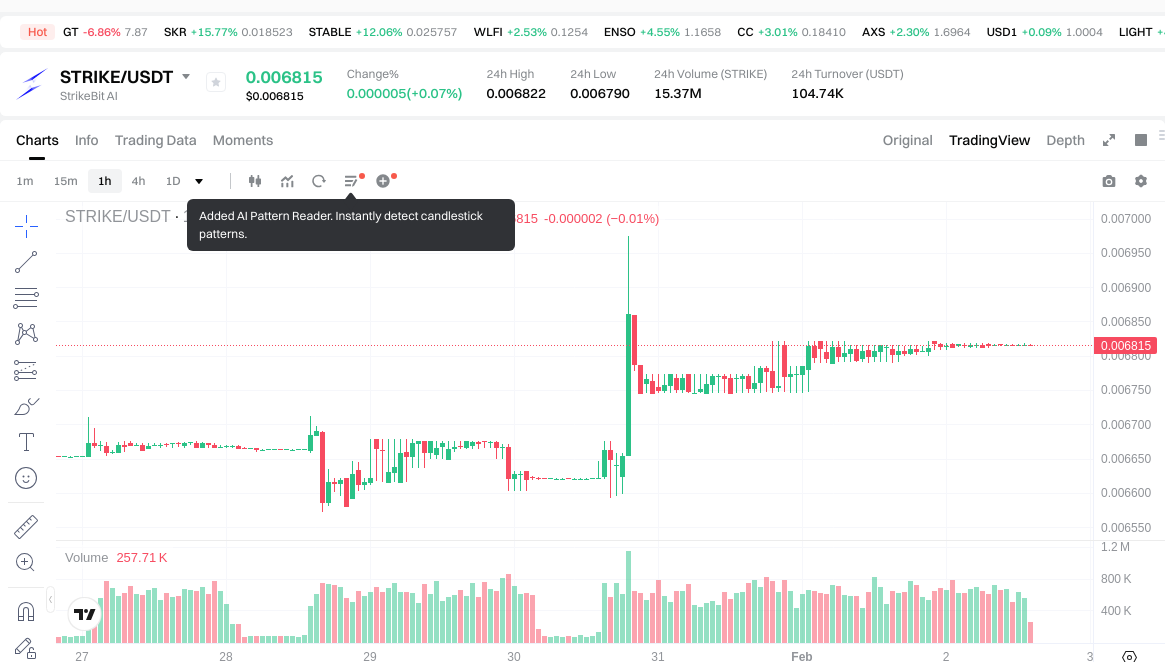
STRIKE is a cryptocurrency asset within the digital asset sector, positioned as a Modular Agent Protocol (MAP) that enables users to build, expand, and compose intelligent multi-agent systems for scalable collaboration. As of February 2, 2026, STRIKE maintains a market capitalization of approximately $1.43 million, with a circulating supply of around 209.9 million tokens. The current price stands at $0.006815, with a 24-hour trading volume of $104,677. The token's fully diluted market cap is estimated at $13.63 million, reflecting a circulation ratio of 10.5% of its total supply of 2 billion tokens.
STRIKE is deployed on the BSC chain with the contract address 0x2aa89a0113bcbbcdc5812c6df794e2d9650fc1af, currently ranking 2263 in the cryptocurrency market with a market dominance of 0.00051%. The token is listed on 4 exchanges and has attracted 3,756 holders. Price performance shows a 2.45% increase over the past 7 days, while experiencing a 2.91% decline over the past 30 days. With its focus on modular agent protocol technology, STRIKE has gradually become a subject of discussion among investors considering "Is StrikeBit AI (STRIKE) a good investment?" This article will comprehensively analyze STRIKE's investment characteristics, historical trends, future price perspectives, and associated risks to provide reference information for investors.
I. STRIKE Price History Review and Current Investment Value
STRIKE Historical Price Trends and Investment Returns (StrikeBit AI(STRIKE) investment performance)
- October 2025: STRIKE launched on exchanges at $0.03015, establishing its initial trading range as market participants began evaluating the modular agent protocol platform.
- October 2025 - January 2026: The token experienced a substantial decline of approximately 77.5%, moving from its launch level toward the $0.006487 support zone during a period of market adjustment.
- January 2026: STRIKE reached its lower price boundary near $0.006487 on January 22, 2026, reflecting a phase of price consolidation and reduced trading activity.
- Late January - Early February 2026: The token demonstrated modest recovery tendencies, with a 7-day gain of 2.45% as of February 2, 2026, suggesting emerging buying interest.
Current STRIKE Investment Market Status (February 2026)
- Current STRIKE Price: $0.006815 (as of February 2, 2026)
- 24-Hour Trading Volume: $104,677.53
- Market Capitalization: $1,430,468.50 with 209.9 million tokens in circulation
- Circulating Supply Ratio: 10.5% of the 2 billion maximum supply
- Recent Price Performance:
- 1-Hour: -0.03%
- 24-Hour: +0.04%
- 7-Day: +2.45%
- 30-Day: -2.91%
- 1-Year: -82.38%
Click to view real-time STRIKE market price
II. Core Factors Influencing Whether STRIKE is a Good Investment (Is StrikeBit AI(STRIKE) a Good Investment)
Supply Mechanism and Scarcity (STRIKE investment scarcity)
- Total Supply: 2,000,000,000 STRIKE tokens with a maximum supply cap of 2,000,000,000
- Current Circulating Supply: 209,900,000 STRIKE (approximately 10.5% of total supply)
- Circulating Market Cap to Fully Diluted Valuation Ratio: 10.5%, indicating significant potential token unlocks ahead
- Token Standard: BEP-20 (deployed on BSC)
- Investment Implication: The low circulation ratio suggests future supply expansion may influence price dynamics and dilution considerations for investors
Institutional Investment and Mainstream Adoption (Institutional investment in STRIKE)
- Holder Base: Approximately 3,756 holders as of February 02, 2026
- Exchange Listings: Available on 4 exchanges, indicating limited but growing trading accessibility
- Market Position: Ranked #2,263 by market capitalization with a market dominance of 0.00051%
- Ecosystem Focus: StrikeBit positions itself as a Modular Agent Protocol (MAP) enabling intelligent multi-agent system development
- Adoption Considerations: The project's focus on AI agent infrastructure may attract interest from decentralized AI development communities
Macroeconomic Environment's Impact on STRIKE Investment
- Market Volatility: STRIKE demonstrated significant price fluctuations with an annual decline of 82.38% from its price level one year prior
- Price Range Performance: Trading between a recorded low of $0.006487 (January 22, 2026) and a high of $0.03015 (October 01, 2025)
- Current Trading Context: As of February 02, 2026, STRIKE trades at $0.006815 with 24-hour trading volume of $104,677.53
- Broader Market Correlation: Performance may be influenced by overall cryptocurrency market sentiment and Bitcoin trends
Technology and Ecosystem Development (Technology & Ecosystem for STRIKE investment)
- Core Technology: Modular Agent Protocol (MAP) architecture designed for building and composing intelligent multi-agent systems
- Technical Infrastructure: Built on Binance Smart Chain (BSC) utilizing BEP-20 token standard
- Ecosystem Applications: Focused on enabling scalable collaboration through multi-agent system deployment
- Development Transparency: Project maintains documentation accessible through official channels
- Long-term Value Considerations: The project's success depends on adoption of its modular agent infrastructure within the decentralized AI ecosystem
III. STRIKE Future Investment Forecast and Price Outlook (Is StrikeBit AI(STRIKE) worth investing in 2026-2031)
Short-term Investment Forecast (2026, short-term STRIKE investment outlook)
- Conservative Forecast: $0.00457 - $0.00682
- Neutral Forecast: $0.00682 - $0.00715
- Optimistic Forecast: $0.00715 - $0.00750
Mid-term Investment Outlook (2027-2028, mid-term StrikeBit AI(STRIKE) investment forecast)
- Market Phase Expectation: The token may enter a gradual recovery phase as the modular agent protocol ecosystem develops and multi-agent system adoption expands.
- Investment Return Forecast:
- 2027: $0.00587 - $0.00959
- 2028: $0.00795 - $0.01047
- Key Catalysts: Expansion of intelligent multi-agent systems, broader adoption of the Modular Agent Protocol (MAP), and potential partnerships within the AI and blockchain sectors.
Long-term Investment Outlook (Is STRIKE a good long-term investment?)
- Base Scenario: $0.00565 - $0.01160 (assuming steady ecosystem growth and gradual market acceptance)
- Optimistic Scenario: $0.01047 - $0.01307 (assuming accelerated adoption of multi-agent systems and favorable market conditions)
- Risk Scenario: Below $0.00565 (in case of prolonged market downturns or limited protocol adoption)
Click to view STRIKE long-term investment and price forecast: Price Prediction
2026-02-02 - 2031 Long-term Outlook
- Base Scenario: $0.00565 - $0.01160 (corresponding to steady progress and incremental mainstream application growth)
- Optimistic Scenario: $0.01047 - $0.01307 (corresponding to large-scale adoption and favorable market environment)
- Transformative Scenario: Above $0.01307 (if the ecosystem achieves breakthrough developments and mainstream popularization)
- 2031-12-31 Forecast High: $0.01307 (based on optimistic development assumptions)
Disclaimer: The above forecasts are based on historical data and market analysis models, and do not constitute investment advice. Cryptocurrency markets are highly volatile, and actual prices may differ materially from predictions. Investors should conduct independent research and assess their own risk tolerance before making any investment decisions.
| Year | Predicted High Price | Predicted Average Price | Predicted Low Price | Price Change |
|---|---|---|---|---|
| 2026 | 0.0074965 | 0.006815 | 0.00456605 | 0 |
| 2027 | 0.009588705 | 0.00715575 | 0.005867715 | 5 |
| 2028 | 0.010465284375 | 0.0083722275 | 0.007953616125 | 22 |
| 2029 | 0.0116792573625 | 0.0094187559375 | 0.00885363058125 | 38 |
| 2030 | 0.011603907315 | 0.01054900665 | 0.009072145719 | 54 |
| 2031 | 0.01307021923935 | 0.0110764569825 | 0.005648993061075 | 62 |
IV. STRIKE Investment Strategy and Risk Management (How to invest in StrikeBit AI)
Investment Methodology (STRIKE investment strategy)
-
Long-term Holding (HODL STRIKE): Suitable for conservative investors seeking to benefit from the potential growth of modular agent protocols. Given STRIKE's position as a protocol enabling intelligent multi-agent systems, long-term holders may benefit from increased adoption of AI-driven blockchain solutions. However, investors should note the token's significant decline of 82.38% over the past year, indicating substantial historical volatility.
-
Active Trading: Relies on technical analysis and swing trading strategies. With 24-hour trading volume of approximately $104,677.53 and recent price fluctuations (ranging between $0.00679 and $0.006822 in the past 24 hours), active traders may find opportunities in short-term price movements. The token's recent 7-day performance showing a 2.45% increase suggests potential for tactical trading approaches.
Risk Management (Risk management for STRIKE investment)
-
Asset Allocation Ratios:
- Conservative investors: Allocate no more than 1-2% of total portfolio to STRIKE given its lower market ranking (2263) and limited liquidity
- Aggressive investors: May consider 5-8% allocation while maintaining strict stop-loss discipline
- Professional investors: Could implement position sizing based on market cap to fully diluted valuation ratio (currently 10.5%)
-
Risk Hedging Solutions: Diversified portfolio combining STRIKE with established cryptocurrencies and traditional assets. Consider correlation analysis with broader crypto markets and AI-focused tokens to reduce concentration risk.
-
Secure Storage:
- Cold wallets: Hardware wallets for long-term storage of STRIKE tokens
- Hot wallets: Limited amounts for active trading on exchanges
- Contract address verification: Always confirm the BSC contract address (0x2aa89a0113bcbbcdc5812c6df794e2d9650fc1af) before transactions
V. STRIKE Investment Risks and Challenges (Risks of investing in StrikeBit AI)
-
Market Risks: STRIKE exhibits high volatility characteristics, with historical price ranging from an all-time high of $0.03015 (October 2025) to an all-time low of $0.006487 (January 2026). The current price of $0.006815 represents a 77.4% decline from its peak, indicating significant downside pressure. Limited trading volume and relatively small market capitalization of approximately $1.43 million increase susceptibility to price manipulation and liquidity constraints.
-
Regulatory Risks: As a BEP-20 token operating on Binance Smart Chain, STRIKE faces potential regulatory uncertainties across different jurisdictions. Policy changes regarding AI protocols, automated agent systems, or cryptocurrency classifications could impact project operations and token valuation. Investors should monitor regulatory developments in major markets.
-
Technical Risks: Network security vulnerabilities related to smart contract implementation, potential upgrade failures in the modular agent protocol, and dependencies on BSC network stability present technical challenges. With approximately 3,756 holders and listing on only 4 exchanges, the token faces risks associated with limited ecosystem development and potential smart contract exploits.
VI. Conclusion: Is StrikeBit AI a Good Investment?
-
Investment Value Summary: STRIKE represents an emerging opportunity in the modular agent protocol sector, offering exposure to AI-driven blockchain solutions. However, the token faces significant challenges including substantial year-over-year price decline of 82.38%, limited market liquidity, and concentrated holder base. While the 7-day price recovery of 2.45% suggests potential short-term momentum, investors should approach with caution given the project's early stage and volatile price history.
-
Investor Recommendations:
✅ Beginners: Consider dollar-cost averaging with minimal allocation (0.5-1% of portfolio) + secure storage in hardware wallets. Prioritize education on AI agent protocols before investing.
✅ Experienced Investors: Implement swing trading strategies leveraging technical indicators + diversified portfolio allocation (3-5%) with strict risk management protocols.
✅ Institutional Investors: Conduct thorough due diligence on protocol fundamentals and development roadmap before considering strategic allocation. Monitor holder distribution and exchange listing expansion.
⚠️ Disclaimer: Cryptocurrency investments carry high risk. This analysis is for informational purposes only and does not constitute investment advice. Investors should conduct independent research and consider their risk tolerance before making investment decisions.
VII. FAQ
Q1: What makes STRIKE different from other AI cryptocurrency projects?
STRIKE distinguishes itself through its Modular Agent Protocol (MAP) architecture, which enables users to build, expand, and compose intelligent multi-agent systems for scalable collaboration. Unlike traditional AI tokens that focus primarily on single-purpose applications, STRIKE's modular framework allows developers to create interconnected agent ecosystems on the Binance Smart Chain. However, with only 3,756 holders and a market cap of $1.43 million as of February 2026, the project remains in early adoption stages compared to established AI crypto platforms.
Q2: Why has STRIKE declined 82.38% from its all-time high?
The significant decline reflects multiple factors: STRIKE launched during October 2025 at $0.03015 but experienced sustained selling pressure as initial market enthusiasm subsided. The token's limited liquidity (24-hour volume of only $104,677), combined with broader cryptocurrency market corrections and the early-stage nature of modular agent protocol adoption, contributed to the downward trajectory. Additionally, the low circulating supply ratio of 10.5% suggests potential concerns about future token unlocks impacting price stability.
Q3: How liquid is STRIKE, and where can I trade it?
STRIKE currently maintains relatively limited liquidity with 24-hour trading volume of approximately $104,677 as of February 2, 2026. The token is listed on 4 exchanges, representing constrained trading accessibility compared to major cryptocurrencies. This limited liquidity increases slippage risk for larger trades and makes the token more susceptible to price volatility. Investors should verify the BSC contract address (0x2aa89a0113bcbbcdc5812c6df794e2d9650fc1af) before executing any transactions and consider using limit orders to manage execution prices effectively.
Q4: Is STRIKE suitable for long-term holding or short-term trading?
STRIKE's investment suitability depends on individual risk tolerance and investment objectives. For long-term holding, the token offers exposure to emerging modular agent protocol technology, but faces significant risks including substantial historical decline, limited adoption, and uncertain roadmap execution. The token may appeal to investors with high-risk tolerance seeking early-stage AI protocol opportunities. For short-term trading, recent 7-day gains of 2.45% suggest potential technical momentum, though low liquidity increases execution risks. Conservative investors should limit allocation to 1-2% of portfolio, while active traders must implement strict stop-loss disciplines.
Q5: What are the primary risks associated with investing in STRIKE?
Key investment risks include: (1) Liquidity Risk: Limited trading volume and only 4 exchange listings create potential difficulties entering or exiting positions; (2) Volatility Risk: Historical price decline of 82.38% demonstrates extreme price fluctuations; (3) Dilution Risk: Only 10.5% of total supply currently circulates, with potential future token unlocks that may pressure prices; (4) Adoption Risk: The modular agent protocol concept requires substantial ecosystem development and user adoption to realize value; (5) Technical Risk: Smart contract vulnerabilities and BSC network dependencies present operational concerns; (6) Regulatory Risk: Evolving cryptocurrency and AI-related regulations could impact project viability.
Q6: What price levels should investors monitor for STRIKE?
Critical technical levels include: Support Zone: $0.006487 (all-time low from January 22, 2026) represents the immediate downside threshold where buying interest previously emerged. Current Trading Range: $0.00679 - $0.006822 defines recent 24-hour price boundaries. Resistance Level: $0.00715 - $0.00750 represents the optimistic 2026 forecast range where profit-taking may occur. Breakout Level: Sustained trading above $0.00750 could signal strengthening momentum, while breakdown below $0.006487 would indicate renewed downside pressure. Investors should set stop-losses below support levels and monitor volume confirmation at resistance zones.
Q7: How does the 10.5% circulating supply ratio impact investment considerations?
The low 10.5% circulation ratio (209.9 million of 2 billion total supply) presents both opportunities and risks. Positive Aspects: Limited current supply could theoretically support price appreciation if demand increases significantly. Risk Factors: The remaining 89.5% of tokens represent substantial future dilution potential through team unlocks, ecosystem incentives, or development fund distributions. This overhang may suppress price appreciation as investors anticipate future supply increases. Token unlock schedules and vesting timelines should be carefully reviewed, though specific details were not provided in available documentation. Conservative investors should factor potential dilution into valuation models and price expectations.
Q8: What catalyst events could drive STRIKE price recovery in 2026-2027?
Potential positive catalysts include: (1) Exchange Expansion: Additional listings beyond the current 4 exchanges would improve liquidity and accessibility; (2) Partnership Announcements: Collaborations with established AI or blockchain projects could validate the modular agent protocol concept; (3) Protocol Adoption Metrics: Demonstrable growth in multi-agent system deployments and active users; (4) Technical Milestones: Successful implementation of roadmap features and ecosystem enhancements; (5) Market Conditions: Broader cryptocurrency market recovery, particularly in AI-focused tokens. However, these catalysts remain speculative, and investors should monitor project development updates and on-chain metrics rather than relying solely on anticipated events.
Share
Content
Introduction: StrikeBit AI (STRIKE) Investment Position and Market Outlook
I. STRIKE Price History Review and Current Investment Value
II. Core Factors Influencing Whether STRIKE is a Good Investment (Is StrikeBit AI(STRIKE) a Good Investment)
III. STRIKE Future Investment Forecast and Price Outlook (Is StrikeBit AI(STRIKE) worth investing in 2026-2031)
IV. STRIKE Investment Strategy and Risk Management (How to invest in StrikeBit AI)
V. STRIKE Investment Risks and Challenges (Risks of investing in StrikeBit AI)
VI. Conclusion: Is StrikeBit AI a Good Investment?
VII. FAQ
How to Buy Cryptocurrency


Trending Cryptocurrencies



2025 SUI coin: price, buying guide, and Staking rewards

How to Buy Crypto: A Step-by-Step Guide with Gate.com

HNT Price in 2025: Helium Network Token Value and Market Analysis

What is SwissCheese (SWCH) and How Does It Democratize Investment?

Cardano (ADA) Price Analysis and Outlook for 2025
How to Invest in Metaverse Crypto

Top Staking Coins for Passive Income

Free Money for App Registration 2025
What is crypto? How can you explain digital currencies to a young child?

Top Cold Wallets for Cryptocurrency: Rankings

Everything You Need to Know About Sybil Attacks